
I am going to be honest about something first, because it affects how I write about places like this.
If I go to too many battlefields, they all start to feel the same.
Visitor center, touring road, pullouts, interpretive signs, a field. I have done enough of them recently that they mush together in my memory, and I have had to accept that a battlefield is something I need to do sparingly — paced out, with distance between them — to keep it interesting for me.
I say all of that knowing that if you are a Civil War person, you love these places and you do not need them paced. That is genuinely great. I am not.
Which is why I want to tell you about Pea Ridge, because it is the one that did not blur.
The day helped
I got a beautiful spring day. Really picture perfect — the kind of day their postcards could have been photographed on.
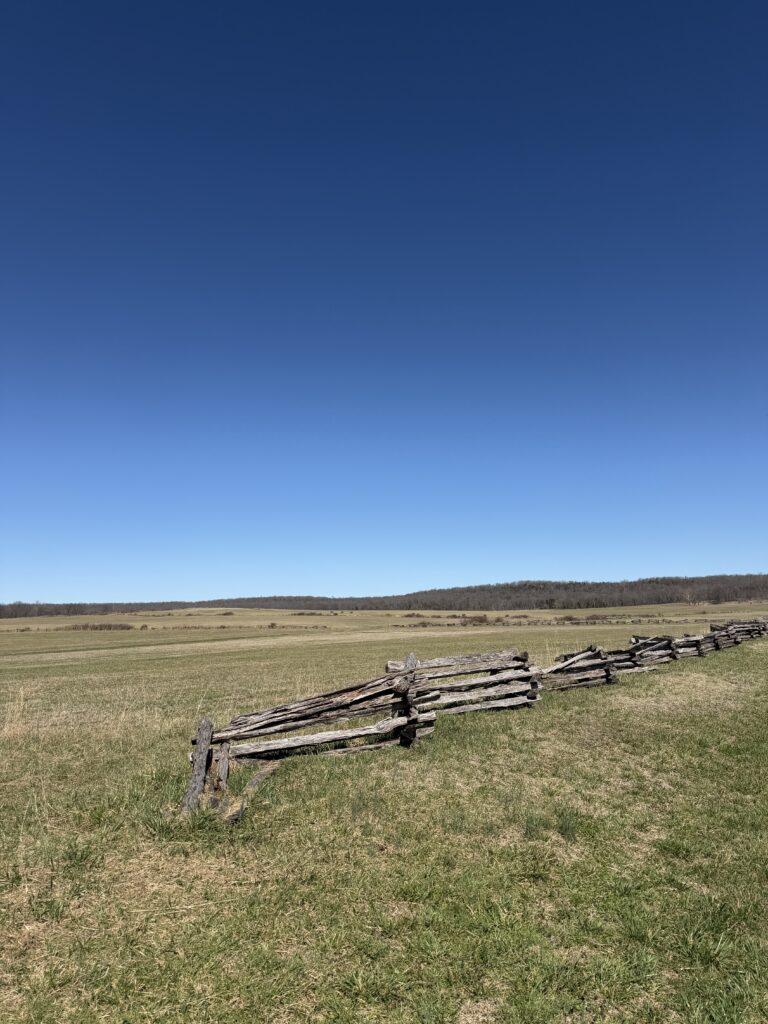
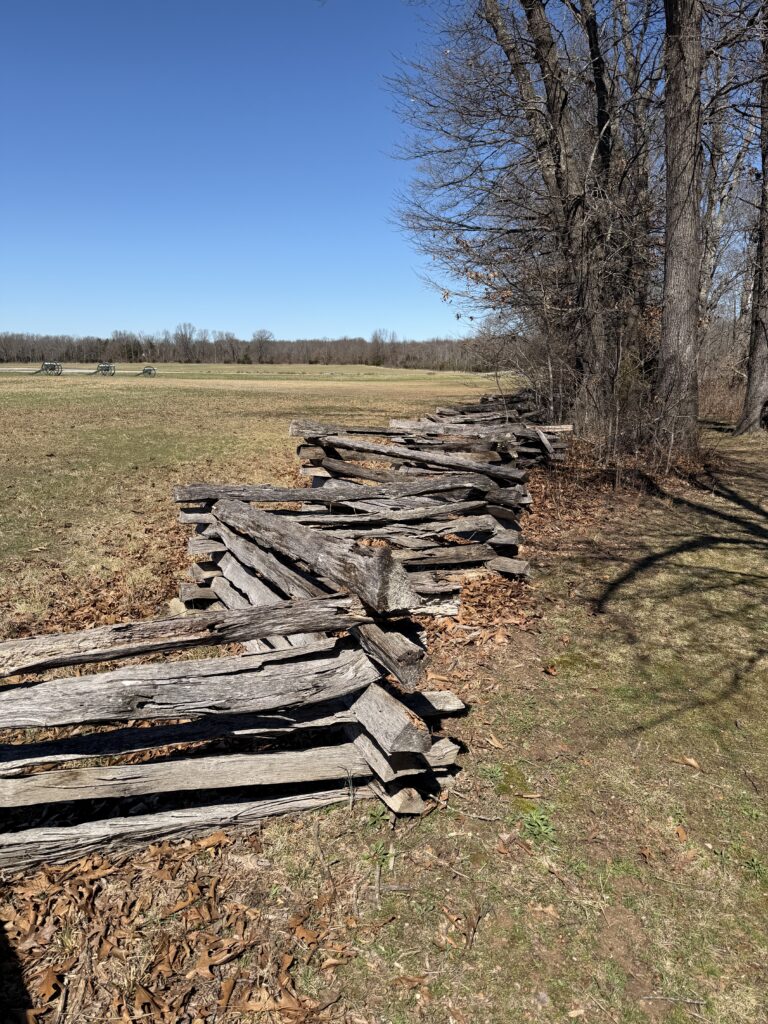
The sky was blue. The fields were golden. And everything was just starting to come back to life with that very identifiable spring green in the trees.
Some of what stayed with me is just that. I am not going to pretend otherwise.
How it works
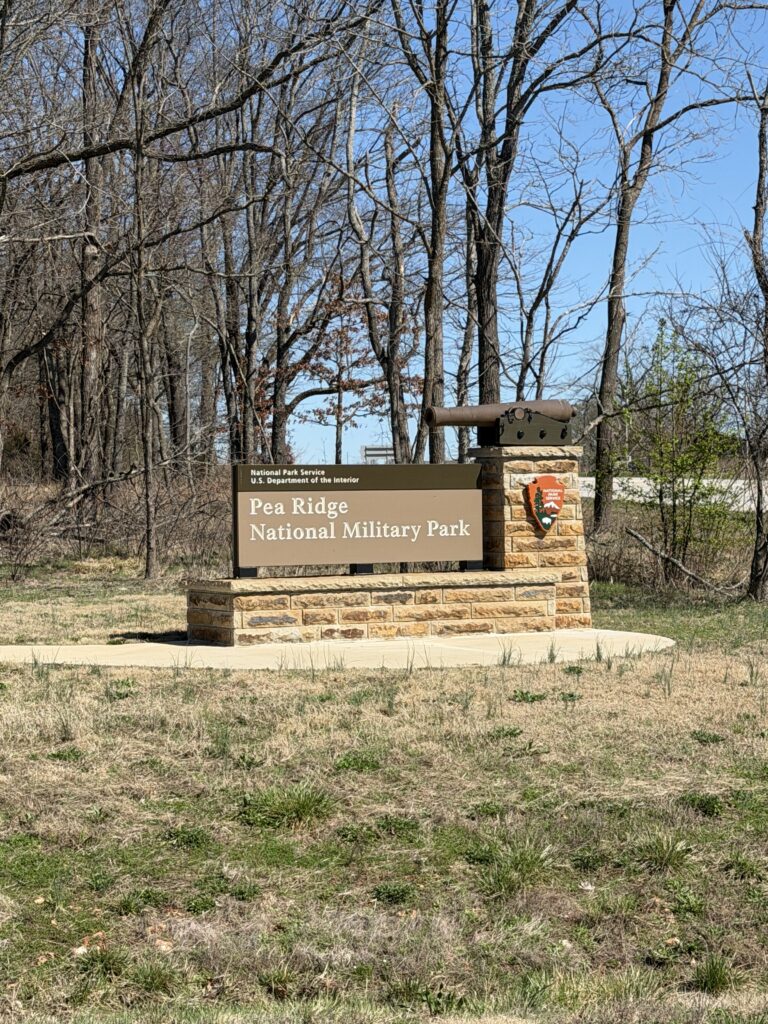
Like many battlefields, there is a visitor center and then a touring road — a seven-mile loop with ten stops, paved the whole way, giving you a lot of places to pull over and explore.
It is an easy park to do at your own pace. Grounds are open from six in the morning until sunset, and there is no fee.
It is a good park for a dog
This is one of the things I liked most about it.
Tootsie and I got out at a lot of the pullouts to read the signs, and she could go and wander a bit each time. Leashed, obviously, but there was no point where I hit a boundary that sent her back to the van.
For a park that is essentially drive, stop, read, drive, having a dog along turns every pullout into a small walk instead of a pause. It changes the whole shape of the visit.
The cannons
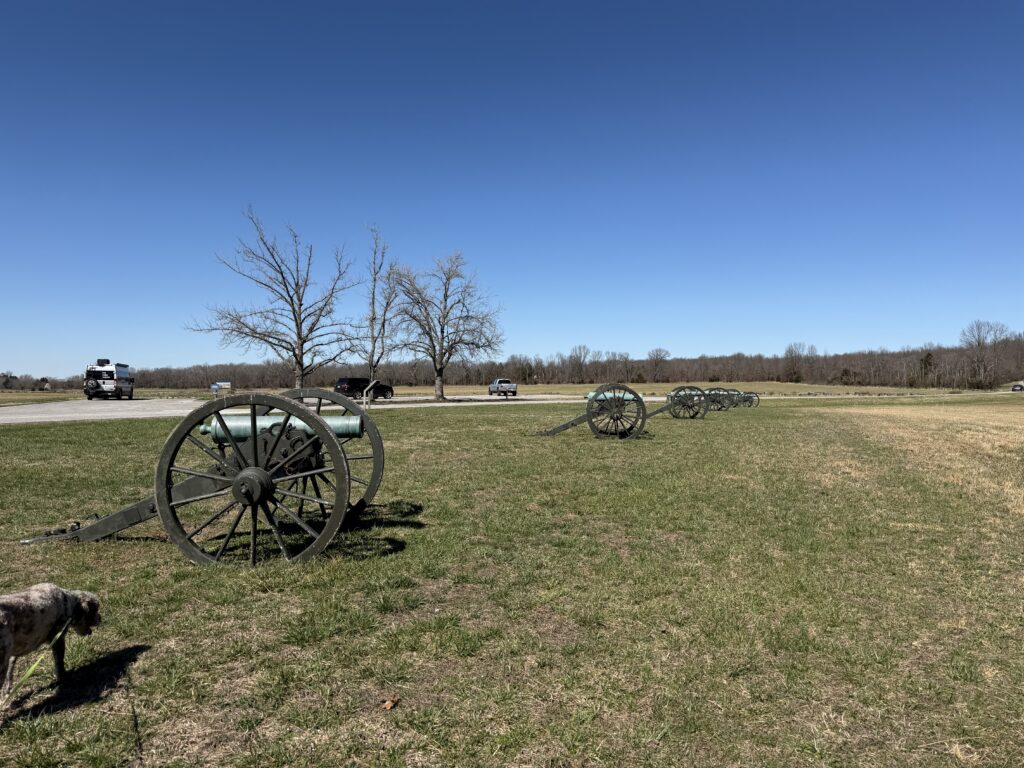
There is a big field to walk around out there, and I found that really interesting — which sounds like a small thing to report, but standing in an open field next to artillery does something that a diagram on a sign does not.
The house at the end
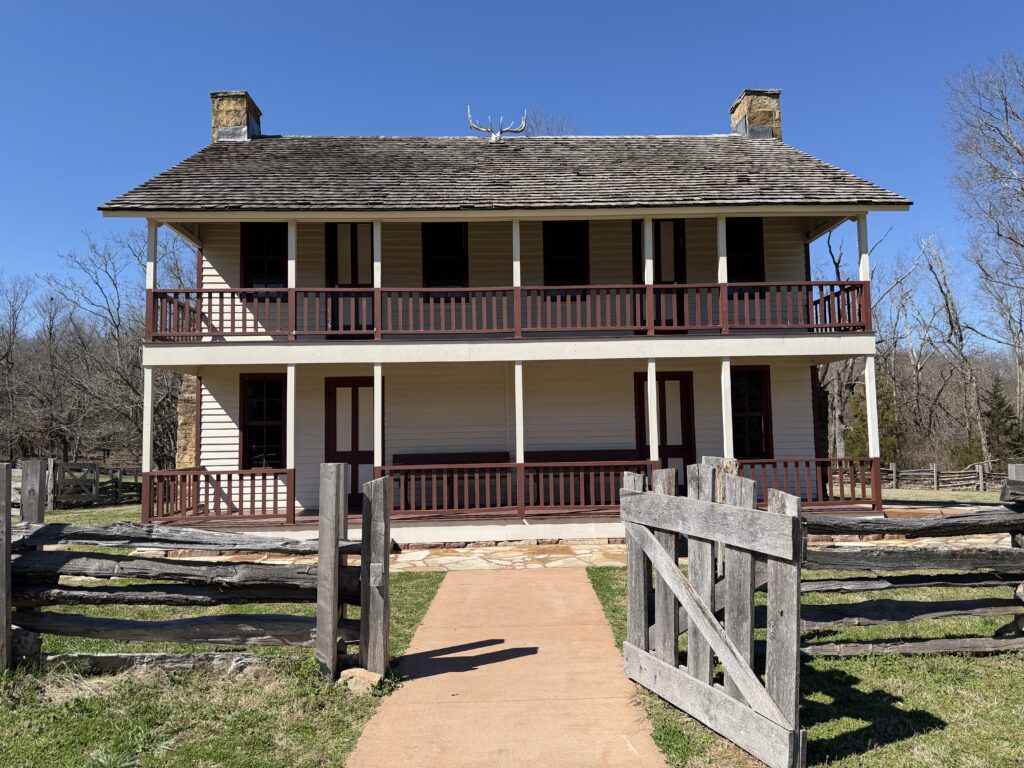
Toward the end of the loop there is a stop where you get out and walk down a road, and there is a home. It is the best thing in the park.
It is Elkhorn Tavern. It was built around 1833, and in 1858 Jesse and Polly Cox bought it, put white siding on it, and mounted a set of elk horns on the ridgepole — which is where the name comes from. It was a stop on the Overland Stage, and by all accounts it was a cheerful place to end up.
On the seventh and eighth of March 1862, the Cox family spent the battle in the cellar. Polly, her son Joseph, his wife Lucinda and the two youngest children, underneath the floor, while the building changed hands above their heads.
It was hit many times. A cannonball went into the upper floor. It served as a field hospital, and for a while as the Confederate general’s headquarters, and then as a Union headquarters — and then in January of 1863 Confederate guerrillas burned it to the ground.
Joseph Cox rebuilt it after the war, on the original foundations. The building you walk up to now is a reconstruction, but the south fireplace and the foundations are the real ones.
That is why I liked it. So often you go to a battlefield and nothing exists except the molded terrain — the shaped ground somebody sheltered behind. This one had more to show.
Why this one stayed with me
Here is the part I did not find out until later, and it is the reason Pea Ridge is not interchangeable with the others.
The first stop on the tour road is not about the Civil War at all.
What you are looking at there are shallow depressions in the ground. They are what is left of the original Telegraph Road — and that is a segment of the Trail of Tears. Cherokee and other Native people were forced along that road during removal in 1838 and 1839. The park protects about two and a half miles of it.
Twenty-four years before the battle, something terrible had already happened on that ground. The war showed up second.
And then this. Pea Ridge was the first substantial battle of the Civil War involving Native American troops. Around nine hundred men came with the Confederate force — the First and Second Cherokee Mounted Rifles, under John Drew and Stand Watie, along with Creek and Choctaw-Chickasaw regiments. They fought here on the sixth, seventh and eighth of March 1862.
So people who had been marched west along that road as children in 1838 had sons fighting over the same fields in 1862. For the country that marched them.
I did not know any of that while I was standing there on a bright spring day looking at golden fields.
I know it now, and it is the reason this is the battlefield I remember.
Plan your visit
Where: northwest Arkansas, near Garfield, close to the Missouri border. (479) 451-8122
Fee: none.
Hours: the grounds and tour road are open daily, roughly 6:00 a.m. to sunset. The visitor center runs about 9:00 to 5:00, and closes Tuesdays and Wednesdays from mid-November through early March. Check before a winter visit.
Size: about 4,300 acres, established 20 July 1956. It is considered one of the best-preserved Civil War battlefields in the country — which is why there is more standing here than at many others.
The tour road: 7 miles, 10 stops, paved. Allow two hours to do it properly; more if you walk.
Trails: roughly 10 miles of hiking trails and 11 miles of horse trails. The Williams Hollow Loop — a little over 2 miles, moderate to strenuous — starts at Elkhorn Tavern.
The stops worth slowing down for
Stop 1 — the Trail of Tears. Shallow depressions that are the remnants of the original Telegraph Road, walked by Cherokee and other Native people during removal in 1838 and 1839. About 2.5 miles of it is protected here. Do not drive past this one.
Leetown Battlefield — where the Cherokee, Creek and Choctaw-Chickasaw regiments fought on 7 March 1862.
East Overlook — a short paved path, about 460 feet, with interpretive panels laying out where everyone was.
Elkhorn Tavern (Stop 8) — a short walk from the parking area to the reconstructed tavern. The best stop in the park.
The battle, briefly
7 to 8 March 1862. A Union victory that helped secure Missouri for the Union.
It was the first substantial Civil War battle to involve Native American troops — roughly 900 men under Confederate General Albert Pike, including the 1st Cherokee Mounted Rifles under John Drew and the 2nd under Stand Watie.
Pets
This is a good park for a dog, and that is not a given at a battlefield.
Leashed pets — six feet or shorter — are welcome on the grounds and the trails. Not inside buildings, which means the visitor center and the tavern interior, but that is the only limit you will hit.
Why it works: the tour road is ten stops of get-out, read, get-back-in. With a dog, every one of those becomes a short walk instead of a pause, and the day turns into something quite different.
Bring water — much of the tour is open field with little shade, and you will be getting in and out of a hot van all afternoon.
An honest word on battlefields
If you are a Civil War person, ignore this — you already know what you want.
If you are not, do not do several of these in a row. They blur. Space them out, and give the one you are at enough time to become its own place. Pea Ridge rewards that better than most, because of the Trail of Tears and the tavern.
Also in Arkansas
Little Rock Central High School, Hot Springs, Crater of Diamonds and the Clinton Birthplace Home.
Traveling with a dog? Where I Would Actually Take My Dog is every park on this site, sorted by whether she can do the activities you came for.
Hours, visitor center closures and road access change. Check with the National Park Service before you go — details here were verified in September 2026.