
Hot Springs is one of the very few parks where I did not camp.
I had been sick. And it turns out I had never once, in all the planning I have ever done, factored in what being sick actually feels like when you are in a tent.
You learn that the hard way exactly once.
So I booked a room at the Arlington instead — and I am so glad I did. I would tell anybody to do it, and I would tell them to do it even if they feel fine.
The hotel is part of the park experience
That is the thing I did not expect.
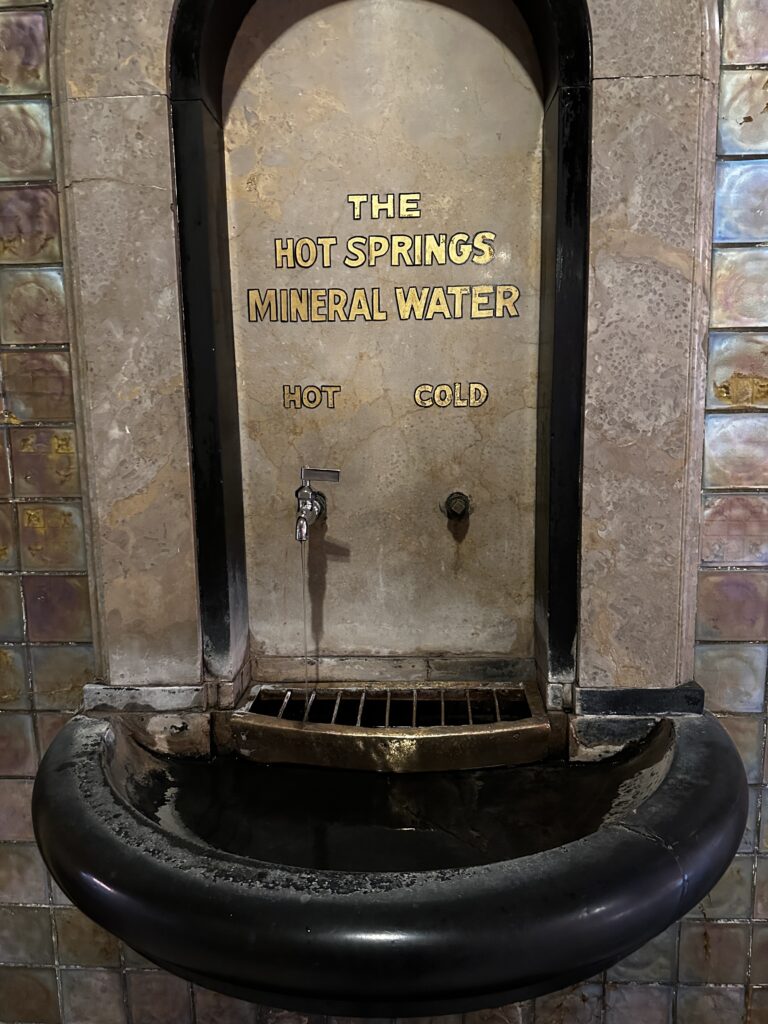
You are immersed in the history of this place before you have even left the lobby. In the foyer there is a fountain where you can fill up water straight from the hot springs. The history of the town and the springs is documented all through the building.
The Arlington has been the place to stay here for a very long time. The building you walk into now opened on the last day of 1924, after the previous one burned, and the one before that went up in 1875. Al Capone used to stay in room 443 — and book the rest of the floor while he was at it.
I have stayed in a lot of places next to national parks. This is the first one where the hotel was not a base camp. It was part of the exhibit.

What this place actually is
Here is what I did not know, and what nobody told me until I got there.
Congress protected Hot Springs in 1832. Forty years before Yellowstone.
It was the first time the federal government set land aside to keep it for public use. It did not get the words national park attached to it until 1921, so Yellowstone keeps the title. But the ground itself has been federally protected longer than any other ground in America.
And what it looks like today is a street of shops.
The water
There are around forty-three hot springs here. The water comes up at about a hundred and forty-three degrees, and the rain that feeds it fell roughly four thousand years ago before it soaked down and worked its way back to the surface.
It is free, and you can drink it. There are fountains around town where people pull up and fill jugs.
I do not know how to explain how strange and lovely it is to watch somebody fill a water jug from a spring that has been underground since the Bronze Age.
The bathhouses
The springs were understood as a luxury, a resort, and a place of healing — all three at once.
And people built accordingly. The bathhouses on Bathhouse Row are enormous, and grand in a way that is hard to convey until you are standing under the ceilings. I had them filed as Gilded Age, and that is not quite right — the buildings standing today went up between 1892 and 1923, so they are later than they look.
What surprised me most is that this was not a Victorian curiosity that faded. The busiest year on record was 1946, when people took more than six hundred and forty-nine thousand baths here.
Then it ended, fast. Antibiotics came out of the war and took away the medical reason to come. Vacations got shorter and people started spreading them across more places. Almost nobody was going to commit to the full prescribed course of twenty-one baths any more.
The Fordyce closed in 1962. The rest followed.
Touring the Fordyce
The park visitor center is one of the bathhouses — the Fordyce, which opened in 1915 and was the largest on the Row at about twenty-eight thousand square feet.
You tour the whole thing. The locker rooms. The bath halls. All of it, with the stories of what vacationing here was like and what people came believing the water would do for them.
It is the best kind of park museum, because the building is the artifact. You are not reading about the bathhouse. You are standing in it.
Something worth knowing about who came
It is easy to look at that street and see rich people in robes, and plenty of them were.
But from 1920 there was a Government Free Bathhouse here, providing treatment to people who could not pay for it. So the same water was a luxury resort and public medicine at the same time, a short walk apart.
I like knowing that. It makes the place more honest than the souvenir version of it.
Walking, when you are not at your best
You can hike up into the hills here, and there is a proper trail network.
I was under the weather, so my hiking was very limited. But I got some good walks in, and the one I would point anybody toward — especially anybody who is tired, or older, or traveling with someone who is — is the Grand Promenade.
It is a half-mile brick walkway running along the hillside behind the bathhouses. Gentle, benches, overlooks. It is the best half mile in the park and it asks almost nothing of you.
That mattered to me that week more than a summit would have.
The brewery
Go to Superior Bathhouse Brewery.
It is in one of the bathhouses on the Row, it is inside the national park, and the food is genuinely good — this is not a novelty stop you tolerate for the setting.
But the setting is extraordinary. It is the only brewery in a US national park, and the only brewery in the world brewing with thermal spring water. They are using water that is four thousand years old and comes out of the ground at a hundred and forty-three degrees.
And the detail I cannot get over: the Superior Bathhouse opened on 1 February 1916. A woman named Rose Schweikhart — a professional tuba player, of all things — reopened it as a brewery on 1 February 2013. Ninety-seven years to the day.
The town
The town itself is really charming, and it has embraced its own history rather than papering over it.
Yes, a lot of it is souvenir shops. But everything is still dressed in the period, and the effect is that you are walking through the era rather than past a plaque about it.
I went there to be somewhere warm while I felt rotten. I came away having been somewhere much older and stranger than I expected, and I did not have to be feeling well to get it.
That is a rare thing in a national park, and it is the reason I would send somebody here who thinks they are not up to a park trip.
Basics
Where: Hot Springs, Arkansas — the park and the town are the same place. The visitor center sits on Bathhouse Row in the middle of downtown.
Size: about 5,550 acres. It was the smallest national park in the country until Gateway Arch was redesignated in 2018.
The dates that matter: federally protected 20 April 1832 — forty years before Yellowstone. Became a national park 4 March 1921.
The water: around 43 thermal springs, averaging 143 degrees, from rain that fell about 4,000 years ago. Free to drink — fill a jug at the public fountains.
What I’d do next time
I’ve never left a park knowing everything about it. Here’s what I’d do differently next time — and I’ll add to this as I find out more.
Take a bath. I went to the bathing capital of America and did not get in the water. I was in no shape for it that week, and the Buckstaff and the Quapaw are both still operating — traditional at one, modern at the other. That is the first thing I would go back for.
Do a longer hike. I was under the weather that week and my hiking was very limited. There is a real trail network here — the Sunset Trail alone runs about ten miles one way, in three sections — and that is the other thing I would come back for.
Bathhouse Row — what each building is now
Built between 1892 and 1923. All eight survive:
Fordyce — park visitor center and museum. Start here.
Buckstaff — still an operating traditional bathhouse
Quapaw — modern spa, pools and hot tubs
Superior — Superior Bathhouse Brewery
Hale — Hotel Hale and restaurant
Lamar — park gift shop
Ozark — Hot Springs NP Cultural Center
Maurice — available for lease from the NPS
Walking and hiking
Grand Promenade — 0.5 miles, brick, gentle, benches and overlooks, running behind Bathhouse Row. If you do one thing, do this. It is also the right answer if anyone in your group is tired or unsteady.
Hot Springs Mountain Trail — 1.7 miles, almost flat, loops the summit
Goat Rock Trail — 1.1 miles to an overlook
Peak Trail — 0.6 miles but steep, up to the observation tower
Sunset Trail — about 10 miles one way, the long one, in three sections
Gulpha Gorge Trail — 0.8 miles, steep, from the campground
The Mountain Tower on Hot Springs Mountain is over 200 feet and gives you the whole region.
Where to stay and eat
This is the park where I would tell you to consider not camping, and not only if you are unwell. Staying in one of the historic hotels puts you inside the history rather than beside it.
The Arlington sits at the north end of Bathhouse Row, across from the park. The current building dates to 1924, there are over 500 rooms, and it still issues real keys rather than key cards — the elevator is hand-operated. The thermal water fountain is in the lobby.
Hotel Hale is a different proposition entirely: it is in the Hale Bathhouse on the Row itself — the oldest building there, 1892 to 1893 — and it has only nine rooms.
There is a campground at Gulpha Gorge if you want it.
Superior Bathhouse Brewery — on Bathhouse Row, inside the park. Good food, and the only brewery in the world brewing with thermal spring water.
Pets
Honest answer: this is a tough one with a dog.
The town is hers, and so is the outside of Bathhouse Row, and so is the Grand Promenade — which is the best half mile in the park and the walk I would send anybody on. On that much, she is fine on a leash.
But touring the Fordyce is a big part of what this park offers, it is entirely indoors, and it takes a good while. That is a long stretch for a dog to be waiting, and it is not a part of the visit I would tell you to skip.
So: come with her if the walking and the town are your day. If the bathhouse is your day, make a plan for her first.
Traveling with a dog? Where I Would Actually Take My Dog is every park on this site, sorted by whether she can do the activities you came for.
Also in Arkansas
Little Rock Central High School National Historic Site is an hour up the road, and it is about as different from this park as two places in one state can be.
Hours, bathhouse operations, tour availability and trail access change. Check with the National Park Service before you go — details here were verified in September 2026.