
This is where The Parks Podcast started.
Little Rock Central High School was my very first episode. I went to the site and recorded it live, in person, standing outside the building. Everything that has happened since started here.
So I have gone back over what I said that day more than once, and the thing I would say differently now is how little I knew when I arrived.
What I was not taught
I did not know a ton about the Little Rock Nine.
I knew the phrase. I could have told you it was about school integration and that it was 1957 and that it was Arkansas. That was about the extent of it.
We are only taught what they want us to know in schools. Which means the rest of our story is out there, but it takes curiosity, and it takes initiative, and nobody is going to hand it to you.
That is most of what this podcast has turned out to be about.
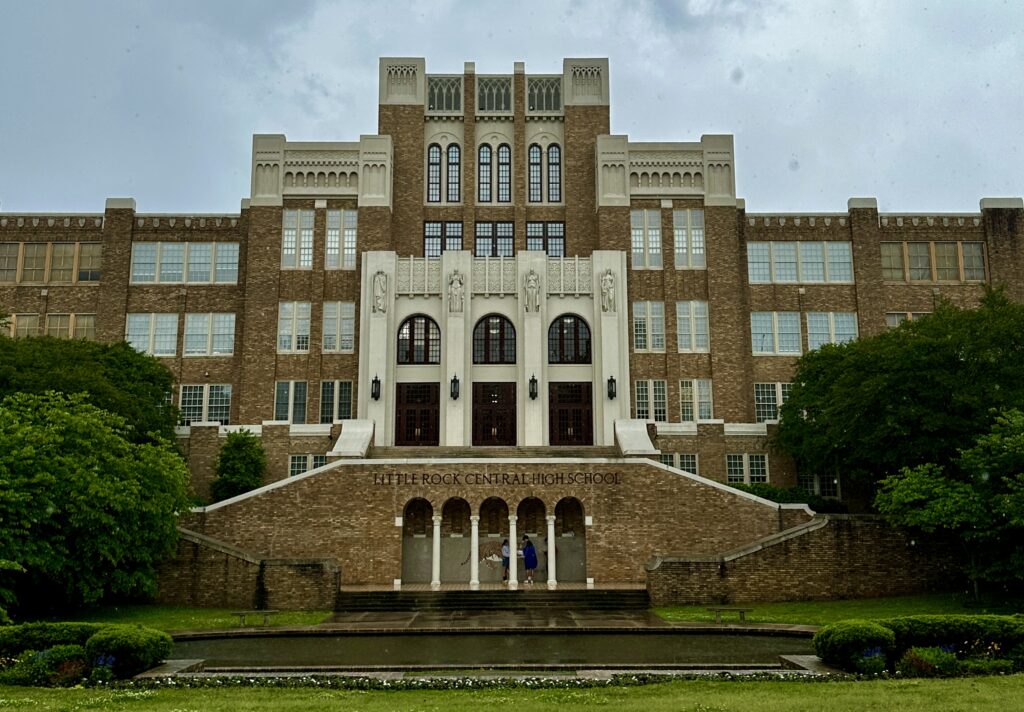
It is still a school
The first thing to understand about this site is that it is not a museum.
Little Rock Central High School is an operating public high school. Roughly two thousand three hundred students, grades nine through twelve, go to class there every day. You can walk the reflection pool and the front steps, but you cannot go inside, because children are in there learning.
It opened in 1927 and it was built to be spectacular — a million and a half dollars, the most expensive and the largest high school in the country at the time, with twenty thousand people at the dedication.
Above the front doors there are four statues, put there when it opened. They represent ambition, personality, opportunity and preparation.
Hold onto that while you read the rest.
The gas station
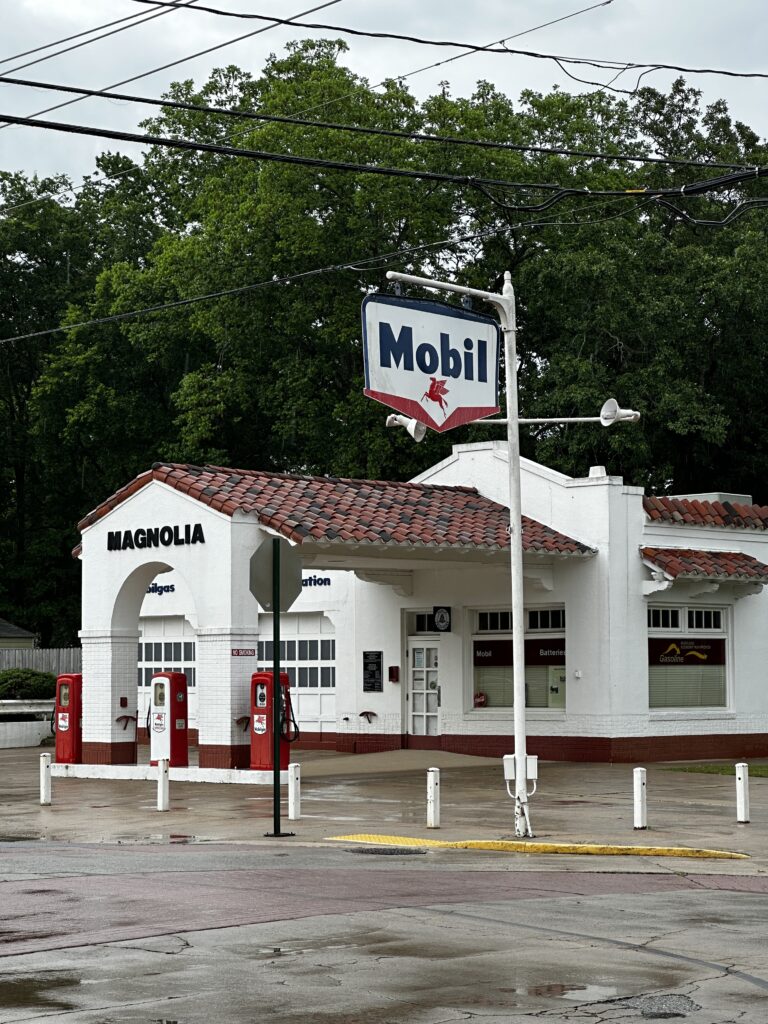
Across from the school there is a restored Mobil station, and it is part of the historic site.
In 1957 it became the press headquarters for the whole crisis. Not because anybody planned it that way — because it was one of the only businesses in the neighbourhood with a pay telephone. Reporters needed to file, and that was the phone.
So the pictures and the dispatches that went out to the rest of the country, and to the rest of the world, went out through a gas station.
It was built in 1928. Mobil restored it to look the way it looked in 1957, and when the Park Service took the site over in 1998 it served as the interim visitor center until the permanent one opened in 2007. You cannot go inside now. You do not need to.
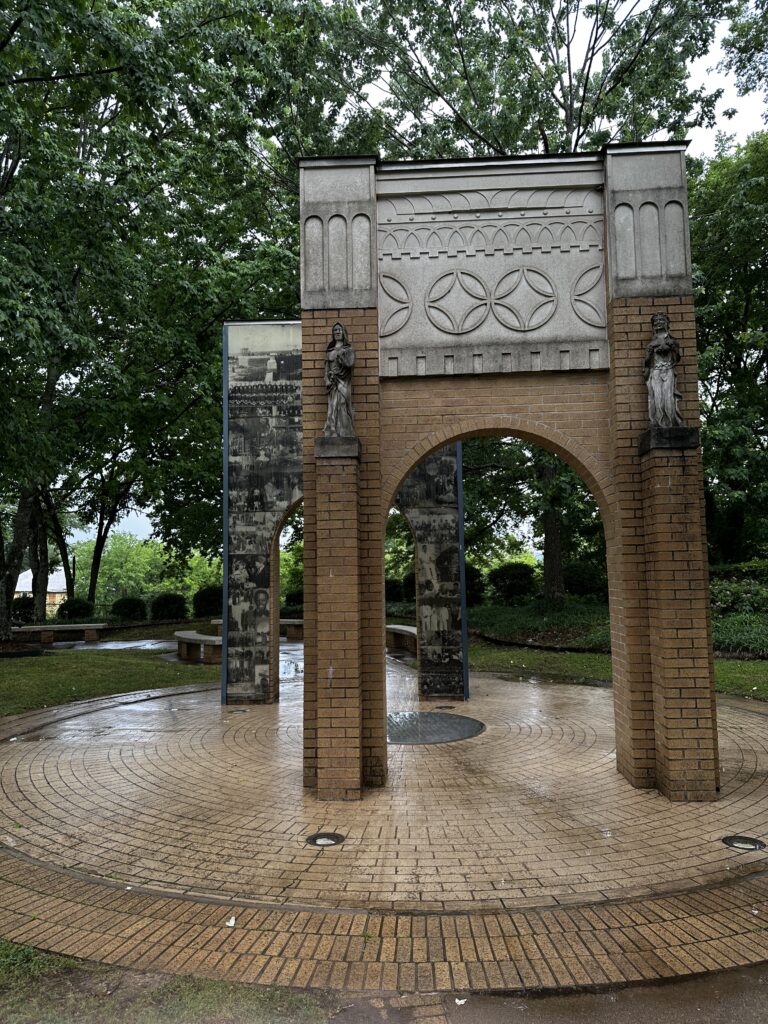
The garden
There is a commemorative garden, and it is a lovely place to stop.
Nine trees and nine benches — one for each of them. At the center there is a circular plaza with arches, and set into the arches is a mirrored photo collage that runs from the school’s opening in 1927, through 1957, to students who are there now. A poem called The Spirit of Central High is etched into the concrete at the middle of it.
It was dedicated on 25 September 2001 — forty-four years to the day after the Nine finally made it inside.
It is a space to reflect, and it is built to be one. Take the time.
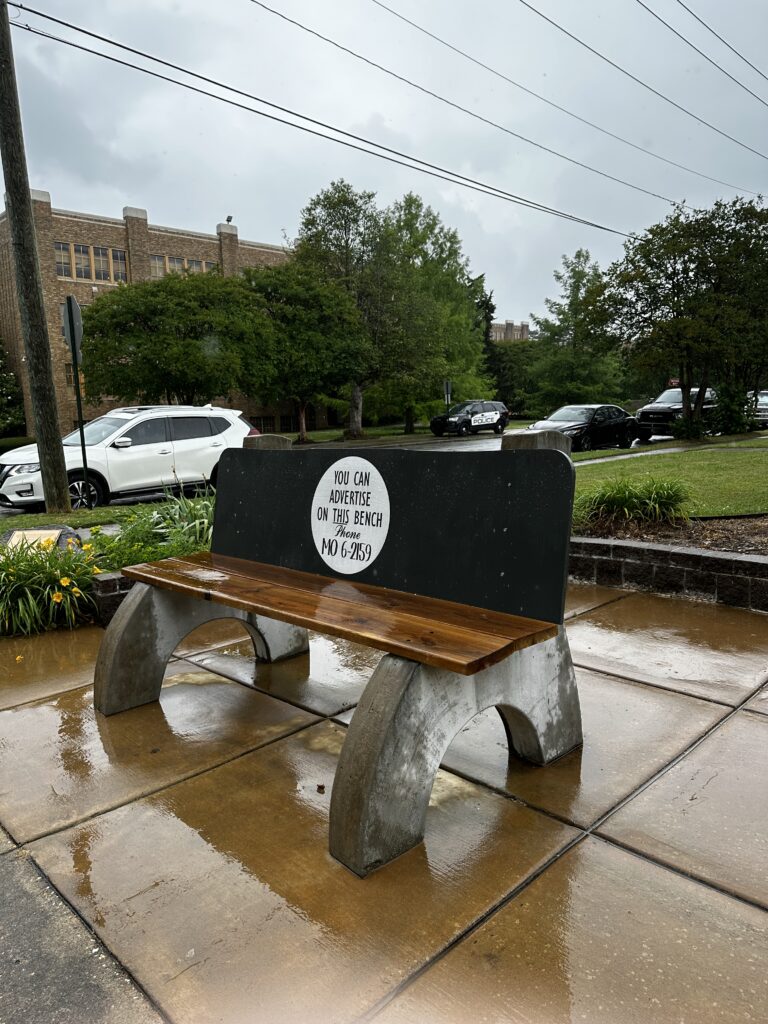
The bench
And then there is the bench.
It is a short walk from the visitor center, and the Park Service calls it the Elizabeth Eckford Bus Bench, because of what happened there on 4 September 1957.
Elizabeth Eckford was fifteen. She arrived that morning by herself — she had not gotten the message about the group meeting up first, so she came alone. The Arkansas National Guard, sent by the governor, turned her away at the door.
And then she had to walk back. Past a crowd screaming at her. Followed, and spat on, the whole length of it.
She reached that bus stop, and she sat down on that bench, and she waited for a bus.
The photograph somebody took of her that morning is one of the most reproduced images in American history. You have seen it whether or not you know you have.
There is a bench there now, and you can sit on it.
I do not have anything to add to that. I would just say go and sit on it.
What happened next, briefly
The governor used the state’s own National Guard to keep nine children out of a public school. On 23 September the Nine got in, and a mob outside turned violent enough that police pulled them out for their safety.
On 24 September President Eisenhower ordered the 101st Airborne into Little Rock and federalised the Arkansas National Guard — taking it out of the governor’s hands.
On 25 September, under armed federal escort, nine children went to school.
They were harassed and attacked all year. Minnijean Brown was expelled in February 1958. The other eight finished the year, and Ernest Green became the first Black graduate of Central High.
The dismissal bell
Here is the thing I actually took away, and it happened by accident.
I was still on site when the dismissal bell rang, and the students came pouring out of that building.
And the overwhelming impression — the thing you could not miss standing there — was how many of those kids were Black.
That is not only an impression. Black students are now the single largest group at Central High, and something close to seventy per cent of that student body are students of color. It is a minority-majority school.
So let me put the two facts next to each other, because standing there I could not stop doing it.
This building’s claim to fame in American history is that the state of Arkansas called out troops to stop nine Black children from walking through the front door.
Today, Black students are the largest group in the building, and they walk out of those doors by the hundred every afternoon at three o’clock.
I do not think that is a tidy happy ending, and I am not going to pretend it is one. Plenty in Little Rock and everywhere else is not resolved.
But I stood on that corner and watched it happen, under four statues that say ambition, personality, opportunity and preparation, next to a bench where a fifteen-year-old girl once sat by herself and waited for a bus.
And it is worth going a very long way to see.
Podcast connection: Episode 1 of The Parks Podcast was recorded live, standing right here. It is where the whole show started.
Basics
Location: 2120 W. Daisy L. Gatson Bates Drive, Little Rock, Arkansas. (501) 516-7230
Size: 28 acres. Established as a National Historic Site 6 November 1998, under Bill Clinton. National Historic Landmark since 1982.
Visitors: 92,108 in 2022.
What makes it unusual: it is the only unit of the National Park System with a functioning high school at its center. Roughly 2,300 students are in class while you walk the grounds — so be conscious of where you point a camera.
Start here: the visitor center. Exhibits, bookstore, restrooms, Junior Ranger program, and all ranger-led tours begin there. The rangers are the reason to go in — ask a question and then stop talking.
Ranger programs: offered at 1:00 p.m. and reservable ahead. This is a small site and programming varies.
How long: it is a walking visit — four stops across a few blocks, outdoors. Give the garden and the bench unhurried time; they are the two places people rush.
When to go: arriving near the dismissal bell is a completely different visit from arriving mid-morning. It is also the loudest part of the day. Know which one you want.
The four places to walk
1. The school itself — an operating public high school of roughly 2,300 students. You cannot go inside. You can walk the reflection pool and the front steps.
2. The Magnolia Mobil station — the 1957 press headquarters, restored to its 1957 appearance. Exterior only.
3. The Commemorative Garden — nine trees, nine benches, the arches and the photo collage. Adjacent to the visitor center.
4. The Elizabeth Eckford Bus Bench — a short walk from the visitor center.
If you only have an hour: visitor center, then the bench.
Elsewhere in Little Rock
The Park Service points visitors to related sites in the city, including Paul Laurence Dunbar High School, the Daisy and L.C. Bates home, and the Testament sculptures of the Little Rock Nine at the Arkansas State Capitol.
Pets
She is fine outside on the grounds, and the grounds are most of this site — the school, the gas station, the Commemorative Garden and the bench. All of it is a walk on pavement across a few blocks, and all of it is hers.
The catch is your time in the visitor center and the museum, which is where the rangers are and where the story gets told properly. Having a dog with you will shorten that.
I would still stop. The bench is outdoors, and the bench is the reason to come.
Traveling with a dog? Where I Would Actually Take My Dog is every park on this site, sorted by whether she can do the activities you came for.
Program times, visitor center hours and site access change, and this site operates around an active school calendar. Check with the National Park Service before you go — details here were verified in September 2026.
The rest of the corridor
Emmett Till and Mamie Till-Mobley National Monument — two years earlier, in Mississippi. You cannot understand 1957 without it.
The Medgar and Myrlie Evers Home in Jackson, Mississippi.