
Most mornings, Bradley Noone walks down to the river at the edge of Browns Canyon National Monument with a cup of coffee and stands there for fifteen minutes. He watches the birds and the cottonwoods. That’s it. For an Army veteran who has spent years helping other veterans find their way back, that small ritual says a lot about why Veterans for Public Lands exists.
The organization launched on Veterans Day, bringing together veterans, military families and supporters to protect, preserve and advocate for America’s public lands. Bradley, the program manager, talks about the Defenders Corps they’re building, the “hardest soft launch” that sent him driving to Bears Ears, the long line of veterans in park history, and the trip to Bears Ears that changed the course of his life.
A note from Missy: The first time I read their tagline, “Bringing together veterans to defend the public lands we served to protect,” it made me emotional, and it still does. Bradley shares something deeply personal in this conversation, and I’m grateful he trusted us with it. If you’re in crisis, please pick up the phone and call. Keep calling until somebody answers.
Episode Guest
Bradley Noone
Program Manager, Veterans for Public Lands
veteransforpubliclands.org · Instagram @veteransforpubliclands
Bradley is a U.S. Army veteran based in central Colorado, a whitewater guide for more than a decade, a former scuba instructor and a longtime public lands advocate. He was a national leader with Sierra Club Military Outdoors, and his 2017 essay on Bears Ears as a place of refuge for veterans is one of the most moving things written about the monument. He knows firsthand what these places can give back.
If you’re in crisis
Veterans Crisis Line: dial 988, then press 1
Text: 838255
Chat: VeteransCrisisLine.net
Free, confidential and open 24/7. You don’t have to be enrolled in VA benefits or health care, and family and friends can call too.
Not a veteran? Call or text 988.
Get involved
Public Lands Web Series
Free. Thursday, November 19, 12 to 1 pm Mountain Time.
Next sessions: January 4 and February 18, 2027.
Sign up at veteransforpubliclands.org
Defenders Corps
A national leadership program for veterans, military families and supporters, with training in advocacy, leadership, community organizing and social media.
The application takes 10 to 15 minutes. The first cohort is announced in January.
Stay in the loop
Join the email list on the home page, or follow along on social.
Donate
What we cover
- What Veterans for Public Lands is, and why its mission goes beyond getting veterans outside
- The Defenders Corps: training veterans, families and supporters to lead in their own regions
- The “hardest soft launch,” and the drive to Bears Ears the morning after
- “The public lands we served to protect”: serving and protecting in different ways
- Theodore Roosevelt, the Buffalo Soldiers and the long line of veterans in park history
- Why public lands are nonpartisan, and a place of healing
- Public lands don’t have to mean a national park: a city park, a greenway, a walk around the block
- You’re still an outdoors person on a park bench
- Birding with cheap binoculars, and becoming a fish identification expert
- Bears Ears with Sierra Club Military Outdoors: a day of service, Cedar Mesa and a warrior welcome home ceremony
- A phone call that saved his life
- Why Bears Ears is worth protecting, and the energy you feel at its ancient sites
- How veterans can get involved, and how everyone else can help
- Speed round: the Statue of Liberty, Swedish Fish, a mountain lion at Camp Hale and the “game over bird”
Show Notes & Links
- Veterans for Public Lands: veteransforpubliclands.org
- Instagram and TikTok: @veteransforpubliclands
- X: @vets4publicland
- YouTube: @VeteransForPublicLands
- Substack: veteransforpubliclands.substack.com
- Bradley’s essay, “For Military Veterans, Bears Ears Is a Place of Refuge and Worth Protecting” (Sierra Club, December 2017)
- Sierra Club Military Outdoors: sierraclub.org/military-outdoors
- Bears Ears Inter-Tribal Coalition
- Bears Ears National Monument
- Veterans Crisis Line: VeteransCrisisLine.net
- Related listening: Our Story: Dark Skies in Southern Utah (Episode 91)
- Related listening: Bears Ears & Grand Staircase-Escalante: WhatJust Happened and What You Can Do (Episode 75)
Transcript
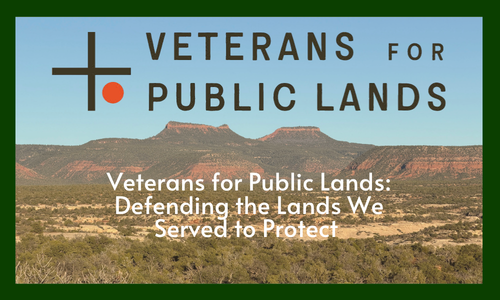
Veterans for Public Lands: Defending the Lands We Served to Protect
The Parks Podcast, Episode 92 | Bradley Noone, Program Manager, Veterans for Public Lands
What Is Veterans for Public Lands?
Missy Rentz: I am so excited to have Bradley Noone join us for The Parks Podcast today. Bradley is the program manager for Veterans for Public Lands. Bradley, welcome.
Bradley Noone: Thank you. It’s great to be here, Missy.
Missy: I am so excited to talk to you. Last week we celebrated Veterans Day, so first, thank you for your service. At the same time, your organization, Veterans for Public Lands, launched. Our parks and public lands benefit so much from our veterans, and organizations like yours, people like you, Bradley, have really helped educate me on this. But our lands also give a lot back to our veterans.
Bradley: Correct.
Missy: Tell me, what is Veterans for Public Lands?
Bradley: Sure. Veterans for Public Lands is a nonprofit organization that unites veterans, military families, and supporters to protect, preserve, and advocate for America’s public lands. It’s a way for us to continue our service and continue giving back to our nation. A lot of veterans struggle with finding a purpose, finding a direction, after we get out of the service, and public lands are something that is perpetually in need of service. And it’s something that is uniquely American, right? They call our national parks America’s greatest idea. We want to continue that protection in whatever manner we can.
The Defenders Corps
Missy: I thought your mission was interesting, because sometimes you come across veterans and public lands organizations where the mission is more about programs for veterans to be out on public lands. But your mission objectives include public lands that stay public, healthy land and water, access for all of us, respect for tribal nations, and a lasting legacy of service. That’s so big. How do you all do this?
Bradley: Like you said, we just launched, so we are in the infrastructure phase. Right now, the way we’re reaching all these different subjects is by developing a leadership training program. That is one of our initial and flagship programs. It’s called the Defenders program. We take folks who have the energy, the time, and the passion, whether they’re veterans, military supporters, or families, and we train them. We give them skills in advocacy, in leadership, in community organization, in social media, so they have the tools to bring back to the public lands in their home regions and continue this fight, continue to organize around our public lands, and continue our service. They rally veterans in their areas to do this.
And we have such a diverse team. We have two surf therapists, one based out of Florida and another based out of California. We have two trails and Forest Service experts, one based out of Arizona and another out of Washington State. And I’m based out of central Colorado, and my background is whitewater. I’m a whitewater guide and longtime advocate. So we have such a diverse skill set of leaders and subject matter experts, and we’re now training others to do exactly that.
Missy: But it’s not a chapters thing. It’s all one big organization, and you just have boots on the ground everywhere.
Bradley: Correct. That’s the goal we’re working toward. Being a brand-new organization, we have our founding members, and in January we’ll announce our first cohort for our Defenders program, our leadership training program.
The Hardest Soft Launch
Missy: We’ve both said several times that you just launched, but you soft launched at some point, right? Because through all this advocacy work this summer and fall, I feel like I’ve seen you everywhere.
Bradley: Well, that bodes well. We’re happy to hear that. Yes, we did have our soft launch. We invited a number of our primary stakeholders, initial employees, and initial vets out to Browns Canyon National Monument here in central Colorado. It was supposed to be a soft launch. We were supposed to garner some support internally within a small group. And on the same weekend that we launched, Bears Ears and Grand Staircase-Escalante National Monuments were downsized by the Trump administration. So the next day, after our soft launch was complete, I drove right down. It’s about a seven-hour drive for me. I spent a couple days in the car down there. I went to Monument Valley. I went to Valley of the Gods.
The PR team we brought in for our soft and hard launch called it the hardest soft launch they’ve ever seen. And honestly, we weren’t expecting this momentum. So over these last few months, we’ve been playing a little bit of catch-up, because we weren’t expecting to be in the public eye this soon. But we’re so thankful for it, and we’ve just had to adapt and run with it.
Missy: Absolutely. It’s such a time of need, and when the need is there for hands and voices and hearts, you just rise to the occasion and you manage it.
Bradley: Yep. And I think the general public outcry against things such as data centers has really garnered a lot of support and helped elevate our message, because that’s something we’re hoping to address. We don’t want to see big tech or anything else come and destroy our public lands and waters.
A Legacy of Service
Missy: Your tagline makes me so emotional. It says, “Bringing together veterans to defend the public lands we served to protect.” When I first read that, it made so many connections for me, thinking about the idea of serving and protecting in different ways, and how they’re similar in so many ways.
Bradley: Yeah. If you look at the history of things like our National Park Service or our rangers, it’s inundated with veterans who felt a want and need to come back and serve their communities and their country. You have examples such as Theodore Roosevelt, right? He was a veteran and arguably one of the greatest conservation presidents, or greatest conservation world leaders, of all time. In fact, he’s only beaten out in lands protected by President Obama, believe it or not. President Obama designated a number of public lands, but he also designated a ton of marine reserves. But I digress.
Theodore Roosevelt was a veteran. He was head of the Rough Riders, and when he came back from leading soldiers in Cuba and across the American West and Mexico, he found his solace, his healing, in our public lands. And then, with the power he was elected to, utilizing the Antiquities Act of 1909, he designated millions of acres of national forest and national monuments. Our first national monuments were designated by him.
And then you also look at our Buffalo Soldiers, right? They came back and immediately started taking care of their lands again. They became essentially our first Ranger Corps, our civilian conservation corps. And we’re looking to continue that legacy.
A Place of Healing
Bradley: The organization and I don’t believe that public lands need to be partisan. They do not need to be part of these culture wars. Public lands are for everyone. They’re nonpartisan. And, to refer back to a conversation you and I had, they’re a place of healing. They’re a place you can go to prescribe healing for yourself, physical, spiritual, or otherwise.
Missy: Absolutely.
Bradley: In my advocacy work in the past, I’ve said that public lands are my church, they’re my therapist…
Missy: Amen.
Bradley: …and they’re my gym. They’re everything to me. And I know I’m not the only one, so I want to make sure I’m vocal about it. I want people to know that there are other people who feel the same way about these lands.
Missy: I started the podcast a little over three years ago, and I’ve been lucky to be introduced to veterans programs and people like you. I’m also a huge advocate for just going outside, even if it’s for five minutes, because once you do it, you’re going to feel different. You might not be able to identify it yet, but you’re going to keep coming back to it because of that healing component. And as an advocate for nature and its physical, mental, and emotional healing, I know our public lands play a huge role in the lives of veterans.
Healing Doesn’t Need a National Park
Bradley: They absolutely do. I’m very thankful to have moved to a very beautiful place, and I have very easy access to our public lands. But I know that’s not the case for everybody, especially in the inner city, and a lot of the East Coast doesn’t have a lot of these big federal public lands.
But public lands don’t have to mean going to a national park. It can mean going to Central Park in New York City. It can mean going for a walk around your block and seeing the trees that are there. If you have a river that runs through your city or town, it can be a greenway right next to it.
For me, I go to a public boat launch, a whitewater rafting and fishing location called Stone Bridge. It’s right outside Browns Canyon National Monument. I go stand by the river for 15 minutes, probably about five days a week. In the morning I take my coffee down there, and I stand there for 10 or 15 minutes, and I just soak in the birds. Right now it’s really good, because the aspens and the cottonwoods have just finished changing to bright yellow, with the river flowing right there. It gives me a sense of peace to start my day, and a little bit of grounding. I’ll sit there with just my coffee, and I’ll just look around. That’s all.
And that can be your experience with public lands as well. It does not have to be a two-week expedition down the Grand Canyon. It does not have to be going out into the backcountry in Bears Ears for a week. It doesn’t have to be going to the Tetons or Glacier, even though those places are wonderful, and I encourage everybody to visit them.
Missy: Totally. I often say I’m the slowest person ever, even though I do it a lot. Could I do bigger? Yeah. I’m in Utah right now, and there’s a juniper bush right at the edge of my campsite, and I want to walk as slowly as I can by it just to smell it and soak in everything.
Bradley: I love it.
Missy: I think sometimes in this industry, because the pictures are so beautiful, we show the avid person hanging upside down from a rock or going down Class V rapids. But you are still an outdoors person if you sit on a bench in a public park and just watch the world go by.
Bradley: 100 percent. Birdwatching is an awesome outdoor activity. It connects you with nature, and you don’t really have to go anywhere special for it. You don’t need much special equipment. A pair of cheap binoculars will get you really far. A reference book will get you really far.
I’ve also been a scuba diving instructor, and after I got a little bored diving the same reef over and over, I started counting and studying the fish. I became a fish identification expert for the Western Caribbean, which is awesome.
Missy: Really?
Bradley: It’s really fun. So there is something for everybody. It doesn’t have to be epic rock climbing or whitewater rafting, like you said. I do enjoy those things, and I like to go out and do the big things, but I recently had knee surgery, and I was on crutches. I couldn’t drive. So I would just go for a quick crutch around my block and look at the mountains. I couldn’t be in them, but I could go look at them. I could get some sunshine, some fresh air.
I think if almost everybody, veterans or otherwise, Americans or humans, just spent a little bit of time outside every day, five or 10 minutes, got that fresh air, got the tidings from nature, got the sunlight, and then went about their day, all of us would be a lot better. We would be a whole lot more connected as humans, to each other and to the world we all live in. This is a home for all of us.
Bears Ears as a Place of Refuge
Missy: Absolutely. You wrote an article for the Sierra Club called “For Military Veterans, Bears Ears Is a Place of Refuge and Worth Protecting.” Your writing was so incredible, and I feel like you carried me and other readers along on this incredibly powerful experience you had down there. Can you tell us a little bit about the journey you participated in?
Bradley: Sure. That journey was a trip put on by Sierra Club Military Outdoors, which I used to be a national leader for a number of years ago. I think that article was written in 2017 or ’18.
Missy: Really?
Bradley: It was a little while ago now. I initially came out as a participant on this trip. The model for the trip was, one, to do a day of service. Then they were called Friends of Bears Ears. Now I believe they’re the Bears Ears Partnership, or something like that, the friends group down there. We did a day of service with them. A lot of times it was either removing old fencing from public lands to restore the rangeland, or we’d build fences. We’d bring materials out to archeological sites to protect them from cattle, or from tourists putting their hands all over them, because they’re very sensitive.
We’d do a day of service protecting something out there, and then a couple days of hiking or backpacking within the monument itself. In the past, we’ve been into Grand Gulch. We’ve been out to the Wolfman Panel. We’ve been to the Procession Panel on Comb Ridge. All in the general Cedar Mesa and Bears Ears area. Absolutely stunning.
And at one point during this four- or five-day trip, we were welcomed onto the Navajo Nation by Jonah Yellowman, the Navajo spiritual leader for Utah Diné Bikéyah and the Inter-Tribal Coalition fighting for Bears Ears. He welcomed us onto his property in Monument Valley for a sweat lodge ceremony, a warrior welcome home ceremony. With our backpacking and our ceremony, it was all about, one, connecting with the natural world, two, connecting with our Native and Indigenous communities and the way they see the area, and three, giving back.
A Phone Call That Saved a Life
Bradley: The first year I went, I was searching. I didn’t know what I wanted. I had just gotten out of the military, or was at the very end of my service in the National Guard. And I went out there, and it changed my life. The initial sweat lodge flipped a switch in my body, in my mind, in my soul, in my heart. I realized that this is the path I need to go on: the path of continued service, for our vets, for our Native communities, for our public lands.
The following year, I was not slotted to be on that trip as a participant, but I was in a bit of crisis. I was in a very poor mental state, driving across the country. I reached out to the former leader of Sierra Club Military Outdoors on that trip, Dan Shoemaker. Unfortunately, he has since passed, from brain cancer due to exposures in Afghanistan and Iraq. May he rest in peace. But I called him in crisis, and he said, “You know what? Whatever. Just show up. We’ll make room for you. We’ll make space for you.” And that instance right there saved my life a bit.
Missy: Wow.
Bradley: I turned a corner, and from there I decided I wanted to be involved. I wanted to be the person leading these trips, the person helping others. And since then, when I get a phone call from a veteran in crisis, I’ll do anything. Back in June, I flew all the way across the country and drove back across the country with a vet because he was in crisis. I’m in this. I’m not in this for money or fame. I’m in this as a true believer.
Missy: Oh gosh. Thank you, first of all, for sharing that with us, because I’m emotional right now. I feel like a lot of that came through in your article, without the specific details. And you had a person. If you are in crisis, pick up the phone and call, and call until somebody answers, because there are a lot of us out there who love humans and want to help. I think that’s really important. And what you all are doing, what I’m doing, is giving people the tools to be outside because, to your point, sometimes it’s just going to stand by the river for 15 minutes without your phone. And look what that did for you.
Why Bears Ears Is Worth Protecting
Missy: I am on my way to Bears Ears. You have been to Bears Ears. We both have advocated and do advocate for Bears Ears. I think it was September 11th when the executive order to remove land took place.
Bradley: When it took effect. It was July 12th, I think, when it was announced. The 11th is when it took effect.
Missy: To you, why is Bears Ears worth protecting? And there are so many people who will never get to Bears Ears. How can they feel more connected with this place, and why it’s so important?
Bradley: Sure. Without physically being on the land, it can be a bit more difficult to fully connect with the true meaning of what it is, and that’s where social media and our documentation of these places come in. I think one of the primary values Bears Ears holds for Americans is the concentration of cultural and archeological sites. There are over 100,000 archeological sites within Bears Ears itself, and that’s only Bears Ears. That’s not Grand Staircase, that’s not Glen Canyon or Lake Powell. It’s one of the highest concentrations of archeological and cultural Native sites, ancestral Puebloan sites, in the lower 48. And that alone should have it protected.
That’s the human history of the people who were on this land before any white settlers came. Before the Spanish, well before the French, the British, the Dutch, and everybody else came to North America, these Indigenous and Native tribes were here. That’s their home. Grand Gulch housed 50,000 people at its peak. It was the size of a city. That’s more people than live in the entire county I live in in Colorado, and it’s not a small county.
On top of that, you have the extremely unique and sensitive desert and canyon environments, and the geographic and geologic value. All of those are worth protecting.
But then you actually get out on the ground and go to some of these sites, and you actually feel an energy surrounding certain archeological sites. I’ve been out to a popular site called Jailhouse Ruin. It’s cool. It’s a two-story archeological site where there was a community. People used to live there. And while you’re walking around the site, it still feels like there’s a community walking around, like it’s another dimension almost.
Missy: Wow.
Bradley: Then you go to other sites in a similar area, only about a mile or two from there in Grand Gulch, like a site called Green Mask. It’s very famous and very unique because of the coloring. Those green pigments are very rare. It’s a pictograph. And you go into that site and you don’t really feel welcome. There’s not a positive energy there. It doesn’t feel like you’re going to be harmed, but it doesn’t feel like whatever energy is there really likes it. And then you go to other ones, and it’s either positive or indifferent.
You do feel different energies down there, and that’s something you can’t feel in a picture. I can do my best to explain it, but until you’re there, I don’t think you’ll truly know what this place is about. That’s why I urge as many people as possible to go visit some of these places, even if it’s once in your life. It really is worth it.
How to Get Involved
Missy: I’m going to link to your article on the episode page so that people can read it and experience it a little bit, along with some of the other things you mentioned. If a veteran is listening to this episode, how do they get involved in Veterans for Public Lands?
Bradley: That’s a great question. On our website we have three different signups. One is our general email list. Just go to veteransforpubliclands.org, and our email list will be right on the main page. If you are a veteran, a veteran supporter, or a veteran family member and would like to get involved in our work in a more active way, and you have the time and the energy, you can search for our Defenders Corps page. We have a whole subsection of our website dedicated to it, with a specific signup and application page. The application is in-depth and will take somewhere between 10 and 15 minutes to complete.
And on the 19th, in a few days, we’ll be launching our Veterans for Public Lands web series. It’s essentially a public discussion-based webinar. We’re going to highlight different veterans and veterans organizations in the space, educate about different public lands and public lands agencies, and share the different missions and projects we’re working on. That will have its own landing page on our website. You can follow our website or any of our social media. All of this will be shared on our socials, and you should be able to link to it through our bios there.
Missy: And again, I will put links to everything you just mentioned on The Parks Podcast episode page. What if you’re non-military? For those of us who aren’t veterans, how can we support and defend our public lands for veterans?
Bradley: Sure, absolutely. The thing is, it’s not just for veterans. Our public lands aren’t just for veterans, right? We are veterans, and we are using our veteran status as a methodology to continue to protect these places. But not just for us. They’re for every single one of us as humans on this earth.
I highly suggest, one, you can follow everything that we do. Come join our public lands webinars. We’ll give advice for anybody to engage with their decision-makers, with their county commissioners, with their senators. We’ll help teach you how to create social media. Keep following us. We’re also happy for financial support or resource support. We do have a donate button on our main landing page. Any dollar amount is wonderful, because that will continue to fund these programs and our advocacy for our public lands.
Missy: You just launched, and you mentioned the Defenders program in January. What do we have to look forward to with you all?
Bradley: We have a lot planned right now, a lot that I can’t share yet because it’s in the planning phases. But our big thing right now is the Defenders. We really want to get a corps of trained volunteers out into American communities and onto American lands to protect their own local communities.
Speed Round
Missy: Amazing. We wrap up every episode with a speed round of questions. Just answer with what first comes to mind.
Bradley: Send it.
Missy: What’s your earliest park memory?
Bradley: Ooh, this might be a different one. My earliest park memory is actually going to the Statue of Liberty. I grew up in western Connecticut. We didn’t have a lot of federal public lands, so one of my first true public land experiences was going to the Statue of Liberty and Ellis Island in New York City. And then I did a lot of hiking back in Connecticut on state lands.
Missy: What made you love the parks?
Bradley: Oh, man. The ability to go around and play, right? There are no expectations. I can go jump on rocks and climb trees, and as long as I’m respecting the land and not harming it, I can truly be myself and let loose. There’s no cell phone, there’s no person telling me to calm down and sit still. You can go out and be yourself.
Missy: What’s your favorite thing about our parks and public lands?
Bradley: Ooh, I like this one. My favorite thing about our parks and public lands is the privilege to fight for them. They’ve literally saved my life, and that could be the main thing. But they’ve given me a purpose. They give me something worth fighting for, something that matters to every single American.
Missy: What’s your favorite thing to do in our parks and public lands?
Bradley: Whitewater rafting, hands down. I’ve been a whitewater guide for over a decade, and there’s nothing like floating through Browns Canyon National Monument, or the Desolation Canyon Wilderness in Utah, or the Grand Canyon in Arizona, or the Rio Grande through Big Bend National Park in Texas. I think about nothing else other than what I’m doing on the river. It’s just the best.
Missy: What park have you yet to visit that’s on your bucket list, and why?
Bradley: There’s one park I’ve been trying to get to for a number of years and still haven’t made it, and it’s Glacier National Park. It’s a bit remote, a bit out there, and that’s part of the draw. Every time I’ve been up in the area, either the weather hasn’t cooperated or something else has come up, and my plans have fallen through. It’s one of the few places in the lower 48 where you can actually see active glaciers. That is something I really want to see, and I would love to document it and bring back firsthand what it looks like versus what it looked like 20 years ago.
Missy: What are three must-haves you pack for a park visit?
Bradley: Oh, man. I have to pack a map. I’m a big fan of paper maps. I like getting myself a USGS paper map and navigating with that. The second thing is always going to be my sense of adventure. It’s not a physical thing, but it’s my attitude as I go into the parks. I’m not really looking to take anything from the park, more to sit with it and experience it, whether it’s hiking or doing a sport. I don’t view it as a resource to be consumed. I view it as something to be alongside, to enjoy with its existence.
Missy: What’s your favorite campfire activity?
Bradley: My favorite campfire activity has to be sharing favorite quotes, from historical figures or excerpts from favorite books. A lot of times on the river, we’ll bring a river library, right? Just a big ammo can with 20 books in it. Some of them are quote books, some of them are stories from the river. We pull from those, and it’s wonderful hearing everybody’s perspective and why they love those quotes.
Missy: Tent, camper, or cabin?
Bradley: Ooh, it depends on the location. But most of the time it’s going to be none of those, and I’m going to sleep on my boat underneath the stars.
Missy: Love that.
Bradley: Or right on the banks of the river. I’ll lay down my Paco Pad, my river sleep pad. I have a little fitted sheet for it, and I’ll break out a sleeping bag right there under the stars.
Missy: Are you hiking with or without trekking poles?
Bradley: Again, that depends on the location. If I’m in a place like Bears Ears or Grand Staircase, where it’s very sensitive, no trekking poles at all, because those holes are going to last forever. But if I’m climbing a 14,000-foot peak here in Colorado, I will absolutely bring trekking poles, because my knees hate me now from not using them.
Missy: What’s your favorite trail snack?
Bradley: Ooh, Swedish Fish. Up in the mountains, they’re really easy to get down, as opposed to, say, a Snickers bar or a piece of pizza, which are a little heavier and harder to get down. They’re easy to grab, good sugar, and they give you lots of energy. Swedish Fish.
Missy: What is your best animal sighting?
Bradley: Oh, which one do you want? I’ve experienced all of the megafauna, all of the large animals in North America. I’ve had two sightings of mountain lions, both just outside the Arkansas River Valley. One was right up at Camp Hale. On the morning of the designation of Camp Hale-Continental Divide National Monument, I had a huge tom, a big male cat, walk right across the road on the northern border of the monument. I had to drive through Camp Hale before they closed off all the roads. The Secret Service was closing off the roads because the president was coming to designate it, so I had to drive through first to get to where we were meeting the Secret Service. As I was driving through Camp Hale at about 5 a.m., there he was. He had to be a 180-pound-plus cat.
Missy: Wow.
Bradley: He was the entire length of one full car lane.
Missy: Oh my word. Oh my gosh.
Bradley: He looked at me while I was driving, continued loping across the road, and then went up into a stand of aspens and didn’t even look back. He goes, “This is my house. Thank you.” And it seemed like he was saying thank you for protecting it.
Missy: Oh, that’s lovely.
Bradley: I’ve had amazing encounters. I’ve seen a thresher shark underwater in Egypt. I’ve seen a manta ray in Curaçao in the Caribbean. I’ve seen bears across the US, Alaska and Idaho. I’ve had a wolf encounter. I saw a lone black wolf in Teton Canyon. You name it, I’ve seen them, and I’m so thankful for each one. I thank the animal every time.
Missy: What is your favorite sound in the park?
Bradley: I don’t know if a lot of people know this sound, but my favorite sound is the canyon wren in the desert canyons on the river. I typically hear them in the mornings on the Colorado or Green rivers, whether it’s Canyonlands or the Grand Canyon. I call them the game over bird, because their call sounds like somebody has a game over in a video game.
Missy: Oh, that’s so funny.
Bradley: But they’re considered good luck in the canyon. If you hear them, that’s the canyons giving you their blessing.
Missy: And what’s the greatest gift that our parks give to us?
Bradley: Their existence. Their unconditional love and their unconditional indifference. They will challenge us, they will improve us, and if we’re not careful, they can break us too.
Missy: Bradley, thank you so much for taking the time to tell us all about Veterans for Public Lands, and for the gift you give us through your writing and your storytelling, helping educate us about these beautiful places. Thank you.
Bradley: Thank you so much, Missy. It really is my honor and privilege to not only be fighting for our places, but to have experienced a lot of them and now to be sharing them.
Missy: Beautiful. That’s it for today’s episode. Until next time, we’ll see you in the parks.
Music for The Parks Podcast is performed and produced by Porter Hardy. Follow us @TheParksPodcast or visit TheParksPodcast.com.