
I was so surprised by how much I liked this place.
I did not know much about Ulysses S. Grant before I went. General, president, and that was about the extent of it.
The first thing: it is extremely dog friendly
I want to call that out early, because it is rare and it shaped my whole visit.
Tootsie could go almost everywhere with me here. Not inside the historic buildings and not in the visitor center, but the grounds, the outbuildings, the walking — all of it, on a leash.
They even have a B.A.R.K. Ranger program, which works the way the Junior Ranger program does but for dogs.
And while I was there I picked up something about a Grant family dog, which sent me looking afterwards. His youngest son Jesse had a Newfoundland called Faithful. Jesse had already lost several dogs by then, so Grant — by that point President of the United States — informed the entire White House staff that if this dog died, every one of them would be discharged.
I cannot tell you whether that is why this particular park is so good about dogs. But it is a very good thing to know about a man I thought I knew nothing about.
He lived with his in-laws
This was my favorite discovery and it is not what you expect.
White Haven was not Grant’s family home. It was his wife’s. This was the Dent family estate — Julia Dent’s parents’ place. Grant met her here.
And he lived here, at his father-in-law’s, farming. He eventually bought the property from the man.
It is such an ordinary, deeply human thing to find at the front end of a presidency. Before any of it, he was a son-in-law living at his wife’s parents’ house and working the land.
The color
And then there is the house itself, which is bright green.
Not a subtle green. A loud one. And somehow it works — it sits in against the trees rather than shouting over them, which is not at all what you would predict from the paint chip.
Here is the story on that. The color is Paris Green, which was fashionable in the Victorian era and is an arsenic-based pigment — genuinely poisonous, later sold as an insecticide, named after a poisoning.
The Grants painted the house this color in 1874, while he was president. We know that because a local storekeeper wrote it down.
A later owner painted it white in 1940, and white it stayed until the Park Service took the site on in the 1990s. Then they argued about it, and decided to put the green back — because that is the color it was when the Grants lived here.
I love that they did. It is a decision that makes people stop and ask, which is presumably the point.

Round the back
Behind the house there is more than I expected, and the outbuildings are where the daily life of the place actually is.
There is a stone building, and there is a chicken house, and there is an ice house — the cold storage. You can walk out to them.
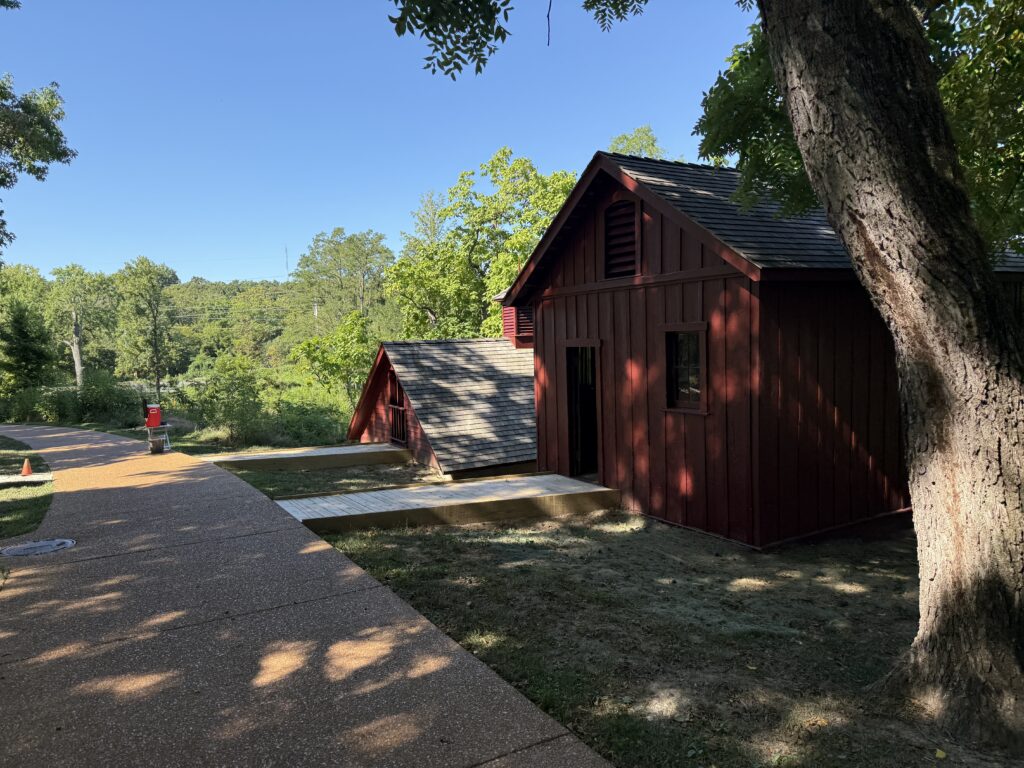
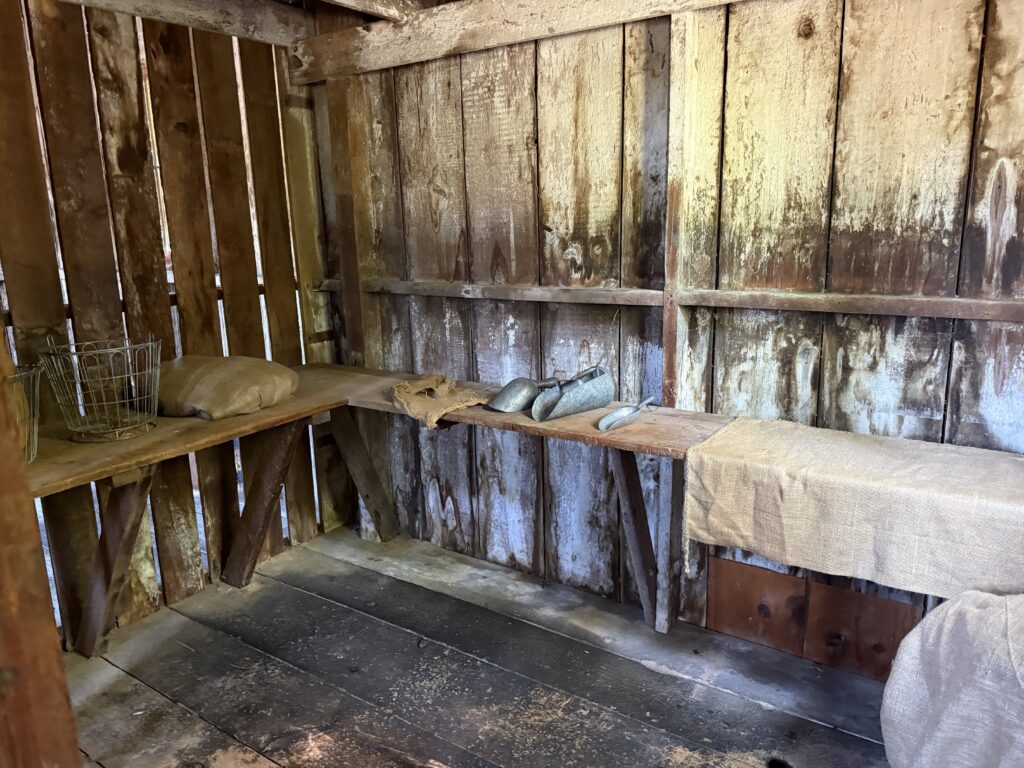
The museum is in the horse stable, which Grant designed himself.
I did not get into the museum. It was getting warm by then, and I was not leaving Tootsie in the car to do it. That is the trade, and I made it again.
What they do here that I want to credit properly
I said I loved the stories and the way they told them, and I want to be specific about why.
From 1854 to 1859, three groups of people lived on this property: the Dents, the Grants, and around twenty enslaved African Americans owned by Grant’s father-in-law.
The Park Service says it in exactly those terms. They have a film about slavery at White Haven. It is not a panel off to one side.
So: the man who went on to command the army that ended slavery in this country spent five years farming beside people who were owned, in a family that owned them, and afterwards bought the farm from the man who owned them.
They do not tidy that up, and they do not make it into a tidy story about growth either. They just tell you, on the ground where it happened.
That is why I liked this place so much more than I expected to. I came in knowing a name and a war, and left having stood in front of a green house where somebody’s complicated life actually happened.
Plan your visit
Where: 7400 Grant Road, St. Louis, Missouri. 314-842-1867. About two miles off Route 66 and a short drive from Gateway Arch.
The house is called White Haven. Built 1812-1816. It was Julia Dent’s family home, Grant’s in-laws, and Grant later bought it from his father-in-law.
Free. There is no entrance fee, and the house tours are free too.
Visitor center: open daily 9:00am to 5:00pm, year round, except Thanksgiving, 25 December and 1 January.
House tours are ranger-led, first come first served, and not open to pets. Most days they run at the top of each hour from 10am to 4pm. At busier times they go every thirty minutes from 9:30am to 4pm.
The museum is in the horse stable Grant designed.
What is here
The main house — Paris Green, restored to its 1874 color
The stable, now the park museum
The outbuildings — a stone building, a chicken house, and an ice house
The visitor center
The green
The house is painted Paris Green, a bright Victorian color made with an arsenic-based pigment.
The Grant family painted it this shade in 1874, documented in a local storekeeper’s records. A later owner painted it white in 1940; the Park Service restored the green in the 1990s, after considerable internal debate, because it is the color the house wore while the Grants owned it.
The history the site does not avoid
From 1854 to 1859 the Dents, the Grants and an enslaved African American workforce lived on this property. The National Park Service states that Grant worked side by side with upwards of twenty enslaved people owned by his father-in-law.
The park has a dedicated film on slavery at White Haven and a virtual exhibit on slavery in St. Louis. Give it your time — it is the most serious thing here.
What I’d do next time
I’ve never left a park knowing everything about it. Here’s what I’d do differently next time — and I’ll add to this as I find out more.
The museum. It was warm, I had the dog, and I was not leaving her in a car to go and look at exhibits. Next time I go when it is cool, or with somebody who can sit with her — because the museum is in the stable Grant designed, and I walked past it.
Pets
One of the most dog-friendly historic sites I have been to, and I say that as somebody who has had to leave Tootsie in the van at a lot of visitor centers.
She can be with you on the grounds and around the outbuildings, on a leash no longer than six feet. There is a B.A.R.K. Ranger program, run along the lines of the Junior Ranger one.
Where she cannot go: inside the historic buildings, including the house tour, and inside the visitor center.
The park is also specific about care, which I appreciated: dogs are not to be left anywhere without adequate food, water, shade and ventilation, and they are not to be tied to light poles, handrails or trees.
The practical catch is the same one as everywhere: the museum and the house tour are both indoors. On a warm day that means choosing. Go early, go in a cooler month, or bring somebody who can take a turn.
Traveling with a dog? Where I Would Actually Take My Dog is every park on this site, sorted by whether she can do the activities you came for.
Hours, tour times and pet rules change. Check with the National Park Service before you go — details here were verified in September 2026.
If this interests you
The Gateway Arch is the other national park site in St. Louis, and the two of them sit at the same end of Route 66. I did them on the same trip.