
I have been to the Gateway Arch twice, and I have never been up it.
The first time, I just did not feel the desire to. The second time I had Tootsie with me and could not have gone up anyway.
I am sure there is great storytelling up there. I am sure the views are extraordinary. People clearly love it and I believe them.
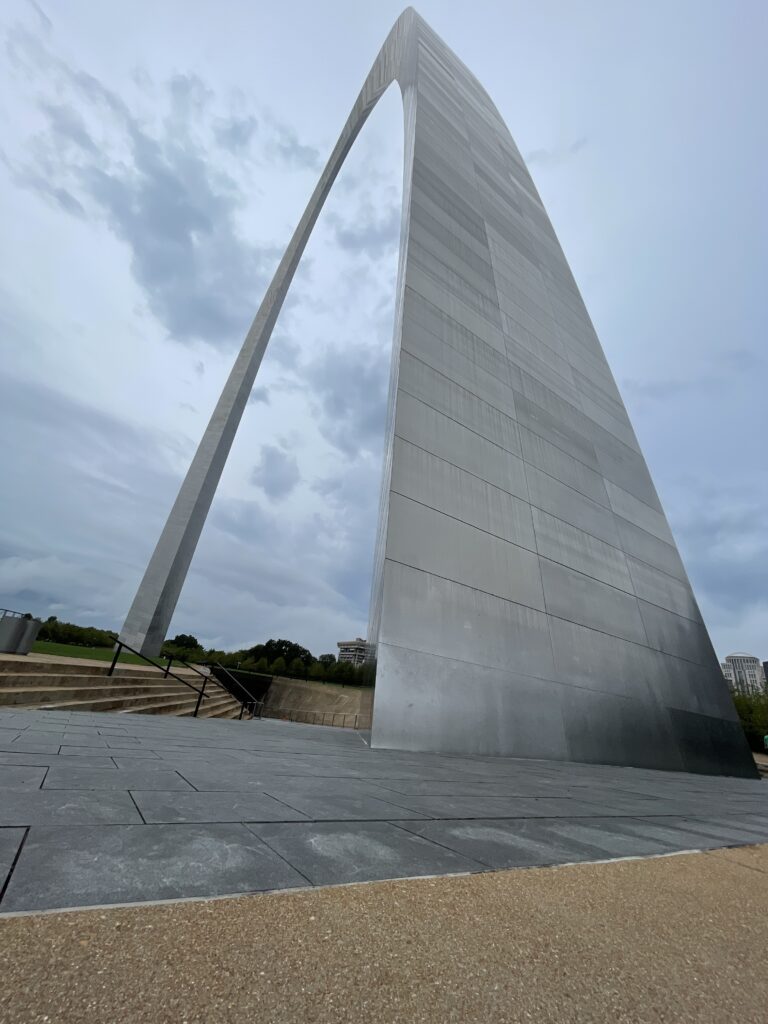
But I have observed it from a few blocks away, and I have stood underneath it.
And it feels complete to me.
I want to say that plainly, because I think a lot of people arrive at famous places carrying an obligation. You are supposed to go up. You are supposed to get the ticket, take the tram, see the view, because otherwise have you really been?
You have really been.
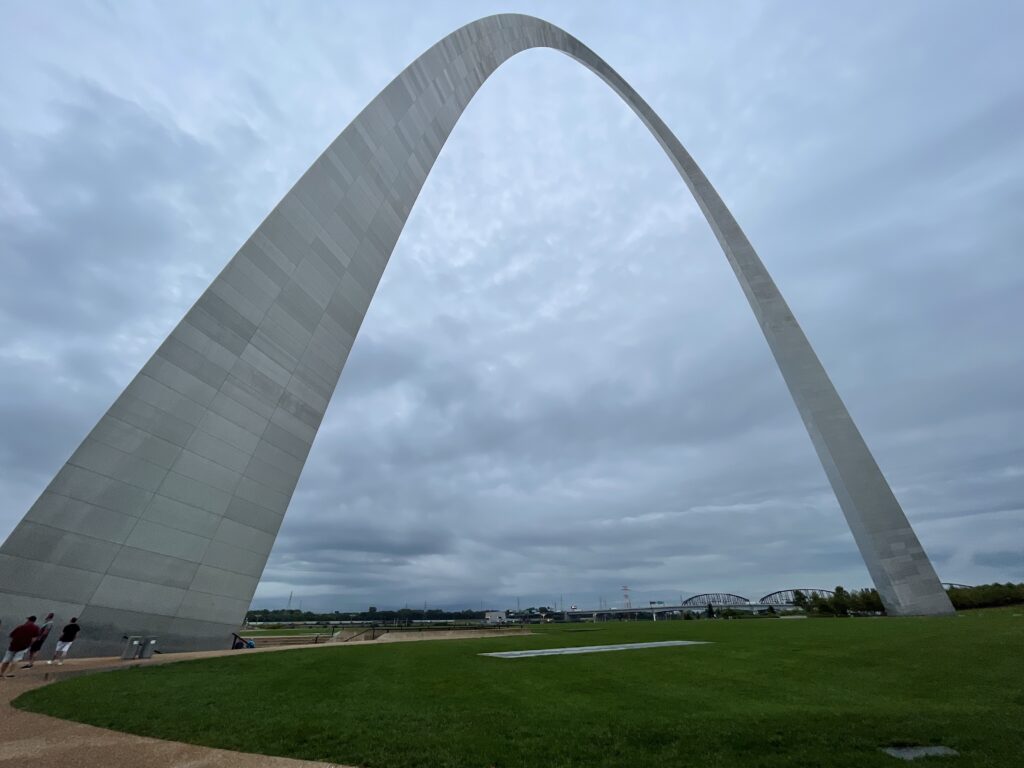
Standing under a six-hundred-and-thirty-foot stainless steel curve and looking straight up it is a whole experience on its own. Walking the grounds along the Mississippi is a whole experience. Seeing it from four blocks away as you come into the city and realizing how big it actually is — that is one too.
I did those. They were enough. I did not need the top of it, and I have stopped feeling like I ought to.
If you want to go up, go up. If you are standing underneath thinking actually, I am good — you are allowed to be good.
Though if somebody tells me otherwise, I will reevaluate. I am not dug in about this. I have just not felt the pull yet, and I would rather say that than pretend.
And then, as it turns out
Here is what I did not really register until afterwards, which is a bit of an irony given everything above.
The Arch is not the only thing in this park.
Gateway Arch National Park also takes in the Old Courthouse, a couple of blocks away. And that building is where Dred and Harriet Scott sued for their freedom, in 1846 — the case that ground on for nearly eleven years and ended with a Supreme Court decision that helped push this country into civil war.
Enslaved people in St. Louis brought freedom suits in that courthouse.
It is at ground level. There is no tram, and no ticket to the top of anything.
So the park I did not quite connect with contains the room where that happened, and I walked right past it.
I said I would reevaluate if somebody gave me a reason. Nobody had to. That is the part I will go back for, and I do not think it will feel optional at all.
Basics
Location: downtown St. Louis, on the Mississippi. The eastern end of Route 66 runs through this city.
Size: about 193 acres — the smallest national park in the United States, at less than 2% the size of the next smallest.
Established: it became a national park on 22 February 2018. Before that it was the Jefferson National Expansion Memorial, established in 1935.
The Arch: 630 feet tall and 630 feet wide at the base — the tallest monument in the United States. Designed by Eero Saarinen with engineer Hannskarl Bandel, completed 28 October 1965.
What is here
The Arch — grounds free; the tram to the top is ticketed and sells out. Book ahead if you want it.
The museum, 140,000 square feet, underneath the Arch
The Old Courthouse — a couple of blocks west
River parkland along the Mississippi
Check current ticketing, hours and Old Courthouse access before you go — this park has changed a lot in recent years.
The Old Courthouse
Dred and Harriet Scott filed suit for their freedom here on 6 April 1846. The case took nearly eleven years and ended in Dred Scott v. Sandford (1857), which denied citizenship to African Americans and struck down the Missouri Compromise — and hastened the Civil War.
The Scotts did not win their freedom in court.
The Old Courthouse was a venue for freedom suits brought by enslaved people in St. Louis.
Pets
Leashed dogs are welcome on the grounds, and the grounds are genuinely worth walking — the river parkland, and the space underneath the Arch.
They cannot go up the tram, into the museum, or into the buildings. There is a B.A.R.K. Ranger program here.
Which is exactly why I did not go up the second time, and I have no regrets about it. If you have a dog with you, this park still gives you most of what it has.
Traveling with a dog? Where I Would Actually Take My Dog is every park on this site, sorted by whether she can do the activities you came for.
Ticketing, hours, building access and pet rules change, and this park has been through significant renovation. Check with the National Park Service before you go — details here were verified in September 2026.
If this interests you
Ulysses S. Grant National Historic Site is a short drive from here — a bright green house, the farm where Grant lived with his in-laws, and a park that tells the history of slavery on that property without flinching.