
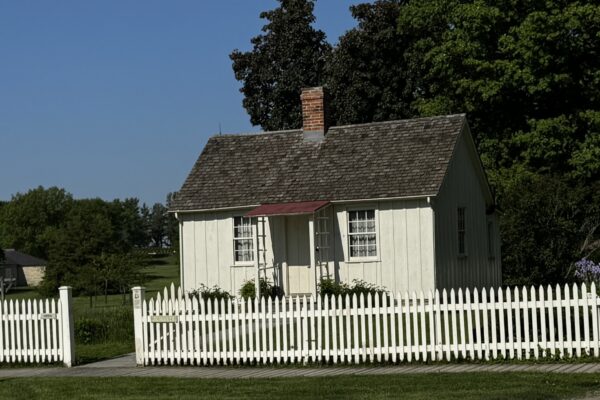
On August 10th, 1874 — give or take a few hours around midnight — Herbert Hoover was born in a tiny two-room cottage in West Branch, Iowa. Five people lived in that cottage. It housed a blacksmith who taught himself his trade, a Quaker minister mother who attended the University of Iowa, and three children who would be orphaned before the oldest was nine. Herbert Hoover called that cottage “physical proof of the unbound opportunity of American life.” Ranger Chelsea Nelson — who taught herself blacksmithing to get her dream job — joins The Parks Podcast to share the full story.
A note from Missy: Herbert Hoover NHS is the most serene surprise in the middle of Iowa. I arrived early on a spring morning. I strolled through the park, around the prairie, past President Hoover’s childhood home, and his final resting place. Then rested under a tree and enjoyed the sounds of the park. Whether an intended visit or a convenient pit stop, this stop is filled with nature and history.
Episode Guest
Chelsea Nelson – Interpretive Park Ranger
Park Stats
- Location: West Branch, Iowa
- Established: August 12, 1965 (President Lyndon B. Johnson)
- Size: 186.8 acres
- Annual visitors: 109,728 (2022)
- Two NPS units in Iowa: Herbert Hoover NHS and Effigy Mounds National Monument
- Presidential connection: One of only two NPS units that includes a presidential library and museum (the other being FDR)
- Key features: Birthplace cottage, blacksmith shop (replica), Friends Quaker Meeting House, schoolhouse (1853 — oldest building in town), grave of Herbert and Lou Henry Hoover, 80-acre restored tall grass prairie, presidential library (National Archives — separate admission)
- Trails: 2+ miles; snowshoeing available in winter (free snowshoes at visitor center)
- Hours: Buildings open 9am–5pm daily except New Year’s, Christmas, Thanksgiving; grounds open 24/7
- Dogs: Welcome on grounds on leash
- Fun fact: Chelsea taught herself blacksmithing to earn her park ranger position
Transcript
Herbert Hoover National Historic Site — Cradle to Grave, the Story of Opportunity
The Parks Podcast, Episode 20 | Chelsea Nelson, Interpretive Park Ranger & Blacksmith, Herbert Hoover National Historic Site
Why Presidential Birthplaces Matter
Missy Rentz: I’m so excited to be here at Herbert Hoover National Historic Site with Chelsea Nelson, who is the interpretive park ranger here. You might hear the birds chirping and the wind blowing because we are sitting outside. Thank you for joining us, Chelsea.
Chelsea Nelson: Oh, absolutely. Thank you for having me — and it is a tongue twister, isn’t it?
Missy: It really is. I have to slow down every time. But welcome to The Parks Podcast. Let me go through some park stats. The site is located in West Branch, Iowa. It was created on August 12th, 1965, when Lyndon Johnson was President of the United States. The park is 186.8 acres. Last year, there were 109,728 visitors. President Herbert Hoover lived in the home on the site for four years before moving down the street — and this tiny little home housed five people, which is mind-blowing to me. He referred to the home as, quote, physical proof of the unbound opportunity of American life. Visiting the site includes his boyhood home, a blacksmith shop, a schoolhouse, a Friends meeting house, his grave and the grave of his wife, and so much more. The site also has two miles of trails — though I think I went more than two miles today through the prairies, which are great for hiking, snowshoeing, bird watching, and so much more.
Chelsea: A couple other fun things — we are one of two National Park Service units in Iowa. The other is Effigy Mounds, which is a completely different, gorgeous park. And we — HeHo, as we call ourselves — are one of only two National Park Service units that includes a presidential library and museum. The other being Franklin Delano Roosevelt. The fact that we’re sitting here on National Park Service grounds with this presidential library museum right here is incredibly unique.
Missy: And it’s not technically part of the park even though it’s within the grounds?
Chelsea: They rent the space or the land from us. That’s National Archives. But the ground they’re sitting on, all these other buildings, the prairie — that’s all National Park Service.
Missy: Why are the homes and birthplaces of presidents included in the National Park Service?
Chelsea: The cottage here — the Hoover Birthplace Cottage — it represents opportunity. These homes are a way for us to tell the story of that individual. What shaped them, what their values were — it’s a snapshot of everyday life of the people in that particular time and place. A big part of Hoover’s story is opportunity. We look at this humble little home, his humble little beginnings, and he wants us to know that. When he’s campaigning for president, he’s essentially saying — look where I came from, and you can do this too.
Missy: He only lived here until he was orphaned at nine, then stayed with other family members until he was eleven before moving to Oregon. And yet he very much still considered this home as an adult.
Chelsea: It could be sentimental things, but also — it was a happy childhood until it wasn’t. He fondly remembers fishing in the creek and climbing trees in West Branch, Iowa. He says every kid should have that opportunity. His mother and father passed away before Herbert was nine. He goes on to have a difficult relationship through his teenage years with his uncle out in Oregon. And from there he picks himself up by the bootstraps. The time he lived in Iowa as a young child, when life was easy — maybe that’s a bit romanticized — but it’s like a mental health thing, right?
Life in 1874 West Branch
Missy: He was born August 10th, 1874. What would life have been like here on this street, in this little house at that time?
Chelsea: First fun thing — we don’t know if it was August 10th or August 11th. He was born at around midnight. No one was watching the clock. Later on, they ultimately decided August 10th. And this year it’s his 150th birthday.
Chelsea: So Jesse, his father, was a blacksmith. Very popular in this little community — this is a Quaker village. He had a great sense of humor. He’s known for his ads in the paper advertising his services in the blacksmith shop. My favorite one has the headline “Ho for Kansas” — because everyone’s homesteading. But he goes, if you don’t go, if you stay here, come to my shop. I have really neat things. Jesse liked to play practical jokes on his wife too, but good-natured ones.
Chelsea: Now Hulda, Herbert’s mother — she was also incredibly popular. She was a Quaker minister prior to marrying Jesse, attended the University of Iowa, and was a teacher. She was known for consistently having good messages during service — and when you’re noted as having good messages over and over, you get promoted to Quaker minister. Herbert’s parents were very important people in West Branch. Jesse ultimately decided farming wasn’t for him — he was very mechanically inclined, taught himself how to blacksmith, and established his own shop. He was one of three blacksmiths in West Branch, population around 500 at the time. A very creative and entrepreneurial mind. And even though the parents weren’t in Herbert’s life that long, you see a lot of their traits passed down to their children — which is really interesting to think about.
Chelsea: I’ve read through a lot of Hulda Hoover’s letters — Herbert’s mother — and she’d write her sisters all the time: oh, I can never get anything done, I’m always having to feed people and clean the house for family and friends to visit. Some things never change. That’s what happens when you live on Main Street in small town Iowa 150 years ago.
How the Park Came Together
Missy: How did all of this property become part of the Park Service?
Chelsea: Jesse, Hulda, and the three kids lived in that little cottage until around 1879, then Jesse decided to sell off the blacksmith shop and cottage, and the family moved into a two-story house. Fast forward a few decades — Herbert Hoover’s in the White House, the presidency is not going very well. He and his wife Lou Henry Hoover — she’s from Waterloo, Iowa, so two Iowans — discuss: what if we go back to Iowa? Not to live, but to see if we can get that birthplace cottage back. Let’s restore it to how it was when you were a baby. Have a place to go, to share values that are important to us. A place to feel good again. And they were both on board.
Chelsea: Now, in the meantime, there’s a lady named Mrs. Skellers. She had purchased that little cottage back in 1890. She and her husband built a two-story house onto the front of it, rotated the cottage 90 degrees, and used the little cottage as their kitchen and dining room. The Hoovers contact Mrs. Skellers — they want to buy the cottage back. She says: sorry, not for sale. I’m getting a good income — 10 cents a hot dog, 10 cents a tour showing people all over the world that you were born in my kitchen. Life was good for Mrs. Skellers.
Chelsea: That was around 1933. Mrs. Skellers passes away in 1935, and through a third party, the Hoovers acquire the cottage. Now Lou Henry Hoover, the former first lady, and her younger adult son take on the cottage as their project. They assemble a team, tear down the two-story house, rotate the cottage back onto its original foundation, and go around town collecting stories — what color was the cottage when Herbert was born? Does anyone have furniture? And so what we see in that cottage today is the project of Lou Henry Hoover. I just find that amazing.
Chelsea: The park grew from there. As some of these buildings were threatened to be torn down — like the schoolhouse and the meeting house — the Hoover Presidential Society purchased those buildings and brought them into the park. As land became available, they acquired it. The park started with that little cottage, but over the next few decades, things were added — the meeting house entered the park in the 1970s. The only buildings that were moved in are the Quaker meeting house and the schoolhouse. The blacksmith shop is a replica — the only replica in the park. All the other buildings and houses are original.
The Blacksmith Shop — and Chelsea’s Story
Missy: Not only do we have you as the ranger — but you are also the blacksmith.
Chelsea: I am one of the blacksmiths. My college degree is in interior design and art, but what got me into that was my love of history — historical preservation, museums. I knew this park was close to my home. I went in, asked if they took volunteers. They said, when can you start? I volunteered as much as I could and told the staff — hey, I’d really like to be a park ranger one day. They really took me under their wings. During that time, our blacksmith of 16 years retired. Light bulb moment. I’m like, I know someone with a design degree who loves history, who wants to be here. The park sent me to a folk school to learn how to blacksmith. I fell in love with it. I came back, promised I would not burn the place down, and spent hundreds and hundreds of hours behind that forge — learning on the spot, keeping my connection with the master smith I learned from, watching YouTube, and just being there. Practice makes progress. I tell school tours all the time: hey, I’m Ranger Chelsea, I’m a park ranger and I’m also a blacksmith. So that means I have the best job in the world.
The Statue of Isis
Missy: Can you tell us about the Statue of Isis?
Chelsea: Isis is a dark bronze statue — tall, seated on a throne. Isis is the Egyptian goddess of life. The statue was a gift to Herbert Hoover from the country of Belgium, 103 years ago, as a thank you for Hoover’s humanitarian relief efforts during World War I, where he went in and fed approximately 8 million Belgians. At the time, the Belgians’ food source was being cut off by Germany. No countries active in the war were taking the initiative to feed these people. The United States said — we’re not even involved in this war, it’s not for us to figure out. Hoover at the time was living in London, England, seeing this a little bit closer. He saw reports of Belgian mothers and their children begging for food. He said, this is a huge problem. He asked permission — as a private citizen, can I go in and feed these starving people? He asked the United States: yes. He asked the UK and Germany: yes. So he established the Belgian Food Relief Committee and fed the Belgian people.
Chelsea: Why Isis? At that time, 103 years ago, the world was going through a huge Egyptian art and design revival — Art Deco has Egyptian influence. Art Deco is a status symbol. So it’s a very, very fancy gift. And she’s the Goddess of Life — if you’re giving someone a thank you for saving millions of lives, the Goddess of Life fits the bill. His police dog that lived with him in the White House was named King Tut, so all these things come together to give us the Statue of Isis. Now — funny side note — Hoover was not a fan of the statue. He thought it was ugly. It sat at Stanford University for a number of years under a roof. When the park was getting underway, he said: yeah, send it to Iowa. She is now probably one of my favorite parts of the park because of the story.
The Gravesite — Cradle to Grave Design
Missy: Tell us about the design of the gravesite.
Chelsea: So this is a birthplace park that also has his burial site. If you stand on the back porch of the birthplace cottage and look up toward the hill, you’ll see two white stones and an American flag — the final resting place of Herbert Hoover and Lou Henry Hoover. When you go up to the gravesite and turn around, the trees frame the birthplace cottage. It’s beautiful — and it’s all by design. His final papers state that view is to never be blocked. I call it cradle-to-grave design. He wanted it as a reminder: look at where you came from, and look at what you can do. That was the message he wanted to share.
The Prairie and Environmental Preservation
Missy: From the outside, this looks like it’s all historic preservation — but you’re both.
Chelsea: We have an 80-acre restored tallgrass prairie just to the south of us. That prairie came along in the 1970s as part of a bigger movement of restoring tallgrass prairies across the country. As far as we know, this is the largest tallgrass prairie in Iowa. We’re so lucky to have a staff member — Ranger Sydney — who is our biotech. Everything she does is the prairie. She’s out there doing research, getting rid of invasive species, monitoring what birds and wildlife and plants we’re seeing. I recently went on a walk with her through the prairie and in just one hour I learned so much. If you do come visit, check our social media — we’ll periodically advertise prairie walks and tree walks.
Planning Your Visit
Missy: Let’s talk about planning a visit.
Chelsea: I’m with the National Park Service, so I will always say — start at the National Park Service Visitor Center. We have a parking lot right in front. A second parking lot for RVs and larger vehicles is across the street. In the visitor center, we have a small display area that talks about Hoover’s life and a 12-minute park video that focuses on Herbert Hoover’s early life in Iowa — his childhood, becoming an orphan, and how what he experienced as a child played a role in how he lived his life. Get your stamp.
Chelsea: On the other side of the parking lot, you’ll see the little birthplace cottage, which you can go inside. The buildings you can enter — the birthplace cottage, the Friends Quaker meeting house, the blacksmith shop, and the schoolhouse, the oldest building in town from 1853 — are very close to each other. Across the creek on your way to the library museum is the Statue of Isis. And then the large limestone building is the Presidential Library Museum. Just beyond that is the gravesite of the President and First Lady, overlooking the birthplace cottage. And beyond the gravesite is the 80-acre prairie.
Missy: It is a walk to get to the gravesite and prairie — not challenging, but a walk.
Chelsea: It’s about half a mile from the visitor center to the gravesite, which is essentially where the trailheads are. But we do have parking spots over by those trailheads and the gravesite, so if you need to drive, you can.
Missy: And there are lots of water fountains throughout, both for humans and dogs. Bring hats and sunscreen in the summertime. The sun is hot here, even on a beautiful day.
Chelsea: The National Park Service side — the grounds, the historic buildings, the prairie, the gravesite — all free. The buildings themselves are open 9 to 5 every day except New Year’s Day, Christmas Day, and Thanksgiving. The grounds themselves are open 24/7 — if you want to walk your dog here at 10 o’clock at night, you totally can. Very dog friendly. Dogs are allowed everywhere except inside the visitor center and the historic houses — on a six-foot leash, respecting wildlife. We have a Bark Ranger program. We see so many dogs and so many repeat visitors. The Presidential Library Museum does have an extra fee — it’s run by the National Archives, so your National Parks pass does not cover it. Different government umbrella.
Chelsea: Outdoor activities: walking, the prairie hike, birding in the summer, snowshoeing in the winter — we have snowshoes available to borrow from the visitor center for free. Cross-country skiing in the prairie as well. And if you come to the park and someone’s giving a blacksmithing demonstration, make sure you stop. There’s always something going on.
Missy: A lot of people focus on the larger parks. And for good reason — they’re all stunners. But what you get from some of these smaller parks is invaluable. I’m driving cross-country right now and this is a pit stop for me. A couple of hours in the middle of the day to explore. And I think those brown signs all around the country — for national parks, sites, forests, grasslands — they’re all such easy stops. A little movement, a little culture, and the stories are so good.
Chelsea: The people that come in and say, my grandparents did not like Herbert Hoover, they blame him for everything, he’s a horrible president — when they leave, they say, I had no idea. What an amazing life during a complicated time. That’s my favorite part of this park. It’s not a well-known story. And it’s not about the politics. It is about his life, and it humanizes him — but it also shows what life in America was like during that time.
Speed Round
Earliest park memory?
Valley Forge. I grew up in Germany — my dad was in the Air Force. When you’re growing up overseas learning about American history and then you go on vacation to see family in Pennsylvania and they take you to Valley Forge, it just hits you different. I sat there and thought: George Washington was here. I had never experienced anything like that before.
What made you love the parks?
They make you feel things bigger than yourself.
Favorite thing about Herbert Hoover National Historic Site?
Watching people’s opinions change — or being enlightened.
Favorite thing to do at Herbert Hoover National Historic Site?
Talk to people from around the world.
Park on your bucket list?
Sequoia. I love being in the woods. I’ve never been there. I just want to feel like an ant at the bottom of those trees.
Three must-haves for a park visit?
Floppy hat. Sunglasses. Chapstick.
Favorite campfire activity?
Ghost stories.
Tent, camper, or cabin?
Cabin.
Hiking with or without trekking poles?
Without.
Favorite trail snack?
Monster mix.
Best animal sighting?
Bison at Teddy Roosevelt National Park in North Dakota. This was a high school class field trip — we unloaded the bus, started walking to a gazebo, walked around a little bend, and this bison was standing right there. Our teacher said, everyone slowly walk back to the bus.
Favorite sound in the park?
The babbling brook under the footbridge right here in the park.
Greatest gift the parks give to us?
A sense of something — whether historical or nature — bigger than yourself.
Missy: Chelsea, thank you for being part of this episode and telling us this amazing story. This was so fun.
Chelsea: Thank you so much.
Missy: Thanks for joining us for today’s episode. Until next time — we’ll see you in the parks.
Music for The Parks Podcast is performed and produced by Porter Hardy. Follow us @TheParksPodcast or visit TheParksPodcast.com.