
I came to George Washington Carver National Monument knowing his name.
That was about it. I could have told you “peanuts.” I could not have told you one true thing about the man.
I got there really early, before anything had opened. Which turned out to be the right accident, because it meant I did the walk first.
The trail
This site has amazing walks, and the main one runs about three-quarters of a mile through rolling hills and woods and prairie.
All the way around it there are historical panels, so you get his life on the farm — what he did as a boy, what he noticed, and how that fed into what he learned and eventually what he knew.
The peaceful morning walk gave me time to take it in and contemplate his contributions and his life.
He was born on this farm. Around 1864. Born enslaved, on this ground, and the trail goes right past the site of the cabin.
So the panels are not telling you about a great man’s childhood in the abstract. They are telling you about a boy on the exact piece of dirt you are standing on, in the last months that owning him was legal.
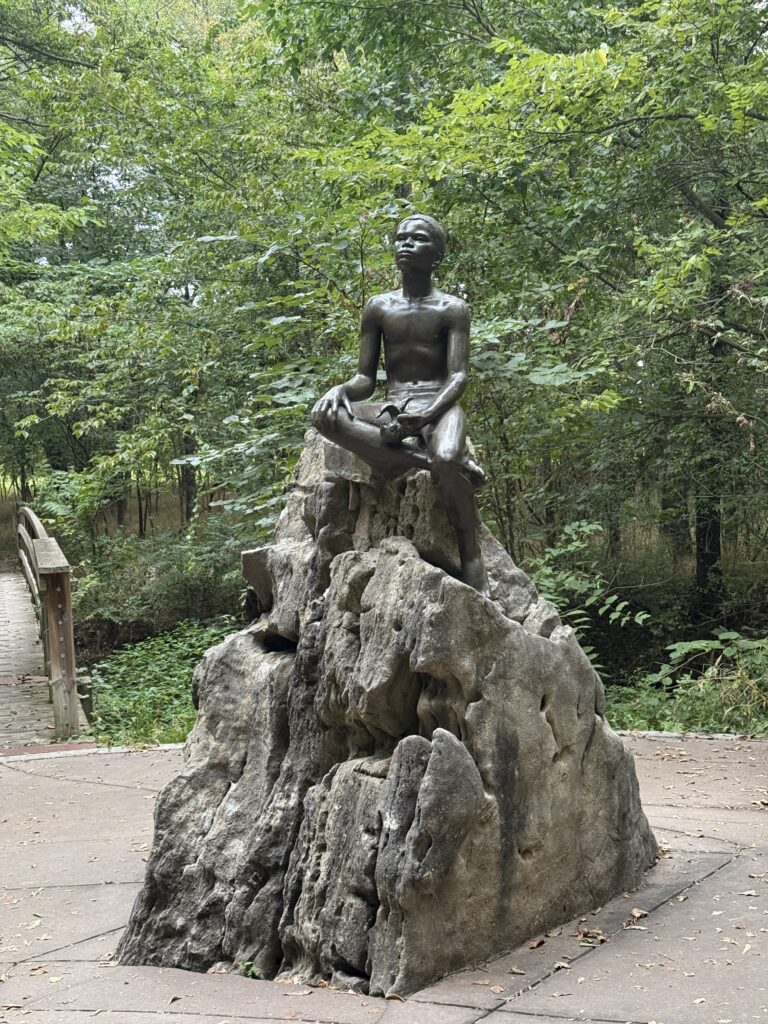
I was amazed at how much he had done
I genuinely was. But I have read more since I got home, and I want to tell you the version I did not have on the trail — because the thing he is most famous for is the smallest part of it.
He did not invent peanut butter. Somebody else patented that in 1895. He did make hundreds of things from peanuts, and he testified to Congress about it in 1921, and that is how he became “the Peanut Man.” And that is just the beginning..
Here is what he actually did.
He fixed dirt. Southern soil was being wrecked by cotton, and the farmers working it were getting poorer every year. Carver showed them that if you alternated cotton with peanuts and sweet potatoes, the soil came back and it cost less than buying fertilizer. When he started in 1896, peanuts were not a recognized crop in this country. By 1940 they were one of the six biggest.
And then there is the wagon.
Carver understood that the sharecroppers who needed this most were never going to come to a college campus. So he built a classroom onto a wagon and drove it out to them. Tools, demonstrations, the actual science, delivered into the field where they were working — to Black farmers and white farmers both, in the Jim Crow South.
It was called the Jesup Wagon. People have since described it as one of the first food trucks.
He also ran traveling schools, and published his research as free bulletins, because research that stays on campus does not feed anybody. The NAACP gave him its Spingarn Medal in 1923.
He earned his degrees at Iowa State — a bachelor’s in 1894, a master’s in 1896. When Booker T. Washington recruited him to Tuskegee in 1896, he was the only African American in the country with an advanced degree in scientific agriculture.
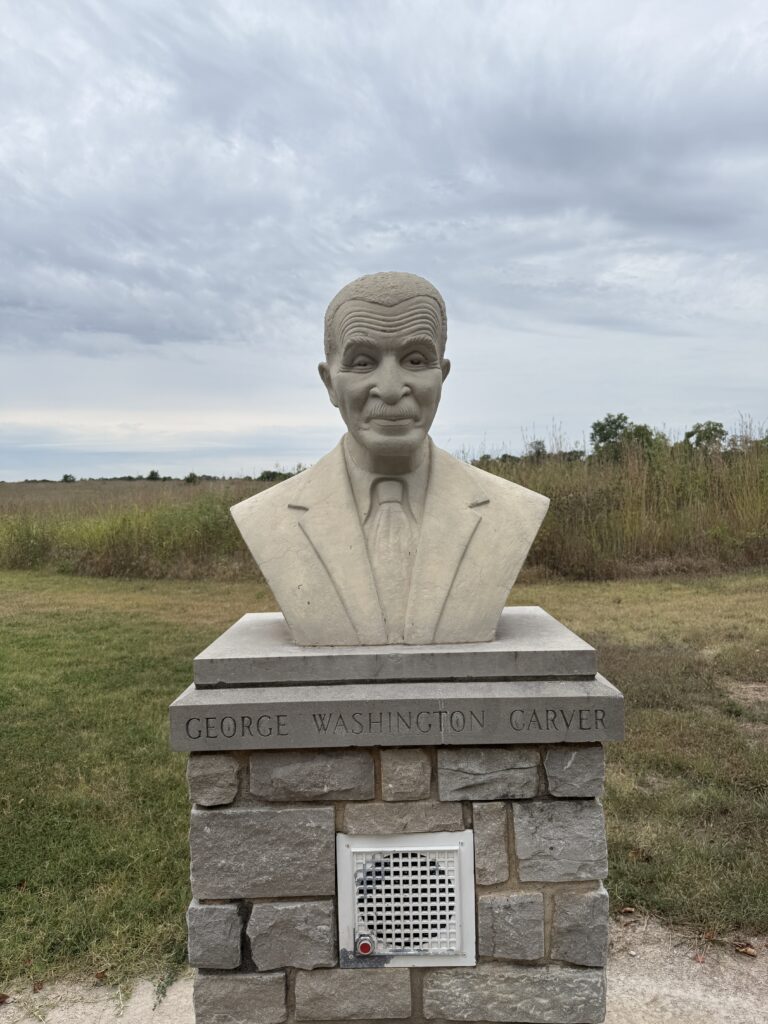
The visitor center is a must
It has the traditional store and the ranger information, but the museum section and the classrooms built to teach school groups about his work are spectacular. They bring all of that history to life in a way the panels outside cannot.
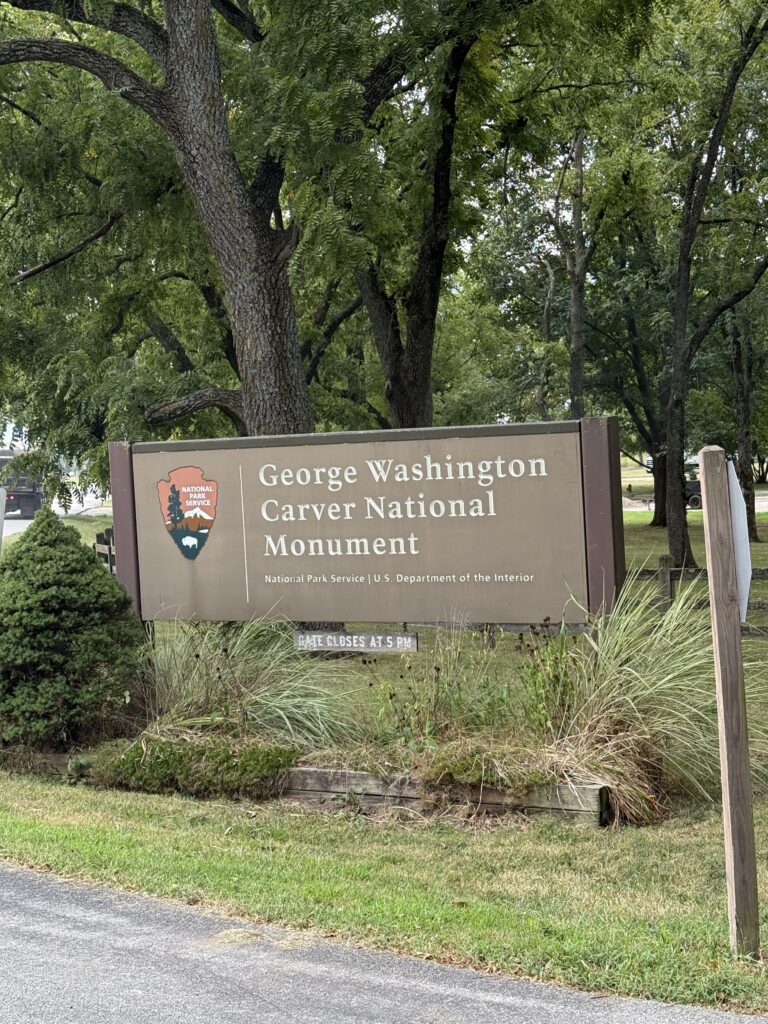
One more thing worth knowing
This place was made a national monument on 14 July 1943, by Franklin Roosevelt.
It was the first national monument in the country dedicated to a Black American. It was also the first dedicated to anyone who was not a president.
In 1943. In a still-segregated country, months after he died.
He said something once that I keep turning over, and it is a better summary of him than any list of peanut products:
“Whenever the soil is rich, the people flourish, physically and economically.”
He meant it about dirt. He also plainly meant it about everything else.
Basics
Where: two miles west of Diamond, Missouri, about ten miles southeast of Joplin. Roughly fifteen miles off Route 66.
Entry: Free. No entrance pass is required.
Phone: 417-325-4151.
Size: 240 acres.
Established: 14 July 1943, by Franklin D. Roosevelt — the first national monument dedicated to a Black American, and the first dedicated to a non-president.
The Carver Trail: about three-quarters of a mile, through rolling hills, woodland and prairie, with interpretive panels the whole way round.
On the trail: the birthplace site, the 1881 Moses Carver house, the Carver family cemetery, and a statue of Carver as a boy.
Start with the visitor center if it is open — museum, film, ranger information, bookstore, and the classrooms built for school groups, which are the best thing here.
If you arrive before it opens, do the trail first. That is what I did, and it works.
Pets
Tootsie came with me and we did the whole trail, and this is a nice easy one for a dog — three-quarters of a mile, gentle, through fields and woods.
Leashed dogs are welcome on the Carver Trail. Six-foot leash maximum, which is the rule across the National Park System — and it does mean no retractable leads extended past six feet.
She did not come into the visitor center, and that is the one hard line here: no dogs in the buildings. Which matters at this park more than most, because the museum and the classrooms are genuinely the best part. So plan for somebody to sit with her, or do the trail and the building in shifts.
Little else to warn you about. It is short, it is shaded in parts, and there is nothing technical underfoot. Bring water in summer — this is Missouri and it gets humid.
If this interests you
Carver spent his career at Tuskegee Institute in Alabama — also a National Historic Site, and also worth your time. Born enslaved in Missouri, forty-seven years teaching in Alabama.
Traveling with a dog? Where I Would Actually Take My Dog is every park on this site, sorted by whether she can do the activities you came for.
Additional Resources
George Washington Carver National Monument — the official National Park Service site.
Hours, visitor center access, programming and pet rules change. Check with the National Park Service before you go — details here were verified in September 2026.