
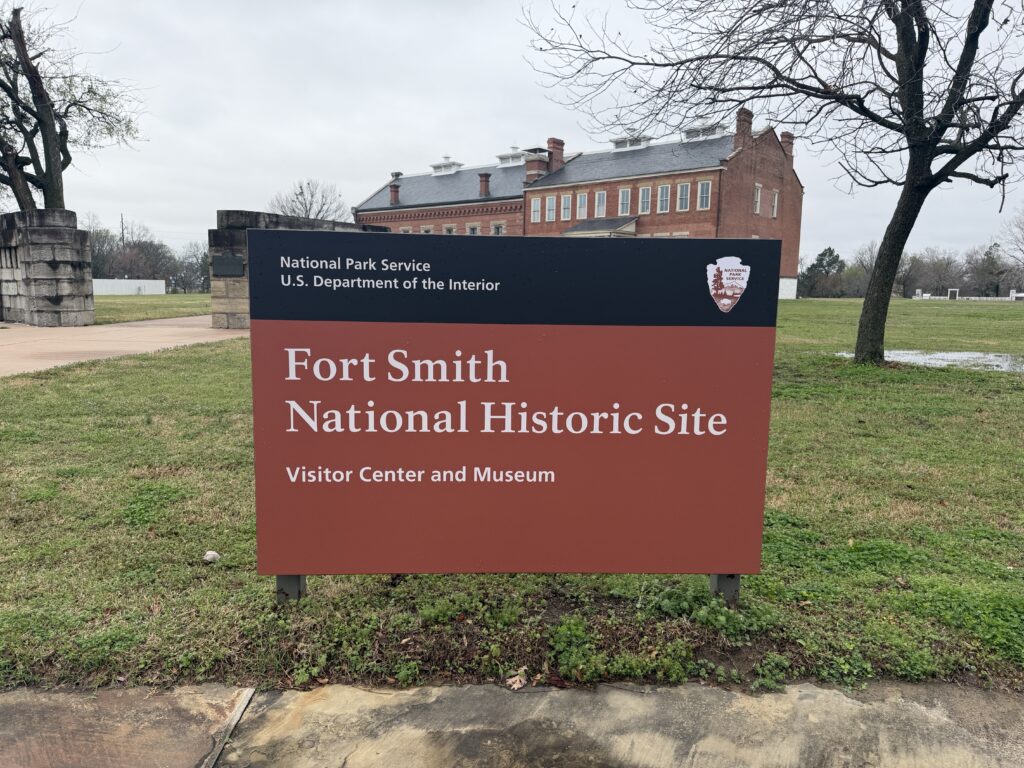
Fort Smith is right in town. You park on the street, walk up, and you are greeted by a big red brick building that looks like a barracks.
That is because it was one.
What you are looking at
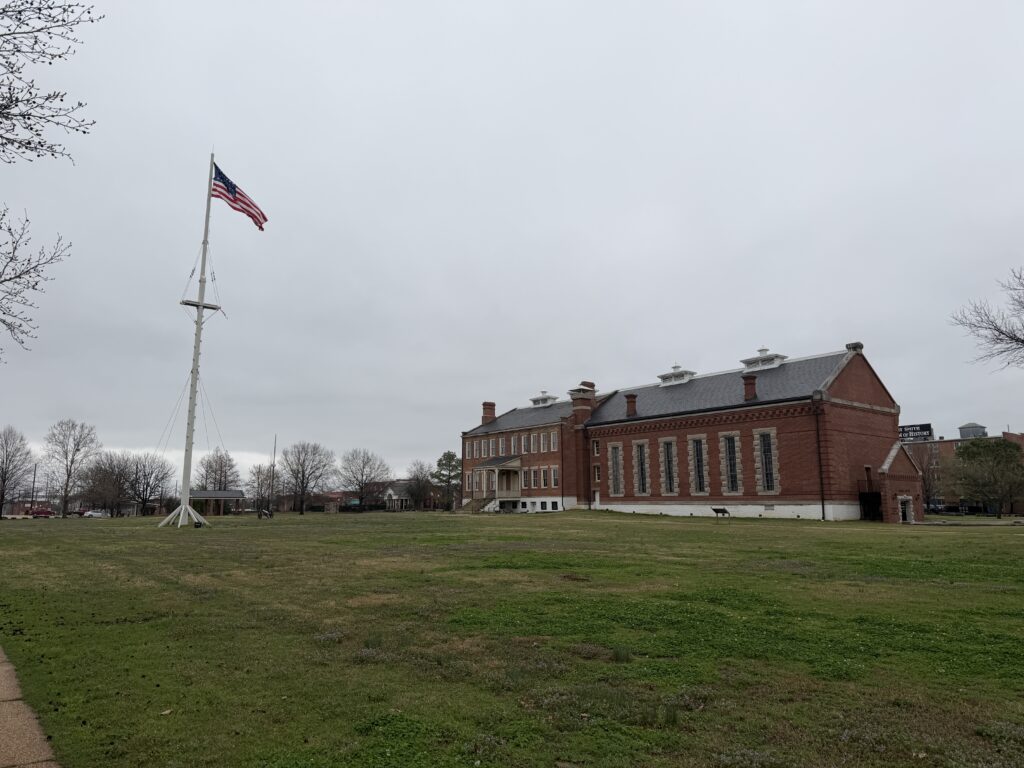
The building was built as the enlisted men’s barracks for the second Fort Smith. When the army pulled out in 1871, it became something else entirely — the federal courthouse, and the jail.
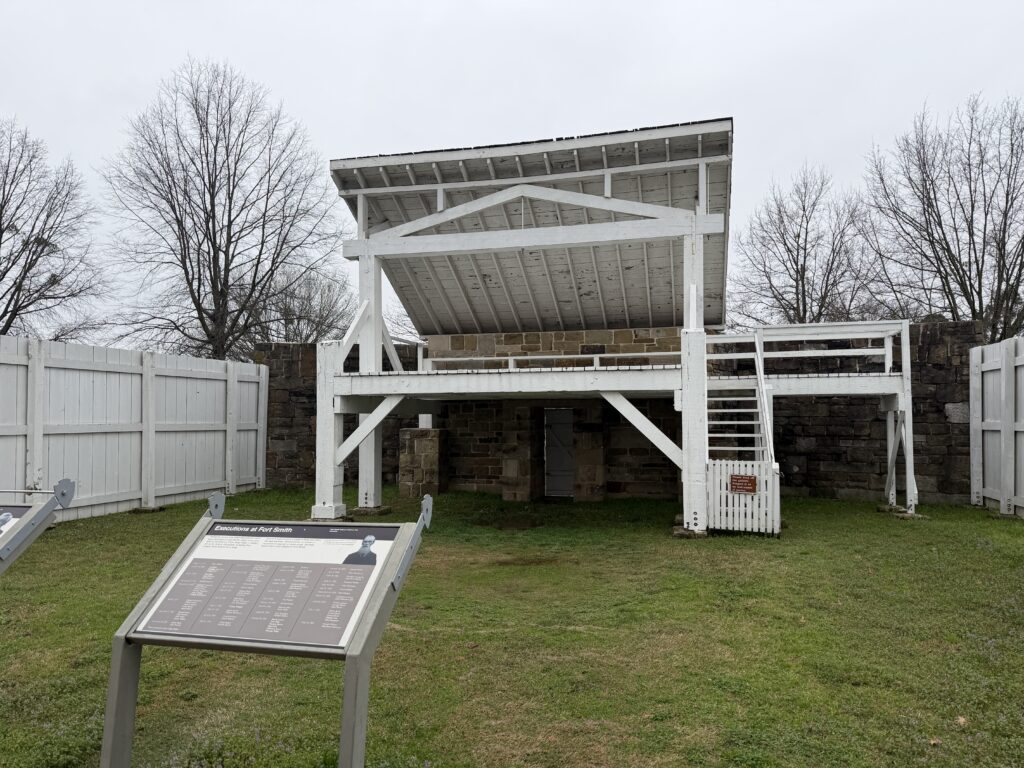
This is Judge Isaac Parker’s courthouse. He sat here from 1875 to 1896, and seventy-nine men were executed during his time on that bench. Eighty-six were hanged at those gallows across twenty-three years. The jail had a nickname: Hell on the Border.
I am not going to write the whole history at you, because that is what the site is for. But it is worth knowing before you walk in that this one building is where soldiers slept and then where people were sentenced to die, and it is still standing on a street corner in a working town.
The visitor center is in the lower level, and they have an incredible film about Fort Smith. It is also a short one — which matters more than you might think, for reasons I will get to. Watch it first.
A note about films, if you travel with a dog
A lot of visitor centers have a film about the place you are standing in, and they are often the best fifteen or twenty minutes of the visit. I miss a fair number of them.
Tootsie has to stay in the van any time I go into a National Park visitor center. So whether I see the film comes down to the weather. If it is hot, I do not go in. That is the trade, and I make it every time without much agonizing.
At Fort Smith I got lucky. It was a really cool day, she was perfectly comfortable, and the film is short. So I got to watch it, and I am glad I did.
I mention all of this because nobody tells you about it when you start traveling with a dog, and it is worth planning around. If there is a film you really want to see, go early, or go on a cool day. And it is a fair question to ask at the desk how long the film runs — a twelve-minute film and a forty-minute film are completely different decisions when somebody is waiting in the car.
Outside, it is wonderful
And then the outside of this site is so dog friendly that it more than makes up for whatever you miss indoors. I took Tootsie everywhere.
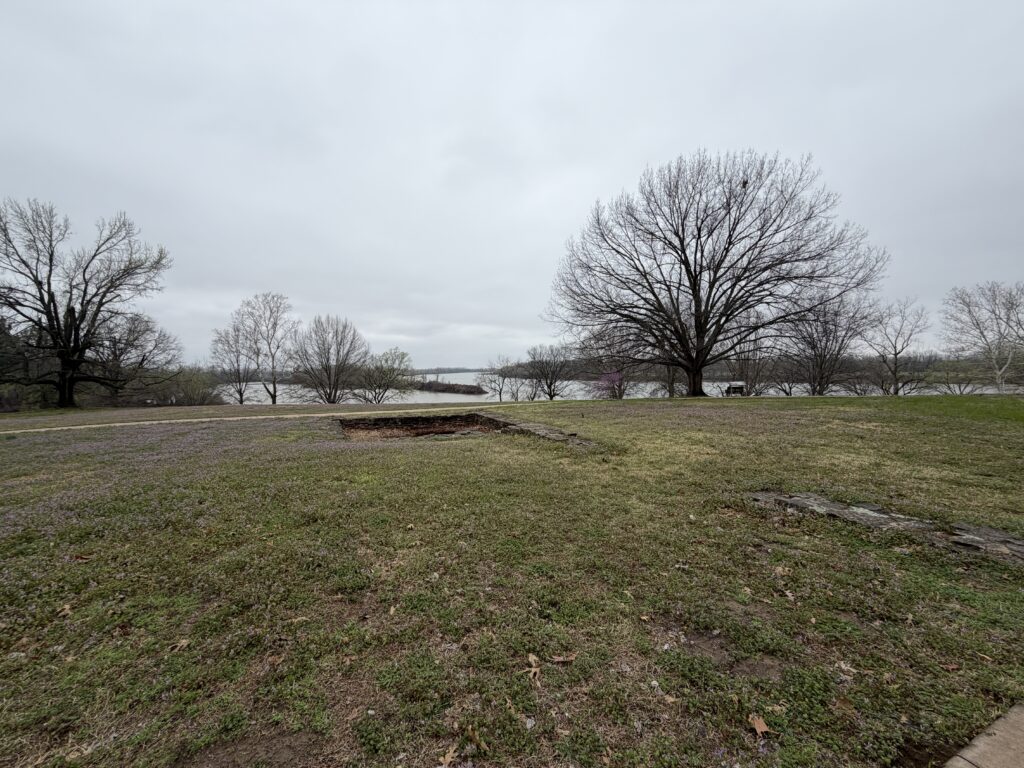
There is a beautiful walking trail that loops you around the grounds with a bit of history along the way — about a mile, paved, with exhibits as you go. It takes you down to where the Arkansas and Poteau rivers meet, which is where the first fort stood in 1817.
The part I found most interesting
Across from the red brick building there is an open courtyard area. It is called the parade ground.
And out on that parade ground are the footprints of two buildings.
At least one is the officers’ quarters. What they have done is lay a slab with the brick outlines of the walls still in it, so you can walk through the rooms — you can see exactly how each room was laid out.
I found that genuinely effective. So often at a historic site you are asked to imagine a building from a sign. Here you walk the floor plan. You can stand in what was somebody’s front room.
The garden
And behind one of those buildings, there is a garden.
That was the thing that got me. I stood there thinking about how they took the time and the care to grow their own food, and I could not decide whether it was for pleasure or out of necessity.
It was necessity. And it was not the soldiers.
The men at the fort ate mostly canned and preserved food. So the garden was tended by the officers’ wives and children, growing fresh vegetables to supplement army rations — and herbs, sage and basil and parsley, both for seasoning and for medicine.
What is there now is a re-creation of the 1860s garden: three long beds inside a white picket fence, planted with heirloom varieties from that period, kept up with the help of local master gardeners.
So on a site that is mostly about soldiers, courts, a jail and a gallows — about men doing hard and often terrible things to other men — the thing I keep thinking about is the vegetable patch that the wives and the children kept going, because otherwise everybody ate out of tins.
That is the part of a fort nobody puts on the sign.
Plan your visit
Where: 301 Parker Avenue, downtown Fort Smith, Arkansas. (479) 783-3961. You park on the street.
Fee: none.
Hours: open daily 9:00 to 5:00. Closed New Year’s Day, Thanksgiving and Christmas.
Start with the film. The visitor center is in the lower level of the barracks and courthouse building, and the orientation film in the mini-theater is the right first move. It is short.
Allow: a couple of hours to do the building, the grounds and the trail properly.
What is here
The barracks, courthouse and jail — built as enlisted men’s barracks, later the federal courthouse and the jail known as Hell on the Border. Both jails can be toured.
The gallows — a reconstruction; the original came down in 1897. 86 men were hanged here over 23 years, 79 of them during Judge Parker’s tenure.
The commissary — still standing, and open.
The parade ground — the open courtyard between the buildings.
Building outlines — officers’ quarters, guardhouse and walls marked out in cement, brick and stone. Walk the floor plans.
The Officers’ Garden — on the parade ground. Three beds, white picket fence, 1860s heirloom varieties.
The 1817 fort foundations — down at Belle Point, where the Arkansas and Poteau rivers meet.
River Loop Trail — about a mile, paved, wayside exhibits, river views.
The history in brief
1817: first fort built at Belle Point, to keep peace between the Cherokee and the Osage.
From 1831: the buildings here held supplies for Choctaw removal. The site is on the Trail of Tears National Historic Trail.
1838: second fort built.
1871: the army leaves.
1872: the barracks becomes the federal courthouse and jail.
1875 to 1896: Judge Isaac C. Parker on the bench.
Pets
Outside, this is one of the easiest parks I have brought Tootsie to. Leashed dogs are welcome across the grounds — the parade ground, the building outlines, the garden, the river trail. I took her everywhere and never hit a boundary.
Inside is a different matter, and it is worth planning for. Dogs are not allowed in buildings, which here means the courthouse, the jail, the commissary and the visitor center with the film.
So the film depends on your weather. I got a cool day and watched it. On a hot one I would not have. Ask at the desk how long a film runs before you decide — that single question makes the call much easier.
Go early, or go on a cool day. And if it comes to it, the outside of this site is still most of the value.
One thread worth following
The Trail of Tears runs through two of my Arkansas posts. Fort Smith held removal supplies from 1831. At Pea Ridge, the first stop on the tour road is a walked segment of the same road. Two completely different sites, one thread.
Traveling with a dog? Where I Would Actually Take My Dog is every park on this site, sorted by whether she can do the activities you came for.
Hours, building access and trail conditions change. Check with the National Park Service before you go — details here were verified in September 2026.