
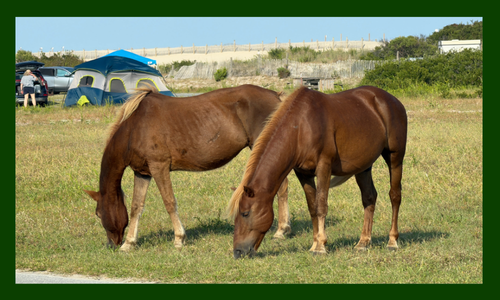
Assateague State Park sits on a barrier island where wild horses wander through the campground and stop traffic on the road in. It’s Maryland’s only oceanfront state park, two miles of beach and marsh at the north end of a 37-mile island shared with a national seashore and a wildlife refuge.
Meghan Rhode, the park’s Assistant Park Manager, joins me to talk about how the horses got there, how to share the island with them safely, and everything you need to know to camp, visit for the day, or bring your dog.
A note from Missy: Before this trip, I hadn’t really been to a park in a couple of months, which for me is a long time. I set up my camper, sat down, and it was the biggest exhale. If you’ve been going and going lately, this is a good place to sit and watch for a while.
Episode Guest
Meghan Rhode – Assistant Park Manager
Assateague State Park
Meghan is part of the Maryland Park Service team that runs the state park side of Assateague Island, from the campground loops to the day use beach. She’s a birder, a parent who camps with her kids, and someone who got hooked on parks as a kid when a ranger got excited about the shark’s tooth she found at Calvert Cliffs.
What we cover
- One island, three agencies: the state park, the national seashore and the wildlife refuge
- Why Assateague feels like a community, with families coming back for generations
- How the wild horses got there: the shipwreck story and the tax break story
- How the herd is managed, and the foals born right behind the campsites
- Maryland’s horses versus the Chincoteague ponies
- Bands, stallions and the daily “soap opera”
- Sharing the island safely: speed, roads and the horse-proof food boxes
- Fishing, crabbing, surfing, kayaking, birding and stargazing
- What to pack: long stakes, your own shade, and checking the wind for bugs
- Day trips, the 5 Tides restaurant, and booking a campsite
- Bringing your dog, and why it takes extra planning here
- Sunsets over the marsh from the causeway
- Speed round: a shark’s tooth at Calvert Cliffs, Acadia on the bucket list, a leaping manta ray, and the sound of sika deer in fall
Show Notes & Links
- Assateague State Park, Maryland DNR
- Campground reservations: through the Maryland State Parks reservation site
- Assateague Island National Seashore
- Chincoteague National Wildlife Refuge
- Ratcliffe House, open seasonally for tours
- 5 Tides Restaurant and Retail Shop, in the day use area
- Calvert Cliffs State Park (Meghan’s first park memory)
- Companion reading: Assateague State Park
- Companion reading: Assateague Island National Seashore
- Related listening: The Birding Boom: Join the Migration (Episode 89)
Transcript
Assateague State Park
The Parks Podcast, Episode 90 | Meghan Rhode, Assistant Park Manager, Assateague State Park
Welcome to Assateague
Missy Rentz: We are headed to Maryland’s only oceanfront state park, on an island once mapped out for beach houses. Where a 1962 storm washed that plan away and left the island to the wild horses who were there all along. Join us as we explore Assateague State Park. I’m your host, Missy Rentz, and this is The Parks Podcast.
I’m really excited to welcome Meghan Rhode to this podcast episode. Meghan is the Assistant Park Manager at Assateague State Park, part of the Maryland State Park system. Meghan, welcome to The Parks Podcast.
Meghan Rhode: Thanks so much. I’m excited to be here today.
Missy: I am too. I just spent a lovely weekend in Assateague, so it’s even more fun to talk to you because it’s all fresh. We start each episode with some stats to let people know what we’re talking about. First of all, the park is located in Berlin, Maryland, which is just about 10 miles south of Ocean City. It was created in 1965. The park is 855 beautiful acres along the Atlantic Ocean.
And some field notes for you: in the 1950s there was a big push to develop Assateague, very similar to what you see in Ocean City. Then in 1962, a storm destroyed homes and structures along the island, so that plan was abandoned, and three years later, Congress designated Assateague Island National Seashore, which is just south of the state park. The park has 342 campsites. It’s huge, and it’s currently home to 83 wild horses. It’s such a great park.
Meghan: Yes, it definitely is. We have a lot to offer on the island. And you’re right, we’re just a small section of it. The island is 37 miles long. It goes from Ocean City to its north all the way into Virginia to its south, and it’s governed by three different entities. The state park is the first one. If you stay straight coming onto the island, you’re going to run right into the state park. We’re about two miles long. To our north and our south is the national park. And once you cross the border into Virginia, you’re in the Chincoteague National Wildlife Refuge.
So there are three different agencies that run the island, and we all have to work together to make sure we’re offering the best opportunities for visitors while also taking care of the resource the best ways that we can.
The Biggest Exhale
Missy: I have to tell you about my experience. I was coming up to go birding for the first time, and it had been a couple of months since I’d really been to a park, when I’m usually in parks every day. So it had been a long break. I got there, I got my camper set up, and it was the biggest exhale, because it’s a park where there are things to do, but one of those things is just to sit and watch.
It warmed my heart to be there with the ocean, and the seagulls, and the horses, and I could feel my body start to slow down. It didn’t take me long. So that was important to me, but tell me why Assateague is such an important part of the Maryland State Park system.
Meghan: Assateague is the easternmost park in the park service. It has that oceanfront. We are the only oceanfront state park. And Maryland in general is unique. We like to call it Little America, because you can see everything from the mountains in the west, travel the bay, and then head out to the ocean in the east. I think Assateague is unique because it’s a community. Our visitors are like family. They come back year after year. You get to interact with them and hear their stories, how their grandma took them the first time they came, and now they’re bringing their kids.
How the Horses Got Here
Missy: You hear about people going to the Eastern Shore, and there are generational memories made in Assateague and places like it. One of the things I knew Assateague for before visiting was the horses, and that is a big draw. Tell us a little bit about the horses and how they got to Assateague.
Meghan: How they got to Assateague is a bit of a mystery, because there are two different theories. There’s the shipwreck version: a Spanish galleon was coming across the ocean, it ended up in a storm and shipwrecked, and the horses were able to swim to shore and have been on the island ever since. This is hundreds of generations of horses on the island.
The other version of the story, which has a little more historical support, is that the island was used for farm animals. Farmers would bring their horses and other livestock over to the island, and that way they also got a tax break, because they weren’t taxed on those animals being out on this land. Eventually it got too cumbersome, and they didn’t bring them back. They’ve survived here all these years and have become wild again.
Managing the Herd
Missy: I know 83 is the number now. Is that about what it stays at, or does it ebb and flow?
Meghan: It does ebb and flow. The National Park Service manages the herd for the Maryland side of the island. At one point they did a survey to figure out how many horses the island could sustain. The herd was well over 100 at that point, and the survey said 80 to 100 is the sweet spot. We like to stay right in there. So they started using birth control on the horses. They had a horse biologist who would go out and survey all the animals.
They do this quarterly, four times a year, to make sure everybody who’s supposed to be here is still here. At that time, they would allow each mare to have one foal in her life, and then they would dart her after that. Between the birth control and natural attrition, the number got below 80. It was in the 70s, and that’s when they decided to start letting the mares have babies again. Ever since then, we’ve steadily seen more and more babies each year.
Last year we actually had two mares give birth right in the campground. It was absolutely amazing. It happened Memorial Day weekend, so the campground was full of people. The word spread. There were hundreds of people, and this mare was right behind the campsites. The crowd was in awe. I pulled up, and everybody was quiet. It was such a beautiful moment to share with so many people. Probably a little earlier everybody had been hustling and bustling and making lots of noise, and then all of a sudden this magical scene appears, and the quiet and the calm among everybody was so amazing. It was a really cool moment for a lot of people.
Not Chincoteague Ponies
Missy: Is it 83 in Assateague, or is that the entire island, including Chincoteague?
Meghan: There are two separate herds. There’s the Maryland herd, and then there’s the Virginia herd.
Missy: That was my next question. How do you tell the Assateague and Chincoteague herds apart? You hear about the Chincoteague Pony Swim, but you aren’t part of that.
Meghan: We aren’t part of that. At the Maryland and Virginia line there’s a fence that separates the two herds. Occasionally one will get from one side to the other, but these horses are monitored so closely. Everybody knows their horses, so if that happens, they’re escorted back to the right side.
Living Alongside Wild Horses
Missy: When I first got there, I was wandering around the campground, and I ran into these photographers. Thank goodness, because I just wouldn’t have known any of this. But they knew those horses, and their stories, and their families’ stories. I saw Happy and Happy’s mares, and I saw Billy Bob, who was standing at a picnic table in the campground just staring at everybody.
They’re really part of the community, even though, I must say, we are all told to stay away from them. That is very clear. They are wild animals. But sometimes they bring themselves into your space.
Meghan: Oh my gosh, yes. The horses on the Maryland side are able to roam freely wherever they please, and oftentimes that’s really close to campsites. So we keep a good eye on them. And they do form communities. There’s the Maryland herd, and within it there are bands. That’s usually one dominant stallion, a harem of mares, and their offspring. Those bands will battle for territory, they’ll battle for food, and they’ll battle for mares. A lot of people don’t understand that that’s all happening in and around where they’re staying.
What they might see is a beautiful scene with the horses out there grazing, and they don’t realize that a couple of campsites down, the competing band is coming into that turf. That’s why we really advocate that you keep your distance. A lot of people come in and talk about their horse experience: “Oh, I’ve been around horses. I’ve been to a farm.” But this is a different game. This is a different animal. You do have to be on your toes.
And each horse has its own story and its own personality. Thankfully we have some really dedicated staff on the island who get to know them and get to know that daily drama. The soap opera is what we often call it. They’re able to tell people what’s happening, who these horses are, and what their names are. A lot of times we can talk about their lineage, when they were born, and how old they are. So there are a lot of fun details we’re able to share with guests.
Sharing the Island Safely
Missy: I’ve never gotten the communications from a park that I got from you all. It was daily, the week leading up, reminding me of the safety side of it. And it’s not only staying away, but also, people are biking there and driving there, so it’s about being safe, because there was an accident this summer where one of the mares was hit by a car.
It’s really important that we understand that when we’re in these places, we are sharing the land. Listen, I’m a believer that we’re sharing the land everywhere, but we really are sharing the land when we’re in parks, and that was pretty devastating.
Meghan: Yeah. It was a rough summer. We do our best to get the word out and tell people how to safely coexist while they’re here on the island. Speed is one of the factors we try to make sure everybody respects, because the horses will travel wherever they want to, and they can jump into a road, similar to deer crossing a highway. Sometimes it’s real slow, and sometimes it’s a little quicker. And in the middle of summer, when the bugs are really bad and the brush is full of them, the horses will go out into the road and just stand there for a while to get away from it all.
Missy: I had a traffic jam with about five of them. They stood there and just looked at you like, “What are you doing in my space?”
Meghan: They know where they want to go, and they’re going to do it on their own time.
In addition to being safe on the roads, we retrofitted all of our picnic tables. If you were camping with us, you saw that we have horse-resistant food boxes on every site, underneath your picnic table. The idea is to keep the horses and other animals from getting your food, as long as you use it properly. We still advocate that you put your food in a cooler or a latched tote and then store it inside those boxes. That makes your site the safest, both for you and for the horses that may come into that area. Food storage is one of our number one concerns while people are camping on the island. We want them to keep a safe distance, but also not attract the horses to their site.
Things to Do on the Island
Missy: We’ve talked a lot about the horses, but the park is quite the playground for other activities as well, and it’s unique because it’s on the Atlantic Ocean. It’s sort of surreal to be in a park on the ocean. Let’s talk a little bit about other things you can do at Assateague.
Meghan: Oh my gosh, you’re right, it is a playground. There are so many activities on the island, as long as you like water. A lot of people come to the park for fishing, crabbing, and clamming. They go surfing, kiteboarding, and kayaking. Some people just come to watch wildlife. They might come to see the horses, but there are so many other animals that live on or visit the island, depending on the season. I’m a birder, so I definitely go out and explore the island for the birds passing through, especially this time of year when all our migrants are coming through. That’s one of my favorites.
People come prepared to do it all. When I go camping at other parks, I try to pack relatively light, but not when you come to Assateague. You have everything but the kitchen sink.
Missy: Right, exactly. They’ve got their bikes, their kayaks, their beach toys, everything on top of their car.
Meghan: Yep.
Missy: You also have a historic home that’s affiliated with the park.
Meghan: Yes, the Ratcliffe House is on state land. It’s run by the Ratcliffe Foundation. It’s a colonial house that’s open during the main part of the season, mostly during the summer, one to two days a week, and they offer tours.
Missy: That’s neat. For me, most of it was outdoor related, but there’s that one. And the visitor center is lovely. I guess it’s more for the whole island. The visitor center before you cross onto the island is really informative and great.
Planning Your Trip
Missy: Let’s talk about planning a trip to Assateague. What’s the first thing you recommend someone do when they think about visiting?
Meghan: Do your research. Camping on the island is different than camping anywhere else. You have to take into consideration that it’s almost always breezy here. If you’re a tent camper, making sure you have the right length stakes is a big one. A lot of times people will bring those screw-in dog tie-out stakes, and those work wonders to hold your camping gear down.
Missy: The little four or five inch stakes that come with the tent would never work there. Not only is it breezy, but you’re in sand, so they don’t get a good grip.
Meghan: Exactly. We always recommend extra long tent stakes to hold everything down. You also have to consider that the campground isn’t very vegetated, so there aren’t a lot of shady spots. You’re going to want to bring your own shade. A lot of people bring pop-up canopies and screen tents to give themselves a space out of the sun.
Missy: Yeah, tarps are important. The other thing is that there are a lot of bugs. Lots of mosquitoes, lots of flies. The people who had screened spaces had a place to get away from it, which was really nice. And when you think about where to stay, camping is the only option on site.
Meghan: Correct.
Missy: But you’re not far from hotels and Airbnbs and all of that.
Meghan: Right. Berlin is a beautiful, quaint town just about 10 miles down the road, and then you’ve got Ocean City, which has a plethora of places to stay. So it depends on what you’re looking for. We’re a highly visited day use park. A lot of people just come out for the day to use the beach, or walk or drive around and look for the horses. So there are different ways to experience the island.
And you’re right, the bugs can be bad. The breeze usually helps, depending on the direction, so another thing to consider before you leave is the direction of the wind. West winds blow the bugs onto the island, and that can make for a kind of miserable stay.
Day Trips and Reservations
Missy: Let’s talk a little bit about day trips, because I think this is a great park for a day trip. When you show up, there’s a massive parking lot, and then a ton of facilities for people visiting the beach. There’s a restaurant and a coffee shop and all sorts of things. Kind of a mini boardwalk, I would say.
Meghan: Yeah. When you come into our day use area, we have the 5 Tides, which is a restaurant, and it’s so good. The food there is amazing. They also have a gift shop with all your basic souvenirs and some camping gear. It’s definitely one of our hotspots to hit before you head out onto the beach, and we always advocate that you eat before you get out there, so we’re not attracting the horses onto a beach that’s extremely crowded. They have a really nice back deck you can sit out on, and a couple of tables inside with air conditioning. Like we said, the sun and the heat can get taxing, so it’s a nice cool-off spot too.
The bathhouses in our day use area were just renovated last year, so they’re very nice right now. And along our boardwalk we have rinse showers, which are really nice. It’s that last stop before you hit the car, one last rinse before you head home.
Missy: And are you open year round?
Meghan: The day use portion is open year round. Our campground is open from the last part of April through the last full weekend of October. We shut down the campground mainly because our water lines are so close to the surface that they would freeze, and we don’t have heat in any of our buildings, so we can’t offer winter camping.
Missy: And when do reservations open for the next year? It’s close to the end of October when this will air.
Meghan: It’s open already. You can book up to 364 days in advance, and if you’re coming in prime season, which is Memorial Day to Labor Day, you’re going to want to book as soon as you can, because those fill up a year in advance. Oftentimes the shoulder season weekends are booked a year in advance too.
Missy: That’s great. And they just go to the Maryland State Park website to do that?
Meghan: You can Google Assateague State Park, and there’s a link right there for reservations.
Pets in the Park
Missy: The other thing I always bring up, because my dog is at my feet right now: let’s talk about pets in the park, and what they are and aren’t allowed to do.
Meghan: We do allow pets in our off-season. From after Labor Day all the way until the Friday before Memorial Day, pets are allowed in our day use area. They’re able to go out on the beach and walk through the campground. Once we get to Memorial Day, that cuts off. They are allowed in our campground in our G, H, and I loops, where we have pet-friendly sites.
We love to see all the pets out there. It’s always a treat. This spring, I don’t know what it was, but in May it felt like everybody had a Labrador, the big chunky kind. Just driving around the camp loops, it was like, “Oh, look at them all.” We always try to give everybody as much information as we can to prepare, and one thing I always like to tell people is that we have a lot of bur grass. Those little stickers don’t only get in your feet, they get in your pet’s feet too. So come prepared, and watch where you’re walking when you step off the path. A lot of dogs come in those little boots to protect their paws.
Missy: It’s a tough one, because I write blog posts about every park and my experiences in them. You all are very generous with your rules on dogs and when you can have them. Yet as a dog owner, I think it could be really tough to have a dog around the horses. The burrs, the hot sand, the fact that there’s no shade. You really have to be on top of it, and it has to be all about your dog and keeping your dog safe, because there’s a lot out there that could be really challenging for a dog.
Meghan: Yeah. Like I said before, it’s a different environment out here, and all those things you just said are things you should think about before bringing them out with you. I know a lot of people love to camp with their dogs all the time, and then they come here and they’re like, “Ooh, this is different.”
And it is tough. It’s a harsh environment. I’m going to go back to the horses. The horses are actually horses, genetically speaking, but over time they’ve adapted to more of a pony stature because the environment is so harsh here. That short, squatty height lets them stay better stabilized out in the marsh. So if it can do that to a horse over time, think about what it’s going to do to a pet while you’re out here. You also have to think about the winds. If the sand is going to pelt your legs on the beach, it’s going to get in their eyes.
What Everyone Should See
Missy: What is something you think everybody visiting Assateague should do or see?
Meghan: Ooh, that’s a good one. One of my favorite things is to watch an Assateague sunset. The sunset or the sunrise, both are beautiful, and the fact that you can see both right there is amazing. We get a lot of great comments about the outdoor showers on the backside of some of the bathhouses, because people love to take their showers and watch the sunset. That sunset is amazing for me, especially along the causeway, which is the entrance road just as you come over the Verrazano Bridge. When the sun hits the marsh, each little pool or pond out there lights up in different colors. It’s like seeing nature’s palette right there.
Missy: Wow.
Meghan: It’s amazing. So definitely watch the sunrise or sunset while you’re here. Just sit on the beach and watch the ocean, because you never know what you’re going to see out there. Boats going by, the waves crashing, and you might see dolphins, you might see whales. All kinds of seabirds come through.
Before you cross the bridge, head into the visitor center. They have so much information about the island and the horses. They have a movie you can watch in the nice air-conditioned theater, so it’s also a good place to go on a rainy day. Start there, and walk the Verrazano. And if you’re a stargazer, Assateague has some of the best stargazing.
Speed Round
Missy: We end every episode with a speed round of questions. Just answer with what first comes to mind.
Meghan: Okay.
Missy: What is your earliest park memory?
Meghan: I grew up in St. Mary’s County, and the first memory I have is visiting Calvert Cliffs State Park and hiking out to the beach. In my mind, that was the longest hike in the world. But once you got there and got to explore the beach, see the cliffs, and find your first shark’s tooth, it was absolutely worth it. I remember that as we got close to the beach, there was a swamp, and in my head, at any moment a brontosaurus’s head was going to come out of that swamp. That’s what I remember vividly. It never did, but I always imagined it would. What got me hooked was having a ranger be excited. I’m sure they had seen the same tooth 900 times, but they were excited that I had found it, and they were able to identify it for me and tell me a little bit about it.
Missy: What made you love the parks?
Meghan: They’re so different from anywhere else in the world, right? We’re all accustomed to towns and cities and even farmland, but in a park, no two days are the same. Nature is there. Nature’s taking over. You’re at her will, if you will, and you don’t know what you’re going to see. It’s a great place to explore.
Missy: What’s your favorite thing about Assateague State Park?
Meghan: I don’t know. I like too much of it. I like it all. Everything from seeing our returning campers to watching the wildlife to winter birding. I like a little bit of everything out there.
Missy: What park have you yet to visit, but it’s on your bucket list, and why?
Meghan: I’d like to go to Acadia, up in Maine. We often visit southern Maine, and we’ve just never made it that far north. I think it would be a great adventure, and I’d like my kids to be able to see it.
Missy: What are three must-haves you pack for a park visit?
Meghan: I have to have my binoculars, my camera, and probably rain gear. Always be prepared.
Missy: What is your favorite campfire activity?
Meghan: S’mores, hands down. I love s’mores. I love watching my kids make s’mores and make a mess of everything and enjoy them.
Missy: Tent, camper, or cabin?
Meghan: I’ve done all three. I think I’m at the stage in my life where I prefer a camper or cabin.
Missy: Are you hiking with or without trekking poles?
Meghan: Without.
Missy: What’s your favorite trail snack?
Meghan: Granola bars.
Missy: What is your best animal sighting?
Meghan: One of my favorites is actually here on the island. We saw a manta ray leap out of the water. It took a while to figure out what I was seeing, but we did get to see it briefly.
Missy: What is your favorite sound in the park?
Meghan: I have two. In the springtime, I really enjoy the first time we hear the chuck-will’s-widow in the evening. It welcomes the spring and summer season. And then as we get into fall, being able to hear the sika deer bugle is just something special. We know winter’s coming.
Missy: And what’s the greatest gift that the parks give to us?
Meghan: A place to relax, a place to breathe, a happy place. That’s what we hear the most from people: “I come across that bridge, and I take that deep breath, and I can feel my worries melt away.”
Missy: I love that. Meghan, thank you so much for spending time with me today, for helping me relive Assateague from a few weeks ago, and for introducing so many people to this very special place.
Meghan: Thanks. I had a blast doing it.
Missy: Thanks for listening. Until next time, we’ll see you in the parks.
Music for The Parks Podcast is performed and produced by Porter Hardy. Follow us @TheParksPodcast or visit TheParksPodcast.com.