
I had never been birding in my life.
Next week I am doing a panel conversation with Wayne Klockner, the executive director of the American Birding Association, at the Maryland Outdoor Recreation Summit in Ocean City. And it struck me that we would have a far more interesting conversation on that stage if I had actually done the thing first.
So I asked him whether he would take me out. He suggested Assateague.
What I did not know when I turned up
Assateague Island is the number one eBird hotspot in the whole of Maryland and the District of Columbia. More than 345 species have been recorded here.
I found that out afterwards.
So my first ever morning of birding happened on the single most productive patch of ground in two jurisdictions, with the man who runs the American Birding Association standing next to me. Which was an extraordinary piece of luck, and I am grateful he said yes.
Getting there, and which Assateague is which
This confuses people, so here it is plainly.
You cross the bridge onto the island, and then you drive the entire length of Assateague State Park before you reach the National Seashore’s ranger station. Two miles of the Maryland end of the island is a Maryland state park. Nearly all the rest of it is federal, and it runs on south into Virginia.
Same island. Same beach. Two different agencies, two different sets of rules and two different sets of fees.
And the fees do not transfer. A state park pass is not valid at the National Seashore, and vice versa. If you are doing both in a day, you are paying twice.
We met at the visitor center, which does not open until nine. Worth knowing if you are coming for birds, because the birds do not wait until nine and neither do you have to — the park itself is open twenty-four hours. It is only the building that keeps office hours.
Three boardwalks and a great many things I could not name
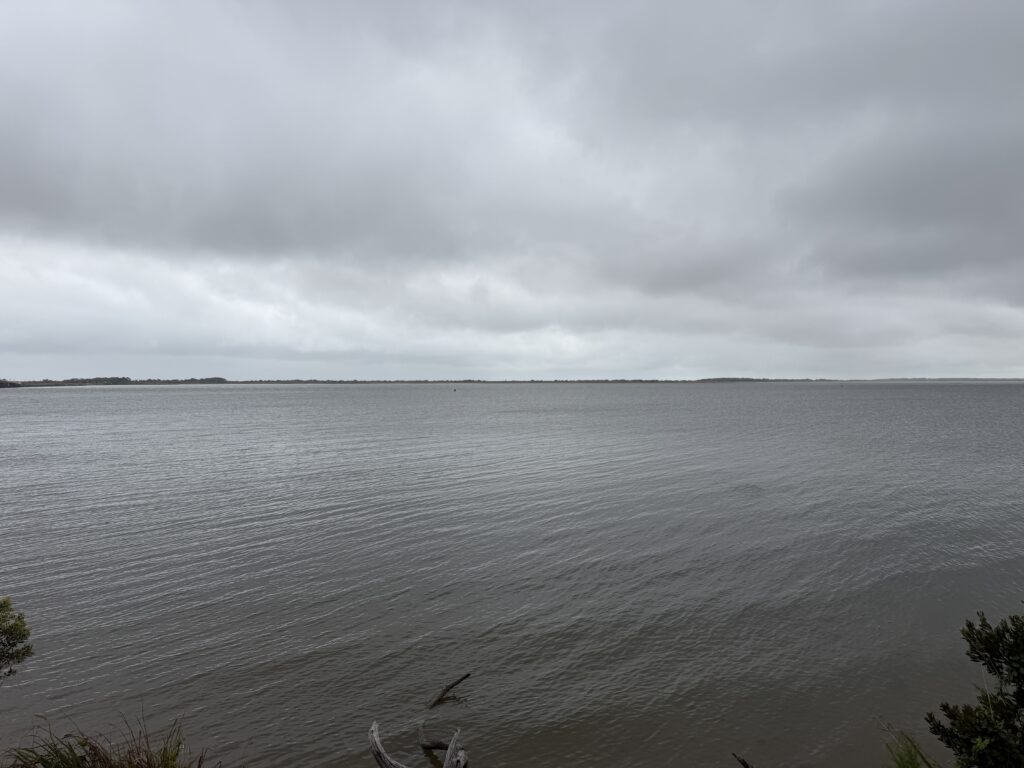
There are three short nature trails here, and they each take you through a different habitat — Life of the Marsh, Life of the Dunes and Life of the Forest. We went out on the boardwalks that carry you over the marsh, and stopped at three different lookouts.
It was September, which is the top of the autumn migration, so we were hoping for volume and variety.
Here is my honest report as a first-timer. I know we saw multiple kinds of gull. Terns. Egrets. Herons. Double-crested cormorants.
And I know we saw a great deal more than that, and I could not tell you what any of it was.
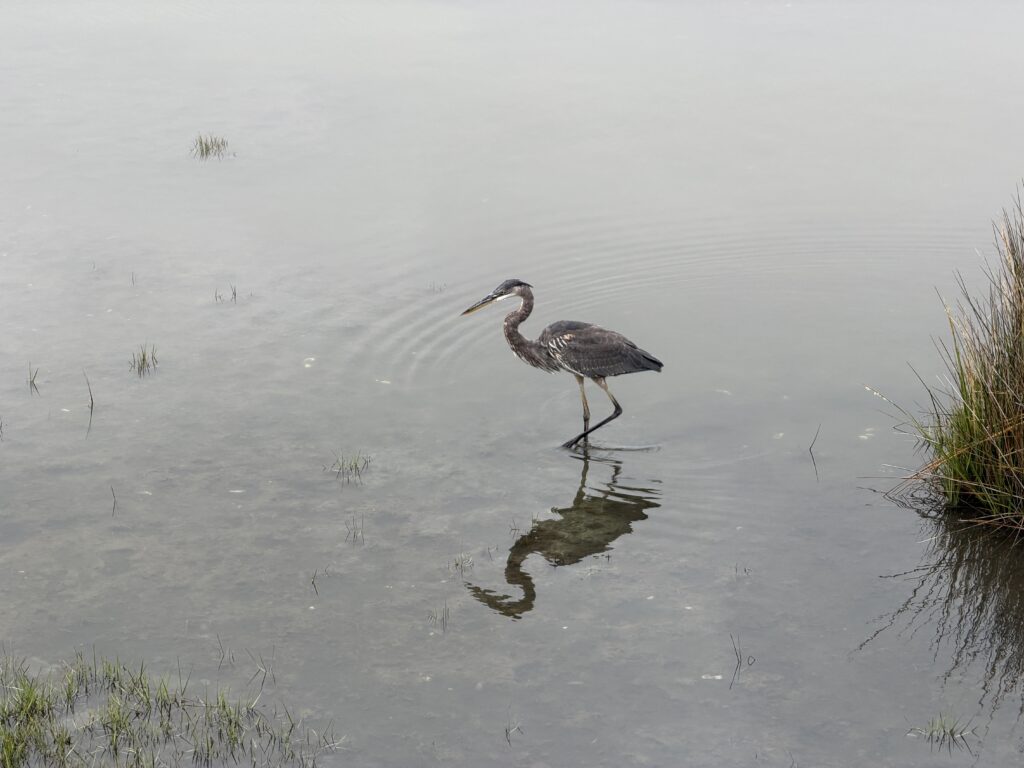
I want to say that plainly, because I think the naming is what puts people off starting. It turns out you do not need to be able to name a thing to stand still and look at it, and standing still and looking at things was most of what the morning consisted of.
We also spent a while watching two crabs conduct a territorial dispute under the boardwalk, which was not on the agenda and was completely absorbing.
The campground is one of the best birding spots on the island
Wayne wanted to walk me through the campground, and I did not expect that. I think of a campground as somewhere you sleep, not somewhere you go looking for birds.
The bayside camping area is one of the top three birding hotspots on this island, with 250-plus species recorded, and it has a reputation for turning up genuine rarities in autumn. If you are camping here, you are already standing in the good spot.
We walked the whole thing and did not see much that morning, which I am told is also birding.
What I did notice is that the sites are very spacious and it is properly quiet in there. The facilities are more basic than the state park’s — cold-water showers and chemical toilets, and no hookups. If you want a hot shower you want the state park. If you want the quiet, you want this.
A horse, through binoculars
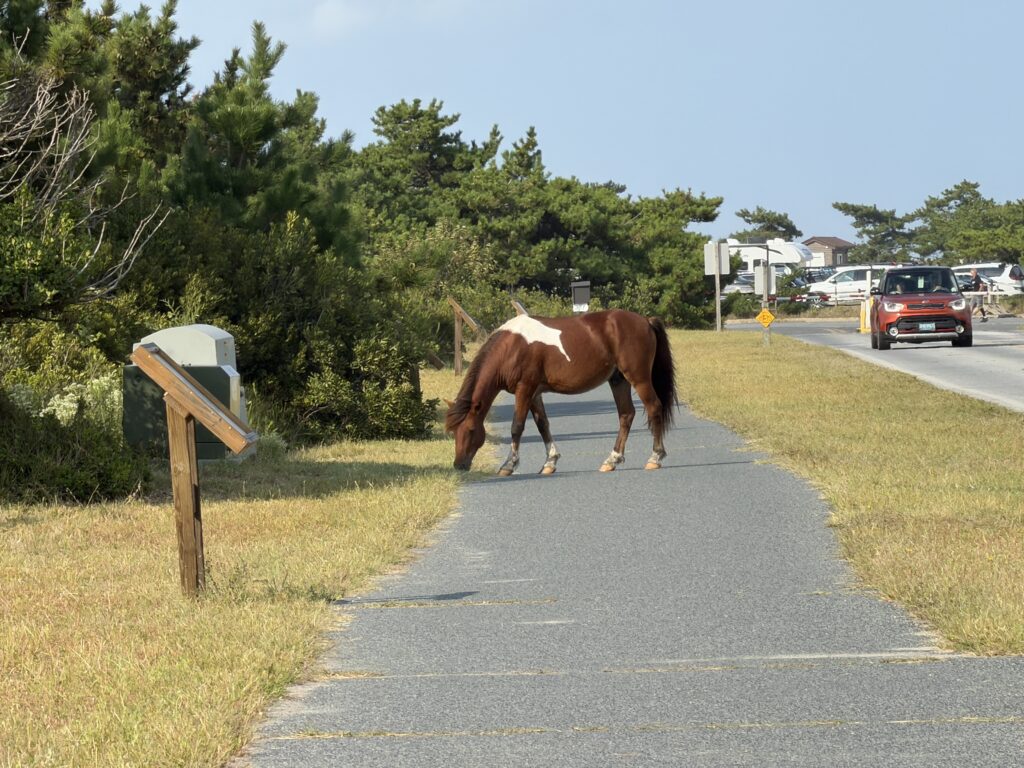
There are wild horses on Assateague.
Some were standing about along the roadway, which is the way most people meet them.
Then, while I had the binoculars up looking for birds across the marsh, I found a horse instead — standing out in the water, well across the way, doing nothing in particular. I would never have seen it with my own eyes. That is the thing about being handed a pair of binoculars for the first time: it is not only that you see more birds. It is that the whole middle distance suddenly becomes available to you, and there is a horse standing in it.
And then, as we were leaving the island, five or six of them were standing in the middle of the road.
A horsey traffic jam. Nobody minded.
What I took from it
I came to have something to say on a stage. I left having learned to stand still.
That is the part nobody tells you about birding. I had assumed it was a knowledge hobby — that the point was identification, and that not knowing the names made you a spectator. It is not. The point is attention. The names come later, or they do not, and the morning is the same either way.
I still could not tell you what most of what I saw was called.
I could tell you exactly where the crabs were.
Plan your visit
Entry: Charged per vehicle, good for 7 days. Check the current rates before you go. Lower rates for motorcycles and for anyone on foot or bike. An annual pass for the seashore is also sold. The America the Beautiful pass covers it.
Your state park pass does not work here, and a seashore pass does not work at the state park. They sit on the same island and share the same beach, and they are two separate agencies. Budget for both if you are doing both.
Hours: the park is open 24 hours a year round. The Maryland visitor center is open daily 9am to 4pm, and the ranger station and campground office run 8am to 6pm seasonally. If you are here for dawn birds or a sunrise, you do not need the building to be open.
The layout: cross the bridge, and you pass the whole of Assateague State Park before you reach the National Seashore’s ranger station.
Trails: three short nature trails — Life of the Marsh, Life of the Dunes and Life of the Forest — each through a different habitat, and most of them are wheelchair accessible.
Camping: oceanside and bayside, and both are primitive. Cold-water showers, chemical toilets, no hookups. Spacious, and genuinely quiet.
The horses: the legal minimum distance is forty feet, which is about a bus length. They bite and kick, and they will go through a picnic table, an open car boot or a tent looking for food. Citations get issued for feeding or petting them. Nowhere on the island has a speed limit above 25 mph.
Virginia: the island continues south into Virginia, where the seashore is managed alongside Chincoteague National Wildlife Refuge and the rules are different again.
What to pack & wear
Binoculars, even if you have never used a pair. Especially if you have never used a pair.
Insect repellent, and then more insect repellent. This is a barrier island with a marsh behind it. Mosquitoes and biting flies are part of the deal and they are not gentle about it.
Sun protection. There is very little shade out on the boardwalks and the dunes.
Water, and shoes you do not mind getting sandy.
If you are camping, a plan for a cold shower or a friendship with somebody at the state park.
Pets
On paper, the Maryland end of this island is more dog-friendly than most national park units, and that genuinely surprised me. Leashed dogs — six feet, no longer — are welcome in a good deal of the Maryland district, including stretches of beach and the campgrounds. A national seashore where your dog can be on the sand beside you is not something you find every day.
Not where I spent my morning, though. Dogs are barred from the nature trails, and the nature trails are the boardwalks over the marsh — which is to say, the birding. They are also off the lifeguarded beach and the backcountry sites. And the Virginia district is a flat no: not the beach, not the trails, not inside your vehicle. If you are driving south with a dog, you stop at the Maryland line.
But here is what I would actually tell you, having been there.
I would not bring a dog to Assateague. Either end of it.
The horses are why. They roam, and they walk through campgrounds, and the Park Service is blunt about what that means: keep forty feet back, because these animals bite and kick, push people away from picnic tables and open car doors, and tear into tents looking for food.
Now put a dog in the middle of that. Your dog cannot keep forty feet from a horse that has decided to walk through your site, and a dog that barks or lunges at a stallion has access to a very bad ending. Even if nothing happens at all, I think it would be a stressful few days for an animal who has no idea what those enormous things are.
The exception is a small dog who is honestly content to settle in the car or the camper while you are out. If that is your dog, you can make it work.
Otherwise this is one I would do without them, and I do not say that often.
The other Assateague
Assateague State Park is the first two miles of the same island — different agency, different fee, hot showers.
Traveling with a dog? Where I Would Actually Take My Dog is every park on this site, sorted by whether she can do the activities you came for.
Fees, hours and seasonal access change, and the two Assateagues have separate rules. Check with the National Park Service before you go — details here were verified in September 2026.