
I went to Tuskegee in April 2026, and the reason I went had started more than a year before that.
I had been paying attention to arguments about what belongs in the history we teach, and which parts of it quietly get trimmed. It sparked rage. And it took me a year to pull together a trip to go visit and learn the history that could be removed.
I wanted to learn this history before somebody decided it was inconvenient. And I wanted to share it while the argument was still going on.
That is what the civil rights part of this trip is. Tuskegee was one of the reasons for it.
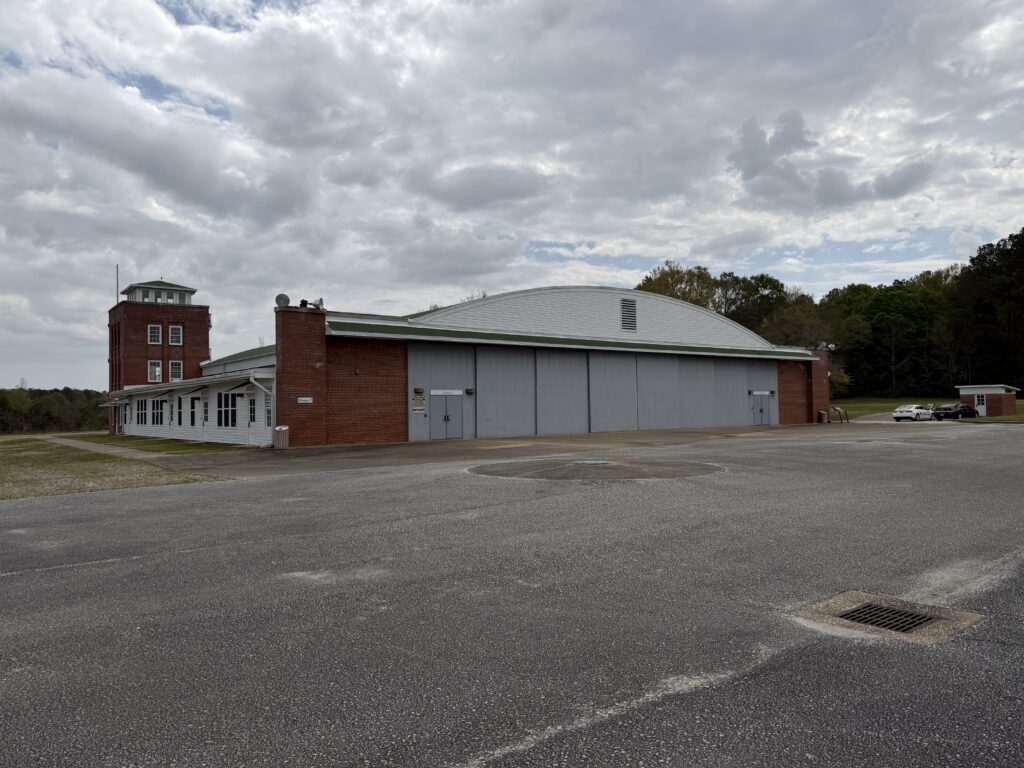
It is much bigger than you think
I pulled into a massive parking lot, left the air conditioning running for Tootsie, and went in on my own.
Start at the visitor center — but understand that the visitor center is the start of the museum, not a stop before it. You walk on from there through two hangars, and both of them are dense with stories, documents and objects from the time.
Hangar 1 went up in 1941 and holds the training exhibits, including a Stearman biplane and a J-3 Piper Cub, which are the aircraft they actually learned on. Hangar 2 was built in 1944 and covers what happened overseas, along with the Double-V campaign — victory abroad, and victory over racism at home. There is a red-tailed P-51 in there and a half-hour film.
Give this place far more time than you think you need.
What I was actually struck by
I walked in thinking I would be struck by the work and the risk of it.
What got me instead was simpler. These were men and women willing to fight for a country that would not grant them basic human rights.
Not metaphorically. The exhibits walk you through it. There was a curfew that kept them out of the town of Tuskegee after eleven at night. Officers were court-martialed for trying to walk into an Officers’ Club. There is an account of a cadet trying to get to church and being hit in the head with a hammer by a bus driver for not following the segregation rules. The exhibits will also tell you about being bused to segregated quarters, and I stood there feeling sad about it and, honestly, a little baffled that anybody thought that arrangement was reasonable.
And they flew anyway. Around 996 Black pilots trained here, with something like sixteen thousand support crew behind them across the war — mechanics, navigators, radio operators, meteorologists, parachute riggers, cooks, control tower operators. Women among them, as mechanics, gate guards and fuselage technicians. It was never only the pilots.
The impact these Americans had is still felt. That is not a small thing to stand inside.
Then I went outside
When I was done in the hangars I got Tootsie and we walked the grounds, and the grounds turned out to be their own experience.
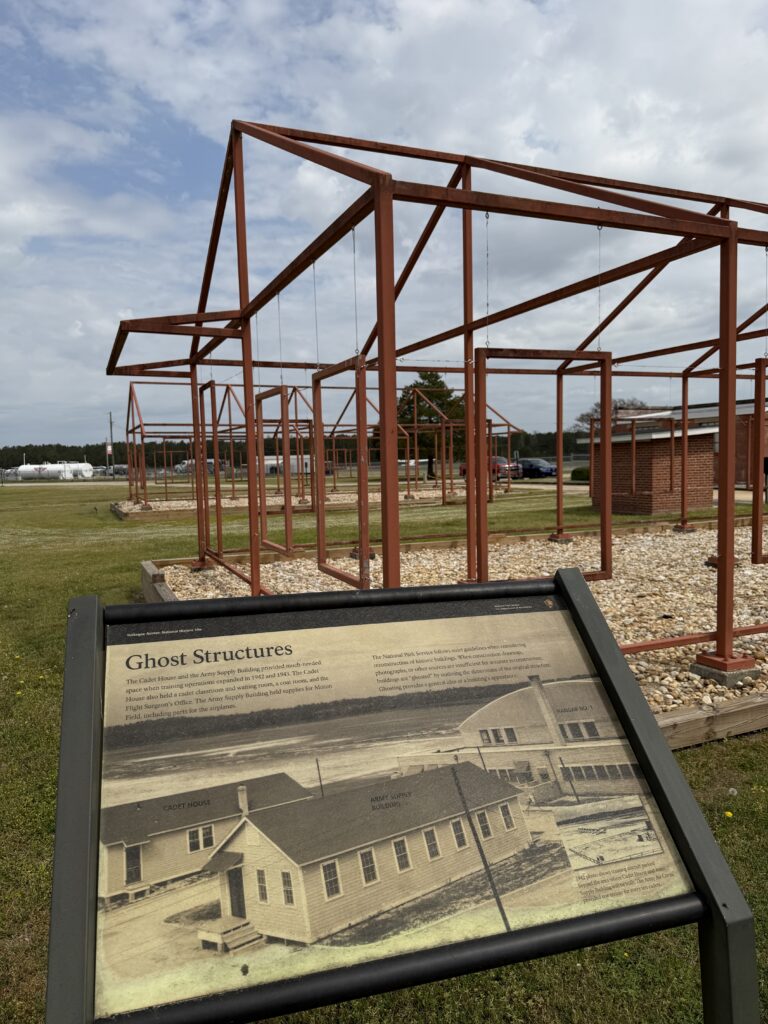
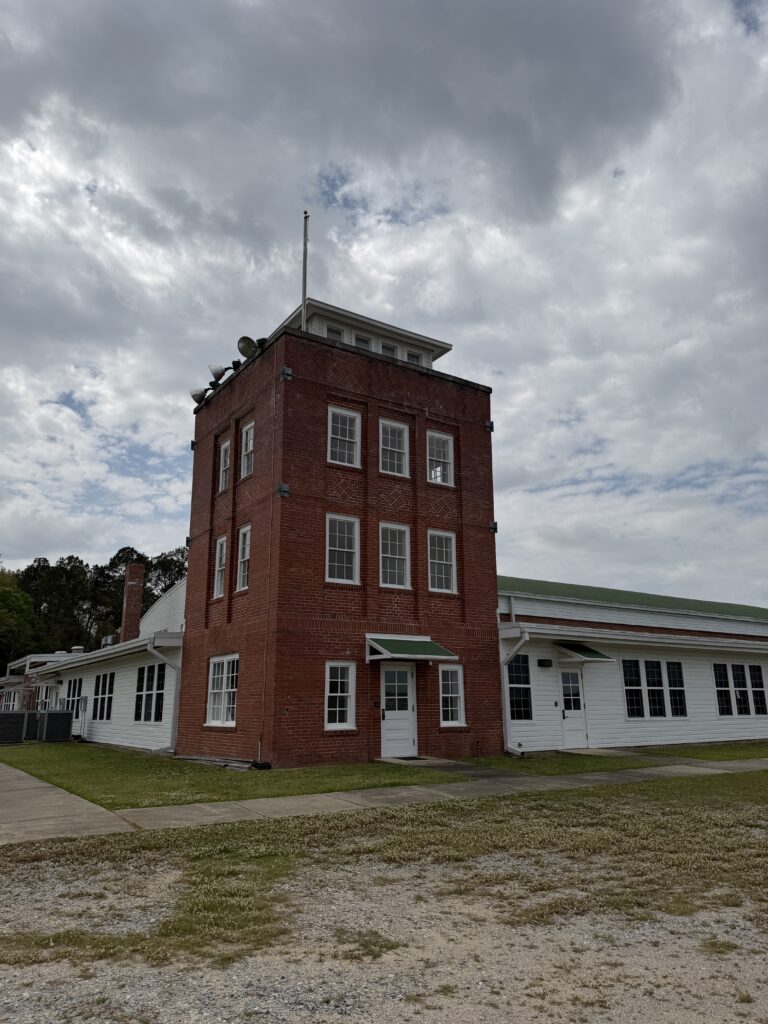
Some of the original buildings are still standing and you can look at them from the outside — you cannot go in, but you can see them.
Where buildings have been lost, they have put up art instead. It is funky and it is genuinely good, and it does something clever: it gives you the footprint and the feeling of the room that used to be there without pretending to reconstruct it. You come away with a sense of the shape of the place.
And the airfield still works. Moton Field is a functioning municipal airport with a five-thousand-foot runway right there, so I stood on the grass and watched planes take off and land on the same ground.
The field is named for Robert Russa Moton, who ran Tuskegee Institute. This was the only place in the country where Black pilots got their primary flight training during the war.
A joyful park
That is the word I keep coming back to, and I know it is an odd one for a place like this.
It was a joyful park for me. I walked around in awe of the lives these Americans led and the work they did — for our rights, and for all Americans’ rights.
And I felt sad, in the same walk, about what they had to put up with to do it.
Both of those were true at once the whole time I was there, and I do not think you are supposed to resolve them. You are supposed to hold them.
Basics
Entry: free. No fee, no pass required.
Where: Moton Field, Tuskegee, Alabama. There is a large parking lot and it is rarely full.
How long: longer than you have planned for. The visitor center leads into two full hangars of exhibits, and then there are the grounds. Give it half a day if you can.
What you will see: Hangar 1 (training, with a Stearman and a Piper Cub), Hangar 2 (overseas combat, the Double-V campaign, a red-tailed P-51 and a thirty-minute film), the surviving original buildings from the outside, and the art installed where buildings have been lost.
The airfield is live. Moton Field Municipal Airport is still operating beside the site, so there are usually planes moving.
On your feet: you are walking the hangars and then the grounds, so comfortable shoes. There is good shade inside and very little outside, so water and a hat from late spring onward.
Worth knowing: the site was authorized in 1998 and did not open to the public until 2008. It is newer as a park than the history makes it feel.
Pets
The grounds here are excellent for a dog. They are huge and spacious and there is a lot of room to walk.
They cannot come into the hangars, and the hangars are the museum, so you will be doing that part separately. I left the air conditioning running in the van while I was inside, which is the arrangement I have ended up using at a lot of these sites.
One honest caveat, from the day I had: I was there when there were maybe three other cars in that enormous lot, and that is why it worked so well. If you show up on a day with an event on and a full parking lot, I would skip the dog part rather than try to make it work.
The rest of the corridor
Birmingham Civil Rights National Monument and the Selma to Montgomery National Historic Trail, both in Alabama. Further afield: the Medgar and Myrlie Evers Home, Emmett Till and Mamie Till-Mobley National Monument and Little Rock Central High School.
Traveling with a dog? Where I Would Actually Take My Dog is every park on this site, sorted by whether she can do the activities you came for.
Hours and access change. Check with the National Park Service before you go — details here were verified in September 2026.