
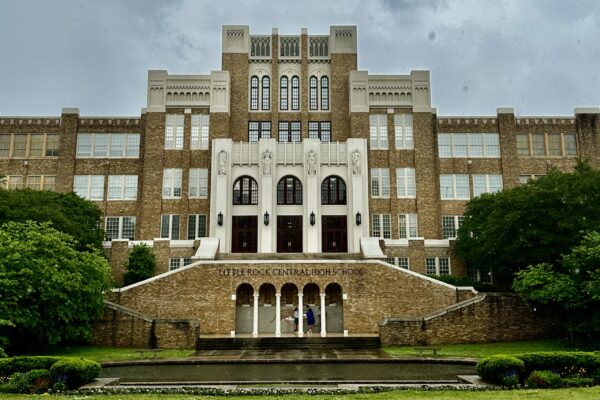
In September 1957, nine Black teenagers walked through the doors of Little Rock Central High School — escorted by the 101st Airborne Division — and set in motion a movement that would reverberate around the world. Brian Schwiger, Chief of Interpretation at Little Rock Central High School National Historic Site, joins The Parks Podcast to tell the full story: the nine students, the Lost Year, the governor who closed the schools, and the moment when a young woman from Afghanistan looked at Minnie Jean Brown Trickey and said, “You are our hero.” Without missing a beat, Minnie Jean said, “No. You are mine.”
A note from Missy: Brian and Little Rock Central High School will always hold a special place in my heart. First, the story of what took place at this school — nine innocent youth, brave enough to take a stand for what was right. They faced ridicule and threats, but they stood their ground. What surprised me is that through the stories, I could also see how little we have changed in many respects. It set the stage for a desire to tell these stories and allow people to witness our parks in a new way. Second — this was my first episode. They helped make my dream a reality.
Episode Guest
Brian Schwieger, Chief of Interpretation
Little Rock Central High School National Historic Site
Park Stats
- Location: Little Rock, Arkansas
- Established: November 6, 1998 (President Bill Clinton)
- Size: 28 acres (Visitor Center, high school, Elizabeth Eckford Bench, Magnolia Mobile Gas station, commemorative garden)
- Annual visitors: 92,108 (2022)
- Unique designation: The only National Park site with a functioning high school at its focal point
- The event: September 1957 — the Little Rock Nine attempt to desegregate Central High School
- The Lost Year: 1958–1959 — Governor Faubus closes all four Little Rock high schools rather than comply with desegregation, affecting 3,600+ students
- Historical context: Followed the Supreme Court’s Brown v. Board of Education ruling (May 1954)
Show Notes & Links
- Plan Your Visit — Little Rock Central High School NHS
- NPS App — audio tour recorded by Central High School students
- The Little Rock Nine — NPS biography
- The Lost Year — NPS history
- Magnolia Mobile Gas Station / Visitor Center
- Selma to Montgomery National Historic Trail
- Tuskegee Airmen National Historic Site
- Manzanar National Historic Site
- Medgar and Myrlie Evers Home National Monument
Transcript
Little Rock Central High School — Where Nine Students Changed the World
The Parks Podcast, Episode 1 | Brian Schwiger, Chief of Interpretation, Little Rock Central High School National Historic Site
Why This Park Exists
Missy Rentz: Today we have Brian Schwiger, who is the Chief of Interpretation at Little Rock Central High School National Historic Site. You’ve been in the National Park Service for 13 years, also having worked at Hot Springs National Park in Arkansas and at Guadalupe Mountains National Park in Texas. Brian, welcome and thank you for being on The Parks Podcast.
Brian Schwiger: Absolutely. Thank you for having me and letting me talk about this place that I thoroughly love.
Missy: Let me go through some stats. The park is located in Little Rock, Arkansas. It was created when Congress established Little Rock Central High School National Historic Site on November 6, 1998. President Bill Clinton was in office. It’s located on 28 acres, which is made up of the Visitor Center, the high school, Elizabeth Eckford Bench, Magnolia Mobile Gas Station, and a commemorative garden. In 2022, there were 92,108 visitors. It is the only National Park site with a functioning high school at its focal point. Tell me a little bit about the park, why it was created in 1998, and its significance in the park system.
Brian: I think Central High School National Historic Site would exist today had it not been for President Bill Clinton, who was an Arkansan — but his being in office 25 years ago definitely expedited its inclusion in the national park system. Within the National Parks landscape, there are many places like this. Just down the road you’ve got Selma to Montgomery National Historical Trail, Tuskegee, Manzanar in California. These are parks that are culturally resource-based and talk about stories that are interwoven in the fabric of America. These stories cross every border and speak every language. It’s really great that the National Park Service has made a concerted effort to protect places like this.
Brian: From 1957, when this story happens, for about 30 years, here in Little Rock, it doesn’t seem like there was a large owning up to or admission of what occurred. The Little Rock Nine have talked about for a long time that it was something they didn’t discuss — not out of shame, but out of trauma. In 1987, the governor of Arkansas had the Little Rock Nine back to the governor’s mansion — the very place where the plot to deny their entry into school had essentially been conceived. That governor was Bill Clinton. I think the seed was planted there. And so from that moment until 1997, the 40th anniversary, a groundswell began here in Little Rock about creating a place of memory and recognition — somewhere visitors could have a meaningful, inspirational experience. Business leaders and community members who felt passionately about this story acquired the Magnolia Mobile Gas Station across the street with the help of the city of Little Rock. That became the first visitor center in 1997. A building that had been neglected in prior years, but was so important during the crisis because of its payphones — the media’s coverage of this story could not have been as widespread without them. That station, handed over to the National Park Service and signed into law by President Clinton, introduced this story to national park visitors who only used to think of national park sites as big outdoor open spaces. You can’t tell the story of America without Independence Hall, without the MLK Memorial, without a place like Central High School — just like you couldn’t without Big Bend or Yellowstone.
Brown v. Board and the Road to Little Rock
Missy: Going back a bit — after Brown v. Board of Education, the Supreme Court ruling that separate educational facilities are inherently unequal, Little Rock was really the spark for desegregating schools and the broader integration movement in the United States.
Brian: Brown happens May of 1954. Little Rock happens September of 1957. In that interim, you see some compliance across the country, but also what’s called massive resistance — including something called the Southern Manifesto, a promise in 1956 by essentially all of the Southern congressional delegations to not honor Brown and to make education a state issue rather than a federally mandated one. Little Rock isn’t the first school to integrate — it’s not even the first in Arkansas. But it becomes this flashpoint. Television is in more homes than it’s ever been, post-World War II. You’ve got a lot of captive audiences watching Little Rock. You’ve got, unfortunately, the perfect politician in place in Orval Faubus, who wants to be elected to a third term in 1958 and sees this moment as a turning point in his career. And it’s the first of the Upper South capital cities to integrate schools. Think about the eyes in Montgomery, Baton Rouge, Atlanta — all watching what precedent is going to be set. You get all the ingredients for that recipe at the same time, and it forms this volcanic explosion that involves the president, two different sets of military forces, the Screaming Eagles — and eventually nine 14, 15, and 16-year-olds. It’s a pretty incredible story.
Missy: Very brave.
Brian: Incredibly brave. When you read about this in history books, it keys on Eisenhower and Faubus, the 101st Airborne, the National Guard. History sometimes does hero and villain, compare and contrast. And in nearly every book, it briefly mentions the Little Rock Nine — might call them children, as if children is a pejorative, as if that diminishes what they knew or did. These were not nine naive young people. They had been told about this. They had no idea what they were going to face — but no one did. They were brave beyond any explanation. Their courage, their integrity, their commitment to nonviolence. I want this opportunity so much that you’ll have to take it from my hands. It cannot be understated, but in so many history books it’s completely left out.
Missy: Because I think it’s important to respect them and what they did — can we say all nine names?
Brian: Absolutely. You had one senior that year: Ernest Green, the only graduate the year of integration — he graduates in May of 1958. Three 10th graders: Jefferson Thomas, Gloria Ray Karlmark, and Carlotta Walls Lanier. And then: Elizabeth Eckford, Minnie Jean Brown Trickey — who is expelled from Central High School and finishes in New York — Melba Pattillo Beals, Terrence Roberts, and Thelma Mothershed.
The Lost Year
Brian: The Lost Year is another portion of this story that hardly gets taught outside of Little Rock or Arkansas. After the integration attempt, Governor Faubus holds a special session of the Arkansas legislature, segregation laws get passed, and a special election is held. If you vote yes, you are in favor of full racial integration of all schools in the district. If you vote no, the argument is we’ll just stop it in the only place where it’s happened — Central High School. By a three-to-one margin, the no’s win. And so the governor closes Central High School — and for good measure, closes the other three high schools as well. Three thousand six hundred-plus high school students, including those remaining seven of the nine, now have to find in-person education.
Brian: If you’re a white student, you have myriad options. You can go to a neighboring school district. Private schools spring up almost overnight to serve those students. But for African-American students, the options are far fewer. Three quarters of the white student population find school to go to. Only one fourth of the African-American students do. And when schools thankfully reopen after just one year, there are only five students of color when Central reopens. Many face the blame as if they had closed the schools. In the absence of the military, there’s still violence and they are completely ostracized. Carlotta’s house gets blown up in the spring of her senior year. It’s just an awful experience. And the governor’s fingerprints are all over it. He is reelected again and again — Arkansas’ longest-serving governor, 12 years in office, leaving only by his own choice. After an unsuccessful run in the 1980s, he tries to come back and can’t get through the primary in Arkansas — because of Bill Clinton. So Clinton stops him. And then Clinton signs this park into law. I don’t know if that’s the correct use of the word irony, but it’s pretty interesting that his path is blocked again — and that the creation of this place that tells the true heroes of the story is signed into law by the same man.
The Impact That Reached Afghanistan
Missy: One of the things that surprised me going through the visitor center was how much is dedicated to the global impact of the Little Rock Nine — the movements they inspired around the world.
Brian: One of my most favorite moments I’ve ever had, personally or professionally, happened because of this place. Minnie Jean Brown Trickey’s daughter, Spirit, was our chief of interpretation for years, and Minnie Jean would often come into the building to see her. On one occasion, there happened to be a group of young ladies from Afghanistan who were the first young women in their families to ever go to school. And these young ladies were in our classroom and we were talking with them about this story. The extent to which they knew it was incredible — they knew the ins and outs. They said the inspiration they drew from it was immeasurable. I was with them and I said, hold on one second. I went and found Minnie Jean — one of the nine, who was right there in the building — and said, can I just borrow you for a moment? She was a hundred percent in. She was so excited to meet these young ladies. When I took her into the room and introduced her, the look on their faces was of just wonderment and excitement — but also knowledge. They knew her story. And one of those young ladies said, you are our hero. And without missing a beat, Minnie Jean said, no. You are mine. To watch that — no difference in generation, language, age, anything. That link from Little Rock, Arkansas reached Afghanistan, and this story tied every difference together. It’s been really life-changing to meet people from everywhere who know this story and have been moved by it. It’s timeless. And I think it speaks so well to young people because it’s a story about young people at a time when role models are fewer and farther between. I’m constantly reinvigorated when we talk about this story and see the emotion and the connection on the faces of the people we are lucky enough to serve here.
Missy: There’s a quote on the wall by cultural anthropologist Margaret Mead: “Never doubt that a small group of thoughtful, committed citizens can change the world. Indeed, it’s the only thing that ever has.” Learning about the Little Rock Nine is just a spark for the rest of the world.
Brian: And that’s the wonderful part about our modern civil rights movement — while many of the stories we know are adult-led, they’re youth-driven. The Freedom Riders, the sit-ins, the Woolworth counters, Freedom Summer, the Children’s March. Young people from the McDonough Three to Ruby Bridges — look at what young people can do. And I don’t think it’s a coincidence that at Ernest Green’s graduation — the first of the nine to graduate — Martin Luther King is there. Maybe that seed planted in a not-even-30-year-old man’s mind, seeing what young people can do. If a 14, 15, or 16-year-old student like the nine would have been can do it, there’s no reason why anyone can’t. Every excuse has been taken. You don’t need to be an adult. You don’t need to be able to vote. You just have to have the courage and integrity to do something great.
Planning Your Visit
Missy: I started this podcast because I wanted to help people who said to me, I don’t even know how to use a park. Let’s talk about planning a trip here. First — it’s part of the National Park Service, but it is a historic site. Can you explain the difference?
Brian: The differences in designation — national park, national historic site, national river, national monument — we all have the same mission agency-wide, but maybe a different last name. A national park is usually a larger, outdoor place with bigger natural features. Over the last 107 years of this agency’s existence, the focus has remained on those values of wildness and open spaces, but it’s also begun to protect places like this — smaller in size, but by no means smaller in scope. There are 420-plus units, and not all of them have the designation National Park. Only 60-plus carry that specific title. But they are no less important, no less valuable, and should by no means be any less visited.
Missy: My number one tip is determine your why. My number two is always stop at the visitor center first — the rangers always have better ideas, and they have bathrooms.
Brian: Always go to the National Park Service website. Use nps.gov as your jumping off point. Check for any alerts — construction, weather, closures, special events. Use the park calendar to see what’s happening when you’re planning to come. And use the NPS app. On ours, we have a 45-minute narrated audio tour — with a transcript — because Central High School students recorded it for us.
Missy: And here you can make it a destination visit, or it could be a pit stop on a road trip. You have the visitor center and then the surrounding grounds — the commemorative garden, the walk down the street to the high school, the memorial bench. And depending on where you are personally, it changes. I found it very reflective and meditative at first. And then high school let out and the streets and lawn fill with kids. To see the integration — it’s a diverse group, playful and fun — and it helped me bridge that time period. I was thinking about those nine kids going into the school, and then all of a sudden you’re surrounded by a thousand kids coming out for the day.
Brian: It would be a completely different dynamic if that school were not an active high school. When you see students walk out of a place that 65 years ago some of those students wouldn’t have been allowed to walk into — it’s a great testament to the achievement and what the Little Rock Nine did to unlock those opportunities. A recent boundary expansion now includes the seven houses across the street from Central High School. And when you step out onto Little Rock Nine Way — a pretty recent change to the street name — you don’t have to imagine where the gas station was, where the homes were, where the school was. It’s the same scene. Go stand on the grounds and think about it. Imagine yourself as one of those nine students. How do you walk in those doors on day one, day two, day three — without giving up, without fighting back? I think it will bring you to an emotion that will be stirred within you.
Speed Round
Earliest park memory?
I grew up in Nashville, Tennessee, so national parks were accessible to us on vacations — the Smokies, Shiloh, Chickamauga. But my earliest park memory is probably Mammoth Cave. When you’re a little kid underground and it’s dark and it’s dirty, you can crawl around — I loved it. I can remember standing at the back of a ranger program and just bombarding the interpreter with questions because I was so curious and she was so kind. When I became an employee with the National Park Service, I called Mammoth Cave and said, I’m sure she’s not there anymore, but can I tell you what this lady meant to me as an eight-year-old? They said she had retired, but they would pass the message on. How cool that my experience as a little kid with no concept of what I would do someday was formed through a moment at Mammoth Cave.
What made you love the parks?
A teacher in graduate school who wrote extensively about the Lost Year, the year the schools were closed. Her connection to this place was so evident that when she connected me with Central High School to volunteer in graduate school, that was a seed planted. Also my parents, who took my brother and me to places that were open and wild — the Smokies, Shiloh, Cumberland Gap. And teachers in high school who made me want to teach history. As an adult I figured out that the National Park Service has some pretty unique outdoor and indoor classrooms, and that you can educate without grading papers. I get to be a teacher every day in a really cool setting, and hopefully have an impact on the students we get to interact with.
Favorite thing to do at Little Rock Central High School?
Tell this story. Just before this interview, we had a program with a diverse room of people — some who were alive when this happened, and young people in college today. And I love seeing the change on people’s faces. You see them getting upset and angry and surprised and smiling. You want them to feel what the nine felt. I love seeing that range of emotion on a visitor’s face every day.
Park on your bucket list?
Manzanar. We just participated in a Japanese-American memorial pilgrimage. There are two internment camps here in Arkansas during World War II, and like Manzanar, they took the liberties away from thousands of Japanese-Americans. George Takei was here recently — he was at Rohr in Arkansas as a young man. I want to go to Manzanar and see the vastness of that place.
Three must-haves for a park visit?
First, protective gear — water, sunscreen, an umbrella. If you’re coming to Little Rock, plan for all four seasons in one day. Second, something to reflect with — your phone’s notes app, a journal. You’re going to think and see things you’ll remember in the moment but don’t want to forget. Third, open-mindedness and curiosity. Be open enough to let yourself be immersed in the story of wherever you are, whether it’s a place like Central High School or a place that’s wild and wilderness.
Favorite campfire activity?
Ranger talks. Hearing somebody share a story around a campfire at an amphitheater — some of my most favorite memories are those. There’s just something great about it.
Tent, camper, or cabin?
Tent. I like roughing it. I like hearing the sounds a tent allows you to hear — the rain, the wind, the bugs. I like to sleep on the ground.
Hiking with or without trekking poles?
The older I get, with. They’re great for balance and stability. Not all terrain is the same, and you don’t want to find out quickly that you don’t have sure feet.
Favorite trail snack?
Anything with peanut butter. Peanut butter is my absolute must-have.
Best animal sighting?
My dog JoJo and a javelina were having a stare-down contest — both kind of figuring out what the other animal was. After about 10 seconds, mama javelina came along, clicked her teeth loudly, and they all trotted off.
Favorite sound in a park?
Silence. Some of the places I’ve had the most transformational moments, you could hear nothing.
Greatest gift the parks give to us?
Opportunity. It’s one of the key words about our story — not by coincidence, because one of the statues above the doors at Central High School has the word opportunity underneath it. Parks give people the opportunity to learn, to be transformed, to be changed, to be inspired, to be motivated. I hope everyone who visits any national park unit takes full advantage of their opportunity to be there — reads, watches, listens, talks, experiences.
Missy: Brian, thank you so much for talking to us today, for sharing your passion for this park and other parks, and for being an amazing storyteller.
Brian: My pleasure. Thank you for letting me talk about this wonderful place.
Missy: Thanks for listening. Until next time — we’ll see you in the parks.
Music for The Parks Podcast is performed and produced by Porter Hardy. Follow us @TheParksPodcast or visit TheParksPodcast.com.