
I have never been inside the Washington Monument.
I lived in Washington for years. I went to college there. I have driven past it, biked past it and walked around it more times than I could count. And I have never once been to the top.
That is the classic hometown problem. You do not do the tourist things in your own city, because you assume you can always do them later.
In my defense, the Washington Monument has spent a remarkable amount of my adult life closed. The 2011 Virginia earthquake cracked it in more than 150 places and shut it until May 2014. It closed again from 2016 to 2019 while the elevator was replaced. Then came the pandemic. If you have been idly meaning to go up for the last fifteen years, you have been working around a lot of scaffolding.
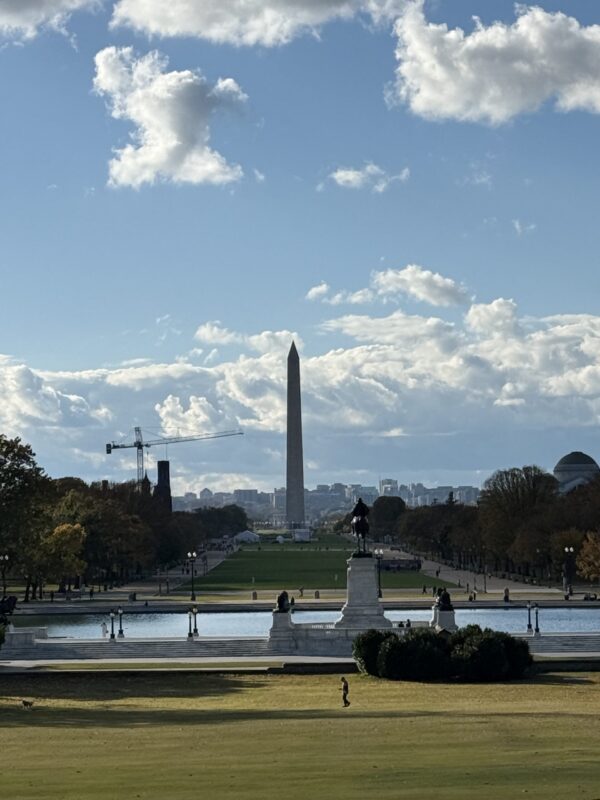
What you see instead
You do not have to go up it to be looking at it. It is the thing everything else on the Mall is arranged around. The Lincoln Memorial looks at it. The Capitol looks at it. The two black granite arms of the Vietnam Veterans Memorial point at it and at Lincoln. You can walk almost anywhere down there and it keeps turning up over your shoulder.
At 555 feet 5 1/8 inches, it was the tallest structure in the world when it was completed in 1884. It held that title for five years, until the Eiffel Tower went up.
The seam in the stone
Get close and look up. About a third of the way from the bottom, the marble changes color. That line is a twenty-three-year argument made visible.
Construction began in 1848 and ran out of money in 1854. Then came the Civil War. Nothing happened for more than two decades. When the work restarted in 1877, the original quarry could not be matched, so every stone above the line is a slightly different shade from every stone below it.
Most monuments hide the trouble it took to build them. This one wears its long pause at eye level, and nobody can do anything about it.
It is not standing where it was meant to stand
Pierre L’Enfant’s plan for the city put a monument to Washington at the exact point where the line running west from the Capitol crossed the line running south from the White House. When it came time to build, the ground at that spot turned out to be too soft to carry the weight, so they moved the whole thing about 390 feet.
The original point is still marked. It is a small stone called the Jefferson Pier, sitting northwest of the monument, and I would guess almost everyone who walks past it has no idea what it is.
The grounds are the real answer
If you ask me what I have actually done at the Washington Monument, the honest answer has very little to do with the obelisk.
The grounds are a wide open slope of lawn, and they get used. There are festivals up there. I have been to concerts. I have been to protests. When I was in college I walked down the hill to see someone perform at the amphitheater on the southeast side of the grounds.
That amphitheater is the Sylvan Theater, and it has been there since 1917. It was the idea of the artist and philanthropist Alice Pike Barney, who thought Washington needed a national theater and that an outdoor one was a reasonable place to start. More than six thousand people turned out for the first night, and the Marine Band played the national anthem.
I think that is what the monument grounds are really for. The obelisk is the landmark. The lawn is the civic space, and it has been doing that job for over a century.
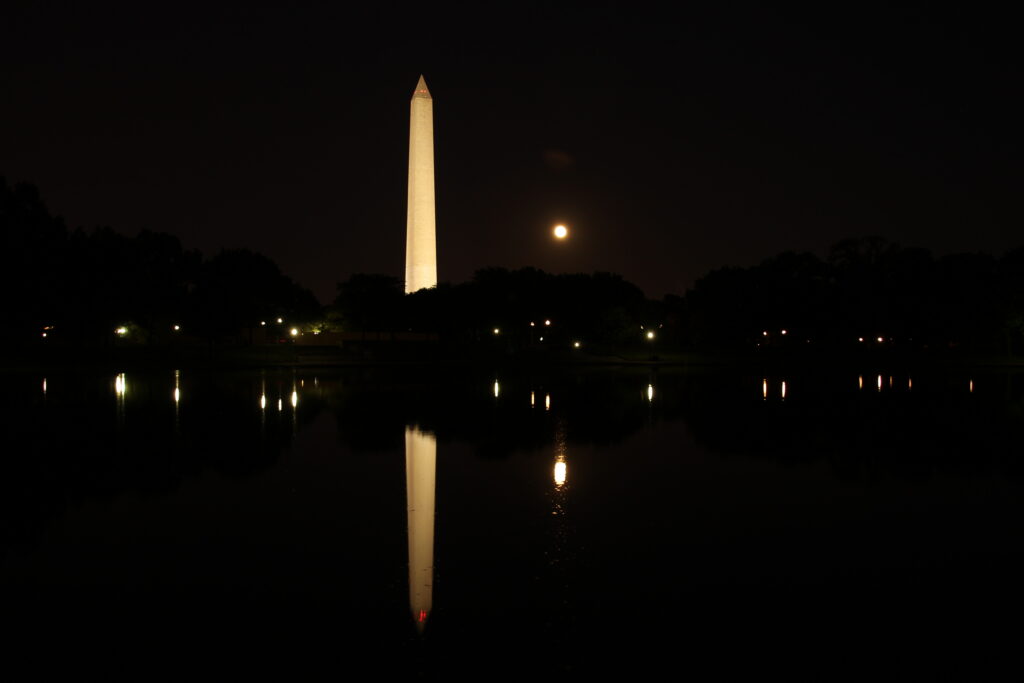
The photograph below is one of mine, taken on a night photography course. The monument and the moon, both of them in the water.
And then there is the tree
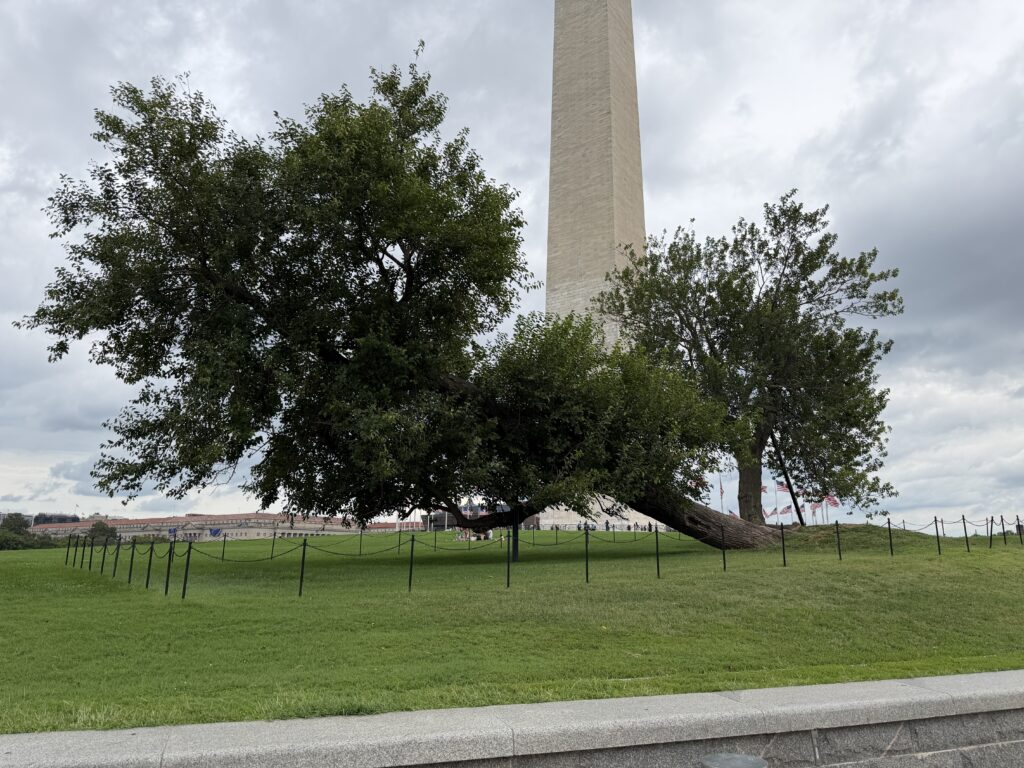
There is a tree on the southwest side of the monument, at about seven o’clock on the circular path. It leans hard. It is braced. It is essentially the only tree of any size out there.
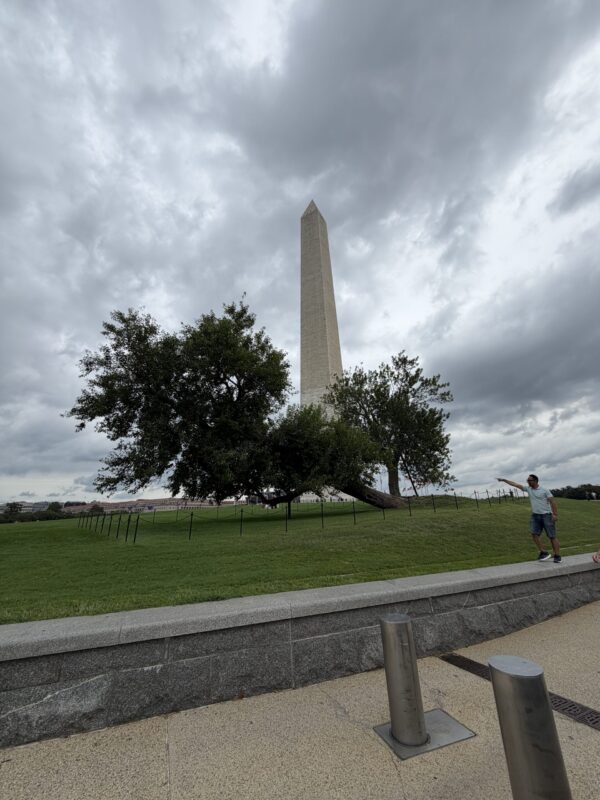
A ranger once told me that nobody knows why it is there.
Nobody planted it. It is a volunteer white mulberry that most likely grew from a seed dropped by a bird sometime in the 1890s, just a few years after the monument was dedicated in 1885.
They call it a witness tree. It is among the only living things on that lawn that watched the entire twentieth century happen from one spot.
Over Mother’s Day weekend in 2019, after days of heavy rain saturated the slope, it fell.
The Park Service did not take it away. They raised it back up about ten degrees, pruned the roots that had been pulled out of the ground, covered them with topsoil and watered it twice a day. It is still there, leaning at the angle it landed at, held up, alive.
I like the tree more than I like the obelisk, and I do not think that is the wrong reaction. One of them is 555 feet of marble that took two generations of arguing and fundraising to finish. The other is a tree nobody planted, that saw the century, that fell, and that people went to real trouble to keep.
Visitor information was verified in September 2026. Hours, tickets and closures change, so check the National Park Service site before you go.
Plan your visit
Entry: The grounds are free and always open. Going up inside requires a timed ticket. There is no admission fee, but advance tickets carry a non-refundable one dollar service charge each.
Tickets: Advance tickets are released daily at 10:00 am on recreation.gov, thirty days ahead. A small additional batch goes up the day before. Free walk-up tickets are handed out first come, first served at the Washington Monument Lodge on 15th Street between Madison and Jefferson drives, with the window opening at 8:45 am. In busy seasons the line forms long before that and the tickets are gone quickly.
Closures: The monument closes one day during the first week of every month for maintenance, and on Independence Day and Christmas Day.
Where: The middle of the National Mall, between the Capitol and the Lincoln Memorial. Smithsonian Metro station is the closest stop.
Worth knowing: The grounds do not need a ticket, a plan or a time slot. If the monument itself is booked out, you have not missed the part I keep coming back for.
What to pack & wear
Pay attention to the weather. Washington, DC is hot and humid in the summer, crisp in the fall and cool in the winter, and the monument grounds are wide open with almost no shade.
Comfortable shoes and water. If you are going up, note that bags are screened and there is no storage, so travel light.
Pets
Leashed dogs are welcome on the grounds, and the lawn is a good place for them. They cannot go inside the monument, and there is nowhere to leave them at the base, so if you have a timed ticket you will need someone to stay outside with your dog.
If you are visiting with a dog, the grounds and the walk down to the Tidal Basin make a better afternoon than the queue for the elevator anyway.