
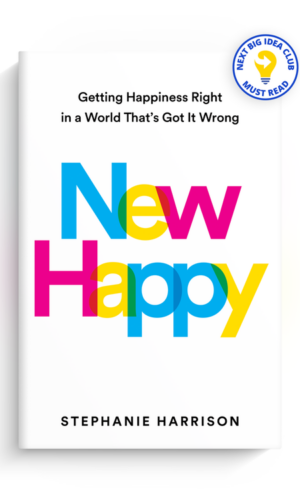
The science of happiness has a lot to say about nature. And it’s not just that being outside is nice — it’s that we were never meant to be separate from it. Stephanie Harrison, creator of The New Happy philosophy and author of the book New Happy, joins The Parks Podcast to make the scientific case for why getting outside isn’t a luxury. It’s a return to who we actually are.
A note from Missy: Stephanie is on the cutting edge of happiness. She was the first person in my life to demonstrate what stepping off the hamster wheel actually looks like. Her work with New Happy provides daily insights and motivations to shift thinking and actions toward real joy. I was so excited to speak with her about how nature plays a role in happiness.
Episode Guest
New Happy Stats
- The New Happy was founded in 2018
- Mission to share new, science-backed philosophy of happiness
- Dedicated to creating accessible tools for anyone to learn how to journey towards New Happy
- 38 Articles
- More than 350 social posts
- 349 daily podcasts
- Countless newsletters
- Helping more than 1 million people every day
Transcript
New Happy — Why Nature Is an On-Ramp to Happiness
The Parks Podcast, Episode 16 | Stephanie Harrison, Founder, The New Happy
What Is the New Happy?
Missy Rentz: Today we have a very special guest, Stephanie Harrison, who is an expert in the science of happiness and the creator of The New Happy Philosophy. Her company, The New Happy, has really revolutionized the way people understand and pursue happiness. She has daily social posts at New Happy Co., newsletters, and all sorts of ways to help people on their journey. And her first book, The New Happy, is coming out on May 14th. Stephanie, welcome to The Parks Podcast.
Stephanie Harrison: I’m so happy to be here with you. What a joy and an honor. Thank you so much.
Missy: I am thrilled. People who listen to the podcast know I love to talk about the physical, mental, and emotional benefits of nature and of parks. And I really feel like you’re going to help me put the seal on it — like, this is legit. It’s true.
Stephanie: I can’t wait. I’m so excited.
Missy: So we start episodes when we talk about parks with park stats, but I did a little research and put together New Happy stats. The New Happy was founded in 2018. You are dedicated to sharing this new science-backed philosophy on happiness. And what I love is that you have all of these tools that are incredibly accessible and free for anyone. On your website, you have 38 articles, more than 350 social posts, 349 daily podcasts, countless newsletters — and every day you are helping more than a million people on their journey to a new happy. It’s mind-blowing.
Stephanie: Thank you. Well, it’s nothing like being in a park and all the joy that they provide, but I am happy to have my little corner to contribute.
Missy: And I think for me, it’s mind-blowing in two ways. First, I met you when you were on this journey — so to see your success is so beautiful and exciting. But then also to see the number of people who are taking that brave step to change their lives is so inspiring. You and I met, I think it was almost a year after you had started. And then shortly thereafter, I took the plunge to start on my own. I had suffered burnout and some anxiety and depression. So I decided to follow a dream and went on a year-long camping trip. And I’m really lucky because during that time, I could follow you and do the work you were suggesting. Your posts really did help me every day on the contemplation of what I was going to do. But I didn’t have the words for it at the time. So — what is the New Happy?
Stephanie: The New Happy is really this approach to happiness that I’ve devised over the last 10 years of research. I’ve tried to boil happiness down into the simplest, purest form — something that anybody can follow and anyone can embody in their lives, no matter what they’re going through or what their circumstances look like. And where I netted out was that happiness is the result of doing two things. One is being who you really are. And two is using who you are to help other people. It’s that combination of the two that allows us to experience not only the personal joy and fulfillment and purpose and contentment that we’re looking for, but also to make other people happy, to contribute to the world, and to make it a better place. That is the prescription that I’m offering people — tools to help them embody that in all of the countless ways it ends up manifesting.
Why We Need This — The Story Behind the Journey
Missy: Those are two big self-projects when you think about it. And I feel like most of us on this journey had some sort of a tipping point that made us realize we have to change. Why did you decide to go on this journey?
Stephanie: I was miserable. Something that I think people assume about me now is that I have always been happy or find it easy. And it really couldn’t be further from the truth. I really had to learn how to be a happy person — which is one of the things that gives me confidence that I can help teach other people, because I know what it’s like to go from one state to another. For me, I was working the job I had dreamed about, living in New York City, the place I’d always dreamed about living — kind of doing all the things I thought would eventually make me happy. And ultimately, I felt incredibly miserable. I was struggling with my physical health, my mental health, my emotional health. I felt a profound sense of purposelessness and almost apathy — like nothing I did really mattered.
Stephanie: I remember one night that I was sobbing, trying to figure out how to move forward. And I had this moment of clarity: hey, you’ve been blaming yourself this whole time, thinking something is wrong with you for not being happy. But what if you were actually just taught all of the wrong things about happiness? That moment led me to go back to school and study happiness — and eventually to where I am today.
Missy: Do you think people have to hit that rock bottom moment?
Stephanie: I don’t think you have to hit rock bottom. I think it’s totally possible to avoid it. For me, it wasn’t though — I needed a real smack in the face of reality. Old happy is very ingrained in us. We’ve been deeply conditioned into this set of beliefs. Some people are really good at taking a step back and asking, is this serving me? I was not that person. So I had to have one of those moments. But I am certain that you don’t have to go through a tragic or difficult experience. You can start to make changes now and experience happiness.
Missy: For me, it was the shoulds. I was living a life of shoulds. So when you talk about identifying your authentic self, that really resonates — because it was quite the process to figure out, well, who am I if I’m living all of these shoulds?
Stephanie: That’s the magical thing about it, isn’t it? When somebody else is true to themselves, when they pursue their authentic life, it gives other people the courage to do the same — even if their authenticity looks totally different. You see somebody out there being true to themselves and it inspires you to do the same, but your version looks really different. And I think that’s so beautiful.
Missy: I agree. I feel like when you are your authentic self — who you were meant to be on this earth — you just shine a light. And that light is so attractive. People want to be part of it, but in their own way.
Old Happy vs. New Happy — and Where Nature Fits
Missy: Right now there are a lot of buzzwords — wellbeing, mental health, wellness, joy, happiness. Are these all the same?
Stephanie: No — I would say probably not. Part of the challenge is that we all have our own definitions of those. And I think that’s one of the biggest problems we have as a society — we have this understanding of happiness that has been given to us and never interrogated in a really meaningful way. We say, I’m trying to be happy, but we’re actually doing all of the wrong things to be happy. So we don’t end up feeling happiness. And then we wonder what’s wrong with us. The metaphor I like to use is: it’s almost like you’re putting in the wrong destination in your GPS, but you think you’re going to the right destination. And you don’t really know until you’re driving around going, this doesn’t look right. This doesn’t feel right.
Stephanie: What old happy teaches us is that happiness is something you will get when you become perfect, when you achieve certain things, and when you can do it all by yourself and never need anybody else. While we would never say that explicitly, it’s hidden in every single message we receive — from our culture, our institutions, our workplaces, our schools, our parents. And that messaging really, really leads us astray.
Missy: For people who listen to the podcast, they might be like — wait, what’s going on here? So I want to tie the ribbon around it and say that I believe parks and nature lead to happiness and can help immensely on people’s journey as they’re figuring out their road.
Stephanie: Old happy teaches us that we are separate from other people and from the world around us — influenced by our individualistic culture that tells you that you have to be entirely self-sufficient and pull yourself up by your bootstraps. But it also has a profound impact on the way that we see nature. If you believe that you are separate from all other creatures and all nature, then over time, because you’re told that the self is the most important thing, you end up elevating yourself above all other things and placing the self at the center of everything. And what does that do? It makes everything else inferior to you, less important. So you are no longer a person who is integrated with the world around you and connected to nature. And therefore — we abuse nature. We abuse the world around us because it’s not as important as we are.
Stephanie: This separateness ends up making us selfish and self-focused, and it removes us from our natural state of being, which is interconnectedness with all things. We are a part of nature — we cannot separate ourselves from it. And what we know from the research is that when you participate in nature, when you honor that connection — whether it’s something as simple as having a plant in your bedroom, all the way through to actually spending meaningful time in nature — you experience increased mental health, decreased depression, decreased anxiety, better connection to other people, greater self-esteem. That profound list of benefits exists because you’re operating in the way that you should be: connected to all other things. That is why nature is so important.
Missy: My favorite place to be in the world is amongst very tall pine trees. Part of it is because I feel small — and that’s when I feel the best. I never thought about what you said in that way, but it is so true.
Stephanie: It’s so beautiful, isn’t it? We have everything to learn from nature and we should be humbled to receive it. Even the fact that as you feel that sense of smallness, you become more respectful and honoring of other people’s differences — that’s what an ecosystem is all about. All of us existing together, having our unique role to play, not feeling like we can’t live in the same place even though we’re different. That’s a lesson that could literally change the world.
Missy: And I think old happy is comfortable. When you think about making that shift, it’s daunting. For me, nature is like an easy first step — because it doesn’t have to be going to Yosemite and hiking a really long trail. It can be go walk in your neighborhood, or to your point, go buy a plant for your bedroom.
Stephanie: That’s such a beautiful suggestion. Nature is one of the on-ramps to happiness, to living the new happy. Just 20 minutes walking in nature lowers your cortisol. And simply getting yourself out of your head and into that feeling of — I’m a part of this, I’m not above it — that shift has so much power for your wellbeing. If you can have that cognitive shift into being like, I’m not alone, I’m connected to other things, that is enough to get you started down the road to greater wellbeing.
What Parks Provide — A New Happy Lens
Missy: As I was reflecting on what I’ve learned from you, I put together a list of things I think parks provide — and I wonder if I could throw them at you and you can tell me how they fit within the New Happy. The first is movement.
Stephanie: Movement from a wellbeing perspective is so important. Such an incredible mood booster. I could connect it with being yourself — the opportunity to express yourself physically as one way of practicing authenticity, of engaging in the physical world. That can be a form of authenticity.
Missy: One of my favorites — play.
Stephanie: Oh, so important. Isn’t that one of the best ways to discover your authentic self?
Missy: Yes. One of the things when people ask me about my journey — at several points when I was at rock bottom or couldn’t figure things out, I went and made a list of things that brought me joy as a kid. Whether it was riding my big wheel or swinging around a street sign in the corner of our yard until you got dizzy. I think play is so beautiful and something we have lost.
Stephanie: Totally. Such an important element. Being away from screens — obviously really hard to discover who you are if you’re busy consuming other people telling you who they think they are or what you should be. Trying something new — huge. You can’t discover who you are by sitting at home and thinking about it, unfortunately. I don’t think you can think yourself into a new way of being. You have to take action, and trying new things is the very best way to do that.
Missy: Doesn’t trying new things trigger something in you that builds confidence and joy? For me, I found that fear and ego played such a major role in my blocking — and that was actually why I didn’t try new things.
Stephanie: Me too. I was so obsessed with worrying about what other people would think of me — as though they spent their time judging me and considering all of the things I was doing, which was of course ridiculous. All that fear and ego did was get in the way of me being there for other people. Trying new things is like the antidote for overthinkers — you just have to push yourself to do those things, and over time you build the confidence to overcome that.
Missy: And one of the things I like about the parks is they feel like safe spaces to try new things. The rangers are there for it. You get to do it your way. It’s such a safe, beautiful spot to try something you’re not sure of.
Stephanie: What about laughter and humor?
Missy: Oh — joy, right? That sense of joy and lightness. And humor usually happens because of somebody else — through a conversation, a connection. So it comes back to connection as well.
Daily Tools — The Emotion Tracker
Missy: One of the things you offered at the beginning of the year was a daily log. Every day you suggest coloring in a dot based on what you’re feeling. What is the benefit of noting these every day, and what’s the objective?
Stephanie: It’s so easy to just get pulled into the things that other people want you to do, or the patterns and habits you developed years ago, and it’s really, really hard to sometimes take a step back and actually notice where you might need to change. Journaling — giving yourself a little moment in the day to go, how am I feeling, what was today like — lets you use your wise mind to evaluate and identify: what’s going on for me, what am I feeling on what days, what was I doing at that time, what changes do I want to make? That simple action can go a really long way.
Five Things You Can Do Right Now
Missy: Everybody who listens to this episode will want to start their own journey or acknowledge that they’re already on one. What are five things someone can do right now that will benefit them on this journey?
Stephanie: The first thing I want you to do is go and look at yourself in the mirror and tell yourself that you’re worthy and loved just as you are. Harder than it sounds — but I want you to try it.
Stephanie: The second: whenever you make a mistake moving forward or something doesn’t go your way, stop using that as proof that you’re bad or not good enough or flawed. Just say, hey, I made a mistake, I’m human, and that’s okay.
Stephanie: The third: pause and think about the things in your life that bring you the most joy and make a list — on your phone or a scrap of paper. Reflect on times you were the happiest in your life, good days and what you were doing, any sources of joy. Keep that list around and try to prioritize a couple of experiences from it whenever you can.
Stephanie: The fourth: this one’s really hard, so if you struggle with it, you’re not alone — ask for help from somebody. Think about something somebody else can do for you and ask them for it. Just say, hey, I’m struggling with this, would you be able to help me in this way? Most people really want to help, but most people aren’t asked. And you deserve help just like everyone else does.
Stephanie: And for the fifth: go out and help somebody else yourself. Find one small way to make a difference in somebody else’s day, to make it a little bit brighter. If you do those things, I can guarantee that they will transform your wellbeing.
The New Happy Book
Missy: You have a new book out — The New Happy, out May 14th. You can pre-order it at newhappybook.com or Amazon or any other favorite book place. What can we expect?
Stephanie: The book is the result of 10 years of work. It really lays out a step-by-step path that you can take to be happier — giving you the exact instructions you can follow. I tried to make it all really easy and really entertaining. There are tons of amazing stories of people who are making a difference in the world and finding happiness. There’s tons of science — hundreds of references, actually so many that we couldn’t print them all in the book and had to host them online. And the book also contains almost 60 pieces of artwork printed on beautiful stock paper. So it’s fully illustrated with my artwork — every few pages there’ll be a piece of art to help you understand some of the key concepts.
Speed Round
Earliest park memory?
Lying in a park in my hometown on a blanket, seeing the beautiful oak trees and willow trees, watching the leaves float over my head.
What made you love the parks?
The peace.
Favorite thing to do in a park?
Watch nature. Just sit there and witness.
Park on your bucket list?
Yosemite. I’ve never been there.
Three must-haves for a park visit?
Water. Snacks — I get hungry very frequently and always need something to snack on. And a book.
Favorite campfire activity?
Storytelling.
Tent, camper, or cabin?
Cabin.
Hiking with or without trekking poles?
Without — though probably I should do with moving forward.
Favorite trail snack?
Mixed nuts — almonds and stuff like that.
Best animal sighting?
A moose.
Favorite sound in the park?
Rustling leaves.
Greatest gift the parks give to us?
Recognition that we’re not alone in the world.
Missy: Stephanie, thank you so much for being part of The Parks Podcast. It was really an honor, and I’m very grateful for your time.
Stephanie: Right back at you. Thank you so much for having me. It was a total joy.
Missy: Thanks for listening. Until next time — we’ll see you in the parks.
Music for The Parks Podcast is performed and produced by Porter Hardy. Follow us @TheParksPodcast or visit TheParksPodcast.com.