
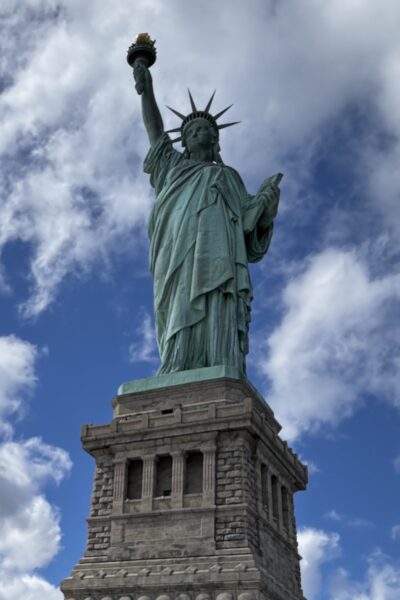
She’s one of the most recognized symbols in the world — and most people have never really seen her. The broken chains at her feet. The torch that was swinging 12 inches off its axis. The fact that Americans almost didn’t fund her pedestal at all. Matt Housch, archivist at Statue of Liberty National Monument, joins The Parks Podcast to tell the full story — of Liberty Island, Ellis Island, and what the promise of America looked like when 12 million people arrived here hoping for a new life.
A note from Missy: I’d seen the Statue of Liberty a million times living in NYC. I’d never wanted to battle the crowds to see her. I went on a cold and gray day. It was surprisingly crowded. But it was Ellis Island that blew me away — learning about the history of welcoming people to the country, and how it differs from what we are doing now. I wish we remembered that time and embraced people coming to our country for freedom.
Episode Guest
Matt Housch – Archivist
Park Stats
- Location: Liberty Island (New York) and Ellis Island (New York/New Jersey)
- Designation: National Monument
- Dedicated: October 28, 1886 (Statue); Ellis Island incorporated 1965
- Managed by NPS since: 1933
- Lady Liberty’s height: 151 feet (305 feet including pedestal and foundation)
- Steps to the crown: 354
- Park size: 12.7 acres (Liberty Island)
- Annual visitors: 3,739,605 (2023)
- Ellis Island: Processed approximately 12 million immigrants, 1892–1954
- Two islands, one park: Liberty Island and Ellis Island are separate sites with distinct histories
Transcript
Statue of Liberty National Monument — The Story Behind the Icon
The Parks Podcast, Episode 17 | Matt Hush, Archivist, Statue of Liberty National Monument & Ellis Island
Two Islands, One Park
Missy Rentz: I’m so excited to be at Statue of Liberty National Monument with Matt Hush, who is the archivist at the Statue of Liberty National Monument. Matt, welcome to The Parks Podcast.
Matt Hush: Good morning. Thank you for having me.
Missy: We start with some fun facts and park stats. This park is located in New York and New Jersey. The monument was dedicated on October 15th, 1924, when Calvin Coolidge was president of the United States. The size of the park is 12.7 acres on Liberty Island. In 2023, you had 3,739,605 visitors. The statue was a gift from France — though news to me, the pedestal was paid for and designed by the United States — and was dedicated on October 28, 1886. It was moved under the management of the National Park Service in 1933. Lady Liberty is 151 feet tall, and including the pedestal she’s approximately 350 feet tall. There are 354 steps to reach the crown. The monument is also home to Ellis Island, which was incorporated in 1965 when President Lyndon B. Johnson was in office. Why is it important that the Statue of Liberty and Ellis Island are part of the National Park Service?
Matt: Both islands — and we do like to say we are two islands, one park. There are some folks who think the Statue of Liberty is on Ellis Island, but these are very much two different sites with two different origin stories, though with similar themes about the promise of what America is, about liberty and democracy, and about what we want America to be. They are cultural heritage sites and universal symbols about both liberty and immigration. It’s fantastic that they’re part of the national park system.
The Gift From France
Missy: The Statue of Liberty was a gift from France. Can you tell us a little about the history and how that came about?
Matt: It still surprises our visitors sometimes. There was a moment I had working in our museum on Liberty Island, and a woman stopped and said, I just don’t get it — why would somebody give us this large monument? I think in some ways we forget that there was a friendship between countries. There were people in France who felt a deep affection for America, and people in the United States who felt the same affection for France. That affection was born out of two things. About 100 years before, there was the American Revolution, and France was principal in assisting the United States. The other reason is that politically, these were Republicans — small r Republicans — who were under the rule of someone they considered a tyrant. So 100 years later, many of these people in France were seeing the same thing, and they were saying, we need to cement this alliance. The gift from France to the United States, when you look at the speeches, it’s about the friendship between the two countries. And the occasion? Let’s make it the 100th anniversary of American independence. Even though the Statue of Liberty wasn’t dedicated until 1886 — we were 10 years late — the original idea was a centennial gift and a show of friendship between the two countries.
Missy: My take was that they were also encouraging what we were doing in the United States — particularly around abolition of slavery. They wanted us to show that it could work so that they could evolve.
Matt: One of the things about the Republicans I’m mentioning was this idea of abolition and emancipation as it regarded American slavery. Many of the men who fought the Civil War and were now in political power wanted to make sure that what Abraham Lincoln called “this new birth of freedom” was cemented. Some of the abolitionists also lived in France, including Edward de Laboulaye, who wrote a lot about the United States and abolition. He was working with the sculptor Auguste Bartholdi, and Laboulaye really encouraged him — you’re going to give a gift to the United States, they just fought this war and abolished slavery, could the monument show something about that as well? And one of my favorite parts about the Statue of Liberty — because a lot of people don’t get to see it — is that she has broken chains and shackles at her feet. From the island you can’t really see it, but if you watch the movie in our visitor center, or if you happen to be in a helicopter above New York Harbor, you can see them. Her right foot is raised. She’s carrying a lamp. She’s walking forward — and she’s walking out of her chains.
Building Her Twice
Missy: Growing up, I imagined she was built in France, secretly, and came over on a barge in all her glory. That’s not how it went down.
Matt: Not only did they build this colossal sculpture, they built it twice. The Statue of Liberty was put together in the streets of Paris first, and then they had to disassemble it, put it in crates, and send it on a ship. They had to put it together first — they wanted to know, do we have this? It was a new system. Gustav Eiffel’s company designed this interior system. The Statue of Liberty’s skin is barely the thickness of a penny — it’s so thin. So they had to test it first. But then the problem was, now we have to take all of it down, put it in boxes, and send it to the Americans. Well, the Americans received all of this and we didn’t have the pedestal ready. So the crates of Liberty — all of her body parts — are sitting on Bedloe’s Island waiting for the pedestal to be built. And all of the pieces had their labels written in French. Some had smeared off. They had to call somebody from France to come assist with putting it together. The romance of her carrying her torch across the Atlantic was unfortunately more of a technological challenge complicated by fundraising.
Missy: They had to get support in America to raise funds to build this base. What was the support like?
Matt: When the United States was told that France was going to give them a big statue, many Americans were like — what? Do we care about this? There was honestly a lot of trouble getting enthusiasm for the project at first. It wasn’t until the intervention of a crowdfunding effort led by newspaperman Joseph Pulitzer, who shamed a lot of Americans and said, what are we doing? They’re giving us this beautiful gift of liberty and we don’t have the funds ready. Congress didn’t get the money together. It ended up being a lot of American people who had to donate money to get the pedestal built. That was the turning point when Pulitzer’s newspaper, The New York World, started the campaign.
Missy: Is that when people started to adopt her as an icon for America?
Matt: That took a lot longer. One of the coolest artifacts we have in our museum collection is a guest register from the early years — and she’s sometimes not even called the Statue of Liberty. She was just called Bartholdi’s statue. It’s honestly not until the Great War, World War I, that you start to see her used as a personification of the United States. After World War II, you’ve had decades of immigrants passing her on their way to Ellis Island, American soldiers leaving for Europe passing her, and she appears in popular media. She becomes not just a symbol of New York City or of liberty, but of the United States of America.
Who Took Care of Her
Matt: The Statue of Liberty is arguably the most famous piece of art in the world — she is an emoji in our phones — but we didn’t know who was supposed to take care of her at first. They decided she had to have a purpose, so they cut holes in her copper torch and put lights inside to make her a lighthouse to guide ships into New York Harbor. In the United States at the time, who controls lighthouses? The Lighthouse Board. But she’s built on top of a fort, Fort Wood, which is run by the U.S. Army. So the War Department and the Lighthouse Board controlled the Statue of Liberty at first. Eventually the Lighthouse Board said this light isn’t really helping anybody, and we’re out of here. Then the War Department said — as you’ve probably heard in other episodes — why are we managing all these national monuments and historic sites? And in 1933 they transferred it to the National Park Service.
Keeping Her Healthy
Missy: There is upkeep. I remember as a child she was surrounded by scaffolding for several years. What is it like to keep her healthy?
Matt: Restoration work has always occurred at the Statue of Liberty. From the first decade she was inaugurated, there were concerns about holes in the copper and cracking in the stone. But the largest restoration was in the 1980s. When crews reached the torch, it was swinging 12 inches off its axis. So the Statue of Liberty Ellis Island Foundation raised a lot of money to repair and restore the statue, and they built a new torch. The old one came down and was eventually moved into the new museum where visitors can see it today in the Torch Gallery. Recently we were fortunate — Congress gave us money through the Great American Outdoors Act — and we’re working on repairing the terraplane of Fort Wood, which is not in great shape.
Ellis Island — The First Impression
Missy: Now let’s shift to Ellis Island. Ellis Island was the first impression of more than 12 million immigrants. Is that number right?
Matt: That’s what we’ve arrived at, and it’s really hard to pin down exactly. One of our National Park Service historians said approximately 12 million of the people who came through Ellis Island were likely immigrants to the United States.
Missy: They came between 1892 and 1954. I can’t imagine how brave someone had to be to leave everything they know, get on a ship, cross the Atlantic, and arrive here. And yet we built this beautiful structure to welcome them.
Matt: It’s the promise of the Statue of Liberty, and it’s the promise of the United States. For many immigrants then, just like many immigrants today, you’re making a huge risk — often a calculated economic risk. My uncle did this a few years ago and made enough money to bring me over. Ellis Island, most of the years that you mentioned, saw 80 to 85 percent of all immigrants to the country come into this building. And the fact that it was a building — that public architects were contracted to design it — two young architects won the contract and built this beautiful place.
Missy: So they get here. What is the process once they get off the boat?
Matt: This is all about — are you able to be landed in the United States? Basically, will you be admitted or not? There are two parts to that process. First, are you physically healthy enough? We had an entire team of doctors from the United States Public Health Service whose job was to examine you to see if you were medically fit to enter the country. Then we had all the immigration laws Congress had passed — we had to ask you questions and judge your fitness as an immigrant. We believe approximately 98% of people who made it to Ellis Island were admitted. But many people were rejected by steamship companies before they even got on a ship, because the companies were fined if they sent over people who wouldn’t be accepted. When you stand in the Great Hall and see that light coming in and hear how the sound bounces off that room — seeing photographs of hundreds of people in that hall, knowing this is the moment where they’re going to be judged to enter the United States or not — that is a moment that many immigrants in our oral history talk about. The apprehension, but also the hope and the excitement about entering the United States.
Missy: Do you think most people came with a plan?
Matt: I think most people had a plan. There were definitely people fleeing persecution, war, and political oppression with less of a plan — they needed to get somewhere better, somewhere with more people like them, in a land of freedom and opportunity. But a lot of immigrants, just like immigrants today, had a plan. They at least knew where they wanted to go, maybe had a part of the country where they could get work. By the 19-teens before World War I, many of them had prepaid tickets and railroad tickets already.
Missy: My aunt told me I had a great-great-great-grandfather who came first, and then five years later the rest of the family came.
Matt: The immigrant enclaves and communities all over the United States — this is absolutely how it worked. Often it would be the men who would come first, get jobs, get set up, and then bring over wives and children. For some immigrant groups it was the opposite. Many of the Irish who came to New York City were women who came first, found work as domestic servants, and then brought over the rest of their families.
What Almost Happened to Ellis Island
Missy: This facility was shut down and abandoned for a while.
Matt: They tried to sell it. They tried to sell this beautiful building. There were people from the state of New York, from the federal government, saying this is a waste of money. And there were some wild ideas — a hotel complex, ethnic immigrant picnic grounds, a pedestrian bridge from Liberty State Park. But no one was ever able to come up with the money to do it. At the same time, the children and grandchildren of immigrants were saying, what my grandfather did was really important, and where he came into the United States was really important. And so when we get to the 1960s, people start saying — how about instead of selling it, we turn it into a national historic site and give it to the National Park Service.
Missy: And you have displays showing what it looked like when it was abandoned — rusted, dusty, extraordinary.
Matt: We have a partner here, Save Ellis Island, who’s working on the Southside Hospital buildings and provides hardhat tours of those abandoned structures. So you can still get a feel for what that would have been like. Calendars were still open to 1954 — to the day they were clearing out their offices.
Planning Your Visit
Missy: Let’s talk about planning a visit. This is one of the busiest parks, I have to imagine. How do you get here?
Matt: Plan in advance. Plan using our website and using the National Park Service app. Go to nps.gov/stli, click on plan your visit, and look for something called Plan Like a Ranger. You want to think about this the same way you’d plan a camping trip or a hike. Take that same kind of care.
Missy: And planning in advance guarantees you’ll actually get here. I also love that the app has an offline feature — yesterday my cell service was very bad, and I was really glad I’d downloaded it offline so I could still access the stories and schedules.
Matt: There are two departure points — one in New York, one in New Jersey. If you want to see both Ellis Island and the Statue of Liberty in the same day, you need the whole day. Grounds admission gets you onto Liberty Island to experience the green space, our museum, concessions, and bookstore. But if you want to go inside the monument — the pedestal or the crown — that requires an advance ticket, because we can only let so many people inside each day. To get to either island from either departure point, you’ll go through airport-style security. Check our website for the list of prohibited items so you’re prepared.
Missy: When you book your pedestal or crown ticket, the time on it is for when you enter the monument — not when you board the ferry. During peak times, the ferry lines can mean two or three ferries and 30 to 40 minutes between them. Give yourself the whole day. And if you have a backpack or stroller, you’ll need to leave them in a locker before going up — bring a quarter to activate it, and you get it back when you unlock.
Matt: What can you do when you get off the ferry at Liberty Island? Please do not miss the museum. No matter what ticket you have, the Statue of Liberty Museum is something you want to see. And then walk around the island — see the statue from all the different angles. Walk around to what we rangers call Statue Front. Take those selfies at the front of the statue. Then from Liberty Island, you board the ferry to Ellis Island — a three-story museum with so many exhibits. If you want to see everything in the Ellis Island museum, you could spend a whole day just on that. Grab the audio tour, catch a park ranger tour if you can.
Missy: What do people need to pack?
Matt: Water. Please bring water. You think you’re coming to New York Harbor, you’re not going on a big hike — but this is still a long, strenuous day. Sunscreen as well. The sun bounces off the water in the harbor. And layers — the wind hits Liberty Island in a way you won’t expect if you’re used to being in the city. Even in the morning at Battery Park, the wind is right there on the water in a different way than in your hotel in Manhattan.
Missy: And about timing — is there a good time of year to visit?
Matt: February is one of our lower-trafficked months, so if you want more space — though of course it’s February in New York. My family came in October, after Columbus Day weekend, and we had a lot of space on Liberty Island. It was really beautiful. There are options if you have flexibility and it’s not just summer vacation timeframe.
Speed Round
Earliest park memory?
I was born in Chattanooga, and the park nearby was Chickamauga Chattanooga National Military Park. My earliest memories are my grandparents taking me to a place called Snodgrass Hill and watching the deer come out of the woods as the sun started to set. I’ve loved deer ever since.
What made you love the parks?
My dad. He believed they were important — not just the stories, but the idea. He was always the guy picking up other people’s garbage in the park, and he talked about this being an important space for all Americans. It belongs to you.
Favorite thing about Statue of Liberty National Monument?
What the Statue of Liberty represents — and still represents today. The same thing Abraham Lincoln talked about. Democracy is never finished. Liberty is never finished. There is a hope and a promise, but it’s something we have to keep working at.
Favorite thing to do at the monument?
Eat french fries — because we don’t have french fries on Ellis Island. And then be in the crown of the Statue of Liberty. My favorite thing as a park ranger was to be in the crown.
Park on your bucket list?
Any park on the West Coast. I have never been to California. I am an eastern United States guy, entrenched in my apartment in Brooklyn, and I need to get out there.
Three must-haves for a park visit?
A journal and a camera that is not my cell phone.
Favorite campfire activity?
I grew up in Gettysburg, Pennsylvania, surrounded by ghost tour companies. I love a good ghost story around a campfire.
Tent, camper, or cabin?
Tent.
Hiking with or without trekking poles?
Walking stick.
Favorite trail snack?
Cashews.
Best animal sighting?
Elk at Wind Cave National Park — the way you’d see them at a great distance and they never let you get too close.
Favorite sound in the park?
The bell buoys. In New York Harbor, early in the morning before visitors arrive, you can stand at the front of the Statue of Liberty and just hear the waves hitting Liberty Island and the slight clinking of the bell buoys out on the water.
Greatest gift the parks give to us?
The parks themselves. The national parks and everything they represent are a gift. I hope that we return that favor by continuing to preserve and protect them.
Missy: Matt, thank you so much for being part of The Parks Podcast today. I’ve really enjoyed hearing the stories.
Matt: Thank you, Missy.
Missy: That’s it for today’s episode. Until next time — we’ll see you in the parks.
Music for The Parks Podcast is performed and produced by Porter Hardy. Follow us @TheParksPodcast or visit TheParksPodcast.com.