
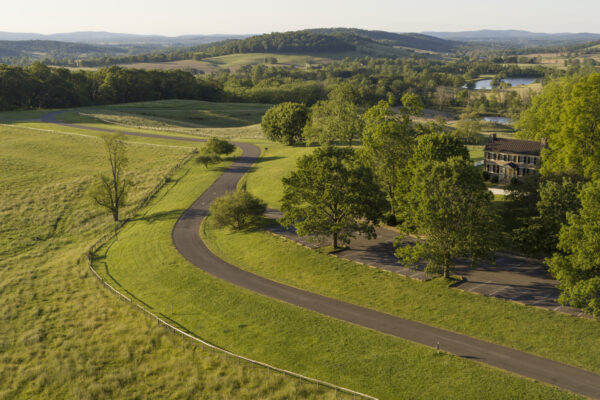
Sky Meadows State Park sits in the rolling hills of Fauquier County, Virginia — about an hour from Washington D.C. — and holds the darkest skies in the region, an entrance to the Appalachian Trail, 20+ miles of hiking and equestrian trails, an active beef cattle operation, a historic manor house, and one of the most remarkable narrow escapes in park history. In the early 1970s, a developer planned to subdivide this land into 50-acre home sites. The gas crisis intervened, a deal fell through, philanthropist Paul Mellon purchased it, and donated it to Virginia — on the condition it become a state park. Park Manager Patrick McNamara joins The Parks Podcast to share the full story.
A note from Missy: Sky Meadows was another go-to park of my youth. And when I lived in D.C., it was a quick escape from city life. Peace, serenity, beautiful mountains, an entrance to the Appalachian Trail, and history — the things that make our parks so stunning.
Episode Guest
Patrick McNamara, Park Manager
Sky Meadows State Park (Virginia)
Park Stats
- Location: Delaplane, Virginia (Fauquier County)
- Established: August 27, 1983
- Size: 1,860+ acres
- Highest elevation: 1,840 feet (top of the Blue Ridge)
- Lowest elevation: 600 feet (park entrance)
- Hiking trails: 22+ miles
- Bridle trails: 10.5 miles
- Bike trails: 9 miles
- Dark sky: International Dark Sky Park designation (2021)
- AT access: Several miles of Appalachian Trail run through the park
- Historic structure: Mount Bleak House (1847) — interpreted to Abner Settle era, mid-1800s
- Agriculture: Active beef cattle operation, beehives, kitchen garden, demonstration wheat plot
- Astronomy programs: Monthly, free with parking fee, led by NASA Jet Propulsion Lab ambassador and Northern Virginia Astronomy Club
Show Notes & Links
- Plan Your Visit — Sky Meadows State Park
- Astronomy for Everyone programs — monthly calendar
- Sensory Explorers Trail
- Children’s Discovery Area
- Hiking trails and maps
- Mount Bleak House tours — select weekends
- Appalachian Trail at Sky Meadows
- Blandy Experimental Farm — University of Virginia
- Clifton Institute — conservation partner
- Piedmont Environmental Council
Transcript
Sky Meadows State Park — Where the Piedmont Meets the Blue Ridge
The Parks Podcast, Episode 14 | Patrick McNamara, Park Manager, Sky Meadows State Park
A Park Born from a Near Miss
Missy Rentz: Just outside of the nation’s capital, this park provides a great escape from the city with dark skies, sensory trails, rich history, and an entrance to the Appalachian Trail. I’m excited to introduce Patrick McNamara, who is the park manager at Sky Meadows State Park in Virginia. Patrick, welcome.
Patrick McNamara: Thank you so much, Missy. Happy to be here.
Missy: Let’s start with some stats about Sky Meadows State Park. It’s located in Delaplane, Virginia. The park was created on August 27th, 1983. It is 1,860 acres. The highest elevation is 1,840 feet at the top of the Blue Ridge Mountains, and the lowest elevation is 600 feet at the park entrance. There’s 10.5 miles of bridle trails, 22 miles of hiking trails, nine miles of bike trails, and access to the Appalachian Trail. I feel like I’m going back home — you are located just a few miles from my hometown of Winchester, Virginia. So I’m really excited to learn more about the park.
Patrick: Yeah, sounds great. Thanks.
Missy: Sky Meadows got its name from a former owner, Robert Hadow — am I saying that right?
Patrick: We pronounce it Hadow.
Missy: Hadow. He had named the farm Sky Farm when he owned the land. But as I was reading your website, this land has changed hands a lot. Can you tell us a little bit about the history of the land — and why Sky Meadows became part of the Virginia State Park system?
Patrick: Sure. The history of the land is quite old. I think about the John Denver song, Country Roads Take Me Home. The mountains are very old — the land kind of starts possibly 600 million years ago with the supercontinent, when modern North America collides with modern Africa and there’s a tremendous amount of uplift that created what is known as the oldest mountain range in the world. Throughout geologic time, we’ve seen the uplifts and the erosion, and all of that weathering brings us to closer to what we can see today.
Patrick: The very first people in and around the Crooked Run Valley would have been Native Americans, somewhere around the 1600s — primarily a Siouan-speaking tribe, and they were the first inhabitants of the Crooked Run Valley. The land has a long history with many different European folks. Fast-forward to Virginia as a British colony — all of the land between the Potomac River and the Rappahannock River just outside of Fredericksburg is referred to as the Northern Neck. Lord Fairfax had inherited the northern neck in 1719. After that, it was purchased by Captain James Ball, who owned much of the Crooked Run Valley and some of the area that is now Sky Meadows State Park. When he died, the property was divided among his daughter and five grandsons. John Edmonds, the next landowner, was a captain during the American Revolution and purchased the land in 1780. His son inherited the father’s land, moved to the property with his new wife. We have an old log cabin on site — with a lot of our parks, there’s urban legend and myth and mystery, so we’re not really sure exactly when it was built.
Patrick: After Isaac Settle — he was a merchant, a tavern keeper, and postmaster in the nearby town of Paris, Virginia — purchased the land in 1810. Isaac built a house a little bit farther south called Bell Grove. Not the same Belle Grove as on your other episode — another popular name of the time. He raised his family here. And in 1835, one of his sons, Abner, gets married. If you come to the park, you’ll hear about Abner Settle — that’s the time period we interpret at the Mount Bleak house.
Patrick: It changes hands a couple of times. Then Sir Robert Hadow and his family take possession around World War II, and he gave the place the name Skye Farm after the Isle of Skye in Scotland. He saw the rolling hills of the Crooked Run Valley — there’s a tendency to get a lot of fog through here — and it reminded him of the Scottish Highlands. As time goes by, the Scott family takes possession and really promotes agriculture. They built a lot of fences, put in a couple of ponds, and built the dairy barn that we have — a pretty profitable operation around the 1950s. The dairy industry in Northern Virginia was really booming at that time. Scott is the one who changes the farm’s name to Sky Meadows. The legend says — what are we going to call it? We’ve got a lot of sky and we’ve got a lot of meadows, so why not call it Sky Meadows?
Missy: Seems appropriate.
Patrick: Take a look out my window here — plenty of meadows, a lot of agriculture, and a big beautiful sky. The Scott family sold it to the Abrams family in the late 60s. James Abrams became a partner in a company called the Piedmont Valley Corporation, and their goal was to subdivide the property into 50-acre home sites. Fortunately for the park, around this time there was the gas crisis, a big recession, and they were tenuous about going through with that plan. That allowed local philanthropist Paul Mellon to purchase the property through one of his proxies. Paul Mellon — one of the richest people in America at that time, really big into horses, with a property not far from here — did not want to see the character of the land change. His goal was to purchase the land and donate it to the state of Virginia with the intent that it would be opened as a state park. The original parcel of 1,132 acres was transferred to a holding company, then transferred to the state of Virginia in 1975. A few years later, after some park planning, it was opened just over 40 years ago in 1983.
Life on the Farm — Then and Now
Missy: When you get to the park, you come through the gates, drive up this driveway, and you’re greeted with this beautiful home. What would life have been like for the Settle family?
Patrick: The Settle family — Abner Settle gets a big section of the land in the mid-1830s, and in the mid-1840s he officially moves in. The house looks identical to his father’s house, Bell Grove. It was originally wood with a stucco exterior, and then sometime in the 1940s they put the stone facade on the outside. They were primarily farmers — upper middle class, I would imagine. They also owned several enslaved people, who would have been providing much of the labor to build and sustain this self-sustaining farm. We have some of his records of what he grew — Indian corn, sheep for wool primarily, hogs, and beef cattle as well.
Missy: One of the things I love on the Virginia State Parks website is the purpose statement for Sky Meadows. I’m going to read part of it: “to provide in perpetuity the opportunity for visitors to peacefully enjoy an historic Piedmont farm and natural area on the slopes of the Blue Ridge and Lost Mountain, while continuing the agricultural uses of a portion of its open land.” It’s that last part that I think is so interesting — because it is still in use today.
Patrick: That’s right. The agricultural commodity we have today is beef cattle. We lease our fields — we’re park rangers and we specialize more in visitor services and helping to connect people to nature, not the best farmers. So we have a fantastic agreement with the Virginia Department of Corrections. They lease the property and help to maintain the fence lines as part of their agribusiness. They also bring out a few probationers who work alongside our tradespeople, learning skills they can take back out into the public after they’ve served their sentences.
Missy: So when you’re driving down Route 17 and you see all those fields with cattle — that is part of the park.
Patrick: Yeah, that’s right — both the east and west side of 17. Outside of the beef cattle operation, we have some really great partners. One of our neighbors started a beehive operation here at the park — the Beekeepers of Northern Shenandoah club continues to support us with that. We still have a kitchen garden that our friends group helps to grow and maintain as a fundraising effort. And this last year, we put in a demonstration plot of winter wheat — our friends with the Department of Corrections brought out their no-till seed drill. Wheat has not been grown on these hills in a very long time. It’s an experiment — we’ll see what happens.
Conservation at Sky Meadows
Missy: Two species you were really working with — both on endangered or threatened species lists — were the rusty patched bumblebee and the loggerhead shrike. When we talked yesterday, you were telling me neither have been seen for a while, which is a little sad. But there are a lot of conservation efforts going on in the area.
Patrick: There really are. A lot of our neighbors have realized the benefit of conserving natural spaces as well — many neighboring areas have their lands in agricultural or conservation easements to preserve the landscape and character of the historic Crooked Run Valley. Right outside our immediate valley, we also have the Blandy Research Farm through the University of Virginia, and some fantastic folks just down Route 17 from us called the Clifton Institute, really helping to educate our greater area on best land management practices. Unfortunately, through our partners — including the Shenandoah chapter of the Virginia Master Naturalist — nobody has seen the loggerhead shrike or the rusty patched bumblebee for a number of years. It’s under debate whether they’re still around. We really do everything we can at a park level to make sure we’re doing everything we can for the environment while balancing that with providing recreational opportunities and maintaining the agricultural land.
Missy: I was reading that there was a planting of a thousand American chestnut trees. And that whole area of Fauquier County is all about the land — big estates, not the development you’ve seen further west on Route 50 or toward D.C. There’s just this bowl of natural beauty that has to help the environment in that area.
Patrick: Yeah, it’s really a collaborative effort. The Appalachian Trail runs through the park — we’ve got a couple of miles of AT that the National Park Service holds some lands along. There’s the Piedmont Environmental Council, a local organization that’s helping to conserve areas through easements. And then the Potomac Appalachian Trail Club — wonderful people to work with. We host a wavy leaf basket grass monitoring site. It’s an invasive species that’s part of an early detection rapid response designation. We act as a host site so they can train their people on how to identify it and instruct on eradication efforts.
Planning Your Visit
Missy: Sky Meadows is not far from Washington, D.C. — it’s a great spend-the-day, escape-life-and-be-outside-in-nature park. What can you do when you visit?
Patrick: We always say your visit to the park starts online. Head to our website — we have a fantastic resource that we keep constantly updated. By far, the most popular thing to do at Sky Meadows is to go take a hike. With over 20 miles of hiking and multi-use trails, whether it’s hiking, biking, or horseback riding, we’ve got a little bit of everything. We also have a really nice picnic area that’s designated as an outdoor classroom, a children’s discovery area, and what’s called the Sensory Explorers Trail — a trail developed in partnership with the Virginia Master Naturalist that uses your senses. It was designed for folks who are vision impaired to be able to experience the park in other sensory ways.
Missy: But anybody can use the sensory trail, is my understanding.
Patrick: Absolutely. It’s a 0.3-mile loop. It’s really great for families with young kids — if you’ve got toddlers who aren’t quite ready for a multi-mile hike, it’s a wonderful introduction.
Missy: When you talk about the hiking — I feel like there are options for different skill levels. Whether it’s going down that road or veering up into the mountains, you can still enjoy a hike.
Patrick: We have some pretty fantastic views right from the parking lot, looking right on the back porch of the Mount Bleak House down the valley. There really is something for everyone. You can get the full elevation change if you want to take a big loop hike, hiking down the Boston Mill Road and heading up into the mountains, touching the Appalachian Trail. Or if you’re looking for something more leisurely, our Lost Mountain side of the park has the Rolling Meadows Trail — it looks just like it sounds, gently rolling as you walk around a meadow.
Missy: And you always see people picnicking there. We’ve mentioned the Mount Bleak House — is there a historical tour?
Patrick: On select weekends, we have some outstanding volunteers who serve as docents and will take you on a house tour so you can see the inside of the Mount Bleak House and that historic area. Right around the Mount Bleak House, you can also see the log cabin I referenced earlier, the old wash house — which we suspect had laundry upstairs and was used as an ice house for refrigeration in the basement — the kitchen garden, the dairy building, and some other run-in sheds that would have been used during the agricultural heyday.
Missy: And I don’t want to glaze over the children’s discovery area. What can we find there?
Patrick: It’s a best-of Sky Meadows for children. There are a variety of different stations that tap into the essence of what makes Sky Meadows fantastic. We have Animal Athletes where kids can be active and pretend — think about what it would be like to be a squirrel running on a fence post. We have the Barnyard Dance with big instruments that kids can go out and play and bang on. We have log cabin building devices so you can see what it would be like to be one of the first permanent settlers. And we also have a kids’ tracker trail through the Discovery Area.
Missy: And you have a junior ranger program — but I like that you’ve taken it a step further with a junior farmer, junior historian, and junior naturalist. What are those programs?
Patrick: We have some booklets available in our visitor center. Depending on your interest, it’s a little activity book with some activities inside and some prompts to get you out into the park to go find different things. We also recently produced a junior astronomer booklet — the park is an international dark sky park, designated in 2021 by Dark Sky International. Once a month, we have our Astronomy for Everyone programs. They’re free — you just have to pay the parking fee. The first 30 minutes features a junior astronomer portion, then a presentation by the NASA Jet Propulsion Lab ambassador who talks about what’s going on in the NASA world and in outer space. And we’ll have anywhere from a few to up to 40 members from the Northern Virginia Astronomy Club come out with their telescopes for astronomy viewing into the night.
Missy: I’m shocked and so excited that it’s a dark sky park, because you’re so close to the city.
Patrick: It’s really the geology that plays such an integral role. We have the Blue Ridge Mountains to the west and Lost Mountain to the east, and because development never made it into the Crooked Run Valley — which is designated as a historic district with homes dating back to the 18th and 19th centuries — we have these really dark skies. It’s something that’s highly threatened everywhere. Even though we have new LED lighting that could be used more efficiently, we’re losing about one star per year in our night sky. One of our goals is not only to provide the recreational opportunity to view the cosmos, but also to let people know there are things they can do at home to reduce light pollution — which impacts people, the environment, and nature, all negatively.
Missy: Other programs throughout the year that people should know about?
Patrick: Once we get into warmer weather, usually around April through November, we have our First Saturday programs. We have Settles Kettle, where a volunteer in the log cabin does an open-hearth cooking demonstration — cooking a whole meal with chicken and dumplings or cornbread and green beans and inviting you in to taste what they’re cooking. We have blacksmiths from the Blacksmith Guild of the Potomac doing blacksmithing demonstrations. The house tours are open, and sometimes we’ll have the beekeepers out for a Meet the Beekeepers program.
Speed Round
Earliest park memory?
One of the first parks I really remember going to as a kid — I grew up in the south suburbs of Chicago — is Starved Rock State Park right on the Illinois River. It’s got an interesting story about the Native Americans who lived there. My dad and I used to pretend and imagine what it would be like to be living in that forest and how cool that would be.
What made you love the parks?
Having a sense of place and a sense of home. I moved to Virginia 12 years ago. I used to work at a nature center down in the Great Smoky Mountains. When I moved up here, Sky Meadows was one of the first places I came to, and it reminded me a lot of living down there. It’s always meant a lot to me.
Favorite thing about Sky Meadows State Park?
Having a sense of place and a sense of home. [See above — Patrick combined both answers into one.] As a visitor — hiking. In my role as manager, I really like park planning and getting inspired to do new things and provide new experiences for our visitors.
Park on your bucket list?
Mesa Verde. When I was in high school, we took a trip to California and I picked up a national parks book and started thumbing through it. Mesa Verde stuck out to me as a really cool spot — it just looked like the neatest place, living in a rock formation like that.
Three must-haves for a park visit?
A map — because if I want to go for a longer hike, I can figure it out on the trail. Water. And snacks.
Favorite campfire activity?
Just sitting and staring at the fire, watching the flames, and having a moment.
Tent, camper, or cabin?
I’ve always been a tent camper, but last year we just got a pop-up camper. So I’ll go with a pop-up.
Hiking with or without trekking poles?
Without — and without a backpack too.
Favorite trail snack?
Any kind of mixed nuts.
Favorite sound in the park?
People. The sound of people enjoying themselves in the park.
Greatest gift the parks give to us?
People come to the parks for a variety of different reasons. I think the greatest thing that parks give us is whatever you need. And it kind of changes depending on where you are in your life or what day you’re having. You go to the park and whatever that is — it’s not always the same thing. So even though it could be the same place, it’s going to be different every time.
Missy: Patrick, thank you for joining us on The Parks Podcast. I love your stories and your knowledge about this beautiful park outside of D.C.
Patrick: Yeah, thanks so much for the opportunity. Come on back for one of those dark sky programs.
Missy: I definitely will. Thanks for joining us for this episode of The Parks Podcast. Until next time — we’ll see you in the parks.
Music for The Parks Podcast is performed and produced by Porter Hardy. Follow us @TheParksPodcast or visit TheParksPodcast.com.