
David Brower, the first executive director of the Sierra Club, was a World War II Army veteran. He climbed with the 10th Mountain Division. The connection between veterans and the outdoors has been there since the beginning. In 2006, at the peak of Operations Iraqi Freedom and Enduring Freedom, Sierra Club launched what is now Military Outdoors — an evolving program that started with military families and has grown to serve active duty, veterans, and the full military community through outings, advocacy, and a network of 64 chapters. Sherman Neal II, a US Marine Corps veteran and Deputy Director of Sierra Club’s Military Outdoors, joins The Parks Podcast on Veterans Day.
A note from Missy: We celebrate Veterans Day by exploring Sierra Club Military Outdoors. Sherman Neal II is a veteran and had a great perspective on what it’s like to serve our country and then need healing and connection.
Episode Guest
Sherman Neal II – US Marine Corps Veteran and Deputy Director
Military Outdoors
Program Overview
- Founded: 2006 (as Military Families Initiative); evolved to serve active duty, veterans, and military families
- Sierra Club chapters: 64 nationwide; actively working in 12 for Military Outdoors
- Who is served: Not just veterans — military families, active duty, and civilians; no ID checks; open to all
- Women: 48% of Military Outdoors participants identify as women (women make up ~11% of veteran population)
- Mental health stats: 58% of veterans have been diagnosed with a mental health disorder; 1 in 3 women veterans have experienced military sexual trauma; 80% of TBI veterans have a co-occurring mental health diagnosis
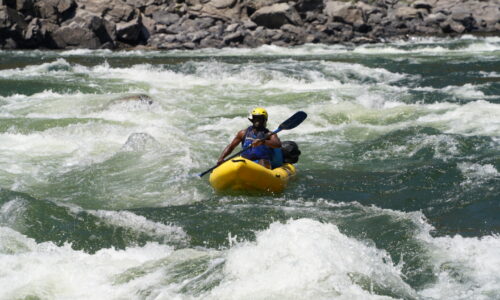
- What outings look like: Ice fishing in Minnesota, sailing on Lake Bde Maka Ska, whitewater rafting on the Salmon River, pole walking at the VA, picnics, cornhole, Class IV rapids — whatever fits the community
- Sierra Thrives (LA): Program run by a family therapist bringing together veterans and community members for outdoor leader training
- Bia Barnett: Former Sierra Club colleague who started The Vet Space (nonprofit for women veterans), became a Military Outdoors grantee, recently organized 40 women veterans on an outing in North Carolina
- Red Top Mountain State Park (GA): Formerly George Washington Carver State Park; named after a Tuskegee Airman who created a park for his community in 1950
Show Notes & Links
- Sierra Club Military Outdoors
- Sierra Club Outdoors for All Campaign
- The Vet Space — Bia Barnett
- Team River Runner — veteran whitewater program
- Every Kid Outdoors Pass — free for 4th graders
- America the Beautiful Pass — annual federal lands pass
- Red Top Mountain State Park — Georgia
- Sierra Club Veterans Day video — YouTube
- Contact Sherman Neal II — Sierra Club Military Outdoors
Episode Transcript
Sierra Club Military Outdoors — Parks, Community, and Healing for Veterans
The Parks Podcast, Episode 46 | Sherman Neal II, US Marine Corps Veteran & Deputy Director, Sierra Club Military Outdoors
Welcome and Introduction
Missy Rentz: I am really excited for this episode. We are celebrating Veterans Day with Sherman Neal II. Sherman is a US Marine Corps veteran and the Deputy Director of Sierra Club’s Military Outdoors. Sherman, welcome to The Parks Podcast.
Sherman Neal II: Appreciate having me, Missy.
Missy: Sherman, first of all, thank you for your service.
Sherman: Thank you.
About Sierra Club Military Outdoors
Missy: Sierra Club launched Military Outdoors in 2006. Can you tell me about the program?
Sherman: Veterans have always had a role in the Sierra Club from its existence essentially. The first executive director of the Sierra Club, David Brower, was actually an Army veteran — a World War II veteran. Some of their outings involved mountaineering in training, and he was in the 10th Mountain Division. So there’s a long lineage that goes beyond the 20 years we’re celebrating this year. The program originated in 2006 — and if you take yourself back to 2006, that’s the peak of Operation Iraqi Freedom, Operation Enduring Freedom, and really a lot of kinetic action going on in the battle space. The program actually began as the Military Families Initiative, with outings that brought together military families outdoors with intentional programming to help the people who were in the rear, mostly the families. As the military mission evolved, the program also evolved. From those outings that started, we began ingraining the program into our Sierra Club chapters — we have 64 chapters across the country, and we’re actively working in about 12. The Military Families Initiative has grown to now working with active duty, veterans, and the military community generally. And it has also added an advocacy element — at the state level, local level, and federal level, we are pushing for legislation that increases equitable access to the outdoors. A lot of the issues that most people share when it comes to access are exponentially higher for veterans, just due to their experiences — physical harms, mental harms, and just the separation and things that come with that life.
Missy: And so it was to meet the need. Which I love — there was this awareness that the Sierra Club saw that need. How did they start it?
Sherman: Our program is nested under the Outdoors for All Campaign at the Sierra Club, where we’re generally pushing for equitable access to the outdoors — we believe that every person has a right to enjoy public lands and access to the outdoors and feel welcome in the outdoors. Underneath that umbrella, in 2006, as that heightened need came due to the kinetic nature of war at the time, there was an opportunity from a funding standpoint, from what the nation saw as a need standpoint, and from the alignment with some of the goals for Outdoors for All, for the military families and veterans to be a part of that work. So it was just a natural fit. And it’s been interesting to me to see how that’s worked in the Sierra Club. I thought there would be some trepidation — when you’re talking about conservation, some of the things that the Sierra Club advocates for, and what people see externally — but that just hasn’t been the case. We’ve seen how seamless it is to bring a veteran outside, and their appreciation that they already have for what the outdoors brings to them — a sense of awe, a sense of peace, a sense of healing, and just building connection with other people outside.
Why Nature Is Especially Valuable to Veterans
Missy: I want to take a little bit of a step back. Outdoor space, nature, adventure — they can all be healing. There’s a physical, mental, and emotional healing that can take place outdoors. Whether it’s moving our bodies or the stress hormones or building community or whatever it is — it’s healing. Science has told us this. Why is nature and our parks and public lands so valuable specifically to military members?
Sherman: That’s a great question. I’ll say personally, for me — I’m biased as a Marine. One of the most vivid memories I have as a Marine is from my second deployment in 2018, when I was in Western Iraq close to the Syrian border with a company of Marines, some soldiers, some French soldiers, some Dutch soldiers — a NATO force out there. One of the missions that I had to complete, which I thought was trivial at the time, was flying in a birthday cake on an Osprey to the middle of Iraq so we could celebrate the Marine Corps birthday. Being completely isolated with no communications, those 250-or-so men and women coming together outside to chop it up, balancing our cake on a rock — that’s the exact type of thing that you can do outside, whether that’s your backyard, whether that’s Yosemite if you have the resources, whether that’s on a kayak eating M&Ms in between paddling. That synergy is just naturally there for veterans. And just like outside, when you go outside and it’s raining and you’re like, how did this happen — it’s miserable in the moment. You end up laughing about it a month later. It’s the same thing with service. The things that we complained about, the things we were mad about and questioning life about — those are the things we text about in the group chat now. So it’s just another space — a natural fit.
Missy: It is funny, because the most frustrating hikes or whatever do tend to be the ones that are the best memory makers — the ones that challenge us and push us out of our comfort zones.
Sherman: It takes a little more time when everything else is factored in, but I see that. And one of the cool things about the program being nested in the Sierra Club is — it’s probably not a mystery that my views on politics, my views on who I am as a person, frankly as a Black Marine Corps officer — we’re a rarity in the Marine Corps — don’t always align with everything. And so the cool thing about the program here is the intentionality when we talk about equitable access and being able to find versions of me and bring them together. One of the coolest things about the program is that about 48% of the people that we serve are women. Women only make up about 11% of the veteran population right now. So there’s something that we are doing that makes people feel more comfortable with the Sierra Club and comfortable being outside. And right now, that’s the moment — we know the populations that are under threat, facing increased mental health issues, and we’re digging into why it is that we’re serving people in a way that makes them feel welcome under the umbrella of the Sierra Club, wherever they’re at.
What the Program Looks Like — Outings, Advocacy, and Connection
Missy: So what does a Military Outdoors program actually look like? If I’m a veteran and I’m listening and I want to be part of this, how would I find it and what would it look like?
Sherman: So the Sierra Club has 64 chapters and about 12 that we’re really actively working with in building out programming. The programming varies significantly based on geography. So if you’re in a chapter that’s near the coast, you might have kayaking-focused outings. If you’re in a mountain state, you might have hiking or backcountry-focused outings. But universally what we’re trying to do is create spaces that feel intentional and welcoming for veterans and military families. Part of what makes us unique is that we try to make it lower barrier — so we’re not only serving the avid outdoorspeople. We’re serving people who have never been outside in a meaningful way but who are looking for community, looking for connection, looking for something that brings them back to some of the things that they loved about service — that camaraderie, that shared experience, that being uncomfortable together, that finding your way through something challenging as a team.
Missy: And I think what’s beautiful about this is — like so many things I talk about in the parks — it’s not just for the elite outdoorsperson. It’s for everybody. And I think that is such a beautiful message for veterans who might be on the fence, or maybe have physical limitations that make them think, well, I can’t do this.
Sherman: That’s so important. And it’s actually something that we’re investing in pretty significantly — looking at adaptive recreation opportunities for veterans who have physical disabilities, who have lost limbs, who have other physical challenges. Because what we know is that the healing power of the outdoors is not limited to people who can run a 5K or climb a mountain. Some of the most profound transformations we’ve seen have been people who simply got outside and sat by a body of water for the first time in years. That can be just as powerful as a summit.
The Advocacy Side — Why Veterans Should Care About Public Lands
Missy: Tell me a little bit more about the advocacy component and why that matters to the veteran community specifically.
Sherman: The advocacy piece is really important, and I think it’s underappreciated by a lot of people. When we talk about public lands, we’re talking about spaces that belong to everyone — every single American citizen. And veterans, who have literally fought to protect American values and American freedoms, have a particular stake in those lands. What does it mean to fight for this country and then have the spaces that represent the natural heritage of this country threatened or diminished? So we see veterans as incredibly powerful advocates, because their voice carries weight in a way that is unique. A veteran standing up and saying, I served this country, and I believe that protecting these public lands is part of what I served for — that resonates across the political spectrum in a way that few other voices can.
Missy: That’s so beautifully said. And I think it’s true — when you hear a veteran speak about these things, it does land differently. It comes from a different place of authority and experience. It also kind of transcends politics in a way that’s really important right now.
Sherman: Exactly. And that’s actually one of the things that gives me the most hope about this work — is that when veterans come together around public lands, around access to the outdoors, around healing, it is one of the few spaces where you can have veterans across the political spectrum come together around something that they all value. And I think that’s incredibly powerful and we need more of that.
How to Get Involved and Support the Program
Missy: If someone is listening and they want to either join the program as a veteran or support the program, what do they do?
Sherman: So the Sierra Club Military Outdoors program is easily findable — you can just search Sierra Club Military Outdoors and you’ll find us. We’re on social media, we have a website, and through the Sierra Club’s chapter structure you can find the chapter nearest you and connect with the local military outdoors programming. For veterans who are looking to participate, the best first step is just to reach out to your local chapter and say, hey, I’m a veteran, I’m interested in getting outside, what do you have for me? For people who want to support the work, you can donate to the Sierra Club’s Military Outdoors program specifically, and those funds go directly to supporting outings and programming and advocacy for veterans and military families.
Missy: And I love this program because it really does represent the intersection of so many things that I care about — public lands, the healing power of nature, community, and honoring the people who have served this country. It’s a really beautiful program and I hope a lot of people will connect with it.
Sherman: Thank you. And I’ll just add — Happy Veterans Day to all the veterans who are listening. Thank you for your service. And know that there are spaces for you outside that are waiting for you, and there are people who want to help you get there.
Speed Round
Earliest park memory?
Going to Yellowstone as a kid. I remember the geysers and just being completely overwhelmed — like nothing I had ever seen. That’s the earliest one that sticks out for me.
What made you love the parks?
The scale of it. The fact that you can go somewhere and feel small in the best possible way. And just knowing that these places exist and are protected for everyone.
Favorite thing about Sierra Club Military Outdoors?
The people. The veterans and military families that I get to work with and support. Seeing someone connect with the outdoors for the first time, or reconnect after a long time away — that’s incredibly rewarding.
Favorite thing to do in a park?
Hike to a high point and just take in the view. There’s something about getting above the treeline and seeing the landscape spread out in front of you that just resets everything.
Park on your bucket list?
The Arctic National Wildlife Refuge — the Alaska refuges up there. I’ve not been to Alaska and I just want to see caribou, fish, and do all that stuff up there.
Three must-haves for a park visit?
A headlamp, a knife, and a water bottle.
Favorite campfire activity?
Telling stories and smoking a cigar.
Tent, camper, or cabin?
Tent.
Hiking with or without trekking poles?
Without.
Favorite trail snack?
Beef jerky.
Best animal sighting?
Black bear.
Favorite sound in the park?
Owls.
Greatest gift the parks give to us?
Peace.
Missy: Sherman, thank you so much for joining us. Thank you for sharing stories and the mission of Military Outdoors. It was an introduction to me and I’m very grateful to you for that. Thank you so much.
Sherman: No problem. Thank you. I appreciate your time.
Missy: That’s it for today’s episode. Happy Veterans Day to all. Until next time — we’ll see you in the parks.
Music for The Parks Podcast is performed and produced by Porter Hardy. Follow us @TheParksPodcast or visit TheParksPodcast.com.