
The Landmark Project started in 2007 as a creative side project — a few outdoor-obsessed screen printers in Greenville, South Carolina making shirts they actually wanted to wear. Ten years later, they’re in 1,500 independent retailers, REI, and National Park concession stores, they’ve given back $1.5 million to conservation causes, and Matt Moreau is walking through Yosemite with his employees pulling out old tires and collecting native seeds. Matt, partner and creative director at The Landmark Project, joins The Parks Podcast to talk about shopping your values during the holiday season.
A note from Missy: I wanted to share more on how companies support our parks and public lands, and challenge people to think about that and their purchasing powers when they make buying decisions. Matt and The Landmark Project have a long history of committing to our public lands.
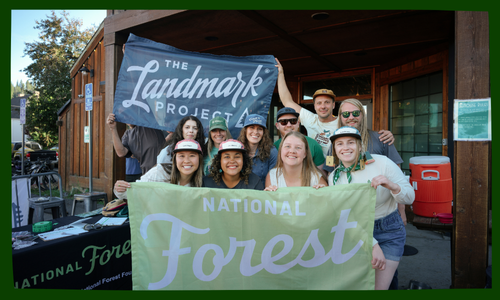
Episode Guest
Matt Moreau – Partner and Creative Director
The Landmark Project
About The Landmark Project
Founded 2007 in Greenville, SC (started as a screen printing shop). Now in ~1,500 independent retailers + REI + National Park concession stores. ~40 employees. Gave back $1.5M to conservation partners since inception. Member of 1% for the Planet. Licensed Smokey Bear, Woodsy Owl, and Leave No Trace artwork — royalties go to wildfire prevention and conservation. Partners with National Forest Foundation, Leave No Trace, NPCA.
Shopping Values – Key Points for Listeners
- Look for licensed products (Smokey Bear, Woodsy Owl, Leave No Trace) — unlicensed versions don’t pay royalties to the organizations
- Check brand websites for specific give-back details: which products benefit which causes
- Look for the 1% for the Planet membership mark
- Support nonprofits directly — NPCA, National Forest Foundation, Leave No Trace all have their own merchandise
- Ask if you can’t find info: if a brand says “we support the parks” but can’t name a beneficiary, question it
- The most sustainable product is the one you wear until it’s threadbare
Show Notes & Links
- The Landmark Project
- The Landmark Project on Instagram
- 1% for the Planet
- Smokey Bear — official licensed merchandise
- National Forest Foundation
- Leave No Trace
- National Parks Conservation Association — NPCA
- Yosemite Facelift — annual volunteer event (September)
- Find your local Friends Group or Land Trust
Episode Transcript
Shopping Your Values — How to Spend in Ways That Protect the Places You Love
The Parks Podcast, Episode 47 | Matt Moreau, Partner & Creative Director, The Landmark Project
Welcome and Introduction
Missy Rentz: Today we have Matt Moreau who is the partner and creative director at The Landmark Project. Matt, welcome to The Parks Podcast.
Matt Moreau: Thanks Missy. I am so excited to be here.
Missy: I am so excited to speak with you. Full disclosure — a couple of weeks ago I got to come into your facility and do a tour, and I loved The Landmark Project before and I really love it now when I see the tender loving care that you guys put into every product and piece of art that you create. So I’m really grateful to you for being here.
Matt: Yeah, it was fun to have you. We always like to lift the curtain and let other people see the magic behind the scenes. For somebody who’s not familiar with screen printing and how we put a graphic on a t-shirt, it kind of looks like a magic trick every time — and I don’t get tired of it. I’ve been doing it for 20 years and I don’t get tired of seeing it. But the artwork lives on my computer screen for such a long time before it actually makes its way onto a t-shirt. So I understand how it’s fun to see — and you get to meet the crew, and yeah, it was great to have you.
Missy: And I think people sometimes take for granted that t-shirts just happen. But when you watch the process and you realize that human beings are integral in every part — they touch your shirt — it is done with love and care and precision. And it just makes anything I see or wear feel more special when I get to experience what I did with you guys and to meet your team and see how they adjust the shirts to make sure they’re on right, and they play with the colors. It’s just a really fascinating process.
Matt: Yeah. I love that. I’m so glad you got to experience it.
How The Landmark Project Was Born
Missy: So The Landmark Project — you’re an apparel company founded in 2007, so you’re almost having a big birthday here coming soon. And you’re a company that is committed to sustainability and conservation. How and when did this whole vision begin for you?
Matt: We started the company because we were already screen printing shirts for other people — imagine a real small company, five or six people at the most, run mostly by outdoor enthusiasts and creatives who all knew each other in college. We got to a point about 10 years ago that we just got burned out on other people’s products that we didn’t care about. It kept the lights on but creative fulfillment was lacking. So because we were all into the outdoors and spent our weekends outside, we just decided — let’s make something that we want to wear. The idea was not to start a brand; it was to start a creatively fulfilling side project, which is how we got the name The Landmark Project, and it stuck. Our friends loved the shirts. We started selling them at cost to people we knew — it was like an inside secret. And eventually we had somebody come by our shop and offer to take samples on the road to their retail accounts. We said, sure, let’s see what you do with it. And that person came back a few weeks later with purchase orders from local retailers. So we were like, oh, I guess we’re doing this. And The Landmark Project was born.
Matt: We never expected it to scale the way that it has in the last 10 years. Early on in our brand story, we started selling to key REI stores, which then became all REI stores. We started selling to National Park stores and concessionaries across the US, and we’re now in about 1,500 independent retailers. In those early stages of growth, when we were scrambling to learn about how to make t-shirts at scale, we realized how great the negative impact was of the textile industry on the environment. And we were at a bit of a crossroads because we knew if we wanted to do this, we had to do it in a way we were okay with. As a small developing brand, you don’t have a lot of control over that yet. You don’t have a lot of power or muscle to flex. So the thing that really stood out to us was — let’s do this in a way that we could be proud of: how we make our garments, the materials we use, the way we screen print, the factories we partner with. And then if we’re going to be telling the story of the national parks or conservation, we need to actually have a give-back component to these products so that consumers who are buying our shirts because they resonate with the message can know there’s a full circle of support going back to charitable partners.
Matt: The early days — since we didn’t set out to build a brand, the first thought was just, let’s make cool stuff we want to wear. But as soon as we started seeing the sales pick up and we realized what potential this whole brand had, we realized we need to do a little bit of good along the way. And I’m grateful that we had that foresight. Because I think we just hit a million and a half dollars given back — and that doesn’t include in-kind donations, volunteer work, and all the intangible benefits of working with our charitable partners. If somebody had told me that 10 years ago, that just by giving small amounts of money for every t-shirt you sell you could reach a million and a half dollars — that would have blown my mind as a young 30-year-old.
Was It Always About Parks?
Missy: That’s a lot of money. Was it always about parks and public land? Was that always your focus?
Matt: Yeah. It started out specifically with national parks, and then we realized — oh, there’s so much more. Everybody would be riding us and saying, hey, I love that Yosemite shirt, but you should do something for this really small, really special national forest in my backyard. Because a lot of people go to Yosemite if they’re lucky once, maybe twice in their life, and yet every weekend they’re spending time in Pisco National Forest — which is what we do. So we realized some of these other public lands have more visitor pressure than some of the smallest national parks, and we need to be telling that story as well. What about cool shirts with Leave No Trace messaging? There’s so much that is adjacent to and related to the idea of park-specific. Everybody has their own personal landmark. Our first hashtag was #MyLandmark — we encourage people to use that, tag us, and let us know this is the place they call home. That just really opened our eyes to the idea that everybody recreates outside in a different way. Whether you’re someone who strolls the streets of your city, or you go completely off grid and backpack through a wilderness area out west, or anything in between — gravel bikes, rock climbing, ATVs, fishing. It’s a huge industry and a really big tent. So we decided not to limit ourselves to national parks and just try to be wherever people are enjoying the outdoors.
The Give Back — More Than Writing a Check
Missy: As you’re building the company, it’s clear that the give-back was part of the mission from the beginning. And oftentimes when I’m talking to organizations, they say, “Oh, but that’s too hard or that’s too expensive.” How did you overcome that challenge in order to stay true to this mission?
Matt: It certainly is an administrative burden. The idea of suddenly starting to take margin from your product and give it to something is a little bit scary. Having done it since the beginning is helpful for us because we know — that’s just revenue we plan for as we’re designing products. Anywhere between one and 10% of that is getting skimmed off, sometimes even 20%, and set directly to a charitable partner.
Matt: I love the 1% for the Planet organization. We’ve been a member for many years. They have a network of brands and companies that give to a network of recipient charitable partners — all vetted and in some kind of conservation or charitable work in the outdoors. While we were building this 1% for the Planet strategy, I was struggling with the idea that 1% doesn’t sound like much. And a copywriter we work with said something really insightful. She said: if you set your compass towards a waypoint but you are one degree off, you’re going to end up at a completely different place. And I thought that was so interesting — because at the beginning, 1% feels really small. But looking back from where we started and where we are now, if we weren’t doing this, we’d be in a completely different place. That’s just a good reminder that there’s no such thing as not giving enough. Give what you’re comfortable doing, and have the goal to grow it over time. Start maybe by just doing in-kind donations or volunteer work — there’s a lot of other ways besides big chunks of cash. I would always encourage people to start with whatever you’re comfortable with, and if you could do better next season, do better. But don’t do nothing. The parks are understaffed, they’re under-resourced, and it’s getting worse. Being able to provide some kind of small financial aid where it counts makes such a difference to the right person.
Missy: I also think it’s interesting — in the outdoor industry, there’s a lot of businesses that give back, and to me, you’re giving back to what makes your business viable. Without those parks, we don’t have gear, we don’t have the need for this stuff. How does giving back work for your organization beyond the $1.5 million? What other things do you all do?
Matt: One of my favorite strategies — we choose to partner with some really interesting heritage artwork licensers. Smokey Bear, Woodsy Owl, Leave No Trace. These companies have IP that goes back up to 80 years. If you’re Smokey Bear, it’s one of the original trademarks of the US Forest Service and it’s still in use, and we pay a royalty on that — up to 10% — on these products. We choose to partner with companies whose royalty goes directly towards conservation. In the case of Smokey Bear — we had wildfires six or seven years ago in the Smoky Mountains here in the east. They’re not as common here as out west, and it was a wake-up call for us. Friends and family displaced, retailers losing everything, some of our favorite trails closed because of damage. So we started working with the Forest Service to put Smokey’s messaging on products we carry. And through that, we’ve been paying a royalty over the years that goes directly towards more education about wildfire prevention. If you see Smokey billboards, if you see Smokey Bear visiting a school — that’s all funded in part by companies like us who do licensing work and keep putting Smokey on products and keeping his message out there.
Matt: Besides that, we also do quite a bit of trail work and service-oriented projects. Last year we helped build a wheelchair-accessible trail through one of our local national forests. We’ve done cleanup projects in our local river and in Yosemite National Park. Everything from a local level — which engages our community and our employees and their families — to going out to a beautiful place like Yosemite or Rocky Mountain and doing meaningful work there. It’s not just writing a check. It’s demonstrating the benefit of rolling up your sleeves and inviting the community to come together on a service project that’s going to benefit them.
Missy: Those are really soul-filling experiences, and to connect with the parks in that unique way is so special.
Matt: Yeah, it is. And I don’t personally sign the checks, so it’s really easy to get lost in the business operations and forget why we got into this in the first place. Those were really fun days — coming in late, leaving early, back when it was just screen printing t-shirts in the house. But the draw of the outdoors was so big that it just kept us going back to it. And now that we’re a business with 40 employees, we run a much tighter ship. We have schedules, our employees have families — we don’t go outside nearly as much as we used to. And it’s so important to just build in those opportunities to remind ourselves: no, this is why we started doing this. This is why we exist. We have to have moments where we can actually get outside and just reconnect. Refill the well. So it provides opportunity for our team, it provides opportunity for other people, and hopefully it shows them that these service projects aren’t super hard to do and maybe they’ll take the initiative to find something in their own area.
Missy: So your activations are open to other people to participate with you.
Matt: Yeah, for the most part they are. We always partner with a ranger or a friends group — they might only have 30 shovels or 30 pairs of gloves, or insurance might cap the group size. So we’re always limited on how many people can participate. But then there are other organizations that can handle very large group sizes, like Yosemite Facelift — every year in September, thousands of people come to Yosemite to take part in a massive, parkwide community cleanup after the summer season. They pick up thousands of pounds of trash, remove graffiti, fix trail erosion. Last time we were there, we were collecting seeds from native species of plants so they can be germinated and planted in areas that need restoration the following season. It’s really cool. And it’s because of our partnerships with companies that actually know what they’re doing — we can show up ready to take marching orders, and we’re relying on ecologists and rangers to help lead those projects. As many people as can come, we are happy to have them.
How to Find Local Organizations to Support
Missy: How would you recommend someone figure out what organizations to work with?
Matt: I usually like to tell people: start with the place that you already love. If you’re somewhere in Ohio, don’t be like, I want to go do a service project in Yellowstone in a couple weeks. There’s always an opportunity on a local level. For us, I’m in Greenville, South Carolina — one of the bigger cities in South Carolina. We’re close to the Blue Ridge Mountains, close to Appalachia and the Smokies just a couple hours away. And in our town we literally have a river that goes through downtown. It used to be the dumping place for all the textile mills back in the thirties and forties — they would dump wastewater, trash, everything, into this river. It’s a beautiful river, but it needs a lot of restorative work. Fixing the pathway of the river that was modified to flow between mill buildings, shoring up the riparian zones, making sure they’re healthy for native insects and animals and birds.
Matt: We started working with the friends group that was formed to restore this river back to good health. The friends group is a very small nonprofit. When we write a check for $5,000, that actually helps in so many ways — paying for water testing, lab testing, supplies for community workdays. Beyond that, we donate our spent cardboard to smother old invasive grasses and plant new ones on top — it’s called air layering. Instead of digging up and removing old plants, you kill them off by layering biodegradable cardboard on top. It’s a neat way of taking materials that would normally just go to recycling or a landfill and putting them to work as part of a solution. And our whole team comes out. We get in the river, we yank out old tires.
Matt: This is all only possible because we care about our local river and there is a friends group that is set up to help put us to work. So find — what’s your local state park? What’s your local national forest? There’s almost guaranteed to be some kind of nonprofit friends group associated with that place. And that’s the perfect place to start because they are in constant communication with the rangers, constant communication with city officials. They know what projects need to be done and funded. And a lot of times these small friends or conservancy groups just don’t have a loud voice. They don’t have a lot of social media following or people on their email list. They might have really good opportunities for the community but they’re just not getting heard or seen. It might take just a little bit of research in your local area and a couple of phone calls or emails to get connected with the right person. But that’s where I like to tell people to start.
Matt: And if you find that you love volunteer work, get a couple of friends and reach out and say, hey, we’ve got a group of 8 or 12 of us — we’d all love to do a service project together. What do you have and what’s a date that works for you? Our local state park would absolutely love that. We have trees that need to be re-blazed because the paint’s worn off and the trees have grown. Here’s the blaze stencil, here’s a can of spray paint — go find the old blazes and paint over them. That’s such a benefit. And you’re walking that trail anyway, you’ve got your friends with you. And every time you’re on that trail later, you look back and see the work that you did.
Missy: And I’m hearing two sides as you’re talking. First, the individual — how you can get involved. But then also from a corporation or business standpoint: it’s more than just money. You’ve talked about the dollars, but you guys give with time. And even taking a look at the resources you have — whether it’s a big social media following, or a ton of cardboard boxes they need for something. It’s amazing. You are already so resourced and you’ve shared with us how we can support these organizations and incorporate give-back into our own missions.
Matt: Yeah, it’s so much more than just writing a check.
Shopping for Good — How to Spend Where Your Values Are
Missy: So speaking of so much more — let’s talk about shopping for good. We are entering the holiday season and one really good way to advocate is to spend where your values are and make decisions based on that. As we’re entering the big shopping season, how does someone find out what an organization is doing? If I want to buy a t-shirt, how do I find out that The Landmark Project is actually giving back?
Matt: Every brand’s gonna tell their story differently. We know our customer really cares about the same things we do, and we don’t want to just shove it in their faces or virtue signal. We want people to know — if you do buy from us, we are doing our best over here to do a little good, and we take that responsibility seriously. Our approach is to just make sure that messaging is accessible on our website. If you want to know more — like specifically what does this product benefit — it’s there on the product page. For Smokey Bear products, it goes directly to wildfire prevention. If you’ve been personally affected by wildfires, that’s an easy one.
Missy: I want to talk a little bit about licensing — you mentioned earlier that you pay a fee to be able to print Smokey Bear. A non-licensed product means they’re just stealing the artwork, and basically no money is going back to support the Forest Service. Correct?
Matt: That’s correct. And the Forest Service does their best to help police this, but you can’t catch them all. Smokey Bear’s been around for 80 years and there’s a lot of print-on-demand, Etsy stores, Temu and Shein — you can find a lot of Smokey Bear products out there that aren’t licensed. And it’s damaging on a few different levels. Number one, the Forest Service doesn’t get any benefit from a non-licensed Smokey Bear product. Number two, a lot of non-licensed Smokey Bear products have messaging that is not aligned with Smokey’s messaging. Smokey is all about preventing wildfires — that’s been the case since day one in 1944, when he was created, and they’ve done an amazing job protecting that intellectual property and that messaging over 81 years. So when you see a Smokey Bear product that says something other than preventing wildfires, it dilutes the messaging and makes Smokey a symbol for other things. A parody Smokey — even for the cannabis industry — is actually really harmful. There’s a heritage of intellectual property we’re trying to protect. When you buy the right ones — the licensed ones — that goes to the Forest Service, which in turn helps get more educational materials and opportunities out there about wildfire prevention, which is the whole point of Smokey Bear.
Missy: And I think as a shopper, if you are looking to have that feel-good moment knowing that what you’re buying is also giving back, it can take a little bit of homework to go and dive into a company’s website and make sure they’re aligned properly.
Matt: Yeah. And a lot of companies — you can shop directly with some nonprofits or charitable organizations that have their own really cool merchandise. I’m thinking of the National Forest Foundation, Leave No Trace — these are partners of ours. If you go to their website, you could buy directly from them, which is a really cool way to support something. The National Parks Conservation Association does gift guides that are all gifts they know support the parks. I would always caution people though — if somebody says they support the parks, that may be true, but if there aren’t at least some real beneficiaries listed or evidence on their site of the charitable work, question that a little bit.
Matt: There are great brands out there, many of whom I would consider competitors, but we’re all in it for the same reason. I’ve never felt animosity towards other people who make National Park shirts or Smokey Bear shirts if they’re doing the right thing. There’s room for all of us. Pick the product that really speaks to you. Pick a product that you’re gonna wear — don’t pick a product just to have it and keep it in a drawer. Wear it out. Get cherished use out of that product until it’s threadbare. The most sustainable product is the one that you keep wearing and never throw away.
Speed Round
Earliest park memory?
Backpacking in Yosemite.
What made you love the parks?
A couple of really amazing sunsets on some of those first backpacking trips, and realizing we have the one-mile-in rule: if you don’t feel like you’re loving a park, just get a mile in on any trail. 95% of the tourists drop off. You don’t see the parking lot anymore. That’s what made me love the parks.
Favorite thing about our parks and public lands?
The even playing field that it brings. I love seeing the diversity of people that enjoy these parks. I like that they’re accessible, and that being in nature shows you it is a universal value — whoever you are.
Favorite thing to do in our parks and public lands?
Backpacking. If I were to have any choice of a sport to continue doing for the rest of my life, that would have to be it.
Park on your bucket list?
Believe it or not, I haven’t been to the Grand Canyon. It’s on my bucket list because it’s one of the most important parks in the US and I’m a little intimidated by it — I don’t want to just day hike. I want to do an epic hike, and the rim-to-rim trail is pretty epic. So I don’t want to visit the Grand Canyon until I have the time and stamina to do that trail.
Three must-haves for a park visit?
A water bottle filter — I like to filter as I go rather than carry heavy water. My national park pass — though I sometimes forget it and have to pay the entry again. And my camera — I travel with my wife and I’m constantly telling her, “Wait, go do that again,” so I can capture the moment.
Favorite campfire activity?
Cooking around the campfire. Put me in a group of friends at a campsite and I want a job to do. I put a lot of thought and prep into a deceptively simple but secretly elaborate campfire meal.
Tent, camper, or cabin?
Neither — I sleep in the back of our vintage 1988 Land Cruiser. We put the backseat down, roll out the air pads, hang up some string lights. It’s perfectly flat in the back, long enough that I don’t have to curl up, and I hate putting away a wet tent. When backpacking, a tent is a necessary evil — but given the choice, we’re sleeping in the back of the Land Cruiser.
Hiking with or without trekking poles?
With, every time. I need to make these knees last.
Favorite trail snack?
Early on it was a king-size Snickers bar every morning on a backpacking trip. I don’t do that so much anymore. Honestly, I’ve replaced snacking with electrolyte packs — I’ve developed a dependency on them, especially in the Southeast when it’s 100 degrees and 100% humidity. Those have been a lifesaver.
Best animal sighting?
What I thought was a bear that emerged five feet off the trail while we were hiking in Glacier National Park — turned out to be a moose. We totally thought it was a grizzly bear. Still scary, still dangerous, but it was just a moose checking us out from the blueberry bushes.
Favorite sound in the park?
The white noise of camping near a creek. Crickets will stop at some point and it gets really quiet and scary. But the creek doesn’t stop — it creates this constant low level of noise that you can fall asleep to really easily. Comforting and constant.
Greatest gift the parks give to us?
The ability to refill the well. Life and work tend to just drain it, and if you keep drawing from that well, you eventually pull up a bucket with nothing in it. That’s what the parks are for me — and I think a lot of people resonate with that. You don’t have to be a business owner or creative. Every now and then you just need to walk in the woods to restore a little something about you that you’ve been missing.
Missy: Matt, thank you for your art and your creativity and your cozy t-shirts and for being with us today on The Parks Podcast to teach us about giving back when we’re doing our shopping and when we’re choosing the companies we work with. Thank you.
Matt: Of course. It’s absolutely my pleasure to be here, and thank you Missy for telling our story and for amplifying things like this that are important.
Missy: Thank you! That’s it for this episode. Until next time — we’ll see you in the parks.
Music for The Parks Podcast is performed and produced by Porter Hardy. Follow us @TheParksPodcast or visit TheParksPodcast.com.