
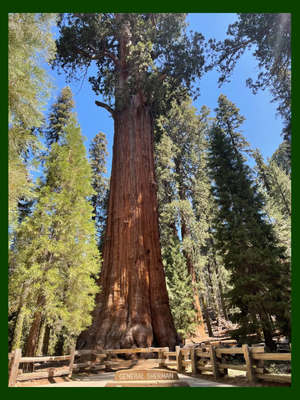
The giant sequoia can live 3,000 years. Its bark is spongy and full of air pockets, adapted for fire. Its cones are the size of a chicken egg and hold hundreds of seeds the size of oatmeal. It is the largest living organism on Earth by volume. General Sherman — the biggest of them all — stands 274 feet tall, 36 feet across at the base, and is estimated to be around 2,200 years old. Holly Strike, Public Affairs Specialist for Sequoia and Kings Canyon National Parks, joins The Parks Podcast to share the full story — the trees, the Buffalo Soldiers, the woman on horseback who saved the parks from logging, and everything visitors need to know.
A note from Missy: I went to Sequoia and Kings Canyon during COVID. Not many of us were around, so being deep in the woods, nearly alone, felt strange and wonderful. It was a gift to experience these big trees and hear their stories as they creaked in wind. The memories came alive again in this episode. And I realize that I have so much more to see on my next trip.
Episode Guest
Holly Streit, Public Affairs Specialist
Sequoia and Kings Canyon National Parks
Park Stats
- Location: Three Rivers, California (Central Valley)
- Two parks managed as one: Sequoia NP (2nd national park, September 25, 1890, President Benjamin Harrison) and Kings Canyon NP (32nd national park, March 4, 1940, President FDR)
- Size: 865,964 acres (97% managed as wilderness)
- Highest elevation: 14,494 feet (Mount Whitney — highest point in the contiguous US)
- Lowest elevation: 1,370 feet (Kaweah River)
- Annual visitors: Sequoia 1,309,573 + Kings Canyon 699,389 (record visitation)
- The trees: Largest tree: General Sherman; 2nd largest: General Grant; some sequoias 3,000+ years old
- Wildlife: 11 fish species, 203 bird species, 73 mammal species, 21 reptile species, 13 amphibian species
- Key history: Army administered 1891–1913 (including Buffalo Soldiers); CCC built the Generals Highway
- Susan Thew (spelled Thue in transcript): Credited for 1926 expansion of the parks; mapped and photographed on horseback at age 40
- Walter Fry: Former logger who counted a tree’s rings (3,266 years), stopped logging, became park superintendent
- The KMC complex fire (2021): High-intensity fire caused significant sequoia loss — reminder of why sequoias need low-intensity fire, not suppression
- Getting there: ~1 hour east of Fresno; ~45 min east of Visalia; nearest airport is Fresno
Show Notes & Links
- Plan Your Visit — Sequoia and Kings Canyon NPs
- General Sherman Tree — the world’s largest
- Congress Trail — 2-mile loop, accessible, paved
- Big Trees Trail — accessible loop around Round Meadow
- Camping — Recreation.gov (15 campgrounds, reservations required)
- Lodges — John Muir Lodge, Cedar Grove Lodge, Wuksachi Lodge
- Crescent Meadow — wildlife and accessibility
- Tunnel Log and Tunnel Rock
- Moro Rock — steep but spectacular
- Fire and sequoias — NPS science
- Buffalo Soldiers at Sequoia
- Accessibility information
Transcript
Sequoia & Kings Canyon National Parks — The Giants of the Sierra
The Parks Podcast, Episode 30 | Holly Strike, Public Affairs Specialist, Sequoia & Kings Canyon National Parks
Welcome and Park Stats
Missy Rentz: On today’s episode, we have Holly Strike, who is the Public Affairs Specialist for Sequoia and Kings Canyon National Parks. Holly, welcome to The Parks Podcast.
Holly Strike: Hi. Thanks, Missy. I’m happy to be here.
Missy: As always, we start with some park stats — and these two parks are incredible. The parks are located in the Central Valley of California, in Three Rivers, California. Sequoia was the second national park, and Kings Canyon was the 32nd national park created. They were dedicated on September 25th, 1890 for Sequoia, and March 4th, 1940 for Kings Canyon. The presidents at the time of creation: Benjamin Harrison for Sequoia and Franklin D. Roosevelt for Kings Canyon. The size is 865,964 acres. The highest elevation is 14,494 feet at Mount Whitney, and the lowest elevation is 1,370 feet at the Kaweah River. Visitation last year was a record: 1,309,573 visitors to Sequoia and 699,389 visitors to Kings Canyon. Some fun facts: the parks were created to protect the giant sequoia tree from logging. General Grant National Park was created four days after Sequoia — that’s what eventually became Kings Canyon. 97% of the land is managed as wilderness. It’s home to the largest and second largest trees in the world — General Sherman and General Grant. And the parks are home to 11 species of fish, 203 species of birds, 73 species of mammals, 21 species of reptiles, and 13 species of amphibians. Holly, I love this park.
Holly: Oh, you are not the only one.
One Park or Two?
Missy: So let’s get into this first, because it can be very confusing — sometimes you see it as Sequoia and Kings Canyon National Parks, sometimes just Sequoia National Park and Kings Canyon National Park. Is it one park or is it two parks?
Holly: It is actually two different parks, but they are managed as one — and both are spectacular. So it can be confusing, but because the boundaries touch and it’s managed as one, a lot of times we just refer to it as Sequoia and Kings Canyon.
Missy: And why is it important that these parks are part of the National Park Service?
Holly: I think possibly every person who has visited these national parks can probably share a personal story of the significance of their visit — and let’s multiply that by 2 million people, and that’s just the direct impact of visitors last year. Sequoia and Kings Canyon have been offering their natural beauty, inviting expedition and adventure, hosting a natural habitat for countless wildlife and flora, and so much more as protected lands for the past 135 years. Some of the oldest sequoias surpass 3,000 years old. And something else to mention is that we’ve seen what can happen to these magnificent trees when they aren’t protected. So Converse Basin is a really good example of that history of what logging giant sequoias looks like. And it’s pretty sad to see some of those old stumps.
Missy: And I think one of the things I’ve mentioned in some previous episodes is how impressed I am at the National Park Service and how they are willing to talk about the mistakes we’ve made in our past — humans learn and evolve. In these parks it’s really about environmental conservation. When you talk about what you were just talking about — to see all of these stumps of these massive trees — were they thousands of years old when they would have been cut down?
Holly: Some of them likely were. Like the Mark Twain stump is pretty big, so I’m guessing that one was a giant monarch and thousands of years old — which is a long time to be around and then just taken down in a matter of days.
Missy: Thank goodness people stepped in and said, this isn’t right. And early on it wasn’t the National Park Service protecting them — it was the Army.
The Buffalo Soldiers — The First Park Rangers
Holly: Buffalo Soldiers, like their white counterparts in the US Army regiments, were among the first park rangers. In general they were backcountry rangers, and in particular they patrolled parts of the west. African American army regiments formed just after the Civil War were dispatched westward, where Black soldiers fought in the Indian Wars and were eventually given the name Buffalo Soldiers by the Cheyenne and other Plains Indians. They saw a resemblance between their dark, curly hair and the matted cushion between the horns of the buffalo, and they were fierce — it was meant to be an honorable title. As background, the Army served as the official administrator of Yosemite and Sequoia National Parks between 1891 and 1913. In that capacity, they helped create a model for park management as we know it today. The Buffalo Soldiers army troops were garrisoned at the Presidio of San Francisco during the winter months, and then they served in the Sierra during the summer months.
Missy: I’ve heard about Buffalo Soldiers in other places. So they didn’t just serve here.
Holly: That’s right.
Missy: Why did they make the shift from the Army to the National Park Service?
Holly: Civilians started getting involved before World War I, but the big shift happened during World War I because the troops left and then civilian management took over. And when the National Park Service was created, we had National Park Service rangers. So the park is actually older than the National Park Service.
Susan Thew — The Woman Who Expanded the Parks
Missy: One of the stories I love about the park is a woman named Susan Thew, who was a park advocate in the early 1900s — a time where women were at home and didn’t play major roles in things. She is credited for the expansion of the parks. Her story I found to be really amazing. I would love it if you would share a little bit about who Susan was and what role she had in the creation or expansion of these parks.
Holly: Susan Thew is just incredible. She’s credited for the expansion of the parks because of the work that she did in the Sierras. Susan Thew came to this area with her husband and took a trip up to the Giant Forest, was immediately captivated by the sequoias, and decided that she was going to be very active in helping with the ongoing efforts to preserve and protect some of the land out here. She acquainted herself with the superintendent, who was John White at the time, and found out all of the efforts that they were doing to grow the parks and protect more natural resources. And so she — on horseback, at 40 years old — went out into the high Sierras and photographed and mapped a lot of the areas that we now know as Sequoia and Kings Canyon National Parks. This wasn’t a small effort. She was out in really rugged terrain, being very descriptive. She created this little gazette that ended up being sent to Congress as they were trying to expand the borders of the parks. And because of the photography, the description, the work that she did — on July 3rd, 1926, the parks expanded greatly and included the Sierra Nevada Crest, Kern Canyon, Mount Whitney. All of those areas were credited to her. What’s also interesting is that the method she used to portray this beautiful nature to Congress is also how Ansel Adams helped establish other areas to be protected. It was a really effective tactic that she pioneered.
Missy: And maybe I’m more sensitive to it now because this is being recorded in April of 2025, and there are so many people talking about what voice do we have. And this is just a prime example of how a normal civilian citizen did something that made a massive difference in the Park Service. If we just do what we’re passionate about and realize that gift can make a difference in this world.
Holly: Yeah. That’s a really great way to look at it.
A Brief History of the Parks — From 1890 to Today
Holly: So Sequoia National Park was established in 1890 — before the actual National Park Service was created. It was being protected by the Army at this time. At that time, we also had the General Grant National Park, which was a tiny little national park established solely to protect the General Grant tree, which is the second largest sequoia. After that, the Buffalo Soldiers came in and made some significant contributions to Sequoia National Park in 1903. One of the most significant is that they created the first really accessible road to the Giant Forest — and that’s where a lot of our visitors still come today. Captain Young was in charge of overseeing the completion of the road to the Giant Forest, which was the old Colony Mill Road. They completed it and extended it up to Moro Rock. They also made agreements with some of the landowners within the park so that eventually the National Park Service was able to acquire some private lands as well. They really set the tone for how national parks were managed.
Holly: After the Buffalo Soldiers, World War I was a turning point — it was no longer the Army guarding these parks. They had some civilian management and then the National Park Service was created in 1916. And then Susan Thew comes in 1926 and assists with that expansion. After that, the Civilian Conservation Corps made contributions that we can still see today on the General’s Highway. The old Colony Mill Road that the Buffalo Soldiers built was the old road. Now the General’s Highway is what the CCC worked on — we can see a lot of their stone work, the culverts. They also created some of the historic signs for the park and did a lot of trail work, just a ton of helping people access these beautiful spaces.
Walter Fry — From Logging to Superintendent
Missy: Another superintendent of the park was Walter Fry. And we talked about how the park is an example of humans evolving and learning. Walter had this same experience himself, because his first experience with the sequoias was cutting them down. How do you go from cutting them down to becoming the superintendent of the park?
Holly: Walter Fry was another incredible advocate and protector of the giant sequoias. He came out here for work, started with logging the sequoias, and immediately did not feel like that was something we should be doing. So he ended up signing a petition in 1890, which was when Sequoia National Park was established. Then he started doing some road construction and ended up becoming a civilian park ranger in 1905. He ended up being the Chief Park Ranger in 1912 and acted as superintendent during the winter months. Once the Army exited the management, Walter Fry was then appointed superintendent of Sequoia and General Grant National Parks for six years. After that, John White became the superintendent. But Fry was still so active in the parks — he ended up being the first nature guide at Sequoia. He led nature walks, wrote nature bulletins, organized the first public museum in Sequoia National Park, which was just a tent. He also spoke at campfire programs — and those are things that we still do today. They really laid the foundation for a lot of the things we are still doing now.
Missy: A story I read — and maybe you can validate — is that he cut a tree and then counted the rings, and that tree would have been 3,266 years old. And that was one of the points where he was like, I can’t do this. To see what he then turned around and did, advocating for this park and helping people appreciate what they were standing in — it’s pretty beautiful.
Holly: I have heard that story as well, and I can just imagine being in that moment and having that sense of clarity about your personal values around nature conservation.
What Is a Sequoia?
Missy: We talk about the trees, we’re talking about these sequoias, and I think when most people hear Sequoia and Kings Canyon, that’s what they think about. But what is a sequoia?
Holly: Okay, sequoias are so incredible. First of all, let me just paint a visual picture for anyone who hasn’t seen a sequoia before. You can exactly imagine a dinosaur walking through these giant sequoia groves — they are humongous. They have this cinnamon-colored bark that looks fuzzy. The bark on a sequoia tree is adapted to be in a wildfire environment — it’s spongy and has a lot of air pockets in it so that when fire comes through, the tree is protected and continues to grow outward. So you’ve got this beautiful cinnamon-colored bark, and then the canopy is just hundreds of feet into the sky.
Holly: In the groves you can see baby sequoias, middle-aged sequoias, and then these giant monarch sequoias, and you can see how they’re different. The ones that have been around forever are just magnificent. They have these tiny little cones that have hundreds of oatmeal-sized seeds inside of them — the sequoia trees actually hold onto those seeds until the conditions are right to distribute them on the ground. There’s a lot of really cool interaction with wildfire and how sequoias actually thrive in a fire environment. They’re in a mixed conifer forest, so there are other giant trees around them, so it’s really hard to gauge the size of things because the giant sequoias are so giant but they’re also around a lot of other really big trees. You’re just this visitor in this giant space. That’s why it’s called the Giant Forest.
Fire — The Complicated Truth
Missy: You bring up fires. Obviously we hear a ton about fires around the country and it’s super scary. But then you also talk about the way sequoias handle fires. You all had a large fire last year and I think it closed the park for a while. What does a fire do? It’s still devastating, correct?
Holly: Yeah, so it really depends on the fire. The fire that maybe most people are familiar with is the KNP Complex — and that fire was in 2021. It was a massive, high-intensity fire. It spread through so much of the park and it did cause a lot of devastation. We lost a lot of sequoias during that fire and it was a pretty scary time. But there are other fires that are very beneficial to sequoias, so it’s complicated. Sequoias really do need fire because it’s a natural occurrence. Before I came to this park, I didn’t realize that wildfire in this area is a natural occurrence — it has about a 10 to 15 year interval when you expect fire to happen again. It clears the ground. The fire is supposed to be a little bit lower intensity — all of the duff and smaller plants get burned up, and it clears the way for the sequoia trees to then release their seeds. Sequoias need a ton of space and those nutrients in the ground to actually grow and survive.
Holly: And what’s been happening in previous fires is that we did a lot of fire suppression as a whole in the past, and so a lot of those fuels didn’t get naturally burned. And so that’s why we’re seeing these bigger fires that are spreading more rapidly, especially during drier summers when everything is really dried up and the fire can spread through ladder fuels. There’s a lot going on there and it’s complicated, and we’ve got a lot of people who are studying this and trying to make the best decisions to help protect these spaces.
Conservation Efforts
Missy: While the trees are certainly the star, the park has a lot of other things to explore. Can you tell me a little bit about the conservation efforts in the park?
Holly: This is a great question and one that really speaks to the National Park Service and its mission to preserve unimpaired the natural and cultural resources and values of the National Park System for the enjoyment, education, and inspiration of this and future generations. Sequoia and Kings Canyon are incredibly special — their boundaries hold over 850,000 acres of protected land. We have two very prominent designated wilderness areas: the Sequoia-Kings Canyon Wilderness and the John Krebs Wilderness, both established by Congress and managed according to the Wilderness Act as federal law. Aside from that, the Park Service employs scientists who study the flora and fauna of our parks, taking care to understand human impacts, and identify species that might be facing challenges — like our bighorn sheep, which are federally endangered, the Pacific fisher, the mountain yellow-legged frogs, and the whitebark pine. And meadow restoration is another interesting area of work for our parks.
Missy: Meadow restoration — I think it was at Herbert Hoover that I first learned about this. I just looked at a meadow and thought, oh, it’s a meadow, it’s just there. But there’s a lot of benefit from a meadow and I didn’t realize that.
Holly: Yes, and this is actually an interesting way to tie this back to our earlier conversation — one of the great contributions of the Buffalo Soldiers was protecting the land from grazing. Meadows were impacted significantly from cattle grazing, so they really protected a lot of these areas just from that. The meadows are a delicate system and they are important. And Crescent Meadow is a really beautiful meadow that people can access pretty easily to see exactly how wonderful a meadow space is. A lot of times people are able to see bears in the meadow too — it’s a place for wildlife to really enjoy.
Missy: Oh, that’s so cool. I’m going to have to come back because I did not go see that.
Planning Your Visit — Getting There and When to Come
Missy: Let’s talk about planning a trip to the park. This is one of those parks where I needed to do a lot of planning and research before I visited because it’s big and it’s spread out and there’s so much to see. How do you even get to the park?
Holly: So it is a little out in wilderness, but people can get to Sequoia and Kings Canyon — it’s about just over an hour east of Fresno, California to get into Kings Canyon, or about an hour and 15 minutes from Visalia. The entrance to Sequoia is about 45 minutes east of Visalia. So Fresno is the nearest airport for people trying to fly in.
Missy: And what’s the best time of year to visit?
Holly: Oh my gosh. Okay, so I get this question a lot and it’s hard to answer because the parks are so beautiful throughout each season. Typically, our visitation is highest from May to September, and that’s also when most of our seasonal areas are accessible — like Cedar Grove and Mineral King, which are closed for a significant part of the winter season because the roads aren’t maintained. But if you want to come and enjoy the parks with less congestion, springtime is really beautiful. Down here in the foothills they’re only green for a couple of months out of the year — the rest of the time they’re that gold because everything’s dried out. The wildflowers are amazing. And then fall is really beautiful to see as well. If you are going to drive up in the winter, that is a challenging time because the weather is so unpredictable. We do have chain restrictions in accordance with California state law, and there are times when people will have to use tire chains or the road can be closed. So you need to be comfortable with tire chains and driving on mountain roads when they can be a little slippery.
Missy: I came at that cusp of winter to spring, and my decision was because I just prefer parks without large crowds — and this is a park that gets large crowds.
Where to Stay — and What to Know Before You Go
Holly: We do have some lodges in the park that are really lovely. We have the John Muir Lodge in Grant Grove, there’s a lodge in Cedar Grove, and the Wuksachi Lodge. We also offer some campgrounds — we have 15 campgrounds in the parks, but not all of them are open at any given time, so people can check out recreation.gov for availability and reservations. In general, we don’t have a walk-up, first-come-first-served situation, so recreation.gov is the best way to see what campgrounds are available.
Missy: And I found that you guys are a park that has the camp store and has everything you need once you get in the park.
Holly: Yeah, we do have the camp store, we’ve got restaurants and other things that are helpful. The Lodgepole Market is really great — a nice place if you forget something or if you’re camping. Our Lodgepole campground is pretty big and serves a lot of people. There’s also a grill there and the Wuksachi Lodge has a grill too, so you can definitely get some food. But people should be prepared with gas in their vehicle — we don’t have any gas stations in the park. There is a gas station between Sequoia and Kings Canyon on the stretch of the General’s Highway that goes through the National Forest, which is sometimes open. The key word there being sometimes.
Missy: The key there is “sometimes.” Fill your tank before you leave.
What to Do — Hiking, Accessibility, and More
Missy: Let’s talk about what there is to do. It’s endless. What are the top things?
Holly: Hiking is probably something that comes to mind for a lot of visitors, and the distance of the hike is a personal preference — so whatever your ability is in hiking is really how you want to plan your trip. People definitely come to see the General Sherman tree, which is the largest tree in the world. That’s also connected to the Congress Trail, which is a two-mile loop you can go on. That’s a great way to see some of the named trees and some really cool sequoia groups. Sequoias can grow as individual trees — like General Sherman is so big because of the area it grew in, with all the space and access to sun and water resources. But some of them grow in clusters or groups, and sometimes sequoia trees actually grow into each other. So if you go on the Congress Trail, you can see a variety of sequoia trees and how they grow.
Missy: On the Congress Trail — I just want to pause for a second because this is a spot that has great accessibility.
Holly: Yes. The General Sherman tree trail is paved, so it is a little bit more accessible. There’s also a Sequoia shuttle that can help people get to the Sherman tree, and there’s an accessible parking lot specifically designated during the summer months. So that makes it a little bit easier to get on that paved trail. If you’re not parking in the accessible parking, you would park in the upper Sherman lot, and it’s about a half-mile trail, but it is pretty steep.
Missy: And even that paved trail down to the tree — it’s not just down to see the tree and back. It’s this great loop that takes you through lots of trees. It’s still steep, it’s got stairs, and if my memory serves me, some benches to rest. But I just think that you all have done an amazing job at making the big moments in the park accessible for everybody.
Holly: Yes. And another really great accessible trail in the Giant Forest is the Big Trees Trail, around Round Meadow. Tying it back to our history, that’s where the Buffalo Soldiers had their end-of-season meal on a sugar pine tree — it’s a really cute story. But it’s a really lovely, accessible, short walk around the round meadow where you can see some giant sequoias.
Missy: So no matter your ability, you can enjoy this park. And the other thing I learned — in my head I was thinking, in order to do a hike, I have to go out and do a four or six mile hike. But here there’s so much to see where you’re just doing a two-mile loop or a mile out and back, and there’s so much to see, but you’re not hiking 10 miles to get to it.
Holly: Yeah, that’s a really great way to explain it. And also — pay attention to your body and what it feels like. If you don’t know what you can do, turn around. You don’t have to do the whole thing. You can do whatever amount you want to do. That’s the whole beauty of being in parks — you really choose your own adventure. I think Crescent Meadow is another great place where you can just walk however much you feel comfortable walking — there’s a parking lot right there.
Missy: I didn’t see horseback riding while I was there, but that’s something that can be done as well.
Holly: So there is some horseback riding through a concessionaire service. And some of those trips you would make a reservation for online. And for fishing — Cedar Grove is actually a great fishing spot.
Missy: Do you need a fishing license?
Holly: Yes, you do need a fishing license.
Weather — Plan for Everything
Missy: One thing I want to talk about in planning a trip to the park is the weather, because it can change on a dime.
Holly: Yes, absolutely. So the weather can vary greatly, and that’s because of the amazing elevation range within these parks. A lot of people experience elevation from about 1,400 feet to between 6,000 and 7,000 feet — that’s what people generally experience when they’re going to the Giant Forest or Grant Grove. It can be 10 to 20 degrees cooler up in the forest than it is down in the foothills, which is a big benefit in the summer. But bring a ton of layers. Being prepared is very important. Checking the weather is important. It’s the Sierras — it can be really last-minute changes and winter lasts a little bit longer up in elevation. We do have forecasts for each area of the park that people can look at on our website to help plan for that.
Missy: I think I would answer that weather question with “we’re expecting snow and 80 degrees.”
Holly: Yeah, exactly.
Cell Service and Safety
Missy: Safety is something I always try to talk about. In this park, there’s not a lot of cell service. I was traveling alone, so I had a deal with my brother — I had a Garmin watch, but I would also text him my trail plan before I would go out. I would sometimes drive almost an hour away to get a cell signal, text him “here’s my plan,” come back in, do the trip, and then go back out and say I’m off the trail. It makes it even more enjoyable because you have to be so present. But I think it’s important for people to understand what they’re going into.
Holly: Yeah, that’s a really good point. Before I was the public affairs specialist, I was actually a park dispatcher — I answered calls for emergency services. It just takes a couple of miles into the park before you lose cell phone service, depending on your carrier. Cell phone service has gotten a little bit better in some of the more populated areas like Lodgepole and Grant Grove, depending on your provider. But people should come prepared to not have a connection.
Tunnel Log, Scenic Overlooks, and Iconic Moments
Missy: I want to talk about the iconic picture where you see people driving through slash under a tree.
Holly: Oh yeah — you’re talking about Tunnel Log. That is something that people can see on their way to Crescent Meadow. There’s a little drive-through and a lot of people like to stop and get a photo of their car underneath Tunnel Log. So it can get a little congested there. And those roads are tiny. Be prepared to wait for your photo if that’s what you’re there for.
Missy: These parks have so many iconic Instagrammable moments — you’ve got the tunnel, you can stand inside of a tree, and then there are amazing scenic overlooks.
Holly: Oh my gosh. Yes. Okay, so this is another choose-your-own-adventure. Tunnel Rock is one of the first places where people stop — it’s different from Tunnel Log. The General’s Highway used to go underneath a rock formation, so that’s one of the first places people stop and there’s a parking area where you can stand underneath this giant rock formation. And then there are a ton of scenic overlooks on the way up the General’s Highway — it was very specifically designed to be a scenic route. You can stop along the way and get some really great photos of just the foothills. On a clear day from Moro Rock, you can see the coastal mountain range — which is a couple of hours away, but you’re so high up, you can see that. Moro Rock is another great spot, but it’s a very steep trail, so it depends on your ability — and also if you’re scared of heights, because it’s pretty exposed.
Holly: And then one of the really epic places if you’re more experienced and want to do something more strenuous — there’s a Lakes Trail with two different routes. The Watchtower route has this incredible open view of the canyon, so deep and so steep, and you can see forever and really see a lot of the geology and glacial formations. And Pear Lake specifically is a great way to see an alpine lake on a day hike — you can get there in one day, which is incredible.
Missy: Oh, that’s so cool. I love it. If you go to The Parks Podcast website and look on this episode page, I’m going to put links to everything that has been mentioned here — because it will be a good resource for you as you start your planning to visit Sequoia and Kings Canyon.
Speed Round
Earliest park memory?
Actually here at Sequoia and Kings Canyon. I had not gone to a national park until I was in my thirties. I went on a backpacking trip out of Lodgepole, up to Ranger Lake and around through Jail Pass, and that was really a life-changing moment for me. I moved out here within two years because it had such a significant impact on me.
What made you love the parks?
I really love the solitude of the parks. It’s a good test of your body and your spirit and the curiosity of nature. For me, it inspires just a ton of curiosity — I’m still curious. There’s so much to learn about these wild and diverse ecosystems, and the intention of being in nature is really just a gift to yourself in a modern age of fast-paced lifestyles and constant screen time.
Favorite thing about Sequoia and Kings Canyon National Parks?
Oh, definitely the diversity of the ecosystems.
Favorite thing to do at Sequoia and Kings Canyon National Parks?
Explore. I love hiking everywhere and learning.
Park on your bucket list?
Any of the Alaska national parks. I haven’t been there — I really just want to experience that huge, wild nature.
Three must-haves for a park visit?
All of the safety stuff — food, water, sun protection, map, first aid kit. And then layers, with that weather we talked about. I need to be comfortable — I am a layering person. And binoculars. I really love looking at wildlife.
Favorite campfire activity?
S’mores and stories.
Tent, camper, or cabin?
Primarily tent.
Hiking with or without trekking poles?
I always have one attached to my pack.
Favorite trail snack?
Fresh fruit.
Best animal sighting?
I love wildlife sightings, so any sighting that is at a safe distance.
Favorite sound in the park?
A running stream — but also bird song. They’re equally tied.
Greatest gift the parks give to us?
Definitely that connection to ourselves and the connection to nature.
Missy: Holly, I am so grateful to you for coming on and sharing stories of Sequoia and Kings Canyon National Parks. They both are such beautiful spaces and I think the world should know about them and go see them.
Holly: Thank you for having me, Missy. This has been really amazing. I love telling people about the parks, and I hope everybody comes to visit.
Missy: That’s it for today’s episode. Until next time — we’ll see you in the parks.
Music for The Parks Podcast is performed and produced by Porter Hardy. Follow us @TheParksPodcast or visit TheParksPodcast.com.