⚠️ This conversation was recorded on March 14th. The specific figures and situations referenced reflect that date. Sandra and I have committed to having follow-up conversations as things continue to evolve — subscribe so you don’t miss them.
At the time Sandra Ramos and I sat down for this conversation, the National Park Service had already lost 1,000 probationary employees — archaeologists, historians, biologists, fire staff, interpretive rangers — many of them with 25 years of experience who had simply taken new positions and were in their acclimation period. The NPS was already down 20% on staffing before a single cut was made. And there were rumors of another 30% cut coming.
Sandra Ramos — known to hundreds of thousands as the National Park Patch Lady — has visited 257 national park sites and spent 20 years in political campaigns and grassroots organizing. She works for the National Parks Conservation Association. And she is one of the clearest, most grounded voices I’ve found for understanding what is happening and what each of us can actually do about it.
This is not a political episode. This is a parks episode. The parks belong to all of us — and right now, they need us to show up.
A note from Missy: I left this conversation feeling energized instead of defeated. Sandra has a way of making action feel possible and doable — not overwhelming. I hope you feel the same way after listening. And I hope you’ll do one thing today. Just one.
Do something today:
- Call your representative: congress.gov/members/find-your-member
- Join or donate to NPCA: npca.org
- Follow Resistance Rangers for rally info: search @resistancerangers
- Find your park’s friends group and donate
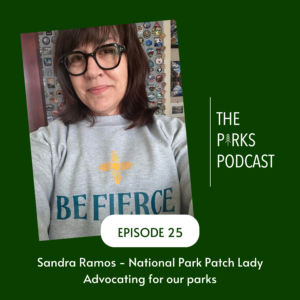
Sandra Ramos – Advocating for our parks
Episode Guest
Sandra Ramos
National Parks Patch Lady
About National Parks Conservation Association
NPCA is a member-driven, nonprofit, nonpartisan advocacy organization on behalf of our national parks. Unlike the National Park Service (a government agency) or the National Park Foundation (congressionally chartered), NPCA is entirely independent — connecting people, parks, and policy. They do conservation work, science work, community organizing, and national advocacy on water policy, wildlife, air quality, and more. For $25 a year, you can become a member and receive their nationally award-winning quarterly magazine.
The Three Organizations — Clarified:
- National Park Service (NPS): Government agency under the Department of Interior. Budget comes from Congressional appropriations.
- National Park Foundation (NPF): Congressionally chartered nonprofit — the official nonprofit partner of the NPS.
- National Parks Conservation Association (NPCA): Fully independent, member-driven nonprofit advocacy organization. No government funding.
What You Can Do — Sandra’s Action Plan
- Call your Congressional representatives — every day: Script: “Hi, I’m a constituent and a supporter of our national parks. The national park in our backyard is [your park name]. It is currently understaffed and underfunded. I want to encourage our representative to support the national park that brings economic value and recreational value to our community.”Sandra’s framework: 27-9-3 — 27 words, 9 seconds, 3 points. That’s your call. Call their Washington office AND every local district office. Call daily. Call Republicans AND Democrats. Republicans — make it personal: find out if they hunt, fish, hike, boat.
Send postcards: Find old park postcards and send them to elected officials. Include the economic argument: jobs, local revenue, visitation numbers.
Contact local officials during National Parks Week (April 19–27): Request 3 minutes on the public comment agenda at your city council or county commission. Give them the economic stats for your local park. No ask required — just share the information.
Go to protests — or support those who do: Follow Resistance Rangers on social media. Follow Lightning Ever (@lightningever). Follow @NationalParkPatchLady. Share everything you see.
Visit parks — but choose wisely: Skip the big parks that are already stressed. Go to small parks where your visit increases their visitation numbers and boosts their case for funding. Support local gateway communities.
Support financially: NPCA membership: $25/year (quarterly magazine, conservation advocacy) Friends groups and park conservancies for your specific park WNPA (Western National Parks Association) — runs park bookstores west of Mississippi Park gift shops and concessionaires
Be kind to rangers: Thank them. Law enforcement, interpretation, maintenance, dispatch, search and rescue — all of them. A genuine thank you is rare and means everything right now.
Show Notes & Links
-
- National Parks Conservation Association — npca.org
- Sandra Ramos on Instagram — @nationalparkpatchlady
- Find your Congressional representative — congress.gov
- National Park Foundation — nationalparks.org
- Western National Parks Association — wnpa.org
- Big Thicket National Preserve — nps.gov/bith
Script for calling your representative (copy and use): “Hi, I’m a constituent and a supporter of our national parks. The national park in our community is [park name]. It is currently understaffed and underfunded. I want to encourage [representative’s name] to support the national park that brings economic value and recreational value to our community. Thank you.”
Transcript
How to Advocate for Your Parks — With Sandra Ramos, the National Park Patch Lady
The Parks Podcast, Episode 25 | Sandra Ramos, National Parks Conservation Association
Note: This conversation was recorded on March 14th. Specific staffing and funding situations referenced reflect that date.
Who Is the National Park Patch Lady?
Missy Rentz: I am so excited to have Sandra Ramos join the Parks Podcast today. Many know her as the National Park Patch Lady, but she’s had a long career in politics and conservation. And while her day job is with the National Parks Conservation Association, we’re not talking about that today. Sandra has visited 257 national park sites and is a big advocate for the parks and the vital role that they play in all of our lives — even if you don’t go visit them. Sandra, welcome to The Parks Podcast.
Sandra Ramos: Thanks so much for having me. I appreciate it.
Missy: So Sandra, you and I were introduced when I was interviewing Gary from Biscayne National Park. And since then, other rangers have said, “You know who you need to meet?” And now I can stop them and say, “Sandra. I know Sandra.”
Sandra: Oh, my goodness. Well, that warms my heart because I think park rangers are the best part of a park. So that warms my heart that rangers say that. It’s been a pleasure to get to know all of them in my travels.
Missy: When we first met and I was dreaming up what this episode was going to be about, never in a million years would I think it’s going to be on this topic — how to advocate for our parks. And I think if people are watching the news, they know what’s going on. But this episode is so important because of your experience in politics and advocacy. I think you’re going to help guide us on what in the heck do we do.
Sandra: I’ll do what I can. I hope I can meet expectations.
Missy: So first — how did you first connect with parks?
Sandra: I had a 20-year career in politics — mostly the campaign aspect, but I also worked for elected officials and did some policy work. My background is in grassroots organizing. I retired from that in 2010, and I really didn’t realize how much of politics had been absorbed into my personality. I was so used to talking about the people I worked for and what they stood for. But I realized after I left that I didn’t have my own. I felt lost and had a really bad depression. A friend said, “Hey, let’s go to Gettysburg and Antietam.” I didn’t really want to go, but I went anyway — and it was my first recognition experience with the National Park Service. I’m a history buff and a history nerd. I particularly love the Civil War and Reconstruction eras — I’m fascinated by the sociology of how our culture in America evolved since then. And so I fell in love. Not having a job, living in Washington, D.C., I learned that there were all these park sites around me and I just started visiting them. I fell in love with being able to talk to really knowledgeable people about parts of our history that were not necessarily taught in schools. These amazing places and vistas and the connection of all of that just really spoke to me. So I started photographing them and putting them on Instagram. And that was that.
Missy: And your handle is National Park Patch Lady. Now, if you’re watching this, this is the first episode we’re launching with video. If you’re watching, you might understand why. But if not — why are you the National Park Patch Lady?
Sandra: Behind me is part of my patch collection. As park enthusiasts — as parkies — we all find that one souvenir item that we like, whether it’s stickers or magnets or mugs. I collect a little bit of all of it, but my main thing is patches. A friend of mine had taken a picture of me in a big black leather chair, and another friend saw the picture and made a meme that said “The National Park Patch Lady on the History Channel.” I posted it for fun, and a bunch of my friends chimed in and said, “Hey, I would totally watch that.” And it stuck.
Missy: Mine is Christmas ornaments. Every Christmas I just relive it. And each of them have a story.
Sandra: Absolutely. I can look at each of these patches on my wall and tell you a story. It feels like a diary of my life that I see every day and that makes me smile. And some of the patches — there’s probably a dozen or so parks I haven’t been to yet, but folks who follow me online have sent me patches from places they’ve been that I haven’t. Even that story warms my heart when I think of this community of folks who love our national parks.
NPS vs. NPF vs. NPCA — The Three Organizations Explained
Missy: I want to explain something people find confusing — people see the National Park Service, the National Park Foundation, and the National Parks Conservation Association. What do each of them do?
Sandra: This happens all the time — I get introduced as working for the Park Service. So: the National Park Service, NPS, is a governmental entity under the Department of Interior. Their allocation and budget comes from the appropriations process of Congress. That’s all government. Then you have the National Park Foundation, which is a congressionally chartered nonprofit — established by Congress to be the nonprofit arm for the national parks. Part of their budget comes from Congress and some they raise on their own. And then we have NPCA, the National Parks Conservation Association. We are a member-driven, nonprofit, nonpartisan advocacy organization on behalf of our parks. The best way to say it is: we connect people, parks, and policy. We do a lot of conservation work, science work that ties into how parks do their science work, and we do a lot that goes from organizing and community levels all the way up to national water policy and wildlife and air quality policy. So that’s the breakdown of the three.
Missy: And it’s important to understand — because there’s a different role each is playing right now.
Sandra: For sure. And when people say, “I want to donate — I don’t know who to give to” — you need to know where your money’s going and what it’s doing for you.
What Is Happening Right Now
Missy: Okay. Let’s spell out what people need to know. And I want to say — this is as of 4:10 PM Eastern time on Friday, March 14th.
Sandra: Right. Because it’s going to change before 5 o’clock. I’m sure there’ll be three more executive orders by then.
Missy: Exactly. And Sandra and I have agreed that if and as things change, we’re going to have more conversations to help people understand.
Sandra: I’m just going to put this in big, super high-level terms so it’s easier to digest. When we entered this administration, the National Park Service was already down staffing 20% across the board. Already understaffed. Then the February 14th mass firing happens — a thousand National Park Service probationary staff fired. And I want to address something: just because they’re probationary doesn’t mean they were in trouble. What probationary means to the National Park Service is you took a new position and had a one-year time period to acclimate to that position in order to be established as permanent. So we have 25-year biologists with the National Park Service who got promoted, were in their probationary period of that job, and were fired. Archaeologists. Historians. Interpretive staff. Maintenance staff. Fire staff. Across the board. Illegally fired. That institutional knowledge is gone.
Sandra: The administration scrambled and said, okay, we’re going to allow 6,000 seasonals hired. That’s a nice number — but on an average year, the National Park Service hires 5,500 seasonal staff across the board. So you’re really only giving us about 500 extra. And we’re already 20% down. And you just fired a bunch of folks. In the last 24 to 48 hours, two judges have said DOGE has to rehire from 18 different agencies including the National Park Service — they have to offer reinstatement to those probationary folks who were fired. As of right now, I have not heard of a park ranger who’s been reinstated across fire service, BLM, or the park service. And there is talk that the administration wants to cut another 30% of staffing. This has probably been the most heartbreaking three months of my entire life, listening to former and current park rangers and their stories about their parks and their colleagues and their friends. The fear and the chaos and the anger and the ridiculousness of this. So that’s where we are.
Missy: And there is also a lot of revenue that comes in through the parks and through the economies in the towns and cities where the parks are. And I would think that number far surpasses the expense of running the national parks.
Sandra: Yeah. The last numbers I saw were something like the Park Service takes in roughly $55 billion in revenue and only expends $5 billion. Let me put this in different terms. Big Thicket National Preserve in Southeast Texas — you’ve probably never heard of it. About 275,000 people visit this park every year. It spans seven counties and 15 discontiguous units. The park supports community-wide 290 jobs in that seven-county region, and brings in almost $20 million to those local gateway communities through lodging, restaurants, outfitters, all sorts of things. In a very rural region where the main employers are the oil and gas industry, you’ve got a park that brings $20 million into that local economy. That’s nothing to sneeze at.
Missy: And so when we talk about funding and staffing being cut, you’re also talking about revenue to the diners and the gas stations and the taxes to those communities. I don’t think the ripple effect has been communicated yet.
Sandra: Right. And in the big parks, they know — Springdale outside of Zion, they’ve been protesting since the first day. The big parks know. Arches. Canyonlands. Yosemite. Yellowstone. It’s the parks like Chiricahua in Arizona — a park that looks like a big park but doesn’t have the infrastructure. But now they’re down staff. And if folks detour to Chiricahua because Saguaro is now closed two days a week due to staffing cuts — what does that look like for those small parks?
Censorship and the Erasure of History
Missy: Let’s talk about the third thing — censorship. What history, what science is being deleted?
Sandra: Again, prefacing this as of March 14th — even in just the last 24 hours, I was reading that Arlington Cemetery’s website has scrubbed every mention of every woman or person of color buried in the cemetery. And there is a list the New York Times posted this week of all the words that were banned — female, cultural heritage, indigenous, tribal. The Park Service can’t even do their work without a lot of this language. And the Park Service was just coming into doing a really great job of changing a lot of their very uncomfortable, written-in-the-1970s wayside and interpretive materials. And now here we are. There is a rumor that any national monument established through the Antiquities Act that has anything to do with anything the administration doesn’t approve of is going to be nixed. Parks like the recently established Francis Perkins National Monument in Maine, or the Carlisle Indian School, or Blackwell School in Marfa, Texas — established just last September. They’re really trying to wipe away a lot of history.
Missy: One of the things I think the National Park Service has done well is owning up to both the good and the ugly — just telling the story. And it makes me mad and sad to see that gone. I got an email the other day about a home in Raleigh — because the priest was an advocate for LGBT, it’s just gone.
Sandra: I mean, it’s fascinating to think that this administration believes they can just press delete and wipe it away. And that is really where it’s important for all of us to be involved and use our voices. I spent 20 years in political campaigns. I’m not one who believes a voice doesn’t count. If everyone who said “my voice doesn’t count” stood in a room together, you’d have a full room. I encourage my friends to do one thing every day. Just one. Tell a person at the grocery store about national parks. Call your grandmother and tell her to call her representatives. Wear a t-shirt — I stand with park rangers. We have to fight back. We have no choice. And no one has an excuse not to be.
What’s Being Done — And What You Can Do
Missy: So what is currently being done? Maybe we divide this into what politicians are doing and what citizens are doing.
Sandra: What politicians are doing — I couldn’t tell you. I don’t know what they’re doing. Obviously everybody’s playing whack-a-mole right now because the administration is purposely trying to create chaos — the more chaos they can create, it’s the smoke to what they’re really trying to do. And my boss recently came out with a statement that this could be the beginning of the end of our national parks, ranger by ranger. We need to take that really seriously.
Missy: So okay — do protests work?
Sandra: Yes, if they’re done well. The thing about organizing — the side that is more conservative is really great at getting lockstep, all knowing the message, all doing the same thing in unison. The progressive side is really great at including everybody but really bad at getting behind one concise message. It drives me nuts when I go to a women’s march rally and there’s science and schools and education all on one sign. Yes, those are all issues — but today is this issue. So show up to the parks march with a park sign. Be inclusive in that community. The more you can build those communities and network them, the stronger we can be.
Sandra: Two weekends ago, the Resistance Rangers organized the entire country and tried to host 433 rallies in 433 parks. They got up to about 175. As NPCA, I wasn’t allowed to participate in a protest. But as National Park Patch Lady, I certainly could. And so I put together the Big Thicket Rally — the middle of nowhere, Southeast Texas, an hour and a half from Houston. In 72 hours that I put it together, 30 people showed up. And I posted pictures on Instagram — I think I’m up to 29,500 people who liked that particular post about my protest. And I’ve had people messaging me: “I never heard of Big Thicket. Where is it? What is it?” I had more traction from the aftermath of my protest than from the protest itself. Do protests work? Is my goal to bring visibility to my park and my issue? Absolutely. Did I do that? Absolutely.
Missy: For me, I felt connected to like-minded people and therefore I was energized. I kind of got rid of some of the discouragement. I left feeling filled with hope.
Sandra: Yeah. And I encourage you to go to those rallies — John, the former park ranger who put together the D.C. rally, is exactly the type of protest I want to support. So if you talk to him, please tell him I’m giving him good vibes.
How to Advocate — A Practical Guide
Missy: People listening — how do we advocate for parks?
Sandra: If you had asked me this question three months ago, it would be very different. The most important thing is to use your voice every day. At least one time every day. Make that commitment — I’m just going to do something. Wear a t-shirt. Talk to somebody in line at the grocery store. Use your voice on social media. I am disappointed that so many people who post beautiful pictures from parks and talk about their trips are not saying anything right now. You don’t know everybody who’s following you. You don’t know why they follow you. And if you can reach somebody who’s never done any type of activism before and get them to do something — you won the day.
Sandra: Send postcards to your representatives. If they support our parks already, thank them for their support. If they don’t, tell them why it’s important. I’ve been encouraging folks in my region to call our Republican congressmen once a day, every day.
Missy: What do you say when you call?
Sandra: “Hi, I’m a constituent and a supporter of our national parks. The national park in our backyard is [park name]. It is currently understaffed and underfunded. I want to encourage our congressperson to support the national park that brings economic value and recreational value to our community.” That’s it. I call it a 27-9-3. Twenty-seven words, nine seconds, three points. That’s your elevator pitch. Call every day. Call their congressional office in Washington. Call every local office in the district. If you don’t like calling — and I don’t blame you, I ran phone banks for a long time — send a postcard. I recently went through all of my park gear and found an entire sack of postcards I never sent. Some of them are even stamped with the date I visited. These are now going to go to elected officials to support our parks.
Sandra: So calling is most important. Call every day, call every office, whether Republican or Democrat. If they’re Democrats who support your park — call them every day too. What that does is put national parks on the priority list. Everything right now feels like a priority — Social Security, Medicare, veterans, environment. But if national parks are that important to you, put it on their radar. And one important number to know: there has been a 20% decrease in funding and a 16% increase in visitation. That’s what you tell your members of Congress.
Missy: April 19th to April 27th is National Parks Week. Is anything being organized that we should be prepared for?
Sandra: I don’t know specifically, but here’s what I do every National Parks Week. I call my local county commissioners or city council and ask to be put on the public communications list. You get three minutes. And I go in and I say: “I want to let you know about something you probably don’t know about, and I want to wish you a happy National Parks Week.” I talk about the national park in my backyard and say thank you. The reason I encourage this is you’re not asking for anything. You’re giving them information and showing your passion. You can say: “Our national park brings in $20 million to our local economy, over 270,000 people visit here, and it supports 290 jobs in our community.” Just talk about it. And if you don’t want to do that for National Parks Week — go to a small national park and send postcards to park rangers to thank them for their service. Right now they are feeling so beaten up.
Should You Visit Parks Right Now?
Missy: With everything going on — should we still be visiting our parks?
Sandra: It’s the individual’s call. Here’s what I will say. There are a lot of people who don’t do the requisite investigating of a park before they show up. And even though you may know the park is understaffed — what if you fall on the trail? What if you get into some sort of accident? A lot of things can happen in the wild. So my advice is: skip the big parks and go to a small park. Most small parks still have trails and great vistas. You still get flat hat rangers to talk to you. You get all the things — but you’re not creating more stress on the infrastructure or on the park rangers. Parks like Big Bend only have roughly 85 rangers for a park the size of Rhode Island. Three-hour lines to get in. Go to a smaller park instead — go to Guadalupe Mountains, go to Chamizal in El Paso. What that does is increase their visitorship, which allows for them to get more funding. And the one thing you want to know to tell your members of Congress: there has been a 20% decrease in funding and a 16% increase in visitation.
Missy: And if you are visiting — what should you be doing differently right now?
Sandra: Don’t rely solely on nps.gov or the NPS app at this point — a lot of the websites have not been updated because of understaffing. It may be worth emailing the park if they have an email, or checking online communities to see what folks are saying on the ground, or calling the bookstore and asking if someone can call you back with current information. And bring a trash bag and pick up trash while you’re there. Do not complain about what the park looks like given the circumstances. And please, please make sure that you’re kind to your park rangers. I had a friend from a South Florida park who messaged me to say the lines were long and visitors were yelling at them that they were taking too long and that they hoped Trump fired them. These folks are the most dedicated patriots you could find. They deserve so much better. Leave no trace policies, be kind to rangers, be kind to visitors, and be kind to yourself in this process.
Ways to Support Parks Without Visiting
Missy: What are ways to support the parks if you’re not visiting?
Sandra: Donate to NPCA and the National Parks Foundation — they’re both donor-driven organizations. But there are also the friends groups and park conservancies that do a lot of work on the ground that don’t get the big park attention. If you have a specific park you have an affinity to, see if they have a friends group and donate to them or donate your time. WNPA — the Western National Parks Association — runs all of the bookstores west of the Mississippi for a lot of small parks and for Saguaro, and they put together all the educational opportunities for parks in the west. And think about your gift giving. Make your gifts in 2025 a little more cause-related. Buy the t-shirt. Buy a gift from a national park store. For $25 a year, you can be a member of NPCA and get a nationally award-winning quarterly magazine about national parks. Buy somebody that gift.
Speed Round
Earliest park memory?
Gettysburg, 2012.
What made you love the parks?
Park rangers.
Favorite thing about parks?
Park rangers.
Favorite thing to do in a park?
Junior Ranger books.
Park on your bucket list?
The entire upper Midwest. Places like Isle Royale and Voyageurs just look absolutely epic, and I just have not gotten to anywhere north of Missouri.
Three must-haves for a park visit?
My passport stamp book. “I brake for brown sign” stickers. And a refillable water bottle.
Favorite campfire activity?
S’mores.
Tent, camper, or cabin?
Tent.
Hiking with or without trekking poles?
Always poles. I’m old.
Favorite trail snack?
Almonds and That’s It fruit bars.
Best animal sighting?
The first time I saw a wild honu in Hawaii. I’d never seen a large turtle like that. It was amazing.
Favorite sound in the park?
The sound of rustling leaves.
Greatest gift the parks give to us?
Community. Hope.
Missy: Sandra, thank you for joining us today. I am so grateful to have met you, to have had this conversation, and to have you as a leader showing me how to lead this resistance lifestyle that is new to me. Thank you.
Sandra: Thank you. I appreciate it. It’s my pleasure.
Missy: You can reach and follow Sandra at National Park Patch Lady on all social platforms. You can follow The Parks Podcast on all social platforms — we reshare information constantly from credible sources. I encourage you to follow the Resistance Rangers, who are doing phenomenal work right now. We are both committed to making sure we help everybody understand what we know, to the best of our ability. And if you have questions, ask us. Thanks for listening. Until the next time — we’ll see you in the parks.
Music for The Parks Podcast is performed and produced by Porter Hardy. Follow us @TheParksPodcast or visit TheParksPodcast.com.