
I went to Saguaro as a day trip, and I am going to be honest with you about it.
It was really pretty. I took a beautiful hike through the cacti and I drove the eight-mile loop on the east side.
And that is about what I have.
Nothing in particular stuck out. I was on a bit of a timetable, and I suspect that is most of the reason — I do not think I did this park justice. There is a lot here I would like to see and I did not see it.
I could write you a version of this where I sound moved. I would rather tell you I was rushed.
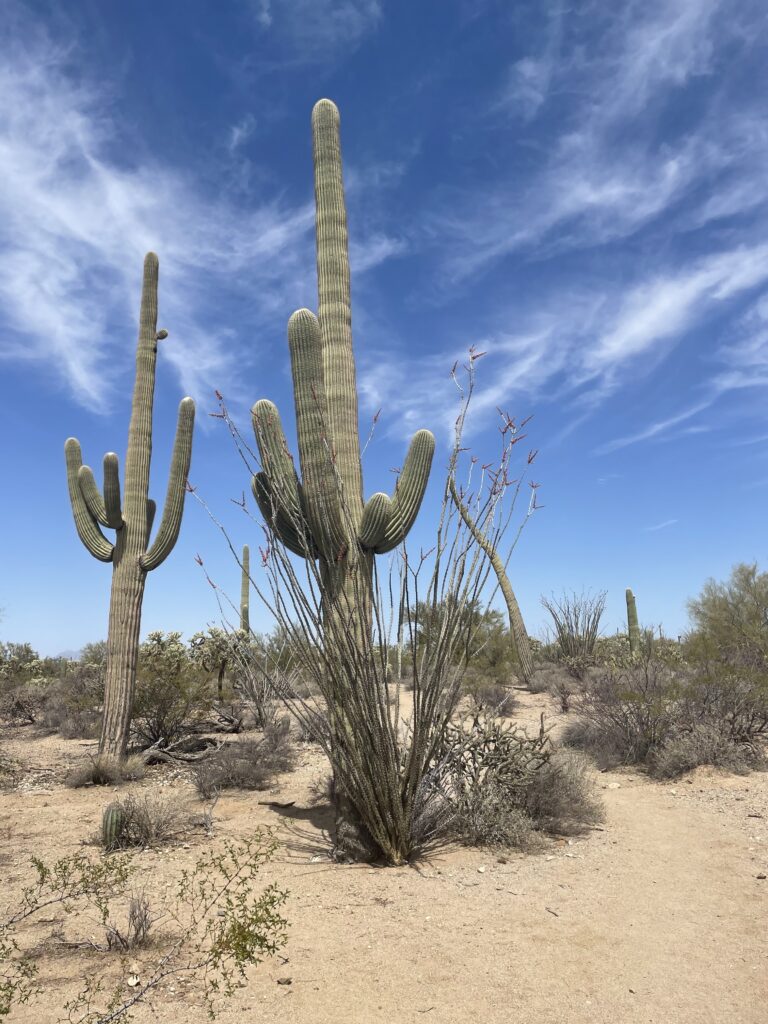
What I did not know I was looking at
Here is what I have learned since.
The saguaro grows essentially nowhere else on earth. It is endemic to the Sonoran Desert — western Arizona and a stretch of Mexico. There are about thirty wild ones in California and none at all in Nevada, New Mexico, Texas, Colorado or Utah. What I drove through is not a kind of desert. It is very nearly the only place.
They live a hundred and fifty to two hundred years.
And they begin almost unimaginably slowly. A saguaro is about a quarter of an inch tall after two years. It can take twenty to fifty years to reach the height of your waist.
Then there are the arms. A saguaro usually does not grow its first arm until it is somewhere between seventy-five and a hundred years old — and plenty never grow one at all. A big one can carry more than fifty.
So every single armed cactus in the photographs I took is older than a century. Most of what I walked past has been standing there since before anyone I have ever met was born, and I went through it on a schedule.
A full-grown one tops forty feet. The tallest ever recorded was seventy-eight, until a windstorm took it down in 1986. And when they are full of water they can weigh three to five thousand pounds — nearly all of it water they are holding against the next drought.
I wish I had known any of that while I was standing in it.
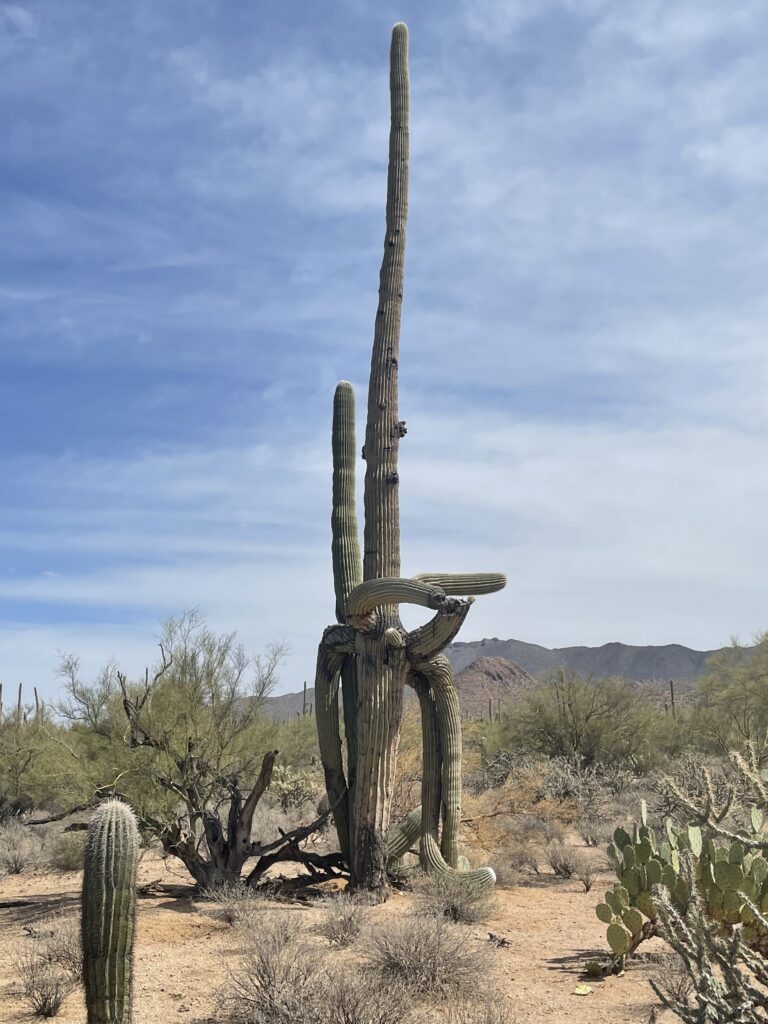
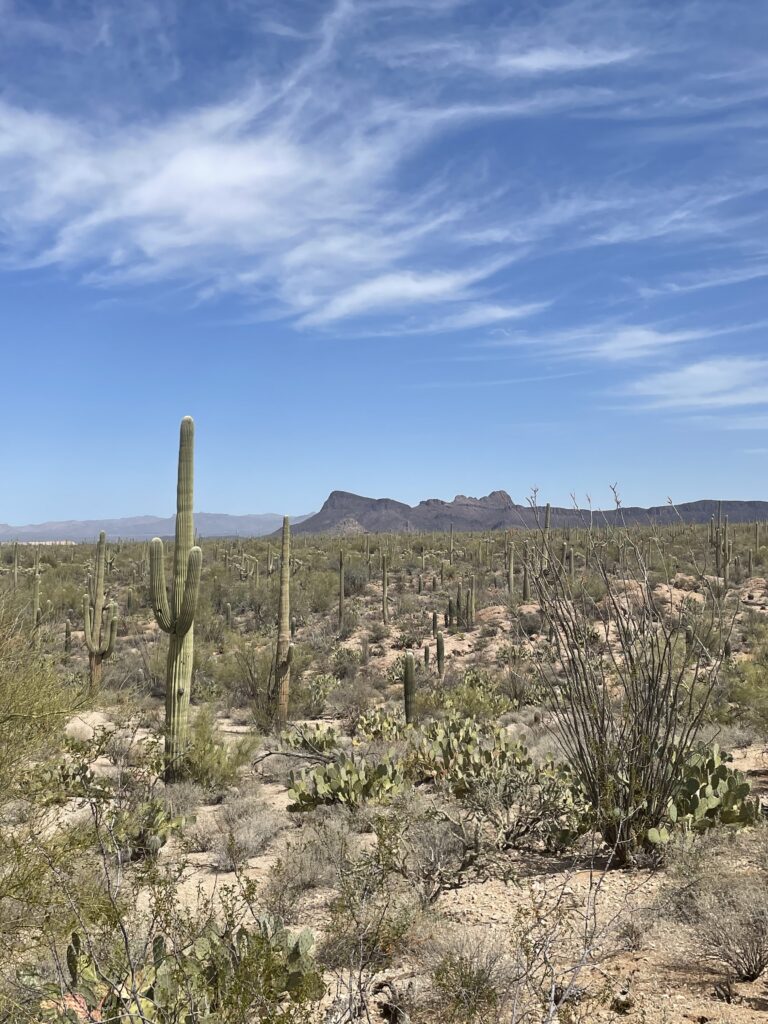
How much bigger this park is than the part I saw
There are two halves to Saguaro, on opposite sides of Tucson. I was on the east side — the Rincon Mountain District, and the eight-mile paved loop.
What I did not realize is that the east side does not stay desert.
It is the larger and more remote of the two, and it climbs. All the way up to Mica Mountain at eight thousand six hundred and sixty-four feet. As it goes up, the saguaro gives out, the ground turns to grassland, and then it turns into forest.
So the park I drove around in an afternoon has a mountain range on the back of it, and the loop road runs along the bottom edge of it.
I am not telling you that to say I should have climbed it. I am telling you because I had no idea, and I think most people driving that loop have no idea either. It is a much bigger place than the afternoon suggests.
Two practical things
Bring water. Emphatically that kind of place, and it is not the sort of heat you negotiate with.
And if you are traveling with a dog, read the rules before you plan a hike. I did not have Tootsie with me, and it would have been far too hot for her anyway — the park warns specifically that burned paws are a common injury out there.
But the heat is not the only obstacle. Saguaro allows dogs on only a handful of short trails and the scenic drives, and bans them from every other trail in the park. So the hike I did is not one she could have come on, whatever the temperature.
That is worth knowing before you drive out with a dog in the back expecting a day of it.
Would I go back
Yes. Not for a day next time — as a destination.
There is a lot I did not see. And now I know roughly how old it is.
Plan your visit
Where: Tucson, Arizona. Two separate districts on opposite sides of the city. The east district is about 17 miles east of Tucson.
Rincon Mountain District (EAST) — Cactus Forest Loop Drive, 8 miles, paved. The larger and more remote half, rising to Mica Mountain at 8,664 ft. Rincon Mountain visitor center.
Tucson Mountain District (WEST) — Bajada Loop Drive, 6 miles, unpaved graded dirt. Denser stands at lower elevation. Red Hills visitor center.
Neither loop takes vehicles over 8.5 feet wide or 40 feet long.
Bring water. More than you think.
East-side trails
Cactus Forest Trail — 5.5 miles through the desert interior, separate from the loop road
Loma Verde / Squeeze Pen Loop — 3 miles
Hope Camp Trail — 2.8 miles
Ridge View Trail — 1.1 miles
Mica View Trail — 1 mile
The densest saguaro is along the southern part of the loop, on foothills with better drainage.
The part most visitors never see
The east district does not stay desert. It climbs to 8,664 feet at Mica Mountain, and as it rises the saguaro gives way to grassland and then forest.
There are six backcountry campsites, reachable only on foot, and backpacking is permitted — if that is your kind of trip.
If you only drive the loop, you are seeing the bottom edge of a mountain range.
About the cactus
Endemic to the Sonoran Desert. About 30 wild saguaros in California; none in Nevada, New Mexico, Texas, Colorado or Utah.
Lifespan 150 to 200 years.
About a quarter of an inch tall after two years. Twenty to fifty years to reach a meter.
First arm usually at 75 to 100 years old — some never grow one. Mature plants can carry 50 or more.
Over 40 feet at full height. Tallest recorded: 78 feet, lost to a windstorm in 1986.
Fully hydrated, 3,200 to 4,800 pounds, nearly all of it water.
Pets — read this before you plan a hike
Saguaro is one of the more restrictive national parks for dogs, and it catches people out.
Leashed dogs — six-foot leash — are allowed only on:
East (Rincon Mountain): Mica View Dirt Road (1.5 mi), Mica View Trail (0.7 mi), Desert Ecology Trail (0.25 mi, paved), Cactus Forest Loop Road
West (Tucson Mountain): Bajada Loop Drive, Desert Discovery Trail (0.5 mi, paved), Golden Gate Road
Dogs are prohibited on all other trails. The park’s reasoning is wildlife disturbance and disease transmission.
And the heat is a hazard, not a caution. The park states that burned paws from hot desert sand are a common injury, particularly in dogs not acclimatised to it. Add cactus spines, rattlesnakes and scorpions.
If you are bringing a dog: plan the short paved options, go early, or leave the hiking for another trip.
What I’d do next time
I’ve never left a park knowing everything about it. Here’s what I’d do differently next time — and I’ll add to this as I find out more.
Give it a whole day, with nothing after it. I was on a timetable and it showed. There is a lot of this park I did not see, and I would like to walk it slowly knowing that most of what I am walking past is older than a century.
Traveling with a dog? Where I Would Actually Take My Dog is every park on this site, sorted by whether she can do the activities you came for.
Road conditions, pet rules, backcountry permits and visitor center hours change. Check with the National Park Service before you go — details here were verified in September 2026.