
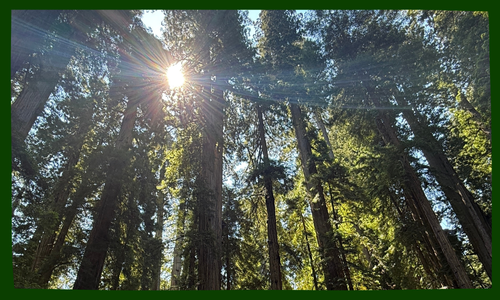
Redwood National and State Parks gave me an escape from summer heat. I sat by a river and watched eagles catch breakfast. I wandered among massive trees, listening to them chatter. I stood on the shore and watched waves crash like I’d never seen before. Redwoods became my summer heaven — and I can’t wait to go back.
Patrick Taylor — Interpretation and Education Program Manager at Redwood National and State Parks — joins me to talk about everything that makes this park unlike anywhere else. Why two thirds of the park was logged before it became a national park. How the California condor came back from near extinction. What the difference actually is between a redwood and a sequoia. And why this may be the most dog-friendly park in the entire National Park system.
A note from Missy: I hiked Cal Barrel Road with Tootsie on this trip and it was one of my favorite park days ever. Patrick’s description of the silence inside the old growth forest — “not the hard silence of a cave or a desert, just this very soft silence” — is exactly what I felt.
Episode Guest
Patrick Taylor – Interpretation and Education Program Manager
Redwoods National and State Parks
Key Topics
- Why the Redwood Expansion Act (1978) codified standards for all 433 NPS units
- The national-state co-management marriage since 1994 — NPS and California State Parks sharing staff
- Redwoods vs. sequoias: siblings — one football player (stocky sequoia), one basketball player (tall redwood)
- Angel rings: offspring trees in a perfect circle around a decayed parent
- Two thirds of the park was logged before becoming a national park
- Redwoods Rising: removing dog-hair forests, daylighting streams, California condor restoration led by Yurok Tribe
- Planning tip: download NPS app, save for offline maps, identify your ONE must-do
- Camping: all campgrounds are state-owned — use ReserveCalifornia
- Dog-friendly: Cal Barrel Road, Walker Road, all beaches — grab the free bark brochure
- Smith River: only undammed river in California; the hidden gem of the north end
- Layers year-round; fog/sunlight photos require early morning or winter visits
Show Notes & Links
- Redwoods National & State Park
- Save the Redwoods League
- California Department of Recreation
- Redwoods Park Conservancy
Episode Transcript
Redwood National & State Parks
The Parks Podcast, Episode 58 | Patrick Taylor, Interpretation and Education Program Manager, Redwood National and State Parks
Welcome and Park Stats
Missy Rentz: In this episode, I’m excited to welcome Patrick Taylor, who is the Interpretation and Education Program Manager at Redwood National and State Parks. Patrick, welcome to The Parks Podcast.
Patrick Taylor: Yes. Thank you. Really excited to chat with you today.
Missy: I am too, because I was at Redwoods this summer and I fell in love with it. So let me start with some park stats. The park is located in Crescent City, California. It was the 33rd National Park, created on October 2nd, 1968 when Lyndon B. Johnson was president of the United States. The park is 138,999 acres. Its lowest elevation is sea level and the highest elevation is 3,262 feet — Coyote Peak. In 2024, there were close to 2 million visitors to the park. The park is made up of 71,715 acres of federal land and 60,268 acres of state park land. The old growth forest makes up 38,982 acres. The tallest redwood is currently 379 feet. The park has between 40 and 100 inches of rainfall every year — which is mind blowing to me. On a visit, you may see California sea lions, Roosevelt elk, salamanders, and banana slugs, along with 33 mammal species, 280 species of birds, 188 species of marine and freshwater fish, and 621 native plant species. This park is mind blowing. It is beautiful. So let’s start with why it’s important that Redwoods National and State Park is part of the National Park system.
Patrick: Yeah, so I think there are two layers to that answer. The first one is very park specific — people come from around the world to experience the tallest trees on the planet, and that’s within Redwood National and State Parks. Walking through the old growth forest, seeing all the wildlife you just talked about, coming here for this experience is the first layer of why it’s important this park was preserved. It’s just a deep place of connection, of meaning. I’ve been fortunate to work in several national parks. In every park you work at, there are people that love it and say, this was a great experience, I’m so glad I came. But this is the one where people seem to have this very deep, core connection — like, oh, something in me turned on that I didn’t know was there. Somehow I feel like these trees are my friends. People just come here — accountants, teachers, whoever they might be — and just have this kind of deep connection with nature that we often forget about.
Patrick: The additional layer is that Redwood National Park specifically was created in 1968 and expanded in 1978, and that expansion act is very important because it codified in federal law what all National Park Service sites mean. We often talk about national parks — there are 60-plus proper national parks like Yosemite and Olympic — but there are hundreds of sites within the National Park Service. Presidential birth homes, Civil War historic sites, seashores, memorials. The Redwood Expansion Act codified that all of these sites, whether they’re a proper national park or not, are going to be treated, operated, and maintained to the same standards. So for the Park Service as an agency, the Redwood Expansion Act was very important in solidifying: we treat them all the same.
The National-State Park Marriage
Missy: This park is unique — it’s a national and state park. How in the world does that work?
Patrick: The way I describe it to people is it’s almost like an arranged marriage — they can work amazingly, and lots of times there are a lot of benefits to them. The state parks that managed the Redwoods in this area were here 50-plus years before the National Park was created. They’ve been preserving and protecting some of these groves and forests since the 1920s. When the National Park was created in the late sixties, the idea was that California would just hand the state parks over to National Park management. State parks said no — we’re perfectly happy managing these ourselves. Why would we just give them to you?
Patrick: So in 1994, we signed the co-management plan that says we’re going to manage the resources within three state parks and the national park for the betterment of the resources and visitor experience. Like any relationship, it has its ups and its downs. But by and large, everybody would agree it is for the betterment of everybody. One example: most of the National Park Service maintenance staff and all the equipment is based in the far north in Crescent City. A lot of the state park staff and supplies are in Eureka, a couple hours south. So if there’s a state-park-owned road that needs to be regraded because of flooding, and we have an entire federal workforce two miles away — the co-management allows us to just share staff and solve the problem. If you walk into any of the five visitor centers collectively across the park, you’re just as likely to see a National Park employee, a state park employee, or a Redwood Parks Conservancy nonprofit partner working there, regardless of who technically owns the piece of land it’s sitting on.
Redwoods vs. Sequoias — Siblings
Missy: California is very lucky to have big trees. What is the difference between redwoods and sequoias?
Patrick: I would say redwoods and sequoias are siblings. Redwoods’ scientific name is Sequoia sempervirens — so they are a sequoia. I like to say they are siblings. One of them grew up to be a professional football player — it’s stocky and solid. The other one grew up to be a basketball player — it’s tall and thin.
Missy: Brilliant.
Patrick: They’re very similar — similar tannins, they keep insects out, they grow to tremendous heights. But they do have their differences. Sequoias — the tallest are going to be slightly smaller in height than the tallest redwoods. Redwoods often taper and get narrow a lot faster, whereas the sequoia stays pretty broad. Coastal redwoods generally don’t go more than a couple miles inland. The sequoias are all in the Sierra Mountain range, a little bit further inland. If it’s really thick vegetation in a photo, it’s probably a redwood. If it’s a little more cleared out, it’s probably a sequoia.
Patrick: There’s also a phenomenon called angel rings, where you’ll have one big redwood that grows for centuries, and then around it, all of its offspring — which might be genetic clones — start growing up around the parent tree. The parent tree eventually dies, rots away, and you have this perfect concentric circle of redwood trees. It’s a little odd when you’re walking around feeling like, what happened right here? Why is there a perfect circle around me? Because those are usually the offspring of the tree that used to be in the middle.
Old Growth — and Why Two Thirds of the Park Was Logged
Missy: What is an old growth forest?
Patrick: The old growth is essentially a forest that has not been logged. And one of the things that surprises people a lot about this park is that the majority of Redwood National and State Parks — two thirds of it — was logged prior to it becoming a park. So most of our work here is actually spent doing restoration rather than preservation. The old growth is the area that was never logged — not to say it was never touched. We know that the tribes around here did practice burning for centuries. But it was never commercially logged. The trees can be up to 2,000 years old.
Why Redwoods Only Grow Here
Missy: Why do they only grow where you are?
Patrick: Their range is essentially the Bay Area up to the Oregon border. For the coastal redwoods to thrive, they need a lot of water. But they don’t just get it from rain — they get it from the fog. Essentially coastal redwoods are not going to do well anywhere where there isn’t regular amounts of fog, and that pretty much limits it to the coast.
Redwoods Rising — Restoration at Scale
Missy: Let’s talk about the conservation efforts at the park. What are the big projects?
Patrick: The biggest one is called Redwoods Rising. Most of the park was logged and then became a National Park later on. From the beginning there was a mission to restore those disturbed areas to old-growth-like conditions. I think the biggest surprise for visitors is that one of the main things we spend our time and energy on here is cutting down trees — and that’s shocking for people to hear. But if you imagine there was an old growth area that maybe had 50 trees on it, it got logged, and then the timber companies planted 500 trees in that same parcel, intending to come back and log again. Then they didn’t come back because it became a national park. And so for 50 years this oversaturated ground has grown into these really thick forests that we call dog-hair forests — devoid of life because they’re so thick that nothing can survive on the ground. The animals can’t live there because there’s no diversity. So we go in and remove a lot of the trees that shouldn’t have been there to begin with.
Patrick: We also do road removal. When the logging companies were here, they put in a lot of roads to get their equipment to the big trees, and most of those roads would cross over stream beds and fill them in with dirt. That blocked the streams so fish species and amphibians couldn’t move anymore. Redwoods Rising is forestry, removing roads, and daylighting those streams — opening them back up mostly for aquatic species to have areas to live and thrive again.
Patrick: In addition to Redwoods Rising, there’s also a condor restoration program here. Condors were gone for over a century, and just a couple of years ago they were brought back, primarily from work done by the Yurok Tribe, on National Park Service land. The condors are a major success story in our restoration. And along that vein, there’s been a big emphasis on restoring tribal involvement in the park — whether that’s them leading programs, participating in cultural burns, or playing a role in management decisions. Really trying to ensure that the tribes have a greater role in preserving this land that they know more about than any of us.
Missy: This was tribal land. And it’s important that they’re back involved in what was their land.
Patrick: Yeah. We’re fortunate here — there are several tribes we work with and they’re all very engaged, very supportive. And one of the things I’m still learning to change my mindset about is not how can we tell their stories, but how do we let them tell their stories on our facilities. That’s been a big push of the park over the last couple of years.
Planning Your Visit
Missy: Let’s talk about planning a trip to visit Redwoods. What’s the first step you recommend?
Patrick: One step, but three stages. Download the National Park Service app. Go to Redwood National Park and save it — that will allow you to access all the data if you’re offline. Most importantly, the map will still work with your GPS pin when there’s no cell signal. And then the last step is find the one thing you’re most excited to experience when you get here. Make sure you keep the first thing the first thing — I’ve seen people get so distracted by the cool other things that at the end they say, oh, we never made it to Stout Grove, and that was the one thing we wanted to see.
Missy: One of the things that was challenging for me when planning was navigating the national-state marriage. Where do I get camping reservations?
Patrick: If you want a campground within Redwood National and State Parks, you need to go to ReserveCalifornia — all of the campgrounds are owned and managed by the state parks. For the rest of the planning — what’s open, what are the trail conditions — I would say a lot of that you’d want to go to the National Park Service webpage or the NPS app. And when you get here, walk into a visitor center and ground-truth whatever you think with a ranger.
Missy: It’s a long park. How would you recommend someone decide what part to visit?
Patrick: Ideally you would spend at least two days here, one in the north, one in the south. Down in the south end, there are more options for trails — so if you just want to maximize hiking time, the south is probably a little bit better. If you’re a little more interested in diversity — you also want to be on the coast, maybe kayaking the river, walking your dog on the beach — then the north is probably more appealing. The biggest difference is the Smith River. There’s a saying I heard when I moved here: you come for the trees but you stay for the river. The Smith River is the only major undammed river in California. It’s about the clearest water you’ll ever see. That’s the one resource the north offers that the south doesn’t have an equivalent for.
Weather, Layers, and Getting That Fog Photo
Missy: I visited in the middle of summer and I was in a sweatshirt and sweatpants the whole time. How do people prepare for the weather?
Patrick: Layers is the only right answer. Even in the summer, most mornings are pretty chilly here — the bottom of the forest floor often doesn’t get any direct sunlight, even on summer days. I’d recommend: a t-shirt, a light sweater, and then a raincoat. You can get away with that almost year round.
Patrick: The other thought is about timing. When people come here, the photo they want is where there’s fog and sunlight beaming through all the different layers of the trees. The best time to get that is when the sun is still low on the horizon — which means, if you’re coming in the summer, you’ve got to get going really early in the morning. Come in the winter and you have a lot of daylight hours where the sun’s pretty low.
Activities and Dogs
Missy: What activities can people do when they’re visiting Redwoods?
Patrick: Scenic drives — we’ve got a couple of amazing roads where you go straight through the park, never get out, and still have a life-changing experience. There’s a lot of areas where you can bike, some mountain bike routes, horseback riding in the forest and on the beaches, kayaking, fishing, birding, wildlife watching, mushroom hunting. I’m probably missing two thirds of the list.
Missy: And one of the things I just want to shout from the mountaintop — your embracing of dogs was better than any park I have ever been to. Down to the fact that when I went to get a brochure, they gave me a dog-friendly one with a listing of dog-friendly hikes and beaches.
Patrick: My understanding is this is another benefit of that marriage with California Department of Parks and Recreation — they just holistically embrace dogs a little bit more than the national parks do. There are several areas you can take dogs in the old growth forest, the beaches are all open — they do need to be leashed. That bark brochure, if anybody’s coming, is the best one to get the specifics. Cal Barrel Road is probably the one you went on. Or Walker Road way up to the north — those are the two best spots.
Speed Round
Earliest park memory?
Lehman Cave at Great Basin National Park. My family would do a cross-Nevada road trip on Highway 50 — known as the Loneliest Road in America — about once a year. There’s not a lot to stop and do there, and that’s where we would always stop.
What made you love the parks?
I grew up not with a family that sought out park experiences. We did go camping once or twice a year — usually local county parks, a lot of junk food, the car 10 feet away. But what it was, was just having fun and realizing the outdoors is a fun place we can enjoy. It’s not something scary. That’s what initially turned the key in me. Then learning more about the Bureau of Land Management, the Forest Service, and the Park Service — the Park Service mission just resonated with me a little bit more than the others.
Favorite thing about Redwood National and State Parks?
How accessible it is — you can show up with very little planning, not knowing where you’re going or what you want to do, talk to a ranger, and 10 minutes later be having an experience you’ll tell people about the rest of your life.
Favorite thing to do at Redwood National and State Parks?
Show it to people for the first time. Seeing people’s reaction to the trees rekindles something in me. But more specifically — hike in the redwood forest. Then go walk on the beach.
Park on your bucket list?
I’ve not been to Alaska at all. All the Alaska parks, but probably Kenai Fjords specifically — to go out and see the glaciers and the whales.
Three must-haves for a park visit?
The National Park Service app. Flexibility — there is almost zero chance you’re going to show up at a national park and everything’s going to go exactly as you want. And treats — I have five daughters and we quickly learned that if the kids aren’t having fun, mom and dad don’t have fun. It’s amazing what treats can solve.
Favorite campfire activity?
Eating s’mores. And then our twist is listening to the Camp Monster podcast series — something our kids really like, and it gives mom and dad a break from being creative.
Tent, camper, or cabin?
At this point we’re a camper family. I mentioned all the kids — the tent wasn’t working out so well anymore.
Hiking with or without trekking poles?
Here in Redwoods, typically without — most of our hikes are not super long nor do they have a lot of elevation gain. But if I’m doing a long hike, then I bring the poles.
Favorite trail snack?
Li hing mui — dehydrated mangoes with a plum powder. I lived in Hawaii for a few years and it’s this incredible combination. Natural sugar, and I get to tell myself it’s fruit so I can eat as much as I want and not feel guilty.
Best animal sighting?
The California condor. It’s not a guarantee if you come to Redwood — most people don’t see one. But if you go to the right places and look for them, and especially if you know the story behind how many people put in the work and what it means not just to the natural environment but to the cultural significance of the tribes — it’s just incredible to see a living, breathing animal that’s here because of what people have done and sacrificed to bring it back.
Favorite sound in the park?
Silence. But the silence here in the redwoods is different. When you’re deep in the old growth forest and there’s not other people around and you really stop, it is surprisingly quiet. Redwoods are not super conducive for insects to eat, so there’s not as many insects, hence not as many birds and other predators. Sometimes you can’t hear anything, but it’s like a very soft silence. How often in our life is there nothing?
Greatest gift the parks give to us?
A sense of place and belonging. When we come to parks — especially the big natural parks — we see a giant redwood in a lush forest, or the Milky Way over a dark desert park, or the ocean from the coast, and we feel very small. But I never feel a deeper sense of connection to the world around me when I’m doing that. The gift of parks is that it really helps cement the relationship we have — that we’re a part of the earth, not apart from the earth.
Missy: Patrick, thank you so much for joining me today. Thank you for the stories and the history and the information on Redwoods. I feel like I got to relive my first experience just in conversation today, and I’m very grateful to you for that.
Patrick: I appreciate it. Thank you. It was nice talking.
Missy: Thanks for joining us for today’s episode. Until next time — we’ll see you in the parks.
Music for The Parks Podcast is performed and produced by Porter Hardy. Follow us @TheParksPodcast or visit TheParksPodcast.com.