
I freaking loved Petroglyph.
Start at the visitor center, and I mean it
Petroglyph is in Albuquerque – a monument co-managed by the National Park Service and the City of Albuquerque.
The visitor center is separate from all the places you actually go to see the petroglyphs. There are no petroglyphs at the visitor center at all.
That sounds like a flaw and it is not. The place is built to send you somewhere. You go in, you tell them what you are working with — how much time, how much mobility, whether you have a dog, how hot it is — and they tell you which canyon to go to.
I always recommend stopping at a visitor center first. Here it is not optional advice, it is how the monument is designed.
They also have an amazing gift shop.
The trail
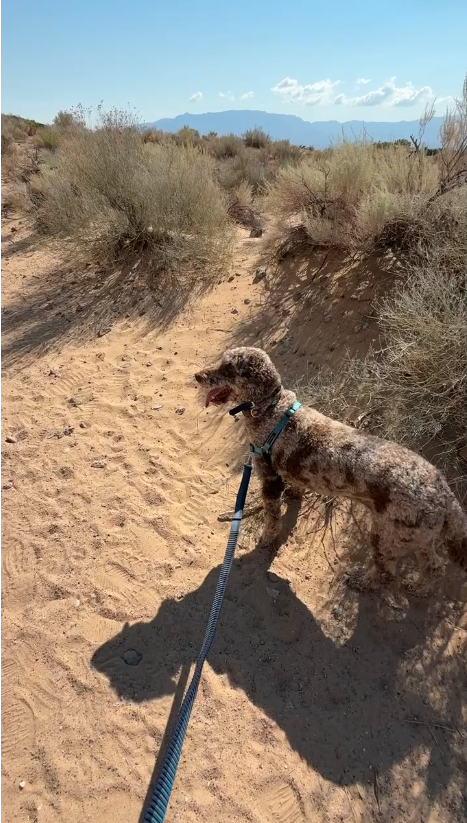
I went early in the morning with Tootsie, before it got too terribly hot, and we walked the full trail.
Tootsie and I opted for Piedras Marcadas Trail. It’s clearly a local favorite based on the parking lot once we returned.
Why it is different from other rock art sites
Here is what makes it fascinating.
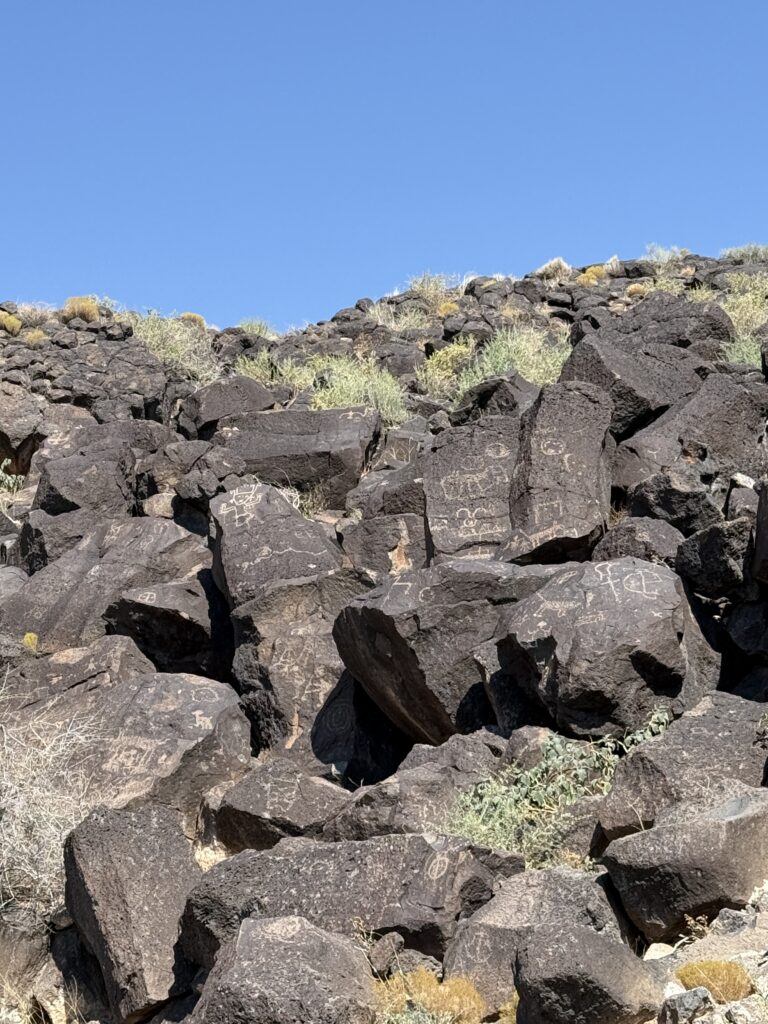
You are right up on top of these petroglyphs.
They are not behind a plexiglass wall. They are not off in the distance where you need binoculars. They are on rocks you are walking beside.
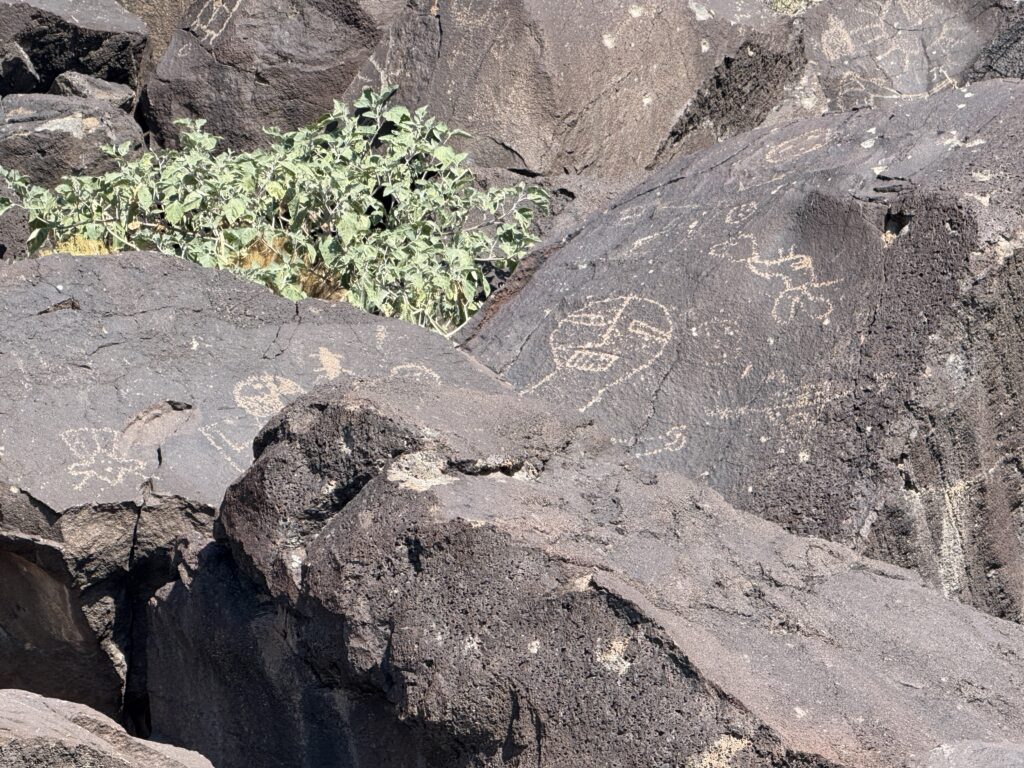
And they are vivid. The rock is black, and where it has been etched the marking underneath comes out bright — so they jump off the stone at you.
About two hundred thousand years ago, six volcanoes on the west side of Albuquerque poured lava down through the arroyos. Everything softer around it eroded away and the hard basalt did not, which is why there is a seventeen-mile ridge of black rock sitting there.
That basalt is actually gray. What makes it black is desert varnish — a dark, glossy skin of manganese and iron that builds up over thousands of years.
So carving a petroglyph means chipping through the dark skin to the lighter rock underneath. That is the whole technique, and it is why these are so legible centuries later.
There are about twenty-four thousand images out there. It is one of the largest petroglyph sites in North America. Most were made by ancestral Pueblo people and by early Spanish settlers — roughly ninety per cent of them between 1300 and the late 1600s. A few, over in another canyon, may be three thousand years old.
Bringing a dog
Dogs are welcome and Tootsie did great.
Two things worth saying properly. First, not every trail here allows dogs — one of the main canyons does not, and you need to know which one you are heading to. The visitor center will tell you, which is another argument for going there first.
Second, I would not have gone much later than we did. That sand gets too hot for a dog, and the parking lots are worse. The park itself recommends dog boots in summer, which tells you everything.
I took a lot of water for both of us even though the trail is fairly short, and I would do that again.
What I did not get, and what I found out later
Walking that trail, what I wanted more than anything was to understand what the message was on those stones.
Thank you, Google, for a little post trip education.
These are not a code waiting to be cracked. They carry deep and living spiritual significance for Pueblo people today, and for the descendants of the Spanish settlers who added to them. And the meaning of many of these images was possibly understood only by the person who made it.
I still want the ranger tour. I just know now what I would actually be asking for.
Basics
Location: the west side of Albuquerque, New Mexico. Co-managed by the National Park Service and the City of Albuquerque.
Size: 7,236 acres along a 17-mile volcanic escarpment. Authorized 27 June 1990.
What is here: roughly 24,000 petroglyph images — one of the largest such sites in North America.
Start here: the Visitor Information Center. There are no petroglyphs and no trails there. It exists to give you current conditions and send you to the right canyon for your time, your mobility, the heat, and whether you have a dog with you. Do not skip it and drive straight to a trailhead. Good gift shop, too.
When to go: early. The desert heat is serious and there is essentially no shade.
What to pack: far more water than the trail lengths suggest. A mile and a half in that sun is not a mile and a half in the shade.
What to wear: shoes you do not mind filling with sand.
The trails — pick before you drive
Boca Negra Canyon — about 1 mile across three short trails, concrete steps and boulders, roughly 100 petroglyphs. No dogs.
Rinconada Canyon — 2.2-mile loop, natural earth with three slight inclines, roughly 300 petroglyphs. Dog access has changed between park publications — ask at the visitor center.
Piedras Marcadas Canyon — 1.5 miles round trip, easy level sand, roughly 400 petroglyphs, the most of any trail. Leashed dogs welcome.
Volcanoes Day Use Area — the volcanoes themselves, no petroglyphs. Leashed dogs welcome.
A note on dogs: the park’s current guidance lists Rinconada, Piedras Marcadas, the Volcanoes and South Point as dog-friendly, but an older trails brochure restricts dogs at Rinconada to the middle canyon trail only. Ask at the visitor center. Boca Negra is a firm no either way.
What I’d do next time
I’ve never left a park knowing everything about it. Here’s what I’d do differently next time — and I’ll add to this as I find out more.
A ranger-guided tour. I want to understand more about the images than a trail sign can give me — including, I now realize, where the knowledge stops and why.
More of the trails. I did one. There are four areas and they are genuinely different from one another — the one I walked had the sand and the crowds; another has concrete steps and no dogs; another is the volcanoes themselves with no petroglyphs at all.
Pets
Tootsie came and did brilliantly — but this park takes more planning than most.
Check which trail before you go. One of the main canyons does not allow dogs at all, and the guidance on another has changed. The visitor center will give you the current answer. Leashes six feet maximum, as everywhere in the system, and no dogs indoors.
The heat is the real issue, and the park says so itself: the sand on the trails and the asphalt in the parking lots get very hot, and the monument recommends dog boots in summer. Go early or do not go.
Carry water for her as well as for you, even on a short trail.
One nice thing: there is a B.A.R.K. Ranger program — pick up the checklist at the information center and your dog can earn it.
Traveling with a dog? Where I Would Actually Take My Dog is every park on this site, sorted by whether she can do the activities you came for.
Trail access, pet rules and hours change, and the dog guidance here has shifted between park publications. Check with the National Park Service before you go — details here were verified in September 2026.