
Petrified Forest is a perfect stop along Route 66!
The shape of the day
Petrified Forest is predominantly a driving tour. Twenty-eight miles of road through the park, with stops all the way along where you get out and look at what is there.
Be realistic about those 28 miles…it takes quite a while, especially when you want to stop and soak up the beauty of this park.
What I kept stopping for
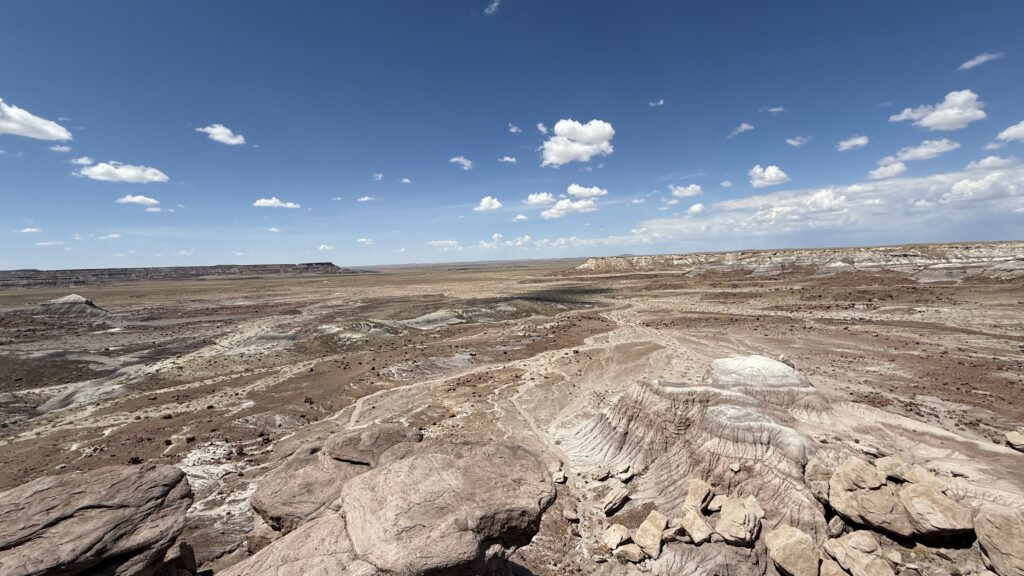
I loved when you could see the layers in the stone. The colors and textures would pop. Oh the stories that could be told and all that these great lands had witnessed.
It is two hundred and twenty-five million years.
It is hard to wrap your head around how old this land, this earth, is. I was constantly reminded of the beauty that is created with patience.
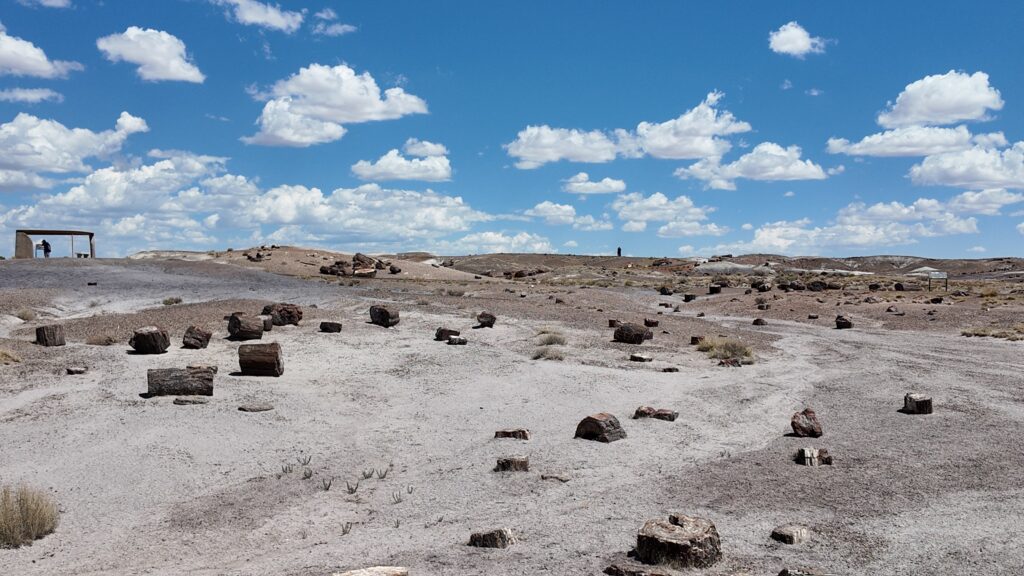
Here is what happened. Around two hundred and twenty-five million years ago this was not a desert. It was low and wet — rivers, floodplains, swamps. Trees fell into those rivers and got buried under sediment and volcanic ash fast enough that they could not rot.
Then groundwater moved through all of that, picking up silica dissolved out of the ash. And as that water filtered through the buried logs, the silica came out of solution as microscopic quartz crystals, inside the wood itself.
So this is not wood that vaguely turned to rock. It is wood whose cells were filled in, one crystal at a time, with quartz. That is why the grain is still there. You are looking at the inside of a tree that is now made of stone.
The color
And then there is the color, which is what I was in awe of.
I have been in so many parts of this country where the stone is not gray, and it surprises me every single time.
The color is other elements that were riding along in the same water — iron, copper, manganese, carbon — laid down in the tissue along with the quartz. Red, orange and pink come from iron oxide. Greens, blues and purples got laid down where there was very little oxygen. Manganese oxide brings in more gray and blue and purple.
So every color in that log is a record of what was dissolved in the water two hundred million years ago. It is not decoration. It is chemistry that has been sitting still for a very long time.
Be ready for the heat. I mean it.
This is high desert and it is exposed, and there is very little between you and the sun. I was grateful for an air-conditioned van in a way I have not been at many parks.
And this is where I have to be honest about the dog
Here is the frustrating part.
Petrified Forest is one of the most dog-friendly national parks in the country. Not grudgingly — properly. Leashed dogs are allowed everywhere in the park except inside the buildings. Every maintained trail. All seven of them. The backcountry too. There is even a Bark Ranger program.
There is almost nowhere else in the system where you can say that.
And I could not use any of it. It was so hot that Tootsie got a quick bathroom breaks and then went straight back into the air conditioning. That was the whole visit for her.
So this is a park where the rules say yes to everything and the weather says no, and those are completely different questions. If you are bringing a dog here, go in spring or autumn, or go early. The permission is not the problem. The temperature is.
Don’t miss the ice cream
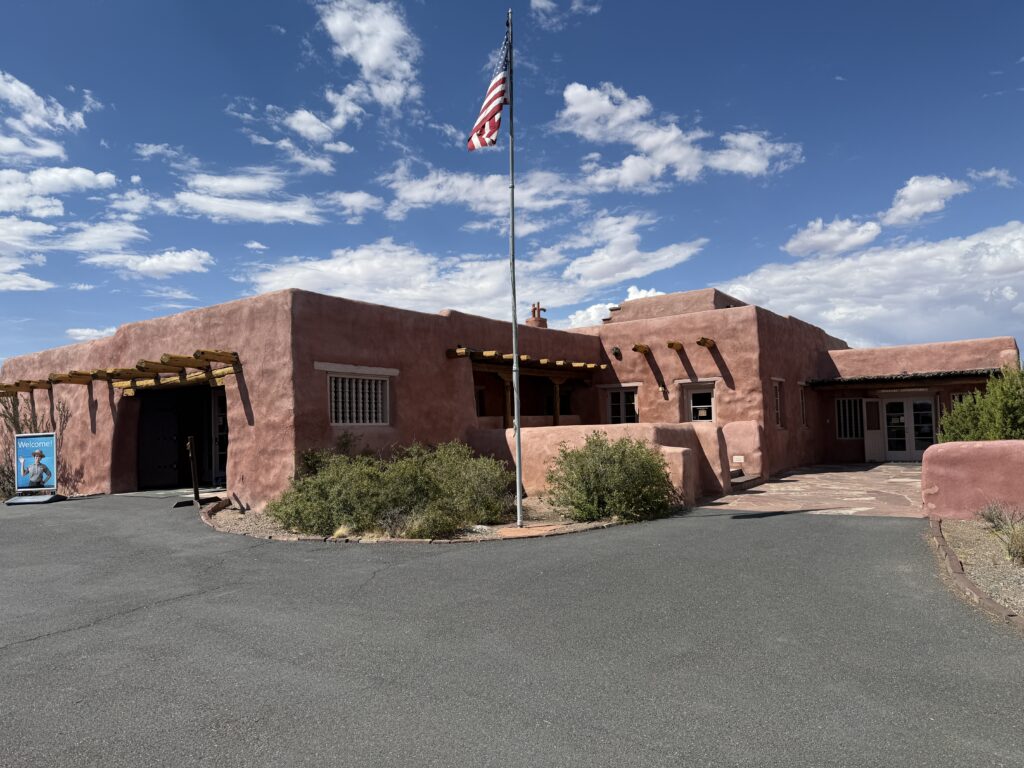
There are visitor centers at both ends of the park road.
The one at the north entrance, off the interstate, is the one you want. That is the Painted Desert Visitor Center, and it has a proper diner — and the best ice cream I found in that part of the country. I highly recommend stopping.
One practical warning: the diner closes at three. The southern visitor center has a curio shop with pre-packaged snacks and that is it. So if ice cream is part of the plan, make sure the north end happens before three.
The thing I drove straight past
Now here is the part I have to own.
Petrified Forest is the only national park in the country that still preserves a section of Route 66.
There is an unpaved stretch of the original alignment inside this park. There is a 1932 Studebaker sitting out in the open. There is a line of old telephone poles marking where the roadbed ran. It is about six miles in from the north entrance, right where the old road crosses the park road. It has a pullout. It has a sign. It has had an interpretive exhibit sitting there since 2006.
I drove past it.
Not a wrong turn — it is on the main road. I just did not know it was there, and I was looking at everything else.
So: the only national park in America with a piece of Route 66 in it, in the year the road turns a hundred, reached by a person who was only there because of Route 66 — and I have a great many photographs of stone and not one of the road.
Go and stand on it. It is right there.
Basics
Location: eastern Arizona, between Holbrook and Navajo. The north entrance is directly off I-40; the south entrance is on US 180.
The road: 28 miles end to end, with pull-offs and short trails the whole way. You can do the park as a drive, which makes it one of the more accessible national parks for anyone with limited mobility, limited time, or a hot car full of dog.
Visitor centers: Painted Desert at the north entrance off I-40 — diner, gift shop, convenience store, restrooms. The diner closes at 3:00 pm. Rainbow Forest Museum at the south entrance on US 180 — fossil exhibits, curio shop with pre-packaged snacks, restrooms.
Trails: all short. Agate House 2 miles · Long Logs 1.6 · Painted Desert Rim 1 · Blue Mesa 1 · Crystal Forest 0.75 · Giant Logs 0.4 · Puerco Pueblo 0.3.
Camping: none. Backcountry permits only.
What to wear: there is almost no shade anywhere, and the wind is serious enough that you want a hat that stays on. Shoes for rough ground, even on the short trails.
What to pack: far more water than you think — there is none in the backcountry.
The Route 66 pullout — do not drive past it
Petrified Forest is the only national park in the country that preserves a section of Route 66.
Where: on the main park road, about six miles from the north entrance, where the original alignment crosses it. Its own parking for cars and RVs.
What is there: a 1932 Studebaker, a line of old telephone poles, the raised roadbed, and an outdoor interpretive exhibit in place since 2006.
Signed, and easy — if you know to look for it.
What you are actually looking at
About 225 million years old — Upper Triassic, in the Chinle Formation.
Trees fell into rivers, were buried under sediment and volcanic ash before they could rot, and silica dissolved out of that ash precipitated as microscopic quartz crystals inside the wood. The grain survives because the quartz filled the cell structure.
The colors are elements in that same water — iron oxide for red, orange and pink; low-oxygen conditions for green, blue and purple; manganese oxide for gray, blue and purple. Copper and carbon too.
What I’d do next time
I’ve never left a park knowing everything about it. Here’s what I’d do differently next time — and I’ll add to this as I find out more.
Stop at the Route 66 pullout. Six miles in from the north entrance, own parking, signed. I drove past the Studebaker and the telephone poles in the only national park that has them.
Come in a cooler month and actually use it with the dog. This park allows dogs on every trail it has, and the heat meant we used none of them.
Give yourself permission to jump off
If you are driving Route 66 to get here, here is my honest advice: give yourself permission to jump off.
There are very long stretches with nothing on them, and there are places where the original road simply is not accessible any more. It can get frustrating and boring when you want to see something and there is nothing, and the interstate running alongside will make up your time.
Some purists want to say they did the whole thing, and that is absolutely fine. But there is a lot of nothing, and you are allowed to skip it.
Pets
This is one of the most dog-friendly national parks in the country — and I could barely use it, which tells you everything about how the rules and the real answer are different questions.
The rules: leashed dogs are allowed everywhere in the park except inside buildings. Every maintained trail, all seven, plus the backcountry. There is a Bark Ranger program, and dogs can join outdoor Bark Ranger activities at the visitor centers.
The reality: it was so hot that Tootsie got quick bathroom breaks and otherwise stayed in the air conditioning.
So: come in spring or autumn, or go early. Far more water than you think for her as well as you — there is none in the backcountry. Consider boots; the terrain is rough in places and the ground gets hot.
Dogs cannot go inside the visitor centers, which is the one place you would want to duck into to cool off. Plan for that.
Traveling with a dog? Where I Would Actually Take My Dog is every park on this site, sorted by whether she can do the activities you came for.
Hours, visitor center and diner times, road access and pet rules change. Check with the National Park Service before you go — details here were verified in September 2026.