
I have been to Mount Rushmore about half a dozen times.
It is genuinely incredible to stand in front of. It is also very busy, and there is a lot going on — you arrive, you come through the gate, there are shops, and then there is a long walkway lined with flags leading you toward the mountain.
That walkway is the Avenue of Flags: 56 of them, the fifty states plus the District of Columbia and the territories. At the end of it is the terrace where everybody stops and takes the photograph, and just below that there is an amphitheater where the rangers run their programs.
All of which is fine. But if that is the whole visit, you have had about twenty minutes and a parking lot.
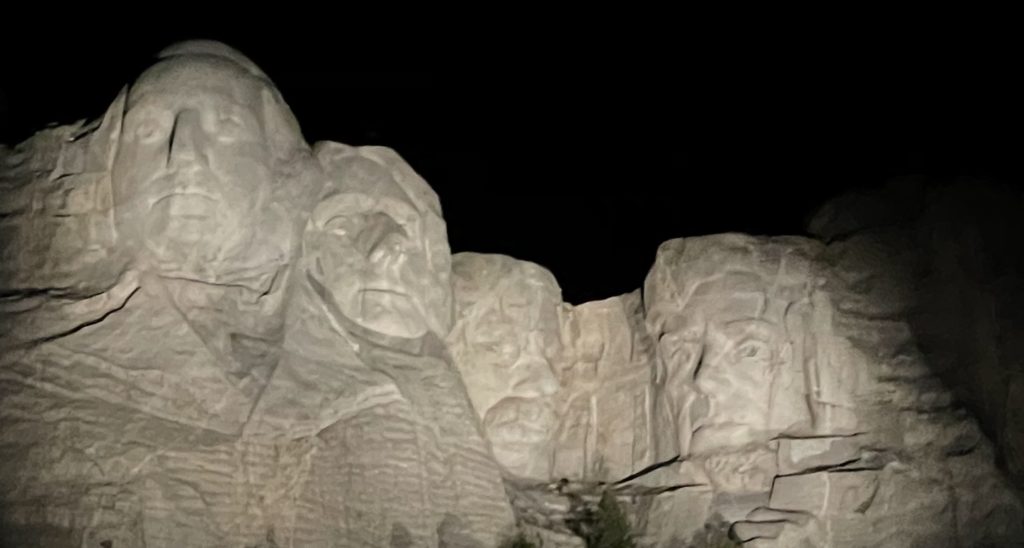
Do the Presidential Trail
The first time I came, I saw the faces and then I went and did the hike, and it was really beautiful.
The Presidential Trail is a short loop that drops down off the terrace and takes you in underneath the sculpture. There are a lot of stairs. Most people standing at the viewing terrace never go down it.
They should. It changes the thing from a photograph into a place. You get in among the ponderosa pines, you get angles on the carving that nobody’s postcard has, and you get away from the crowd almost immediately, because the crowd is not coming.
That is the difference between stopping to look at some faces in a mountain and actually visiting.
Whose hills these are
Here is something I did not know until recently, and I am still working my way through it.
Mount Rushmore is carved into the Black Hills, and the Black Hills were guaranteed to the Sioux by the Fort Laramie Treaty of 1868 — set aside, in the language of the treaty, for their absolute and undisturbed use. Then gold was found. In 1877 Congress passed an act taking the hills back, on the strength of an agreement signed by about a tenth of the adult men, when the treaty itself required three quarters.
In 1980 the Supreme Court looked at all of that and ruled, in United States v. Sioux Nation of Indians, that the 1877 act had been a taking of tribal property and that just compensation was owed. The award was the 1877 value of the land plus a century of interest — around $106 million at the time.
The Sioux have never taken it. Accepting the money would legally close the claim to the land itself, and the land is the point. So the award has sat in a federal account ever since, gathering interest, and it is now worth well over a billion dollars. Untouched, for forty-five years.
I am not telling you that to spoil your visit. I am telling you because I have stood on that terrace six times without knowing it, and knowing it makes the sixth visit a different one from the first five.
Make it part of something bigger
This is an easy trip, and it is a much better one if it is not the only thing you are doing.
It slots naturally into a Badlands trip, or anything else you have planned in that part of South Dakota. And the Black Hills National Forest wraps around the memorial with genuinely good hiking in it — there is far more walking within half an hour of this parking lot than there is inside the memorial itself.
Come for the faces. Stay for the hills they are carved into.
Hours, fees and program times change seasonally. Check with the National Park Service before you go — details here were verified in September 2026.
Basics
Entry: free. There is no entrance fee at Mount Rushmore.
Parking: A parking fee per private vehicle, with a lower rate for seniors 62 and over. Check the current rates before you go. Your ticket is good for a full year, so a second visit within twelve months costs nothing.
The America the Beautiful pass does not cover the parking. This catches people out, and I want to be clear about it because I recommend that pass constantly. The federal passes waive entrance fees. There is no entrance fee here to waive, so you pay for parking whatever pass you hold.
Hours: seasonal. Roughly 5am to 11pm from mid-March through September, 5am to 9pm in October, and 6am to 9pm through the winter. Open daily, year round.
Evening lighting ceremony: a ranger program runs from late May to the end of September — 9pm through early August, 8pm from mid-August. Included with your parking. Outside that season the memorial is still lit after dark, but there is no program.
On your feet: the Presidential Trail is not long, but it is almost entirely steps, so wear shoes you can do stairs in. The Black Hills sit high enough that mornings and evenings stay cold well into the season, and the amphitheater after dark is a good deal colder than the parking lot was at lunchtime.
Busiest in high summer. This is one of the most visited places in South Dakota.
Worth knowing: the Presidential Trail is the thing most visitors skip, and it is the reason to give this place two hours instead of twenty minutes.
Pets
This is a hard one, and it is worth knowing before you drive in rather than after.
Dogs are allowed in the parking garages and on the grassy pet exercise areas between them, on a six-foot leash, and that is the whole of it. They cannot come past the entrance pergola, which rules out the Avenue of Flags, the viewing terrace, the Presidential Trail, the ranger programs and every building. Citations are issued, so this is enforced rather than suggested.
Your dog can see the mountain from the pet area. The faces are small from there and I am not going to pretend otherwise.
The alternative is genuinely good, though. The Blackberry Trail starts near the west parking garage and runs about a mile out to join the Centennial Trail in Black Hills National Forest, and dogs are welcome on it. You can make that a gentle walk out to Horsethief Lake and back, which is around eight miles.
So the honest plan is this: one of you does the memorial while the other takes the dog into the national forest, and then you swap. There are also kennels in Hermosa, about half an hour away, and in Rapid City.