
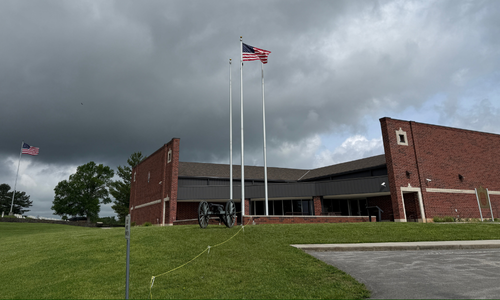
Mill Springs Battlefield National Monument is one of the newest units in the National Park Service — designated in 2020 and still actively being built. The visitor center is spectacular. The history is extraordinary. And what makes this park different from almost any other is that you can watch it being born. Chief of Interpretation Andrew Miller joins The Parks Podcast to share the full story: the Battle of Mill Springs, why it was a watershed moment in the Civil War, how a community grassroots effort preserved this land from the ground up — and what visitors can expect when they come today, and how different it will look in five more years.
A note from Missy: Mill Springs was fascinating because it’s a new park. They are just at the infancy of creating a traditional park. Hearing about how a park is created, what is currently there, how the community supports its development, and what to expect in the future is fascinating to me.
Episode Guest
Andrew Miller – Chief of Interpretation & Resource Management
Mill Springs Battlefield National Monument
Park Stats
- Location: Nancy, Kentucky
- Designated: September 22, 2020 (President Trump)
- Size: 647 acres
- Annual visitors: 8,579 (2024)
- The battle: Battle of Mill Springs / Battle of Logan’s Crossroads, January 19, 1862
- Significance: First major Union victory in the West; watershed moment in the Civil War’s western theater
- Soldiers from: Eight states
- National Registry of Historic Places: Confederate Mass Grave Monument (Somerset), Gen. Felix Kirk Zollicoffer Monument, West Metcalfe House, Mill Springs National Cemetery
- Preservation history: Listed among 10 most endangered Civil War battlefields in the late 1980s; preserved by the Mill Springs Battlefield Association over decades before NPS designation
- Historic home: Brown-Lanier home (Confederate HQ before the battle) — tours offered Saturday, May–September
- Adjacent: Historic operating mill (managed by Army Corps of Engineers)
- Dogs: Welcome; Bark Ranger program
Show Notes & Links
- Mill Springs Battlefield National Monument
- Plan Your Visit — Mill Springs Battlefield National Monument
- Battle of Mill Springs history
- Mill Springs Battlefield Association
- American Battlefield Protection Program
- NPS App — self-guided battlefield tour
- Bark Ranger Program
- Nearby: Camp Nelson National Monument
- Nearby: Abraham Lincoln Birthplace NHS
- Nearby: Mammoth Cave National Park
- Nearby: Big South Fork National River & Recreation Area
Episode Transcript
Mill Springs Battlefield National Monument — Kentucky’s Winter Battle and the Birth of a New Park
The Parks Podcast, Episode 35 | Andrew Miller, Chief of Interpretation, Mill Springs Battlefield National Monument
Welcome and Park Stats
Missy Rentz: In today’s episode, I am joined by Andrew Miller, who is the Chief of Interpretation at Mill Springs Battlefield National Monument. Andrew, welcome to The Parks Podcast.
Andrew Miller: Thanks, Missy.
Missy: So let’s start with some park stats and introduce people to a relatively new part of the National Park Service. Mill Springs Battlefield is located in Nancy, Kentucky. It was created on September 22nd, 2020 during Donald Trump’s first term as president. The park is 647 acres, and in 2024 there were 8,579 visitors to the monument. Some interesting facts: this battle, taking place January 19th, 1862, was one of the rare winter battles in the Civil War. It was the first major victory of the West. Soldiers from eight states took part in the battle. And several areas in the monument area are on the National Registry of Historic Places, including the Confederate Mass Grave Monument in Somerset, Kentucky, the General Felix Zollicoffer Monument, the West Metcalfe House, and Mill Springs National Cemetery. Andrew, this is such a unique park and it was probably my first experience visiting such a young park.
Andrew: Yeah. Most people when they go to national park sites expect certain types of signage, a certain approach, a certain feel. You’re looking for the arrowhead everywhere, and you’re looking for this large presence. A new site doesn’t have all that.
Missy: No. And it was really cool — the visitor center is amazing. That feels very new, it’s spectacular. But throughout the rest of the park, there isn’t — I’m going to call it the polish — but I don’t want to say that in a way that detracts from it, because it’s really cool and the history is still told. But you really do understand that a park isn’t just a ribbon cutting and it’s all open. It’s an evolution.
Andrew: Absolutely. And I think that’s important to remember — every single national park from the original one in Yellowstone all the way to today has been built up from the ground up. Every single one of them has their story of what happened there and what makes them nationally significant. You have that aspect, and then you have the practical questions: where do we put bathrooms? How do we get people here? How do you put signage on highways? How do you develop a brochure that self-guides people through it? All of these tiny little facets, which we sort of take for granted because they’re just supposed to be there. For any listeners that have gone to newer parks, especially those created within the past five years, some have amazing infrastructure that exists, like Mill Springs Battlefield — which we were very fortunate — and other new sites are just a lone wayside in a field that is commemorating the story as they develop the park and come up with a general management plan. There’s a lot that goes into it.
The Grassroots Effort — How a Battlefield Becomes a Park
Missy: And you’re very dependent on the work that was done prior to it becoming a park. We talk about how there are Friends organizations and groups that were really advocating for the park and doing maybe sometimes the work of the park long before Congress actually said, now this is part of the National Park Service.
Andrew: Yeah. I think a lot of these places start with grassroots activity — just generally local people who have a passion for preserving these places. And I would harken back to our forebearers, the veterans themselves. This is specific to battlefields and specifically American Civil War battlefields — the veterans were the ones who came together and reconciled their differences in the 1880s and 1890s through a variety of veterans organizations. When it came time to understanding the impact of the Civil War on our nation’s history, they recognized that there were significant places where blood was shed and people lost their lives, and that they had to come together to develop a plan for commemorating them. It starts with individuals — and like anything else, we go from enthusiastic young people who are passionate, those are the soldiers, to graying old men who are now congressmen and senators, governors, lawyers, people of influence who use that influence to sway the public into helping acknowledge and preserve these places of national significance. That type of grassroots effort initiates the first five national military parks: Chickamauga, Chattanooga, Shiloh, Gettysburg, and Vicksburg. And then throughout the 20th century, incorporating a dozen or so more battlefields.
Andrew: And so as the nation continued to grow, there was significant encroachment on Civil War battlefields. A list came out in the late 1980s of the 10 most endangered Civil War battlefields, and this area near Nancy, Kentucky — referred to as Mill Springs Battlefield — was one of the top 10 most endangered. Local citizens in this area took it upon themselves to put together an association: the Mill Springs Battlefield Association. And it’s through their effort — not only recognizing the need, but organizing themselves through a grassroots effort and chasing after grants through the National Park Service’s American Battlefield Protection Program, along with a variety of other national, state, and local fund sources — to build this battlefield up, acquire the land, and officially preserve it. And that’s significant because these people, before the National Park Service got here, are the ones that did it. The National Park Service did not come in and preserve this land. We are now the torch carriers. We are fortunate enough to take the legacy of the veterans first — who fought here — and the people that came after them who preserved this place of significance. And now we get to develop it further.
Missy: It is interesting, because when you’re doing the driving tour, at more established parks it’s all battlefield. Here you’re driving past people’s homes, and as I was doing it, soaking up the history, I was thinking — what must it be like to live on a former battlefield?
Andrew: Right, exactly. And that’s not unique to this battlefield either. You could go to Fredericksburg and see that the majority of that battlefield is totally taken up with urban sprawl. Another classic case would be Murfreesboro in Tennessee, where Stones River — the battle there, I think, encompassed 6,000 acres of fighting — and they’re reduced to I don’t even know, a thousand maybe. That gives you an idea of what was lost if preservation doesn’t happen. Kennesaw Mountain would be another battlefield — it’s the largest green space in Atlanta. So there’s a ton of people there who live on hallowed ground. I think the difference here is that this area of Kentucky is so rural, which is both a blessing in that we are able to preserve this place — but at the same time, you kind of feel a little bit out in the middle of nowhere.
The Battle — Kentucky’s Neutrality, the Winter Campaign, and Why It Mattered
Missy: Okay, so I want to talk about the battle. Tell me about the battle and what role it played in the Civil War.
Andrew: For your listeners, most people when they think of the Civil War think of Gettysburg or Vicksburg. But Civil War battles don’t happen in a vacuum. There’s not one single event that impacts the whole war. We look for simplicity in how we teach history. But this battle that transpires in present-day Nancy, Kentucky — it probably shouldn’t have ever happened — but through the course of events during the Civil War, it does. And it has such a massive impact on how the Civil War was going to progress west of the Appalachian Mountain range. What happens at this battle could truly be considered a watershed moment — everything changes after it. And in a nutshell, that’s why it’s nationally significant enough to become a National Park site.
Andrew: The two respective states — Kentucky and Tennessee — are considered sister states. When the Civil War erupts, as those states secede and prepare themselves to self-govern, there are four other upper-southern states debating secession. Many of the people in these states are constitutionalists — they believe in this nation and they don’t necessarily want to give up on it. When the insurgents in Charleston fire upon Fort Sumter on April 12th, 1861, the war is officially begun. And it’s at that moment where many of these upper-southern states do a 180. The final state to secede is Tennessee, on June 8th, 1861. And so secession delegates came to Kentucky also to woo and sway this commonwealth. The governor himself was a pro-secessionist governor, but the vast majority of the people who lived in Kentucky were not — they remained steadfast to the union, the government, and the constitution. Abraham Lincoln said that while I hope to have God on my side, I must have Kentucky, because it is a truly buffer between the Old Northwest — the states of Ohio, Indiana, Illinois, Wisconsin, Michigan, Minnesota, Iowa — these union states were above the Ohio River, and Kentucky would serve as this buffer between Tennessee, which had seceded, and these pro-union states.
Andrew: Kentucky had been officially neutral this entire time — they wanted nothing to do with this Civil War. I always say for those listeners old enough to remember Yosemite Sam with his two pistols facing both directions — that’s Kentucky. Remove the pistols and put Colonel Sanders with two pistols, maybe that’s it. When the Confederates march a force into the western part of the state, the state legislature in Frankfort decides that the neutrality thing is done. We’ve been invaded. We are now aligning ourselves with the Constitution and the Lincoln administration. However, even as the general assembly has decided to go with the north, the state still remains in limbo. A Confederate general named Felix Zollicoffer — who had been tasked with controlling pro-Unionists in eastern Tennessee and declaring martial law there — hears that the general assembly in Frankfort has decided to go with the Lincoln administration. He marches his force and invades the Commonwealth. Zollicoffer is a unique individual with no professional military background, but he had the kind of influence many officers have in the beginning of the Civil War. He had been a US politician, a newspaper editor. And this guy — he was a Whig, not a Democrat and not a Republican. He was very much, when all the secession talk was going on in the state of Tennessee, saying we must remain loyal to the Constitution. And when the shooting started and Lincoln called for volunteers, Zollicoffer was one of those people in Tennessee who did that 180 and said, no, we must prepare to defend ourselves.
Missy: And did I read this correctly that Lincoln was very savvy — he publicly really talked about and respected the neutrality, and yet provided arms so Kentucky could protect itself?
Andrew: Yep. Secretly, yes.
Missy: Yeah. But then in the end, it was a fantastic strategic move because he was getting Kentucky on his side. Is that a right interpretation of what I’ve read?
Andrew: I think it’s very fair. Lincoln understood that the United States government couldn’t officially interfere with that neutrality because he needed Kentucky. He’s also Kentucky by birth, and his wife was a Kentuckian. He understood that while they may be pro-union, they are also slaveholders and the elite are. So he sent a Kentuckian named William Bull Nelson to start to influence and enlist men for the union cause. Nelson was about 300 pounds, about as Navy as it gets. He was commissioned a general in the Army — unusual, leaving his naval background to become an Army officer. Nelson sets up the first major training facility for Union soldiers near Camp Nelson. That was called Camp Dick Robinson, and it was really the first official training facility for Union soldiers. Many of the individuals who fight at the Battle of Mill Springs from Kentucky trained there. But also the Eastern Tennesseans — men who were placed under martial law, threatened with loss of property, arrest, and maybe even death — became refugees. They left their families and fled through the Cumberland Gap to the safety of Kentucky and really to the folds of the US Army at Camp Dick Robinson. These individuals will be organized, trained, and will eventually end up on the battlefield here at Mill Springs, fighting Tennesseans.
Missy: What role did winter play? How did that impact this battle?
Andrew: Armies didn’t campaign in the wintertime — if you harken back to Napoleon going to Russia in the middle of winter and losing his entire army, it’s just not a smart decision. Generally, armies hunkered in and built their winter quarters and waited until the spring thaw. The roads would either be frozen solid with ruts, which weren’t good for humans walking on it and definitely weren’t good for animals or wagons or artillery. So winter battles are rare.
Missy: Why did it happen then?
Andrew: Zollicoffer entered the state, was marauding around disrupting union camps. He fought a battle near London, Kentucky — the Battle of Wildcat Mountain — lost the battle, and was forced to retreat back into Tennessee. He looks for a viable place to have a winter encampment. He finds on the bend of the Cumberland River a small locale called Mill Springs — on the south side of the river, with good fertile farmland, multitudes of streams, a really good mill for producing corn and flour, just about anything an army would need to subsist off during the wintertime. And he decides to send the majority of his force across the Cumberland River to a place called Beech Grove. And he’s thinking that if he has both of his men on both sides of the river, he can spread his camps out, improve the health, but really control the river itself.
Andrew: When we think of Civil War battles, we try to simplify — the armies marched there and they fought. But you need to think about logistics. River traffic still dominates the logistics of the Civil War. The Cumberland River is going to be a means of conveying large amounts of food, ammunition, and forage for horses, and it’s also a direct communication line to Nashville. So Zollicoffer is thinking, I have a direct communication line, I can get all the stuff I need. The Union Army authorities in Louisville recognize that Zollicoffer is hunkered down, but he’s not that important to them — they want to go to Bowling Green, then Nashville. But they start getting very alarming messages. A union officer had been sent to Somerset, Kentucky — Albin Schoepf — and he’s like, whoa, there are a lot of guys here and I’m going to get cut off. And it really puts the bug in the authorities in Louisville, and they decide to send George Thomas, the Union General, and his large division. They begin a march on January 1st, 1862. For 17 grueling days, the weather has a massive impact — the roads are muddy, the men are dragging the wagons and cannons through the mud and mire. They arrive at Logan’s Crossroads, which is Nancy today, and they do exactly what the Confederates were doing — they’re soaked and they just want to be warm. And the Confederates, who had hunkered in and nearly completed their winter quarters, are actually starting to run out of food. There are a lot of circumstances of why this battle happens. The Confederate General Crittenden arrives in January, sees the situation, and calls a Council of War on the 18th — he says, we have to do something before the Union Army gets all their men here. And so the Confederates march up the road and try to surprise the Union Army on January 19th. It’s out of fear, out of the dire situation that Zollicoffer has really put them in. And for the Union Army — I just think they really figured the Confederates would stay put. That is the logical thing to do. But that’s not what happens.
Planning Your Visit
Missy: And they would have had all winter to prepare. That’s fascinating. Let’s talk about planning a trip to Mill Springs. How do you recommend somebody start?
Andrew: The best thing to do — you can go to our park website at www.nps.gov/misp. You can also just Google “Mill Springs Battlefield.” The website will give you the list of activities, basic generic information, hours, current conditions, weather, FAQs, directions, things to do, our calendar if you’re looking for a specific type of program, safety, and accessibility. But I also want to say — this is one of those parks where if you see the brown sign on the highway and you just want to get off, this is a great park to do that. You can get there, go into the visitor center, talk to us, make your way through the museum area, and feel so informed. There are a lot of parks where I encourage pre-planning, but this is one of those where you would have just as great of a time if you saw the brown sign and decided, I’m ready for a pit stop.
Missy: And I will say I got there right when you opened, so I had you all to myself for a while. I got so much information and great storytelling. What are people going to see when they visit?
Andrew: When you come here, we’re fortunate to have that infrastructure from the former association. There is a comprehensive museum with really amazing exhibits and displays — a lot of artifacts pertaining to the Civil War, many pertaining specifically to the battle itself. There’s archeology that was done here, so there are artifacts from the battlefield in the museum. Our park film — we have a 20-minute orientation film for visitors to watch so they can get the nuts and bolts of why this place is important. The park itself is discontinuous in that it’s not all-encompassing. You go to the visitor center and then you can utilize a variety of different interpretive media. The National Park Service app can take you around the battlefield. You would go to the core battlefield — there are hiking trails on the battlefield, wayside exhibits to read, and several monuments from the early 20th century. And then you would drive down the road to go to the Confederate winter encampment site, which is about nine miles away. So you’re going from downtown Nancy where the battle was fought, and then you follow the route of pursuit — when the Confederates lost the battle and were routed, the Union Army pursued them down the road that you drive down. Then you get to the fortification site and there are trails down there. You can see where in the ground the Confederates had dug the shallow floors where they built their log huts they were living in. You can see the evidence still there.
Andrew: Fortunately, we were very lucky over the past six months to officially accept a historic home — the Brown Lanier Home, which served as Zollicoffer’s headquarters just prior to the battle. We offer tours of it every Saturday from May through September. And the historic mill nearby is operating and managed by the Army Corps of Engineers — you can go to their site and see the mill operate, and come to the house where the Millers actually lived.
Missy: And that area — even though it’s remote, you have Lake Cumberland, Mammoth Cave is about an hour and a half away, there are several incredible Kentucky state parks. So definitely a spot where you could put together a really incredible vacation.
Andrew: There’s something for everybody. Big South Fork is 40 minutes south, which divides the Kentucky and Tennessee border. Camp Nelson is an hour north — if you’re looking to understand logistics in the Civil War and African American enlistment, that’s a powerful story. About an hour to the west is Abraham Lincoln’s birthplace. And then about an hour and 20 minutes is Mammoth Cave.
Missy: You just gave my tour that I took. Can you bring a dog?
Andrew: Yeah, absolutely. The only place in the entire park that a dog is not allowed — other than a service animal — is the museum. But the dogs can come into the visitor center. We have a really active Bark Ranger program that anybody can do. And we have poop receptacles in the park — one at the visitor center, one at the Zollicoffer Crawford Park, and one down at the Brown Lanier Home. We have dog bowls out for water. So we love dogs. We want to see them. And the incentive is: bring your dog, get your Bark Ranger badge here.
What to Expect in the Coming Years
Missy: This is a new park, only five years old, and parks evolve. What can we expect to see in the coming years?
Andrew: So one of the most interesting things when you walk into the visitor center — on the wall you’re going to see what we assume is the most historically accurate map of the battlefield area, done just after the battle. It shows you not only what Nancy looked like at the time period of the Civil War through the eyes of the engineer who did this map, but where every single fence was and every single location of a home. That’s going to be one of the most important guiding documents for a cultural landscape report that will hopefully enable the National Park Service over the next 25 years to transcend this back into what the battlefield looked like in 1862. What you’re going to start seeing over the next couple years is the replacement of the original fencing and putting it in the locations shown on that map, so that you have a very good context of where the battle was fought and where the property lines were. You’ll also see a lot of new signage — NPS arrowhead signage, tour stop signage. You’re going to see more ranger programs, a larger presence as we try to get more larger groups and RV tours to come here. We are developing a staff ride for active duty military members. Our trail systems are going to expand. And then we are hoping over the next couple years to get a National Park Service film completed here, and to start looking at a rehabilitation of the museum to get more accessible exhibits. When you visit Mill Springs Battlefield as it is today, you see a blip of what it will become. If you come back, you’re going to be blown away — the new film will be amazing, the museum will be awesome, the trails will be so developed. It’s super exciting to be a part of.
Speed Round
Earliest park memory?
Probably my parents bringing me to the FDR Home in Hyde Park, New York. We had lived across the river in Highland, New York, and I have a very vivid memory — very young, this is late eighties — going to the FDR home. And then years later finding out, oh yeah, by the way, that’s a national park site. But that would be the first park I very vividly remembered in my mind.
What made you love the parks?
I think just a passion for preservation. I’m a history geek. I fell into the whole Cannonball Ranger thing initially, but the more parks you work in and the broader the mission, you really understand that mission holistically and buy into it completely. I started as a volunteer, so for those listeners — yes, I am a manager in the National Park Service now, but I started out as a volunteer. And you can too. That passion really developed through volunteerism and being like, whoa, this is awesome, I didn’t even know this was a thing. And then learning more and recognizing that this was a viable career option. It just clicked and I never looked back.
Favorite thing about Mill Springs Battlefield National Monument?
We have some staff here who grew up in the park — who saw the association preserve this place from the ground up. They truly are the torch carriers. Their parents helped, their parents donated their effort, their blood, their sweat, their tears. And here they are now contributing as National Park Service employees. They’re younger than I am and they’re going to carry that legacy far beyond my career and truly build this place into what it’s supposed to be. Watching them develop and grow as rangers, and just as people, has been really the honor of my life — to watch the park grow and watch them grow with it.
Favorite thing to do at Mill Springs Battlefield National Monument?
Any single opportunity to talk to the visitors when they walk in. Going out into the resource and walking around, wrapping my mind around what happened on the battlefield, but meeting visitors, making those visitor contacts, and having them ask these really great, thoughtful, insightful questions and being able to get them to have that aha moment. That’s what national parks are for — for people to come together and have these amazing opportunities to connect with one another.
Park on your bucket list?
I haven’t been west of the Mississippi to any of the western battlefields — that’s a bucket list thing. I’ve never been to Wilson’s Creek. I’ve never been to Rocky Mountain National Park, which I’d like to see on a full national park tour making my way there. Mount Rainier is another one I would love to see. It’s just a matter of time.
Three must-haves for a park visit?
A little first aid kit. Water. And a map of the battlefield for context. If I’m going hiking more broadly, the first two things and then probably bug repellent or something like that. But I’ll also admit — I’m probably going to walk in, be like, God, this is beautiful, walk right back out, get in my car, put on the AC, cruise down the road, and be like, that was awesome. I got my park sign picture. We’re happy, we’re good. Let’s go back to the hotel. And I’m not even upset about it.
Favorite campfire activity?
We’re a pretty musical family, so playing the guitar and singing. Just sitting around and kind of noodling on the guitar, having everybody sing together.
Tent, camper, or cabin?
I like all of them. I’m probably going to go with the cabin. I like to be out in nature until I don’t, so I’m cool with it.
Hiking with or without trekking poles?
So interestingly enough, I’m one of those — oh, poles are dumb — people. And then I went down to the Grand Canyon, got a permit, went to Phantom Ranch. They were all like, where are your poles? And I was like, I don’t need that. And they gave me poles and thank God they did because it changed my perspective. I don’t know if I would ever hike without poles anymore. Never too old to learn something.
Favorite trail snack?
Probably just something salty. Like a peanut butter and jelly sandwich, pulled out of the bag, just munching that while walking around.
Best animal sighting?
When I was a kid, we were in Canada near Ottawa, and we saw a lynx one time, and I thought that was the coolest thing. I went and bought an Ottawa Lynx hat — this was like 1992 — because I thought that was the coolest thing I ever saw.
Favorite sound in the park?
I love to hear owls out in the park. But I really just like listening to different bird noises. I’ve started to download and listen to different bird calls so that when I’m out in the park and people ask, I’ve been trying to identify different species of birds on the battlefield.
Greatest gift the parks give to us?
A place of reflection. I’ve heard great stories about survival and life and hardship and people who found themselves at their lowest point and just needed a place to go to be able to reflect and unwind or have some semblance of peace. A national park is going to give you whatever you want it to, because they’re diverse and they offer so many different opportunities. And the good part is they’re ours. They’re for the people. There are spaces that are preserved and conserved for people, so that we have a place to go when we need that opportunity.
Missy: Andrew, thank you so much for spending time with us, for sharing your passion for this park, and teaching us about Mill Springs Battlefield.
Andrew: Yeah, absolutely. We’re here for you, so anybody that wants to come out, we’re looking forward to chatting with you. Thanks for the opportunity.
Missy: Absolutely. That’s it for today’s episode. Until next time — we’ll see you in the parks.
Music for The Parks Podcast is performed and produced by Porter Hardy. Follow us @TheParksPodcast or visit TheParksPodcast.com.