
In 1919, the city of Detroit purchased land in the far northwest corner of Wayne County and built a tuberculosis sanitarium. The design philosophy was simple: fresh air, exercise, community, and purpose heal people. So they built a self-sustaining community in the woods — doctors’ residences, nurses’ housing, a working farm, full city infrastructure — all of it in a 944-acre forest that would eventually become one of the best urban parks near Detroit. Cale Leftwich, Park Supervisor at Maybury State Park, joins The Parks Podcast to share the full story — including Leslie, the possibly haunted presence that every staff member in the park’s history has a story about.
A note from Missy: Maybury is one of those parks where I walked around and tried to imagine what it must have been like in the early 1900s. I am drawn to the innovation and realization that nature would heal. And that is a major reason why I’m doing this podcast, to introduce people to a fun activity that oh, by the way, helps us.
Episode Guest
Kale Leftwich – Park Supervisor
Maybury State Park (Michigan)
Park Stats
- Location: Northville, Michigan (west of Detroit, 16 miles from city edge)
- Designated: State park 1975 (land acquired 1971)
- History: Detroit Municipal Tuberculosis Sanitarium, 1919–1969
- Size: 944 acres
- Park type: Day-use only (no public camping; organized Boy Scout camp only)
- Named for: William Mayberry — financier who personally designed the road system through the sanitarium grounds
- Trails: Paved and unpaved; plowed and groomed for cross-country skiing in winter
- Maybury Farm: Operating farm run by the Northville Community Foundation under lease; original farm burn in 2003, new barn relocated from 3 miles away, animals donated
- Friends of Maybury: Active fundraising and volunteer group that helps operate the track chair program, history hikes, first day hikes, and various events
- Track chair: Battery-powered wheelchair on tank tracks for mobility-impaired visitors; Friends of Maybury serve as volunteer guides
- Michigan State Parks fee: $18/year for in-state vehicle registration pass; $13 if purchased at Secretary of State; $10/day or $39-40/annual for out-of-state
- Cell service: Full cell service throughout the park
- Playground: New ADA-accessible playground equipment, funded by Northville Firefighters Fund, private donation, and DNR match
- “Leslie”: The park’s possibly resident ghost — every staff member in 30 years has a story
Show Notes & Links
Transcript
Maybury State Park — The Up North Feel, Right Outside Detroit
The Parks Podcast, Episode 24 | Kale Leftwich, Park Supervisor, Maybury State Park
Welcome and Park Stats
Missy Rentz: I’m excited to welcome Kale Leftwich, who is the park supervisor at Maybury State Park. Kale, welcome to The Parks Podcast.
Kale Leftwich: Thank you so much for having me.
Missy: We start each episode going through the stats of the park. Maybury State Park is located in Northville, Michigan, which is just west of Detroit. It was designated in 1975. The park is 944 acres. And some fun facts — in 1919, this land was home to the Detroit Municipal Tuberculosis Sanitarium, and that was open until 1969. I was blown away by how accessible this park is and how much activity can be done there, so close to a major city.
Kale: And that’s the big part of it — so close to a major city. When you walk around this park and you’ve got 100-year-old oak trees surrounding you, you would not know that you are 16 miles from the edge of Detroit. At the time when this park was built, Detroit was one of the fifth or sixth biggest cities in the world. So that is what makes us such a rare resource. There are some parks that try to put trees and have paved paths through the woods, but they don’t have paved paths through 100-year-old oak trees — not this close to the city. Everything has been developed. But because of this park’s unique history, it has not gone through those developments. It actually was treated as a park early on, even though it was a hospital, because the design of the hospital was to heal you. So we’ll get into some of that. But yes, your stats are right on — we’re 944 acres, which in Wayne County, which is the county in which Detroit resides, is a large piece of public land.
Missy: And it’s interesting because even the roads surrounding this park — it feels like a city. So it’s like you’re immediately brought into this other world.
Kale: Yeah. We’ve got what we like to call in Michigan the “up north feel, but downtown.” In order to get this experience, you have to drive three hours up north to get to the bigger forests — but not here. We have it right here. It’s surrounded by all kinds of development, which as everything begins to get more and more developed around us, that makes us more and more relevant. This is such a rare resource. And we keep trying to say that when people come to us — they want to say, hey, what can we do here, what kind of things can we do to bring people in? And we say, we don’t need to do anything. The attraction is that there is nothing here. People come here to unplug, to enjoy what we already have. So as long as we can present it that way and educate people on that, we’ll never have a problem filling our parking lots.
The History — A Tuberculosis Sanitarium Becomes a Park
Missy: I mentioned that it was opened in 1919 as the Detroit Municipal Tuberculosis Sanitarium. Can you tell me about the way-back history of this land and that facility?
Kale: So it kind of ties into what we just went through with COVID — how we all kind of had to stay in our own little places to not spread disease. This is the northwest corner of Wayne County. So Wayne County said, hey, what do we do with our people with tuberculosis so that we don’t spread it through our city centers? I know — we’ll designate some land in the very corner of our county, and that’s where we will send people to get better, but also to keep it away from the city centers. And in that day, the thought was: fresh air and exercise is what you need. So they found some land that hadn’t been developed. Some of the areas were farmland, but a lot of it was just existing forests that had probably been logged in the late 1800s. So it already had 30 or 40 years of growth, which contributed to its park-like feel even a hundred years ago — and more so now that it’s had lots of time to just sit and develop into what it has become.
Missy: And I think for me — and I think this is my own ignorance — but I couldn’t imagine being kind of sent away or put away in a facility when I was sick, until I went through COVID. And then I thought — without other resources, without modern medicine, the idea of fresh air, getting out of the city, exercise. It makes a lot of sense.
Kale: Yeah, absolutely. It was the spot treatment — somewhere to get away and heal. And that’s what this place was.
Missy: So it was eventually named after William Maybury — he was a finance and banking person who retired early and then became an advocate and really ended up being in charge and helping build and run this facility.
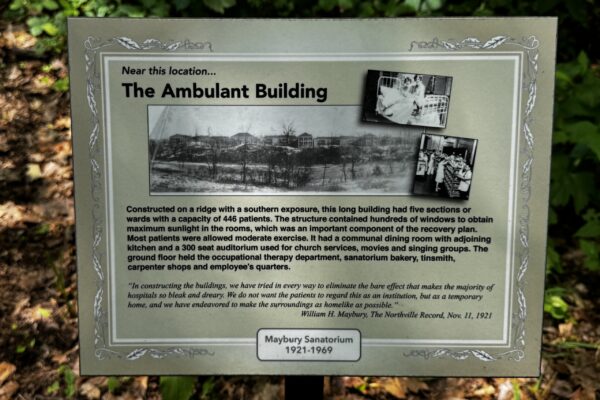
Kale: Absolutely. So it’s named after him, but he had a much more hands-on approach. It wasn’t just like, hey, we’re going to name it after this guy because he was in local government or made a big donation. He wanted to be a large part of this. He was actually one of the ones that went through the woods and kind of designed all the roads that tied everything together. Him and another guy went out there staking the roads — which today, more than a hundred years later, are the basis for our hiking paths. So when you’re walking those paths, that was a rich financier from a hundred-something years ago designing this hospital. There are so many ties to history in this place that you might not know about. And so we’re doing our best to put that story out there. We’ve got interpretive signs along the way, we’ve got history hikes — we’re really trying to get that out there because it is so unique. So many other parks are like, oh, it was once a factory and it was donated, or it was once hunting land. But how many were tuberculosis treatment centers?
Missy: And I think when I expected to arrive, I expected the ruins of the buildings — and that’s not really here. Most of the buildings were closed or torn down by the time the state got the land. But there are really great historical markers throughout that tell the story of what was there, and oftentimes have pictures of what it would have looked like. So there are ways to experience it.
Kale: Yeah. And even still, when we do our history hikes, the hospital closed in 1969 — it might seem like a long time ago, but we still get people that have a direct connection. Some of them were there when they were kids — they’ll raise their hand and say, yeah, my brother was here, or I was here when I was eight or nine. With the advent of modern medicine and antibiotics, I’m fine now — but they were there. So there are still tangible links to this day to the tuberculosis center.
The Farm — A Community Built to Heal
Missy: Oh, how meaningful to have that living history. He was also an advocate for a farm so that they could have fresh fruits and vegetables. Is that the farm that’s still a part of the park?
Kale: Correct. He started the whole living farm so they could have fresh food, fresh meat — another way to get exercise, another way to give you purpose. Hey, you’re not allowed to go back down into the city, but maybe we can go out here and plant some vegetables and have that all be part of the healing process. And yeah, that farm was still in existence when the state took over in 1975. The hospital ends, the state acquires the land in 1971, and for four years they begin to develop a plan and demolish the old buildings. In 1975 it opens as a park, but they also kept the operating farm. They knew how important that was to the community. So for the next 30 years, the farm operates as part of the park and does all kinds of educational things. Unfortunately, in 2003, there’s a large barn fire and the original barn burns down. At that point the state wasn’t entirely sure — does this still fit into the mission statement of preserving the land and providing recreational opportunities? But there was such an outpouring of concern from the community. They wanted to see this farm back. So many people had memories tied to it for the previous 30 years.
Kale: While the state was trying to figure out what they were going to do, a nonprofit organization — the Northville Community Foundation — stepped up and said, hey, we would love to run this thing if you guys would provide a lease to us. And we said, fantastic. This is the perfect marriage of what we need to do. They’ve got the financial backing and know how to operate it. We’ve got the land. And then about three miles away, there was another roughly the same size, roughly the same age barn that a subdivision was going in, and they said, you guys can have the barn for free — you just got to move it four miles down the road. So the Northville Community Foundation put together enough donations to move the barn. Animals were donated and the farm is back operating. It’s incredibly important, incredibly successful, and just a great addition to the park. They can do things that we just can’t — they’ve got a staff that’s probably larger than ours. Just a great partnership and a real testament to the community around here.
Missy: Yeah. And it’s nice to have that continue. The other thing he did — he created houses for physicians, houses for nurses. There were men, women, children. He really made this a community within a community. It was completely self-sustaining — water towers, electricity, everything was there.
Kale: Yes. And it’s so not what you would expect when you’re out there walking a hiking trail and you see a sewer cap. Because there was full infrastructure through this entire place — city sewer, city water, a power plant. And yes, there are still some morsels of it out there. The idea was that this was its own community. The doctors lived on site. When all of the hospital stuff was torn down in the early 70s, they kept three doctors’ residences — one to be the park headquarters, and then the other two for the park manager and park supervisor for employee housing. So those old doctors’ residences became our headquarters and residences for the previous supervisors. Somewhere in the mid-90s we did away with park housing, and supervisors lived off-site. But for decades, they were utilized as housing for the park supervisor.
Missy: So there is still something there that you can look at and see kind of what was built there.
Kale: Well, just last year or two years ago, when we built the new headquarters, the previous supervisor went everywhere trying to see if anyone would be interested in those buildings — the Northville Historical Society, anyone who could get done to save it. However, because the state had invested in them over the years and added modern windows and modern conveniences throughout, they lost kind of the things that would designate them as possible historic structures. So there wasn’t the interest out there. But they made the best of an unfortunate situation — they did a prescribed burn and a lot of the firefighters in the local communities got to have a nice training exercise out of it.
Friends of Maybury — A Community Like No Other
Missy: You talked a little bit about Maybury Farms, which is what the farming community is. But you also collaborate with another important entity — the Friends of Maybury. I feel like you guys do a lot about bringing community in and you work together with the community.
Kale: Yeah, the Friends of Maybury are a fantastic group. They help in so many different ways — they run a few events, including first day hikes. They help with history hikes. They fundraise for the park. They help out with volunteer hours for invasive species pulls — like if we sometimes have garlic mustard in the park, they’ll organize something to help take care of that, or invasive phragmites. So they help us through our stewardship efforts, our fundraising efforts, they help us run events. We meet monthly. Their president and vice president are what I consider friends. We have a great working relationship. They also help bring ideas.
Kale: They are super helpful in our track chair program. For those that don’t know, we have a battery-powered wheelchair on tank tracks — the track chair — that can get people who have mobility devices out onto the trails. And so the Friends of Maybury are our track chair guides. When someone calls and wants to rent the track chair, we don’t always have the park staff available — our staff is out mowing the grass, prepping the picnic shelters. But through my track chair guides, which is mostly the friends group, I can send out an email blast and say, who’s available tomorrow from two until four? And one of them will show up and help.
Kale: And when you think of a friends group, you think maybe they do some bottle drives and get you a hundred bucks or a car wash to make you $200 so you can plant a tree. That’s not this group. They’re tied into different corporations and community members that have some good finances. Without speaking about actual numbers, let’s just say they provide us with a lot of financial help.
Missy: And I think not only is this one so unique because it is so integrated — but also it’s a reminder that there are ways to get involved and support your local parks. It felt like I was part of the community when I was there to hike and spend the day. So yeah, they’re really special.
Planning a Visit — Day Use, Fees, and Getting There
Missy: Let’s talk about planning a trip to the park. How do you find that most people use Maybury State Park?
Kale: For the most part, you could kind of consider us an outdoor gym. People just come here to walk, to run, to hike, and to mountain bike. So it’s those types of day use activities, but it’s community-based. You rarely see one person by themselves — it’s always two ladies in the morning, or a couple of guys going for a hike, or four guys going by on mountain bikes. It’s like a community meeting space as well as for health and wellness.
Missy: And it’s a day-use park — there’s no camping in this park, correct?
Kale: Correct. We have an organized Boy Scout camp, but you have to be Boy Scouts to use it. It’s a rustic facility — vault toilets and hand-pumped wells. So roughly every other weekend we’ve got a Boy Scout group in here. But you can’t pull your camper in and camp out or anything like that.
Missy: And what’s the fee structure when someone comes?
Kale: We’re set up like any other Michigan State Park in that our fees are based around a vehicle fee. Anyone that walks or bikes into the park is free to use it. All Michigan State Parks are free to walkers and bikers. However, if you want to bring your vehicle in, the fee structure is based around your license plate. You can purchase what we call a Recreation Passport — our fancy word for our annual pass. If your vehicle is registered in the state of Michigan, for $18 you can purchase a pass that’s good from the day you bought it until your registration runs out. And if you’re a Michigan resident, you can get it for $5 cheaper if you purchase it when you register your vehicle at the Secretary of State — that’s our name for the DMV here in Michigan. So it’s only $13, and you get it for the full 12 months, and you can go to all 104 Michigan State Parks as many times as you want. It’s incredibly reasonable. Michigan State Parks is — we don’t have Yellowstone or the Grand Canyon, but compared to other Midwestern states, the amount of Great Lakes parks we have, the camping, the sand dunes in Michigan, what we consider mountains up in the Upper Peninsula, parks on the largest lake in the world — Lake Superior. It’s a really diverse and impressive park system.
Missy: And for me, I was out of state — there was a kiosk that I put my license plate in and put my money in and put it in a little envelope.
Kale: Yep. A little bit more expensive for out of state, which is how most systems are set up. We do a $10 daily or a $39 or $40 annual. Really great value.
What to Do — Trails, Fishing, Shelters, and Cross-Country Skiing
Missy: When you get to the park — we’ve talked about hiking, biking, horseback riding. Because I’m a Southerner, I didn’t think about cross-country skiing, but now that I know it, I’m like, what a great place after a nice snow.
Kale: Yeah. So we’ve got a little apparatus that goes behind our Gator — and our Gator actually switches from tires to tracks in the winter — and it pulls that apparatus behind it that lays down these perfect cross-country ski trails. We need about four inches of snow and we like to see three or four days of below-freezing temperatures so we can go out there and spend eight hours making the trails. But we will if we have to — that’s what we’re here for, is to provide that recreational opportunity. And on the other side of that, on those paved trails that we talk about, what we do in the winter is plow the snow from one side of the trail — and keep in mind it’s an eight-foot-wide asphalt path through the woods. We’ll plow the snow to one side to build it up. That allows walkers and hikers to walk on the plowed section. And then on the other side we lay the cross-country ski trails.
Missy: It’s fantastic. So it’s still a park to come to if you just want to go for a walk in the winter — just wear a coat. Tell me about the fishing, because the trails I took did not take me anywhere near it.
Kale: Oh, but there are trails that do. So we have the Maybury fishing pond — I’d say it’s probably 25 acres, gets to about 15 feet deep. It’s manmade through an impoundment, a dam. And then there are elevated fishing piers along a trail that go around the circumference of the pond. It hasn’t been stocked recently, but I’ve still seen people pull out pretty decent-sized bass out of it. Fishing’s fairly decent — but I mean, can you ever really know how good the fishing is? Can you ever really trust a fisherman? But yes, I have seen some people pull some things out of there and for the most part we get positive fishing reports on it.
Missy: The two other things I want to talk about — you’ve got great shelters for picnics and recreation, and you have the coolest playground for kids.
Kale: Yes. So first, the shelters. We’ve got four park shelters here. They’re fantastic. To me, it’s really weird because people will be like, what’s so special about them? And there isn’t anything special about them except for the fact that they just perfectly fit harmoniously with nature. They don’t have bright colors. They’re painted a leather brown, Rust-Oleum on the steel posts, with asphalt shingles — just everything that you want to give you a great outdoor experience without drawing your eye away from nature. They’re there to be in nature. You don’t need fancy. You need clean. You need something that will work perfectly for the purpose that you’re there for. And I’m passionate about them because they’re one of our most popular draws. We have so many birthday parties and weddings and gender reveals and company picnics — a million different things that people come to this park for and have been coming here for years.
Kale: Moving into our playground equipment — we are so happy to have it. Playground equipment is so expensive these days, especially if you’re getting cutting-edge ADA-accessible playground equipment. And that’s exactly what this is. The previous playground equipment was original from around 1980, and every year we’d bandaid it back together. But you make leaps and bounds in 40 years for playground equipment. This new stuff was funded through great community outreach — the Northville Firefighters Fund helped out with a big part of it, a private donation from a man who lost his wife to cancer and wanted to make a donation in her name, and then the DNR matched the other 50%. All people coming together. With the old equipment, you might see seven to ten cars next to it. Every single day now, I’ve got 50-plus cars. And they move the snow off of it and just get right to playing — all year long. It’s right off of the parking lot, it’s accessible, it’s educational, and there are just so many good things about it.
Events — From Easter Egg Hunts to Astronomy Nights
Missy: A lot happens in Michigan State Parks and you guys have events in different focus areas throughout the year. What are some key events that people might want to plan a trip around?
Kale: So one of our biggest ones is what we put together with the farm — that’s the Easter egg hunt. Every year around Easter, there’s a large Easter-themed event. And we’ve switched away from the competitive Easter egg thing where the big kids push the little kids away. We put out the Easter eggs, kids run out and get one, and as long as they come back with one egg, they can trade it in and get a goodie bag with all their stuff. So it ends up being more of a fun farm community event. We’ve got face painters, the full farm set up — all the spring babies are out, baby goats, baby ducklings running around. Just a great event. We fill our parking lots for it, which in April with Michigan weather is a coin flip. Sometimes you get a sunny 50-degree day, but you might also get a windy rainy 35-degree day.
Kale: All of our hikes are really popular too, whether it’s a first day hike or a history hike. We keep all of these events on Maybury’s website as well as the DNR’s website. Just last weekend we had an astronomy-themed event where the Astronomy Club of Ann Arbor brought out a bunch of high-powered telescopes and allowed the public to look through. And you had people that could explain to you, interpret what you were actually seeing — because you can bring a $30,000 telescope and put me on it and I might not know what I’m looking at. If I don’t have someone explaining, here’s what you’re looking at, here’s how far away that is, here’s how big that is — that’s what really blows your mind. We’ve got a 5K seemingly every year, lots of different fundraising runs, mountain bike races — there’s just so many good events. I’ll put links to the event pages on the episode page.
Leslie — The Park’s Resident Ghost
Missy: When I was introduced to the park, I heard a rumor that it might be haunted.
Kale: Yeah. No one believes anything is haunted until you work night shift. Once you work night shift, things just sometimes don’t make sense. So roughly about 15 years ago, we would get these messages on our voicemail asking for Leslie. This is a public park — there’s no Leslie that works here. There’s never been a Leslie that worked here. Yet all these messages, and it wasn’t the same voice. It was different voices. So that kind of gave us an idea of: is Leslie somehow tied into the park?
Kale: At the old headquarters, there would be just weird occurrences — books falling off shelves when you’re there alone, lights turning on and off that are not motion-activated lights. And it always seemed like it was not anything insidious. It was always benevolent. You would hear creaks and stuff. The old headquarters had two floors, so you would hear footsteps above you, and that would just be the most unnerving thing. But I was working with a ranger one time when I was still just getting started in parks, and she would just yell at Leslie. She’d say, “Knock it off, Leslie.” And it would stop.
Kale: So now we’ve moved to this new building, and I have been sitting in this office and the lights in the hallway have turned on and then turned off. Now they’re motion-activated. I’m like, okay, maybe a mouse ran or something — that’s what turned the light on. But when a motion-activated light works, it stays on for 15 minutes. Not this one. It would turn on, stay on for six seconds, turn off, turn back on. That’s not how this works. And you’re the only one in here. So you get out and walk around, look, nothing.
Missy: Hi, Leslie.
Kale: Yeah. So you say, “Hi, Leslie. Hope everything’s okay today.” Everything’s great until it’s at night. And then it gets weird. We like to think it maybe has something to do with the sanatorium. Not sure. Everyone who has worked here for the last 20 years has had weird experiences like that. Everyone’s got a Leslie story.
Missy: I think this is going to air shortly before Halloween. So I’m very excited to have that ghost story be part of it.
Preparing for the Weather — and Practical Tips
Missy: It can get cold in Michigan, but you’re year-round. So how would you best advise people on preparing to be outside in different kinds of weather?
Kale: You’re going to dress for the worst possible situation. You don’t look at what you actually see — you think about what could possibly happen. So if it’s 40 and sunny out, think about what happens if it gets windy and starts raining. You always want to be able to cover up your skin — exposure is the worst thing. Even if it’s just extra layers, light layers, that’s enough to really protect yourself. You want that flexibility. And this park still confounds people, even though it’s two miles by one mile. Realistically, if you walked in any direction straight for 25 minutes, you should be able to run into a main road. Yet sometimes people get lost and have been lost for four to five hours saying, I just couldn’t find my way out. We do our best to put great maps out there, we’ve got trail markers at every intersection. But when you’re fresh to parks, you can just kind of get turned around. So protect yourself, make sure you’re ready for the weather, bring your snacks, bring bug spray, bring sunscreen if it’s hot. Just the old Boy Scout adage: always prepare.
Missy: My grandfather used to always say there’s no bad weather, just bad clothing. And it is a park where your car is not that far away from you, so it is easy to bring those layers. A couple of other things I noticed when I visited — there are great bathroom facilities right off the parking lot. And there’s a bike fix-it station. I think that was the first time I had ever seen one, and I think that’s a huge asset.
Kale: And to me, that’s a huge kudos to the community that we can have those types of facilities and not worry about them. These are a bunch of expensive tools on a little cable system — are these going to walk off with someone? Are they going to get vandalized? No. They have been out there for years and people have respected them. Same thing with the bathrooms. Those are original structures from the early 80s. I have worked in some other parks an hour away from here, and you put something brand new in and within a year it’s got people’s names carved in the doors. Those bathrooms from the early 80s have aged beautifully — just like those shelters, complete harmony with the surrounding nature. They don’t draw your eye away. They complement it. They just feel right where they’re at.
Missy: The other thing I wanted to advise is downloading the trail map. I was someone who just wanted to immerse myself and I didn’t have that. So that’s why I can understand why you could get lost — because I wandered. But it would have been helpful to have the map beforehand, just in case.
Kale: Absolutely. And one thing you might not expect — even with that rustic, middle-of-nowhere feeling in the woods — every cell phone I know works perfectly in the park. So utilized correctly, your phone is a heck of a tool: take pictures, document your trip, keep yourself safe through communication or through maps.
Missy: Yeah. And the last thing — we talked about cold weather, but I went in the heat of the summer and there were lots of gnats and mosquitoes. So take some bug spray, and if it’s going to be cold, don’t forget your chapstick. Nothing is a reason not to go to this fantastic park.
Kale: Absolutely. And your experience is going to be dictated by how much preparation you put into it. One thing I’ll say — don’t sleep on Michigan’s heat and humidity in the summer months. We think of ourselves as a Northern state, and it can get super cold in the winter. But 96, 97, 98 degrees is possible in July here with the same humidity you’ve got down South. It was intense.
Missy: I don’t think I have been in humidity like that. And I lived in Houston for a while.
Speed Round
Earliest park memory?
Going camping with my parents.
What made you love the parks?
How they make you feel. They feel great to be in them, to see them, to feel them, to smell them.
Favorite thing about Maybury State Park?
The mountain bike trail.
Favorite thing to do at Maybury State Park?
For me, it’s mountain biking. But as a park supervisor, it’s seeing people enjoying the park.
Park on your bucket list?
Sequoia. I have visited Glacier, the Grand Canyon, Yosemite — three of the most beautiful places in the world. But I can’t imagine seeing the largest living organism in the world, a sequoia tree. I just want to see it and smell it and hug it.
Three must-haves for a park visit?
My cell phone — to document things, to write about it later. Water, because that’s the one thing that can keep you safe. And the proper clothing. How about a good travel partner? That’ll work.
Favorite campfire activity?
Is it okay to say bourbon? Marshmallows. Yeah, either of those two — maybe together.
Tent, camper, or cabin?
I’m a car camper. I love the security of the car. I’ve got a full-size Suburban, so I can sleep in the back. I can have the keys in the ignition — things get kind of weird, I can leave at the drop of a hat. It’s hard-sided. I don’t have to worry about weather. And at least my car door will slow a grizzly bear down for 10 seconds — enough time to get in the car and get out of there. I feel secure, I feel free, I feel like I can do what I want. The car allows me that flexibility.
Hiking with or without trekking poles?
Without. I’ve got hands if I need to use them for scrambling. And I don’t want one more thing I’ve got to hold or lose.
Favorite trail snack?
Snickers.
Best animal sighting?
Around here, it’s the coyote — because they hide so much. Even though we’ve only got 944 acres, you hear them all night long. But if you get a chance to see one, that’s cool. It’s rare.
Favorite sound in the park?
Either kids enjoying the playground, or just the sound of leaves when you’re walking on a trail.
Greatest gift the parks give to us?
That they recharge us. They bring us back around. Life brings you down. Parks bring you up. Recharge.
Missy: Kale, thank you so much for being part of The Parks Podcast.
Kale: Absolutely. Thank you so much for having me.
Missy: Until next time — we’ll see you in the parks.
Music for The Parks Podcast is performed and produced by Porter Hardy. Follow us @TheParksPodcast or visit TheParksPodcast.com.