
In the winter of 1805–1806, Meriwether Lewis, William Clark, and the Corps of Discovery reached the Pacific Coast of what is now Oregon. They were 18 months into their journey. They had 130 elk to shoot, 336 pairs of moccasins to sew, and months to wait until the mountain snows melted enough for their return. Before settling in for winter, they did something remarkable: they asked everyone in their party for their opinion — including Clark’s enslaved man York, and Sacagawea. It was 1805. Jon Burpee, Superintendent of Lewis and Clark National Historical Park, joins The Parks Podcast to share the full story.
A note from Missy: I thought this was going to be a pit stop park, but it’s so much more than that. Jon shares the history, the importance of the location, and the commitment to integrating the indigenous story. I love watching a park embrace the evolving story as information is discovered.
Episode Guest
John Burpee – Superintendent
Lewis and Clark National Historical Park
Park Stats
- Location: Astoria, Oregon (and six units across Oregon and Washington)
- Established: Fort Clatsop National Memorial 1958; redesignated Lewis and Clark NHP October 30, 2004 (President George W. Bush)
- Size: 621 acres across six units
- Annual visitors: 267,118 (2024)
- The six units: Fort Clatsop (OR), Salt Works (OR), Middle Village/Station Camp/Qiqimaqn (WA), Dismal Niche (WA), Cape Disappointment (WA — managed by WA State Parks), Fort to Sea Trail
- The Corps of Discovery: Winter encampment 1805–1806 (approximately 4 months)
- Wildlife: 14 vertebrate species, 100 bird species (including endangered brown pelican), 10 amphibians, 20 fish, 3 reptiles
- Trails: 16 miles within Fort Clatsop unit; Fort to Sea Trail (6.5 miles fort to coast)
- Ethno-botanical garden: Partnership with Confederated Tribes of Grand Ronde
- Salmon restoration: Wetlands restoration projects to support returning salmon
- Lewis’s dog: Seaman — a Newfoundland, the second most expensive item purchased for the expedition — the park celebrates Seaman’s Day annually
- Dogs: Welcome on leash
Show Notes & Links
- Lewis and Clark National Historical Park
- Plan Your Visit — Lewis and Clark NHP
- Fort Clatsop unit
- Cape Disappointment — Washington State Parks
- The journals of Lewis and Clark — University of Nebraska Lincoln
- Fort to Sea Trail
- Ethno-botanical garden
- Undaunted Courage by Stephen Ambrose
- Seaman’s Day — annual event
- Camping — Cape Disappointment unit (WA State Parks)
Episode Transcript
Lewis and Clark National Historical Park — Journals, the Columbia River, and the People Who Were Already There
The Parks Podcast, Episode 36 | Jon Burpee, Park Superintendent, Lewis and Clark National Historical Park
Welcome and Park Stats
Missy Rentz: In today’s episode, I am joined by Jon Burpee. Jon is the park superintendent at Lewis and Clark National Historical Park. Jon, welcome to The Parks Podcast.
Jon Burpee: It’s a real pleasure to be here. Thanks for having me, Missy.
Missy: I’m going to jump into some park stats. Lewis and Clark National Historical Park is located in Astoria, Oregon. It was dedicated on October 30th, 2004 — but it was really a re-designation when multiple sites came together, the original being Fort Clatsop National Memorial, which was May 29th, 1958. At the time in 2004, George W. Bush was president of the United States. The park is 621 acres. In 2024, there were 267,118 guests who came to visit the park. Some interesting facts: the park commemorates the westernmost point of Meriwether Lewis and William Clark’s journey. Lewis and Clark created what they called an extraordinary friendship with the native tribes that lived in what’s now Oregon and Washington, and that started a beneficial trading system there. The park is home to 14 species of vertebrates, 100 birds including the endangered brown pelican, 10 amphibians, 20 fish, and three reptiles. It’s a very popular stop on a migratory bird journey, and this was like one of my surprise and delight parks. I popped in and fell in love, Jon.
Jon: I feel that as well. This is one of the places that as a kid I first visited and it drew me in — and that’s when it was the tiny little Fort Clatsop National Memorial. And now being back with this expanded park it’s kind of a Cinderella, right? It just fits perfectly. It’s got a good nature of history and a really stunning expanse of nature as well.
Missy: So why is it important that Lewis and Clark National Historical Park is part of the National Park system?
Jon: In many ways, when you look at this early Republic period, there’s not a story that stands out more than the Lewis and Clark Expedition. This is a pretty — for the period — a pretty daunting thing that Jefferson asks Lewis and Clark to do. Just want you to go across the continent by land through a lot of areas that we don’t understand, we don’t know who owns. You’re going to interact with a lot of indigenous people who probably don’t speak any language that you can speak, or vice versa. We want you to look for all the good stuff that could potentially help us as a nation. We want to learn scientific information — Jefferson’s a very scientifically-minded guy. And you should be able to do it on $2,500 and make it back. Of course they spent quite a bit more in reality. But it’s a story of America’s boldness in its early days. And I think that in its own makes it incredible. But I think the significant stories of the indigenous people that they intersect with is a story that we increasingly need to understand.
The Re-designation — Six Units, One Story
Missy: First, I want to talk about the re-designation. What were the elements that came together?
Jon: It’s very funny. This initial spot, this Fort Clatsop National Memorial — the site traditionally understood to be where Lewis and Clark and the expedition spent their winter — was joined together actually about 20 years after its founding with the Salt Works. An area where Lewis and Clark sent men down for about seven weeks to boil salt water 24 hours a day to extract salt. And as we were coming up to the bicentennial of the Lewis and Clark Expedition, there were other sites that we knew were associated with the story. Local congressional supporters decided that Cape Disappointment — this area that is truly where you can say Lewis and Clark and the expedition got to the ocean on the north shore — was to be included. It’s an amazing site run by our partners, the Washington State Parks. The Middle Village, or Qwíłł’qwil, also referred to as Station Camp — a summer village site where they spent essentially 10 days and decided the fate of the rest of the entire journey at that moment. And then a spot that Clark described as Dismal Niche — six days, probably six of the most miserable days that they spent there. And those sites were brought together along with the far end of the trail to the sea to become this new national historical park. So it provides a lot of opportunities, recreational and educational, because of all these resources.
Missy: I have to be honest — anytime I think about Lewis and Clark, what sticks in my mind are the stories of the adventure. I almost forgot — I did forget — until I was researching and visiting your park, that there was a purpose. The adventure might be what hooked me in the book, but there was a purpose in collecting information.
Jon: Absolutely. For Jefferson who saw the United States in grand terms, he saw this as an opportunity to bring together multiple interests — the interest of the United States to find a practicable way to the west. He was looking for an easy way to the west. They didn’t find that, but they did find a practical way to the west that actually did then lead to future settlement, future growth and exploration. So the interest of the government brought together with the interests of the economic side of the country — what furs can be obtained, what are the mining opportunities, where’s good land for future farms — and then brought together with Jefferson’s deep, intense scientific interest. All those things had to come together really to make this happen. When Jefferson lets Congress know that we’re going to do this, he sends essentially a secret message. It’s announced more as a fait accompli than anything else. We’re going to do this. It was an absolute passion project for Jefferson but also served the needs of the nation.
The Chinookan People — Traders Long Before Lewis and Clark Arrived
Missy: You talked about the natives and the relationship that they had with them, because so often in the parks that I’ve talked to, the relationship with native peoples — the people that they ended up taking the land from — it’s contentious, and it’s sad and scary and all those things. But that’s not the relationship that they had formed out here.
Jon: No. One of my favorite activities with visitors is we stand and we imagine the geography — the mouth of the river which drains one sixth of the continent. It’s a highway to many indigenous cultures. And we talk about how do the people to the south get things from people to the north? The people here, the Chinookan-speaking peoples — anybody from the interior who wants something from the ocean, they get it through the Chinook. So long before Lewis and Clark arrived, long before Robert Gray — who’s the first non-native person that enters the Columbia River that we know of, at least in 1792 — before any of that happens the Chinookan peoples are traders. They do really well at this. By the time Lewis and Clark show up, there’s been at least 13 years of direct interaction with the Chinook and the Clatsop, Kathlamet, and the other people of this end of the river, where they’ve been trading with European ships.
Jon: And I think there’s something interesting about when Lewis and Clark arrive — Clark writes that the trade goods they have left can fit on two handkerchiefs. These are bigger than the handkerchiefs our grandpas may have carried around, but still — compared to all the other traders that were here, Lewis and Clark’s arrival in clothes that have essentially rotted off of them, replacing them with leather — compared to the guys on the ships with all those goods — it was a different thing for the local peoples. But when you look at the hospitality of the lower Chinook — I’ll say it extends to this day as a culture and as a people — the hospitality that they took with Lewis and Clark was pretty impressive. Doesn’t mean that Lewis and Clark didn’t bring their own cultural ideas with them, and at times found things within Chinookan culture that they didn’t like. But it led to a much different interaction than we often think of when there’s that interaction between the newcomers and the people of the land.
Missy: And a lot of that relationship, and what the Chinook taught Lewis and Clark and the whole crew — that’s in the journals. We know a lot about that relationship.
Jon: Yep. Absolutely. And that’s one of the great things. Lewis and Clark’s expedition is so vivid because of the journals, because of how it’s recorded. It’s truly neat to be able to see and then combine it with what we’ve learned from our indigenous partners. And there are so many overlaps between the story. As a historian, that’s super satisfying.
The “Vote” at Station Camp — and the Decision to Winter
Missy: So they made a collective decision to stay there for the winter. What would that have been like?
Jon: There’s this funny moment at the Middle Village, also referred to as Station Camp — it’s a spot on the north shore of the river, part of the park today. And they do something. Sometimes people refer to it as a vote, and that makes me pull back a little bit because it is a military expedition. When I ask veterans do you remember a lot of democracy during your time of service? They say no, not really. But great military officers will often listen to the enlisted folks. And I love this moment — it’s a moment where there’s a solicitation. They had three options: stay on the north shore where they weren’t seeing a lot of game, stay in the Chinook summer village at Qwíłł’qwil, or return upriver to a place called the Sandy River. And they record everybody’s opinion. In Clark’s journal you can go to that date and read each and every one of the opinions.
Jon: What’s intriguing to me is it’s not just the sergeants and the privates, or even some of the civilian contractors essentially that were with them. But they include Clark’s enslaved man York, and they include Sacagawea — the indigenous woman, the wife of Toussaint Charbonneau. And they record their opinions. And sure enough, when you look at it, it feels like a vote, because the majority of them said they wanted to go to the south shore, and Lewis found a spot that was a good spot for temporary quarters. I think that’s an extraordinary story — that at a time where an indigenous woman and an enslaved African man wouldn’t necessarily be asked their opinion of much, it’s there recorded in the captain’s journal.
Missy: And the more you learn about the expedition, all of those who went on it — especially by the time they got out west — were so knowledgeable, and their perspectives would have been very valuable.
Jon: Yep. Absolutely. I think the sign of a good leader often is to listen more than speak. And that’s one of the geniuses of Lewis — making sure that he has all the right people, and then also making sure he has all the right supplies and skill bases to make this happen.
What It Was Like to Winter There
Missy: When they were out there, how long had they been on their journey at that point?
Jon: They had spent their first kind of winter in the greater St. Louis area, 1803-1804. They spent their winter at Fort Mandan. And then the winter of 1805-1806, they spend out here. They’ve been on the journey quite a while. There’s actually some reference, as they return back to the St. Louis area, to surprise that they were even still alive — people had just figured they’d been gone so long. And that’s the other thing I often think about — we talk about all this adventure throughout the journey, but it’s a boring time here. They’re just marking time. They’re waiting for the snows on the Bitterroots and in the Rockies to go down enough that they can return. So you’ve got essentially four months that they spend here at the mouth of the Columbia River waiting their time. So many veterans I’ve talked to who have been deployed talk about how those days — particularly when you know those days stretch longer and longer for you to get home — how those days can be challenging.
Missy: I’m sure away from loved ones and just ticking them away, and they’re long, cold days.
Jon: Absolutely. And one of the worst things you can have is bored enlisted men. So they’re doing all the tasks they need to sustain themselves. They shoot over 130 elk while they’re here. They sew 336 pairs of moccasins. Two and a half bushels of salt are pulled from salt water. They make candles. They’re preparing for their journey home. Keeping enlisted men busy is probably a good idea in those circumstances. And it’s cold.
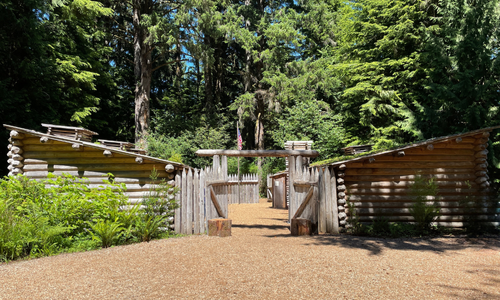
Missy: And when you go and you see the replica area, those aren’t luxurious settings for them.
Jon: No, indeed. It’s quickly built. It’s the greatest Christmas gift — they move in essentially on Christmas Eve, and they’re indoors whereas they’d been sleeping largely outdoors. Their tents had rotted, and that had to have been this great moment. Within the journals, you see the hardships. There are mosquitoes throughout much of the time here. There are fleas. One of the sergeants writes that of the time they were here, there were 12 days — so of the four months, 12 days where it didn’t rain, and only six days where the clouds broke enough you could see the blue sky. November to March is a tough time to live here, particularly in those situations.
Environmental Conservation — Wetlands and Salmon
Missy: We’ve talked a lot about the history. But you all are one of those parks that has both historical preservation and environmental preservation and conservation. Let’s talk a little bit about what you all are doing from an environmental perspective.
Jon: We’re really fortunate in that Congress gave us a really straightforward mission. Our legislation says that not only are we to share these stories from all these perspectives, but also to restore the landscape as it looked in 1804-1806. That can be a little bit challenging because some of the uses in the past really have transformed it. But as a superintendent, I’m so incredibly proud of the types of projects we’ve pulled off in terms of wetlands restoration. A park this size with a staff this size — probably no one would expect us to pull off these things. And the other thing is we’re in an area where salmon survivability is really challenging, particularly young fry returning to the ocean. Much of the lower Columbia has been rip-rapped or armored to control flooding. Here we get to create those spaces of sanctuary — which is super important for the culture of the Pacific Northwest, whether it’s thousands of years of indigenous history or sports fishermen today. We’re really helping to return salmon to their former glory, hopefully.
Missy: And I think that’s important when people say, oh, I don’t use a park. You do. I can’t think of many people who wouldn’t benefit from what the park does. Your recreation might not be in the park, but you benefit from the work. The other thing that was really surprising to me about this area was the different ecosystems. How many is it — three or four different ecosystems there?
Jon: It is. We have a trail called the Fort to Sea Trail, which surprisingly goes from the fort to the sea.
Missy: Creative name, Jon.
Jon: But I love it — it essentially starts down at the Lewis and Clark River, works its way up over Clatsop Ridge, and as you’re going up and over and then down to the ocean you’re seeing really the landscape of this area. In a six-and-a-half-mile hike you’re seeing all of it. I’ve got a couple of favorite spots. One is the wetlands on the South Slough Trail — it’s got a really nice hill that makes me work harder than I probably should be working, and then I drop down into this beautiful little low area, this wetlands with skunk cabbage, just symbolic of the Pacific Northwest. But I love going up to the Cape Disappointment unit and seeing old-growth Sitka spruce. When you sit there and you tower over those things in the South Slough that are growing in that wetlands, and then you get towered over by those Sitka spruce — you realize that this park has something pretty special.
The Ethnobotanical Garden
Missy: One of the features that I did not see — so you are on my list to come back — is the ethnobotanical garden.
Jon: Yeah. It’s been a project we’ve worked on particularly with the Confederated Tribes of Grand Ronde and the Clatsop-Nehalem Confederated Tribes, to essentially bring forth some of the types of plants that were important to the native peoples and recorded in the journals of Lewis and Clark. What I love is when I’ve been down there with our resources folks and they’re telling the story of these plants — how many people don’t recognize those plants and have that moment to realize, wow, these really are the plants that define part of our culture. Things that were written about within the journals are right there at your fingertips to touch, to smell, to experience, to look at. And I love that.
Jon: I almost look at it like a research library — you get to see things that then you get to put in context out in the wider world. I’ve had some wonderful moments hiking with my kids where I had pointed out a plant, but then later out on the trails, they showed me the same plant. My eyes may have just walked past it on the trail, but their eyes had focused in because of that ethnobotanical garden.
Planning Your Visit
Missy: Let’s talk about planning a trip. What’s the first step you recommend to people when they’re planning a visit?
Jon: I love the nps.gov website — it is full of amazing information. I highly recommend folks download the National Park Service app, because particularly when you’re on site it truly helps. I think of a couple years ago at the Redwoods where I was so happy I had maps loaded even though I couldn’t get a signal. With a historic story of this magnitude, I highly recommend folks hit one of our two visitor centers — either here at the Fort Clatsop unit, or up in the Cape Disappointment unit, which is an amazing museum in its own right. Those will ground you in the story and the context. This park is six units, or six different little areas, so thinking about logistics is important. What can I see in the time I have? And contact us — we’ll be happy to share ideas of how to plan for your visit.
Missy: I agree with you about the website because you can really go down quite a rabbit hole. The first time I went I had done very little research. Now that I’ve been and prepared for this conversation, I would have a totally different experience going to the park.
Jon: Absolutely. And here you’ve got a guide for a day-by-day experience in many ways. One of my daily things is I read the journal entries that happened for those dates from 1804, 1805, 1806. The journals are online — the University of Nebraska Lincoln has an amazing resource where you can pull up individual days, but you can also pull up individual topics and see all the journal entries. The folks who have read a general book like Undaunted Courage, or have dug into the journals themselves — they’re going to find an even bigger connection to this place.
Missy: The park doesn’t have lodging, but you all are in a prime area. You’re close to Portland, close to so much. Lodging isn’t an issue when people come to the area, it’s just not in the park.
Jon: That’s right. Although we do have camping up in the Cape Disappointment unit, run by the Washington State Parks — they have yurts and those types of things. But we are in an area where, since 1811 when the first American settlement, a fur trade post called Fort Astoria, was established — almost immediately people are coming out. The towns that grow up — whether it’s Astoria, Seaside, Warrenton, Cannon Beach — especially in the summertime, they’ve got lots of hotel rooms.
Missy: Also you’re in a region where there are a lot of national parks — between Olympic and Rainier and Crater Lake, you’re on this nice tour, a great summer vacation with everything pretty close.
Jon: One of my favorites — I’ve had quite a few folks whose entirety of their vacation was to hit these national parks in this order: Lewis and Clark, where you get the story of the native peoples and the explorers. Fort Vancouver, where you get the story of the early settlement of the Pacific Northwest and a fur trade story. Seattle Klondike — one of the smallest little sites that we have but it tells the story of the boom of Seattle and the growth of the Pacific Northwest. And then you’re in the shadow of Mount Rainier. It’s just this giant tour that always makes me want to get in the car with them.
What to See and When to Visit
Missy: When people come to visit, what can they see?
Jon: They can see the replica fort and these great exhibits, both at the Cape Disappointment visitor center and here at Fort Clatsop. They can get out and hike and experience the forest — I love a misty, moisty forest. So those are the big activities, the big things they can see throughout the park.
Missy: Is there a time of year that you recommend?
Jon: Of course, summertime — it is beautiful out there. But if you really want to experience it as Lewis and Clark did, I highly recommend coming in December. There’s a week between Christmas and New Year’s where we essentially have the fort open with folks in period clothing. I always joke that anybody can visit during the summer and it’s a good visit. But if you really want to experience it — let us throw you in some moccasins in December and see what it was really like for Lewis and Clark here.
Missy: Oh, that’s a really cool idea. Okay. How do people prepare for a visit based on weather and time of year?
Jon: We’re essentially a rainforest. That sergeant who wrote about all that rain — it’s a true thing for much of the year. The summers of this part of the world are beautiful and mild. I love when we complain that it’s 75 and has gotten too hot. But the winters are pretty wet. Highly recommend folks dressing appropriately for the weather because it can be pretty tough if you get wet tennis shoes when you’re hiking our trails.
Missy: Jon, when I was there — it was five years ago now — and it was during the first summer where there was a 114-degree heat wave. That was hot out here. It is not normal.
Jon: That was a challenge. I was actually on duty on an acting assignment at Pearl Harbor, so I missed the heat entirely. You got to experience something at Lewis and Clark that I didn’t get to experience.
Missy: I don’t recommend it. Can you bring your pets to Lewis and Clark?
Jon: Yeah, this is a fairly pet-friendly place, and there’s a specific reason for that. The second most expensive item that Lewis purchased for the trip was his dog Seaman. And Seaman was a Newfoundland. In fact, we just had Seaman’s Day just a few days ago where we have a whole bunch of Newfoundlands in and their owners helping tell the story of Lewis’s dog — a valuable member of the expedition. So we do the typical things — on a leash, under your control — but we get a lot of folks who bring their dogs, not just Newfoundlands but other types of dogs as well.
Missy: I love it. You might be getting a golden doodle here in a few weeks.
Jon: Alright!
Speed Round
Earliest park memory?
Fort Vancouver, eight years old, being fascinated by the idea that there were people who were here long before me.
What made you love the parks?
As a historian, the ability to be transferred and transformed. Lincoln said it best when he said that these sites like Gettysburg have value. We could remember these things anywhere, but when you’re standing in the footsteps of those who came before us — I love that connection.
Favorite thing about Lewis and Clark National Historical Park?
There’s so many things, but I will say this — the staff is extraordinary. I’m so lucky to get to work with these people. They bring this place to life and I’m a very lucky superintendent.
Favorite thing to do at Lewis and Clark National Historical Park?
I love to get out on the river when I can. I love to hike here as well. But probably my favorite thing is talking with visitors. I’m out of my office probably more than I should be, but I get out there and talk to visitors and help share this story — and that’s just an honor and a privilege.
Park on your bucket list?
The National Park of American Samoa. It may be on the bucket list for a long time, but just the nature of — first of all the tropical paradise that by all pictures it looks like — but the way the Park Service works with the local population I think is really unique. But I have not met a park I didn’t like.
Three must-haves for a park visit?
My phone with the National Park Service app. Good walking shoes. And just an openness to learning something new.
Favorite campfire activity?
I do love s’mores. But I love some of the old school campfire programs that still happen in quite a few parks — the ability to sit there, part of a group, part of a community, learn and participate. Every time I sit around a campfire, I think of some of the best places that I’ve learned from good people.
Tent, camper, or cabin?
I am still a tent camper, although I recently have begun to realize that there is some beauty in things that have wheels on them. But still a tent camper.
Hiking with or without trekking poles?
The older I get the more I believe in trekking poles for stability. I also have a nice set that I can put a camera tripod on or attach my phone to, and that makes for much better photography for me.
Favorite trail snack?
I’m an old-fashioned guy — Gorp is always good. Increasingly though I find myself just enjoying the local berries. Here you can pick up to a pint a day of berries, and as we move into berry season it’s fun to get to try those.
Best animal sighting?
Probably a sidewinder rattlesnake at Scotty’s Castle of all places. A large group of people gathered around that rattlesnake, and even though I have a small fear of rattlesnakes, helping to successfully move that rattlesnake away from those folks was pretty cool. But beyond that, I increasingly love the diversity of birds around me.
Favorite sound in the park?
There’s a spot on the South Slough Trail where there’s a boardwalk that crosses a creek. If I could properly ever record the sound of that little waterfall, I think I’d play that constantly in my head.
Greatest gift the parks give to us?
To realize that we’re part of something bigger — that we have a great opportunity to impact the world around us. One of my favorite things is anything that gives me a chance to realize I can do outside the park what I’ve learned within the park. Whether that’s studying history because of a visit to a site like Manzanar, or just realizing at my house that I need to worry about those invasive plants that aren’t the local ones we really need out here.
Missy: Jon, thank you for joining me today. Thank you for your storytelling and your knowledge and your passion for Lewis and Clark. I really appreciate it and I’m grateful to you.
Jon: Truly appreciate the opportunity to share it, and I look forward to folks coming in and finding their magic in this park, whether it’s this one or any of them out there.
Missy: Absolutely. Thanks for joining us for today’s episode. Until next time — we’ll see you in the parks.
Music for The Parks Podcast is performed and produced by Porter Hardy. Follow us @TheParksPodcast or visit TheParksPodcast.com.