
My experience
The Korean War Veterans Memorial is one I always forget about. And it is really one of the more beautiful spots on the Mall.
On a recent visit I walked up and said to my friend, “Remind me what the Korean War was about?” Which led the two of us down a beautiful rabbit hole about our own history.
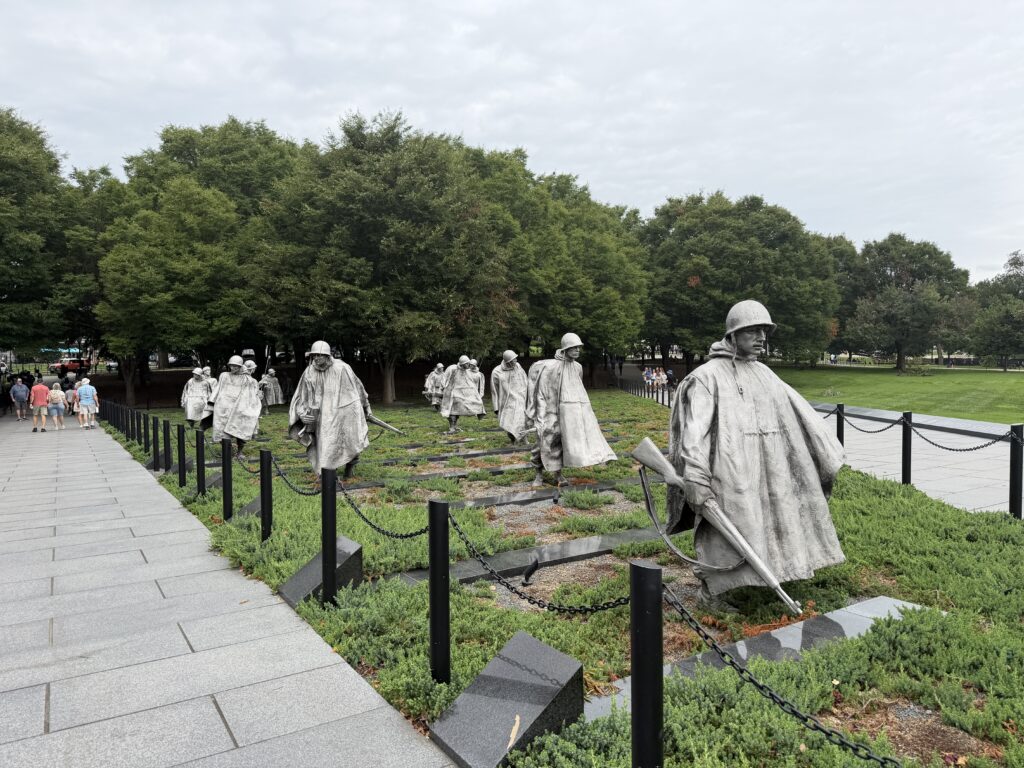
In this memorial you see soldiers walking through a field toward the water. The expressions on their faces and the tools they are carrying tell you what their work was and what they were feeling. And then the wall has etchings, and those etchings are of real service members from the war.
I am fortunate enough to see these monuments on a regular basis. When I lived in Washington it was several times a year. Now that I am ninety minutes down the road in Richmond, I make a point of going — because it is close enough that not going would be a choice.
And because I think it is important to remember the history of the wars we fought, why we fought them, and what we can learn from them in the hope that we do not repeat them. And it is important to show respect to the people who served, and to the ones who did not come home.
The Forgotten War
Here is the thing I did not know when I asked my friend that question.
The Korean War’s other name is the Forgotten War. It sits between the Second World War and Vietnam and gets crowded out by both. So the question I asked out loud, standing in front of it, is the exact question this memorial was built to answer.
It ran from 1950 to 1953 and ended in an armistice, not a peace treaty. Technically it has never formally ended.
What you are looking at
There are nineteen statues. Frank Gaylord sculpted them in stainless steel, each one around a thousand pounds. They are a platoon on patrol — fourteen Army, three Marines, a Navy corpsman and an Air Force forward air observer. The juniper bushes and the strips of granite they are moving through are laid out to be the rough terrain of Korea.
And this is the part I had walked past without seeing.
The wall beside them is polished. The nineteen statues reflect in it, and the reflection makes thirty-eight.
Thirty-eight is the parallel that divided Korea. Thirty-eight is also the number of months the war lasted.
So you are not looking at a squad. You are looking at the two numbers that define the whole thing, standing in a field.
The wall
The etchings are of real people. The mural wall runs 164 feet and carries more than 2,500 images, sandblasted into the granite from archival photographs. Louis Nelson did it.
What I did not realize is who they are. They are overwhelmingly the support troops — nurses, chaplains, mechanics, cooks, crew chiefs. The ones carrying rifles are standing in front of you as statues. The wall is everybody else.
At the far end there is a shallow black pool ringed with linden trees, and an inscription: Our nation honors her sons and daughters who answered the call to defend a country they never knew and a people they never met.
A Wall of Remembrance was added in 2022, listing 36,634 American and 7,174 South Korean dead.
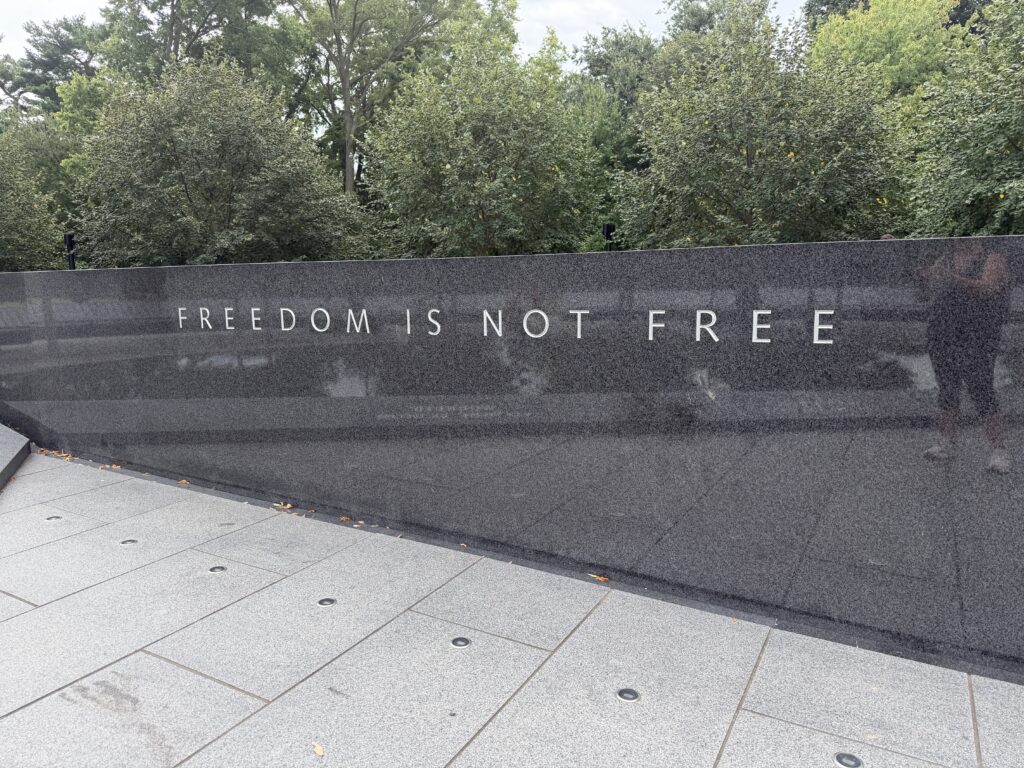
And somewhere on the granite, inlaid in silver: Freedom Is Not Free.
What I’d tell a friend
Find the angle where the reflection works. Stand so the statues and their reflections line up and count them. That is the whole memorial in one look.
Give the wall real time. It reads as texture from a distance. Up close it is two and a half thousand faces.
Go at either end of the day. It is open around the clock, and the low light on stainless steel is completely different from noon.
Ask the question out loud. If you do not know much about this war, you are in the majority, and that is the point of the place. Look it up while you are standing there.
Plan your visit
Entry: Free. No fee and no ticket.
Hours: Open 24 hours a day. Rangers are on duty during the day and are worth asking — this is a memorial that rewards a question.
Where: The southeast side of the Lincoln Memorial, across the Reflecting Pool from the Vietnam Veterans Memorial. The two are an easy walk apart and most people do them together.
Parking: Limited metered street parking on Ohio Drive SW. Metro or walking is easier.
Worth knowing: The memorial was dedicated in 1995. The Wall of Remembrance, with the names of the dead, was added in 2022.
What to pack & wear
Pay attention to the weather. Washington, DC is hot and humid in the summer, crisp in the fall and cool in the winter, and you are outside the whole time.
Comfortable shoes, and water — there are places to refill a bottle along the way.
Pets
Leashed dogs are welcome. It is entirely outdoors and the National Park Service lists the Mall memorials as pet friendly, so there is nowhere your dog has to wait for you.
Six-foot leash, clean up after them, and keep them off the field with the statues in it.
Hours, parking and pet rules change. Check with the park before you go — details here were verified in September 2026.