
John Goodwin was a National Park Service ranger for 27 years. He worked Rocky Mountain, Mount Rainier, North Cascades, Everglades, and Golden Gate. He was a law enforcement officer, EMT, wildland and structural firefighter, and search and rescue professional. He was struck by lightning twice. He had 20 hospital stays. He battled PTSD for 10 years. He became the mayor of Coma, California. He wrote a book called Echoes of the Badge. And then he got on an Amtrak train in San Francisco, rode it to Chicago, then to New York, then to Washington D.C. — and stood on the steps of the Lincoln Memorial to fight for the parks he spent his life protecting.
A note from Missy: I met John on the steps of the Lincoln Memorial. He and his son had trained across the country to protest the administration’s attacks on our public lands. That moment has built a friendship and I loved having him on to talk about his experiences as a National Park Service police officer.
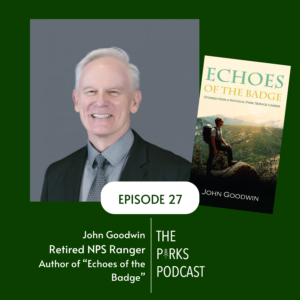
Episode Guest
John Goodwin, Retired NPS Ranger
Echoes of the Badge
Career Stats
- 27 years as a park ranger (retired 2017)
- Parks: Rocky Mountain NP, Mount Rainier NP, North Cascades NP, Everglades NP, Golden Gate NRA
- Roles: Law enforcement, wildland firefighting, structural firefighting, EMT, search and rescue
- 20 hospital stays; struck by lightning twice; diagnosed and treated for PTSD
- Mayor of Coma, California
Show Notes & Links
- Echoes of the Badge — purchase at any major bookseller
- John Goodwin / Lightning Ever on Instagram
- Resistance Rangers
- National Park Patch Lady / Sandra Ramos
- National Park Service — Law Enforcement Rangers
- Find your Congressional representatives
- Backcountry safety tips — NPS
- Hug a Tree survival program — children’s safety
Transcript
Echoes of the Badge — Life as a National Park Ranger
The Parks Podcast, Episode 27 | John Goodwin, Retired National Park Ranger & Author, Echoes of the Badge
A Life in the Parks
Missy Rentz: In today’s episode, we are so lucky to have John Goodwin join us. John is a retired National Park Service Ranger and the author of Echoes of the Badge. John, welcome to The Parks Podcast.
John Goodwin: Thanks, Missy. Thanks for having me on today.
Missy: John, we start episodes talking about stats, and so I did a little research. You were a park ranger for 27 years, retiring in 2017. You worked at five parks — Rocky Mountain National Park, Mount Rainier National Park, North Cascades National Park, Everglades National Park, and Golden Gate National Recreation Area. Your roles included law enforcement, wildland and structural firefighting, EMT, and search and rescue. You had 20 hospital stays. You faced off against bears and alligators. You were struck by lightning twice. Then you became the mayor of Coma, California, where you live — and you are the author of a book called Echoes of the Badge. What a life.
John: It’s been a good life.
Missy: I want to talk to people just quickly about how we met. I got a note from a mutual friend saying, “You need to know John. He’s in the middle of taking an Amtrak across the country, and he’s going to do a protest at the Lincoln Memorial in Washington, D.C.” I live 90 miles from Washington, D.C. So I’m there — I’m a hundred percent there. And I met you at the foot of the Lincoln Memorial and we protested together.
John: Yes, we did.
Missy: It was very good and very bonding. I feel so connected to the people that we spent time with. And even your journey — you and your son Sean mentioned several stories about talking to people on your way across the country.
John: Yeah, we did. That was a choice I made — to take the train rather than fly, not only to reconnect with the country at ground level rather than 30,000 feet, but also to interact with people on the train. Whenever I got somebody’s ear, I would just talk to them about public lands and the employees who work there.
Missy: And you let the rest of us travel with you because you did a great job posting to your socials, which we’ll certainly link to. Your book is Echoes of the Badge. I read it while perusing some parks recently — it was really fun to do it that way. You share a glimpse inside your life, but also the life of park rangers. And I am somewhat ashamed that I didn’t realize the scope of work of our rangers. I see them at the entrance, I see them helping me with trails, I see them leading tours. But never in my life did I realize the scope of the work that you do.
John: No, it’s amazing. It’s like a small city — or even a big city. You’ve got the teachers, who are the interpretive rangers. You’ve got law enforcement — police officers are the law enforcement rangers, who are also search and rescue and firefighters. You’ve got public works, which are maintenance employees. You have dispatch. The only thing unique about that is we all wear the same uniform. People used to come up to me and say, “Oh, since when did rangers carry guns?” And I’m like, forever — I’m a law enforcement ranger. And they’d say, “Oh, that person over there leading the tour, they don’t have a gun.” And I’m like, that’s because they’re the teacher equivalents of what we have in the park. They’re called interpretive rangers. That leads to a lot of confusion. Imagine going to a city or town and everyone’s wearing the same uniform. It would be confusing.
Why He Became a Ranger
Missy: It is a true labor of love to be a park ranger. Why did you decide that you wanted to be one?
John: The background on my Zoom is Great Sand Dunes National Park — that’s where my love of the National Park Service started. Before my dad got sick, we used to pile into a Dodge camper van and travel around western national parks on summer vacation. And Great Sand Dunes was the go-to every summer. Back then it was a national monument. And I saw the rangers — at the entrance stations, at the desk where you ask questions, at the campfire talks, patrolling, doing maintenance. For me, that was my superhero. I wanted to be a park ranger since I was that small. Of course, life gets in the way, and I didn’t get the opportunity until much later. But it was a dream. And it all started with Great Sand Dunes.
Missy: And you can see how it impacted you as a kid by the way you treat kids when they come up to you. Because even at this protest, when a child would come up, you were down on your knees at their level, you let them wear the hat, you engaged with them in such a special way.
John: Absolutely. Our parks are set aside for future generations. Every opportunity I had as a ranger, I wanted to interact with young kids — not only, since I was law enforcement, to take away the fear of dealing with a law enforcement officer, but also to just let them wear a hat for a second. I went through several hats during my career because only so many can withstand the abuse from little kids. But I just loved interacting with every kid because they may not become rangers themselves, but they’ll have that appreciation for the public lands. And that’s so important. Because what we’re seeing right now especially is that threat to public lands. And I’m hoping that the people I interacted with — not only on the train ride, but during my career — those are the people who will start speaking up and saying, stop.
The Scope of the Job
Missy: How would you define the role of a park ranger?
John: Everything and anything. Any given day, you have no idea what you’re walking into. You can go in — I used to joke with younger rangers, they’d come in and ask, “What are we gonna do today?” And I’m like, whatever pops up. You can have your best laid plans and they’re gonna go astray. You’re gonna get called to go in a rescue, a fire, whatever. You have to wear many hats during the day — whether it’s firefighting, boat patrol, a National Guard helicopter overflight looking for marijuana fields. You have to be flexible. And this is not only true for law enforcement — interpretation rangers may get dragged into search and rescue as volunteers. Many are trained in wildland firefighting. You just have to wear many hats if you’re working for the Park Service.
Missy: I found when I was reading your book — it’s almost like reading a journal. It was really raw and vulnerable in the storytelling. You chose to put yourself in harm’s way multiple times to help someone else. I had to remind myself to breathe. There were middle-of-the-night hikes and boat rescues and overnight stays. And you were struck by lightning twice. I’m not sure I would’ve gone out on a boat again after being struck once.
John: It takes a special person to have to go out after getting struck the first time — and then get struck another two years later.
Struck by Lightning — Twice
Missy: Can you share a little bit of that story?
John: So the first lightning strike — this was right before a hurricane was coming towards Florida. My job that day was to get on my Boston Whaler and go out into Florida Bay and contact people either camping or on the international waterway. I left the port — Flamingo, like the bird — and made it right out of the port when a lightning storm came. Being on the open water, you can judge where the thunderheads are going because in the Everglades, there’s no mountains. You follow which way the anvil’s pointing. That’s usually the direction it’s going. However, lightning can strike many miles away. The whole day I was just narrowly missing one lightning strike after another. I finally had enough and pulled into a marina, filled up the Whaler, went to a restaurant, checked the weather channel. It looked really bad. I called my buddy Bruce back in Flamingo on the park radio and he said, “It’s dark and overcast, but I’m not seeing any lightning.” So I decided to try to make it back.
John: I was going through a channel called Mana War Channel when — last thing I remember before my heart stopped was the lightning. Just a beautiful white light that was everywhere. I didn’t feel it. People say what did it feel like? I’m like, I don’t know. I thought I was dead. It was just utter peace. And then — whatever brought me back — I was on the deck of the boat in the most pain I’ve ever been in my entire life. It apparently went through my left shoulder, went across my heart — that’s why the heart stopped — and then exited out my right arm and right leg. Coming to on the deck, I realized I couldn’t put any weight on my right leg. My right arm was useless. I hobbled to my feet, turned off the boat — which was somehow going in the opposite direction — called dispatch, and thankfully the radio still worked. Their first thing was, do you want us to send somebody out there? And I was like, no, I don’t want anyone else to get hit. So I gradually navigated back myself. Horrible boat ride. Just in so much pain the entire way. And they got me into an ambulance in Flamingo. That started a battle with PTSD. I should’ve felt lucky to be alive — but I didn’t really feel lucky, because you’re just in so much pain still.
PTSD and the Willingness to Talk About It
Missy: One of my passions is wellbeing and mental health. I find nature to be very healing. You are very open about your journey with all of it — the lightning strikes, the friends you’ve had die in the line of service, the suicides at Golden Gate. It was like one thing after another. I wanted to be like, please tell me not every one of your days was like this.
John: It was a horrible battle — a 10-year battle with PTSD. So imagine that covered the time when I was in Golden Gate. I was dealing with my own inner struggles while having to see people’s bodies float on shore after jumping off the Golden Gate Bridge, and having to stay on scene until the coroner arrived. And dealing with drug overdoses, purposeful or accidental. It takes such a toll. The reason I’m so open about that battle is I just don’t want others to suffer needlessly. Get help, get treatment. It’s effective. You’ve got to stick with it, and it can be very painful because it opens up a lot of wounds. But if you don’t help yourself, you can’t help anybody else.
Missy: And I noticed how supportive your peers and friends were in the book.
John: I did. I lost a few friends and coworkers along the way. And I shared with everyone who wanted to listen — with the trainees I had as a field training officer. I would take them to different spots where things had happened, just to show them what to be careful of. There was one story in the book where I reached for a man who was about to jump off a cliff, and afterward somebody told me: “Don’t be hard on yourself. He probably would’ve taken you with him.” I struggled with that so much until I had that realization. Sometimes it’s just the wrong place at the wrong time. But you keep going on.
The Joy in the Work
Missy: It’s not all lightning bolts and rescuing people. There were a lot of fun stories.
John: Oh, absolutely. I remember going to Rosie the Riveter National Monument — they were trying to break the world record for the number of Rosies under one roof. And there was a little girl there, maybe seven or eight years old, dressed as a Rosie the Riveter. So cute. She came running over to me. Her mom was apologizing and I said, “Don’t be.” We ended up getting a picture taken. It’s moments like that. Or I remember a young boy and his mom came into my absolute favorite coffee shop in San Francisco — Art Bistro on Gary Boulevard. The boy was just looking up at me with his mouth agape, eyes wide open. I said, “I’ve got something for you in my patrol vehicle.” I went and grabbed some brass buttons that go on the dress uniform jacket — I had bought them on my uniform stipend. I gave him a handful of brass buttons and told him what they meant and which jacket they go on. A couple of months later I see his mom, and she told me — he took those brass buttons with him on a week-long backpack trip with his dad. He kept those buttons with him the entire trip. That was his motivation to finish it. Those are the moments that made my career so amazing.
Planning a Trip to a National Park
Missy: In every episode, we talk about how to plan a visit to a specific park. This is a unique opportunity to talk to you as a ranger and get your perspective broadly.
John: First of all — how are you gonna get there? Look at your budget. Do you need camping reservations? Check nps.gov. See if you need backcountry reservations if you’re going backcountry camping. See what ranger-led programs are going on — maybe you can tailor your trip to those. Plan for whichever type of camping or lodging you’re going to do, or a combination. But don’t over-plan. And especially when you get to the park — try to have half a day or even a full day of doing absolutely nothing. Unwind. All of us bring all this garbage from the cities with us. When you get to a park, just unwind. Give yourself half a day to a day before you start doing anything. Because if you get to the park and immediately hit that trail, you’re gonna carry that baggage with you for a while. Set up your tent, go on a short hike, go to a ranger-led tour. Just hang. Pull out your sleeping bag and look up at the sky. Let it happen.
Missy: I love your idea about holding space. When I was on my year-long trip, I was in Yosemite, and Yosemite is one of those parks where there’s a lot of “shoulds” — everybody telling you what you should do. And I woke up one day and was like, I don’t want to. I took my chair and packed a cooler and got my binoculars and I went and sat under El Capitan. And I spent eight hours talking to people and looking up at people climbing the rock face. And it was one of the most spectacular days because I just let it happen.
John: We don’t allow ourselves to let that happen. That’s the key.
Overcoming Fears — and Ranger-Led Programs
Missy: What’s your advice for people contemplating something new they’ve never done before?
John: I say go for it. But I’m not going to tell a person they need to overcome their fear by doing this or that. I’ve tried climbing Half Dome on the cables twice and maybe I’ll do it again. The first time I chose not to go up because my son was having a little anxiety attack at the base and I stayed with him. The second time I made it up about a third of the way and my shoes were awful. But both occasions I was able to see people interacting with each other at the base of the cables. And I noticed some people were just egging others on — “Just do it! Just overcome your fear!” It’s not like that. That can actually make your fear a lot worse. Understand what your fears are, and understand that it may take a lot to overcome them — and that it’s usually gradual.
John: There are ranger-led programs for almost everything. Say you want to go to the Everglades but you’ve never been on a canoe. There are ranger-led canoe trips. They’ll show you everything. You’ll wear a PFD. You might have an encounter with an alligator, but it usually won’t hurt you. If you don’t want to get on the canoe, maybe just sit at the water’s edge for a while and watch. See other people going in and not getting attacked by alligators. That alone may help. So look at all the resources your national parks, monuments, historic sites, and recreation areas have — and then plan accordingly.
Safety in the Parks
Missy: What can people do to best prepare for their own safety?
John: Bring the 10 essentials with you, even on a short hike. Don’t go above your comfort level. Always — always — let people know where you’re going. That is a failing I’ve seen so many times. People never let anyone know what backcountry site they’re going to, what trail they’ll be on, when they’re due to come back. And we’d have to look — hopefully they have a backcountry permit so we can go to those sites. My district alone in the Everglades — Flamingo district — was 500,000 acres. So let people know where you’re going and when you’ll be back, what car you’re driving. All of that.
Missy: And should you let a ranger know too? I always feel like a burden.
John: You’re not at all. We would rather know your itinerary. You can write on a post-it: the make and model of your car, when you’re leaving, what trailhead you’re going out on, what backcountry sites you’ll see, and emergency contact numbers — not just one, but several. The visitor center is probably the best place to go — that’s usually where you get your backcountry permits too. Especially if you’re solo. Definitely let somebody know. And make sure to check in when you’re back.
What to Do When a Child Is Lost
Missy: I was on a hike in Georgia recently and a mom came running up to me completely panicked — her six-year-old had gotten out of sight on the trail. He was quickly found, but I thought: what should mom do in that situation?
John: The mom should stay on scene — she knows the child. What she should do is send another person down to call the ranger. Give that person the child’s description — how old they are, what nickname they go by, anything. That other person makes the call. The parent stays on the main trail and doesn’t go off looking all over the place. Your child is probably just ahead or just off the trail nearby.
John: And to be proactive before a trip — tell your child: hug a tree. I know that sounds weird, but it works. I told my niece that when she was a little girl. She got lost once and she hugged a tree and they found her. She said, “Uncle John told me to do this.” Literally tell them: hug a tree, don’t move. The only exception is if you’re near a cliff or in danger of falling — secure yourself. But please don’t wander. We’ll do a hasty search from the last known location first, and then a full team comes. Help is coming. Best thing is to stay put. Park your buns by a tree and just sit there.
What to Tell Your Kids Before a Trip
Missy: What conversations should you have in advance to prepare your kids for a safe trip to a park?
John: Get them a whistle. Buy your kids whistles — carry a few extra in your pocket. Shouting is just like talking. If you do it long enough your voice gets raspy and it won’t carry far anyway. A whistle will carry miles. So give them a whistle and tell them: if you’re in trouble, blow that whistle and keep blowing it until help gets there. Tell them about campfire safety rules — don’t run around a campfire. The number of kids I had to respond to as an EMT who fell into fires, their hands badly burned — it’s horrible. Bring a first aid kit. Communicate to the kid at their level what they’re going to be experiencing out there. But don’t make them so paranoid they’re like, I’m not going — this is too scary. Just be honest with them. Let them have fun and let them be kids.
What Is Happening to Our Parks Right Now
Missy: There’s a lot happening right now and you and I are both busy advocating and protesting for our parks. Can you talk about what’s going on?
John: Literally every day I see something else. When this administration took power in January, first it was no more seasonals. That got walked back. Then they cut Park Service employees who were probationary — and that doesn’t mean newbies. That could be people who finally got that supervisor promotion they’d been waiting years for. A lot of those people got their jobs back or job offers. But here’s what your listeners really need to understand: a lot of these parks are remote and you’re in what’s called required or permitted occupancy. That means you are living in government quarters. If you lose your job, you lose your house. When these men and women lost their jobs, they had to pack everything into a trailer and drive to mom and dad’s or a friend’s couch — they lost the house and the job. Then they got an email saying sorry, you’re back. Some said, the heck with this, I’m going to do something else. Others made their way back, had to unpack everything — only to get daily emails saying retire now or else, take this voluntary separation or else. Not just Park Service employees — all federal public lands employees are going through so much turmoil right now.
Missy: When we talk about seasonal employees, it’s not just the person serving your concession or the person at the gate. These are the people who are going to find you if you get lost. These are the scientists and researchers keeping our animals alive and our plants growing. And the other story — the history that is being rewritten and erased. I hope the Parks Podcast plays some role in helping to preserve some stories.
John: Oh my gosh. The removal of important people from National Park websites is horrible. Harriet Tubman was one example — they removed her and then put her back on. And the Buffalo Soldiers, who played a critical role in the national parks. History needs to be told the way that it happened. You may not like it — reading my book makes you feel like you need to breathe. But it’s history. Everyone needs to appreciate that. And there are so many women, men, and persons of color who are being just erased. It’s horrible.
Missy: And I think the National Park Service, in recent history, has done a really good job of just telling the story — including stories that do not shine them in the best light. I can’t talk to Shenandoah National Park without talking about how they took land from the people of Appalachia. It’s really important.
How to Advocate — and How to Visit Right Now
Missy: What can we, as common park-goer citizens, do to advocate for our parks — and to help on our visits?
John: Fight — and never give up the fight. When you get to a national park, thank a ranger. Law enforcement, search and rescue, dispatch, interpretation, maintenance — thank them. It was so rare in my career to get thanked. I didn’t do it for that — I did it because I was serving the public and protecting our parks. But every little thank you meant so much. So please — let them know that you care. Give them a genuine thank you.
John: When you’re home, advocate for the national parks, the public lands, the employees. Show up at protests — and I get it, people have different comfort levels. If you can’t go to a protest, write, email, call, all of the above. Include your state representatives in the conversation. Make it personal to them. Find out what they like. Do they like to hunt, hike, fish? Make the argument personal. The logging threat going on right now — if you don’t have that hillside of trees, you’re gonna have a lot of debris that chokes the rivers and streams. Your fish population’s gonna plummet. The species you go out and hunt? They’re gonna die because there won’t be vegetation for them to eat. Whether you hunt, fish, hike, or just breathe air — this affects you. Advocate anywhere and everywhere that you possibly can. Please protest if you can. You don’t have to travel to DC like I did.
Missy: There’s something happening there every weekend. For people who want to know what’s happening, look for John’s socials — “Lightning Never.” The Parks Podcast shares information too. We aired an episode with Sandra Ramos, the National Park Patch Lady. And there’s the Resistance Rangers.
John: Yes, they’re great. Indivisible is good too. And please share — you can even share my personal email. If anyone has any questions I can help them with about parks, just let me know. I’m happy to answer.
Missy: Now, when it comes to going to parks right now — are there services we should know are going to be different this year?
John: Yes — all of them will be impacted. Prepare for longer lines. If you can get there early morning or later in the day, avoid the midday rush. Check online to see if you need reservations to enter a national park. Bring a trash bag with you — gloves, a little trash picker, anything you can safely handle. Leave the bigger items for maintenance. Bring your toilet paper and hand gel. The restrooms may not be as clean as you’d want, and they may not have toilet paper. Follow Leave No Trace principles. Know the local conditions. And please bring a map and compass — and learn how to use them. Your phone may not have coverage. Bring a portable charger because your phone’s probably going to die. And be realistic on your abilities this year. I used to see people heading up Half Dome with one Costco water bottle and no sun protection for a 16–17 mile round trip. And they’d say, “Oh, if I get hurt, they can just carry me out.” And I’m like, no — they’re gonna put you on what’s called a long line. You’re going to be in a safety harness, but you’re going to be outside the helicopter flying down into the valley. It’s not a joy ride. Understand your limitations. Be prepared.
The Lincoln Memorial Speech — Read in Full
Missy: You made some remarks in front of the Lincoln Memorial that made my socials go viral. I was wondering if you would read them for our audience today.
John: I would be happy to. I actually printed them out.
I stand before you at this sacred place — a monument to a leader who fought for justice, unity, and the very soul of our nation. I stand here not as a politician, but as a retired ranger.
Many years ago, I took an oath to protect our lands, uphold the law, and serve the people of this nation. Today I’m here to honor that oath. I had the privilege of serving alongside some of the most dedicated and selfless individuals — National Park Service rangers who devote their lives to preserving the beauty, history, and very essence of our country. From the glaciers of Mount Rainier to the vast wetlands of the Everglades, from the rugged peaks of the North Cascades to the urban beauty of Golden Gate, I witnessed their unwavering commitment to safeguarding the places that belong to all of us.
I carry their stories with me. I carry the memory of those who sacrificed their safety, their wellbeing, and even their lives — Phil Otis, Sean Ryan, Margaret Anderson, Nick Hall, to name just a few. They gave everything to protect our public lands and the millions who visit them. And I stand with them still. Because they deserve more than words of gratitude. They deserve action, respect, and unwavering support.
We gather here today out of love for our public lands. But love demands responsibility. It demands that we raise our voices when those ideals are threatened — when the stewards of our lands are ignored, when the places we treasure are placed at risk.
I traveled here from San Francisco to Chicago, then from New York to Washington, D.C. by train. I could have flown, but I wanted to reconnect with our country at ground level, not at 30,000 feet. Along the way, I met people with differing political views, yet all shared a love for our public lands. I told them the realities of what rangers do. I told them about the two times I was struck by lightning. About the assaults I endured in the line of duty. About the hospital visits, the surgeries, and the PTSD. I told them about the lives I saved and the ones I couldn’t. And I told them I did it not for the money, but because I believed in making a difference.
Then I told them about the men and women who have also dedicated their lives to our public lands and to the people who visit them — only to have their jobs taken away, not because of performance, but because their names appeared on a DOGE spreadsheet. This administration is gutting our public land workforce under the illusion of saving a few dollars. What they don’t understand is that public lands aren’t a cost. They’re an investment. They contribute 2.2% of our nation’s GDP — that’s $1.1 trillion in 2022 alone, according to the Bureau of Economic Analysis.
I will not stay silent. I will stand with my fellow rangers. I’ll stand with every American who believes in justice, in conservation, and in the protection of public lands. Because this land is our legacy, and we must protect it — not just for ourselves, but for future generations.
To borrow the words of Aragorn from The Lord of the Rings: A day may come when our public lands are lost, when those sworn to protect them are cast aside, and when silence prevails over action. But it is not this day. This day we fight.
Missy: As moving today as it was then. Thank you so much for sharing that with this audience.
Speed Round
Earliest park memory?
Great Sand Dunes National Park — right behind me in the Zoom background here.
What made you love the parks?
Just going there every summer with my family. Smelling the piñon pines, the sagebrush. Listening to nothing. Listening to silence.
Favorite thing about the parks?
It’s a place you can go and get rid of all the stuff we carry. Letting go of the baggage and living life.
Favorite thing to do at a park?
Hike.
Park on your bucket list?
Sequoia and Kings Canyon National Parks. My wife and son don’t do well with twisty turns, so I’ve been waiting. Maybe I should just be selfish and go by myself.
Three must-haves for a park visit?
Besides the 10 essentials — toilet paper. And paper towels. You’re gonna need them. Ziploc baggies and trash bags. And an external power bank and cords — a lot of people don’t bring their cords, so bring a cord for whatever you’re going to charge.
Favorite campfire activity?
S’mores.
Tent, camper, or cabin?
When I was younger, tent. But my back loves a nice mattress now, so probably a camper or cabin. I still love to backpack though.
Hiking with or without trekking poles?
With.
Favorite trail snack?
Anything with chocolate.
Best animal sighting?
Always bears.
Favorite sound in the park?
Silence. It is so underrated. Silence.
Greatest gift the parks give to us?
It gives to us what we all have still inside of us — that primal need for nature. All of us have that within us. Some people may be afraid to be out there, and maybe they need to get out there and enjoy it on their level, gradually. There’s no good or bad with Mother Nature. It just is. And I think all that resonates within each of us. It truly does. When you’re out there — give yourself that day. Just let go. Feel that little bit of anxiety creeping in: I’m on this trail, I’m a little bit further away than I should be, do I have enough water? That’s actually a good thing. Because we just have so much comfort in our cities. Getting away from that and feeling a bit uncomfortable is actually a good feeling.
Missy: John, thank you so much for joining us. I want to remind everybody that your book, Echoes of the Badge, is available wherever you get your books. Please check it out — these stories are incredible, and I highly recommend it. I am very grateful to you for being on this show, for sharing your knowledge, your passion, your love. I stand with you. I fight with you. And I’m really grateful to have met you and your family. I’m looking forward to a reunion in San Francisco later this year.
John: You’re welcome anytime. And I just want to thank you for doing what you’re doing — introducing the National Parks to people who may not have ever been to one. You’re actually saving the rangers a lot of work because you’re preparing your listeners for what to expect when they get there. So kudos to you.
Missy: Thank you, John. It’s a passion of mine. I think everybody should have the gift of hugging a tree.
John: Agreed. Totally agree with that.
Missy: Thank you for joining us for today’s episode. Until next time — we’ll see you in the parks.
Music for The Parks Podcast is performed and produced by Porter Hardy. Follow us @TheParksPodcast or visit TheParksPodcast.com.