
Jessica Bowser is in her fifth season of Virginia Outdoor Adventures — 80+ episodes covering everything from fly fishing to elk tours to ice climbing to caving to wilderness survival skills. She’s done most of it for the first time on camera. She’s a lifelong learner, a community builder, and a believer that anyone can do the outdoors any which way they want. Jessica joins The Parks Podcast to share how she got started, what she’s discovered, and exactly how she’d help someone brand new to outdoor recreation take their first steps.
A note from Missy: Jessica takes playing outside in Virginia to the next level. Once you start going to Virginia State Parks, she shows you all that they have to offer and how to do the activities.
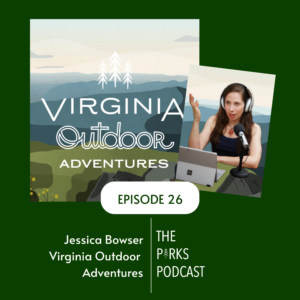
Episode Guest
Jessica Bowser
Virginia Outdoor Adentures
About Virginia Outdoor Adventures
Virginia Outdoor Adventures is a podcast about outdoor recreation across Virginia — hiking, kayaking, caving, mountain biking, ice climbing, birding, foraging, wildlife tracking, fly fishing, archery, and more. Every episode is told from a beginner-friendly perspective. Jessica lives in Virginia (originally from the Cleveland area) and has discovered most of what she covers through the podcast itself.
Show Notes & Links
- Virginia Outdoor Adventures — podcast website
- Virginia State Parks — Let’s Go Adventures program
- Virginia State Parks — all 42 parks
- Girls Who Hike Virginia
- Avenza Maps — offline trail maps app
- AllTrails — trail planning and GPS
- 10 Essentials for hiking — REI guide
- Virginia State Parks on Instagram
- Consignment gear — REI Used Gear
Transcript
Virginia Outdoor Adventures — You Can Do the Outdoors Any Which Way
The Parks Podcast, Episode 26 | Jessica Bowser, Host, Virginia Outdoor Adventures Podcast
How Virginia Outdoor Adventures Began
Missy Rentz: Today we are so lucky to have Jessica Bowser, who is the host of Virginia Outdoor Adventures. Through her podcast, she takes people on adventures and teaches them all about the great fun that can be had in Virginia. Jessica, welcome to The Parks Podcast.
Jessica Bowser: Thank you so much for having me, Missy. I’m a big fan of your show.
Missy: Mutual admiration here. So you are in the middle of your fifth season of Virginia Outdoor Adventures — that’s more than 80 episodes. And you share so much knowledge about outdoor fun. I use your episodes to guide my own adventures. Why did you decide to get into the podcast world and share these amazing stories?
Jessica: Well, I am a lifelong learner and educator and also a huge outdoor enthusiast. And I think there are so many incredible opportunities right here in Virginia that people don’t know about. For years I had been exploring Virginia and sharing those experiences on a personal level — on my personal social media accounts with friends and family and neighbors. And over the years a lot of people said to me, Jessica, you really should write a book or start a blog. And I thought, yeah, who’s got time for that? But then the pandemic hit and I was sitting at home trying to figure out what to do with my time, just like so many of us were. And the idea of a podcast came to mind. I just gave it a try for fun. I launched a couple of episodes and was incredibly surprised when the podcast sort of took off on its own. I think it was right place, right time. Everybody was looking for a safe way to be outside and to de-stress and to be able to see people in an environment that they didn’t have to worry about. And so it kind of took off and hasn’t stopped. I’m in season five now — officially 71 numbered episodes, but bonus content included is over 80. And I can’t honestly believe that I’m still doing it. But I think it just goes to show that I’m not the only one who thinks that Virginia is a beautiful state with lots of opportunities for outdoor recreation.
Missy: Yeah, not at all. And one of the things I really love about your podcast — like The Parks Podcast, we talk about a specific park or public land. But you really talk about the adventures that can be had in these places. Sometimes parks, sometimes rivers, sometimes just all over. Have you always been an adventure person?
Jessica: Yeah, I think so. I was fortunate to grow up in an area that had a lot of outdoor space — my backyard literally dropped off a cliff into what was known as Metro Parks. I grew up in the Cleveland area and had wildlife coming through my backyard all the time. I just remember being really fascinated by the outdoors and spending almost all of my time outside as a child. Watching the foxes come through the yard, the wild turkeys, the owls, the deer, being enthralled with the changing of the seasons. And I think I made that connection to nature at a really young age. Of course, you can do the outdoors any which way you want — there’s no right or wrong reason. But I have friends who are trail runners who are just trying to get a certain number of miles in, flying down the trail because they’ve got a goal in mind. And that style’s not for me — but that’s okay. I have always really loved the outdoors and I can’t imagine myself not being in it.
Missy: I love the way you say that — “you can do the outdoors any which way” — because I think that’s really true. And I think sometimes people can get nervous or hung up on the idea that they should be doing it a certain way or have certain gear. And that’s just not the case.
Jessica: That’s right. The gear especially. There are so many gear junkies out there. People have asked me to do a video showing my gear closet, and I’m like, well, it’d be really short. Even though I’ve been doing this my whole life, I don’t want to accumulate a bunch of junk and I don’t want to spend every last dime on more and more gear. For me, it’s really about focusing on what I’m going to use most — the best bang for my buck — and not falling into that trap of buying more and more. The consumerism around outdoor recreation is just the same as it is with clothing and everything else in our society. Anybody who’s walked into an REI store will realize that pretty quickly.
What Stories She Tells — and Why Community Is Everything
Missy: You have introduced me to so many different things in Virginia. I’ve spent the majority of my life here, and I love that, to learn that you are not from here — because you would think it with how knowledgeable you are. What kind of stories do you look to tell and how do you go about crafting them?
Jessica: Well, I think first and foremost, it’s about community. The outdoors has communities within it. All of us who live in Virginia are a community. And then as you get to know folks who love the outdoors, you start to find all these smaller communities within it — a mountain biking community, a climbing community, a caving community. People find their niche and then they find their people and they get really engaged in it. And it’s really cool to meet these folks because they’re so passionate. I find myself becoming a member of all these different groups, and it’s through them that I really learn about activities I didn’t know about. As you said, I didn’t grow up here, but even if you did, unless you’re really tuned in, you may not even know that these communities exist around you. So I love the sense of community. And as I’m telling stories, I try to keep that top of mind because a lot of folks, especially newcomers, might be feeling a little bit intimidated. And I think if you can find other people like you, you’re much more likely to feel comfortable and to get engaged. For example, I just recently did an episode with the hiking group Girls Who Hike Virginia — they are very active, doing hundreds of events all across Virginia every year, some beginner level, some more advanced, with a backpacking subgroup within their group. So there’s a lot of different opportunities to find your people. Community is key.
Missy: And I love that you’ll do things that are tangential to the activities — you’ve talked to naturalists and authors, you’ll talk about forest bathing or advocate for the parks. It’s really interesting how broad you’ve made the story, but it’s all about outdoor fun.
Jessica: Yes. And I think all of those things are connected. When I think back about why we have parks today — it’s because somebody had a vision for the parks and what they would do for our community, and they invested in that vision. If we don’t continue those investments, we won’t continue to have the same results. The parks have to be maintained and they have to be funded. And I feel like a lot of people simply aren’t aware of the investments that are required for parks to continue to thrive and be available to all of us.
Missy: Yeah, that’s so true. And I love reading about the medical benefits or the environmental benefits — keeping the shore from eroding, for example. They’re so much more valuable than just a place to recreate.
Jessica: I think that’s right. And if we love the outdoors, we have to be willing to pay it forward and protect them.
What She’s Discovered — and Tries for the First Time
Missy: What kind of different places and activities do you like to introduce people to?
Jessica: My favorite thing to do is introduce people to things they didn’t know existed here. I would be willing to bet that a lot of your listeners don’t even realize that we have caving in Virginia, or we have ice climbing, or we have elk tours. And foraging for wild edible plants, birding — all different ways to experience and enjoy the outdoors. I try to do it all from a beginner-friendly perspective. When people hear “ice climbing” they’re like, I’m not gonna ice climb. But almost anybody can, really. It’s much easier than you’d probably think — and if you’ve got a guide who knows how to do it safely with all the correct gear, it’s a great day outing and a lot of fun. All of my episodes are very beginner-friendly with the idea in mind that many people have never tried it before.
Missy: How often do you do an episode and it’s the first time you’ve done that activity?
Jessica: Many. The ice climbing one, for sure. The caving one, for sure. Foraging for wild edible plants. Even mountain biking — I did an episode on that a couple seasons ago. I always get together with the guest before we record because I need to experience these things to be able to talk about them. And a lot of times it’s the first time I’ve ever done it. So I have another caving episode coming up with some rangers from Virginia State Parks, because believe it or not, some of our state parks have caves and there are public caving tours available through the park. That’s something a lot of people don’t know about. A ranger-led program is a perfect way for somebody who wants to try caving to do it safely.
Missy: And I noticed from your socials — you do a lot of meetups and group hikes and invite people to come out.
Jessica: Yeah, well, usually I’m joining up with somebody else’s group hike — tagging along and then letting people know that I’m going to be there so they can join if they want. I don’t host my own hikes. And I’ll be honest with you, Missy — that’s just an insurance thing. I’m not going to purchase an umbrella policy to take people on a hike. But I do like to get together with people and see people in person, so I do my best to let folks know where I’m going to be and encourage people to come out.
Missy: Okay, so these activities that you’ve done — what have you been introduced to that you’re now a huge fan of?
Jessica: What am I not a huge fan of? There really isn’t anything that I haven’t enjoyed. There hasn’t been a single thing. I even went surfing — and that I was kind of like, oh, I don’t know about this. It was much harder than I thought it was going to be. I don’t think I ever even made it up on the board, but I ended up with a boogie board and was just riding the waves. I felt like a child — like that little kid on a boogie board just having the time of their life. That was me. And it took somebody to say, it’s okay for you to do this. Who cares who’s watching? And it doesn’t matter what anybody else thinks. This is fun — just let yourself go. And so I did. And it was an absolute blast. The problem is that I end up with way too many new hobbies. My poor husband’s like, we need a bigger house for all of this gear. I’m like, I need a rooftop tent and a kayak and a paddleboard. And I guess that circles back to — you have to be careful you don’t go down that rabbit hole. But yeah, I have picked up a lot of new hobbies in addition to a lot of new friends.
Missy: I love to hear that you have to give yourself sometimes a little pep talk. Because I do think that going out and trying something new can be intimidating, and that fear could prevent you from trying something. So I think it’s important for people to hear that you do all these amazing things and you sometimes need that pep talk.
Jessica: Oh, yes. In fact, people quite often say to me, you’re so brave. And I’m thinking, who are they talking to? I mean, really — I don’t feel that way at all. But I think what the outdoors has given me, on a very personal level, is an ability to challenge myself in a way that nothing else has. And by that, I don’t mean being stupid or being reckless. But if there’s something I’d like to try that I’m nervous about, if I can get myself through it, I come out on the other end going, man, I’m such a badass. I ride that wave for a long time. It could be something as simple as solo backpacking for a night or two, or solo camping in a new place. Even as a child I was terrified of the woods at night. And there’s still a little bit of that hanging on. But I know that if I’m smart about it, I should be able to enjoy these activities safely. And I do tend to push myself occasionally and take on challenges I never thought I could do. It’s so rewarding — and then I think, okay, what’s the next thing?
What She Hopes People Take Away
Missy: When you host these conversations, what do you hope people take away from it?
Jessica: I hope they have the information and the inspiration they need to plan their own adventure in Virginia. I hope that people feel like they have the tools that they need, that the lingering doubts have been answered. And I hope they feel that they can reach out if they have additional questions — or if I can put them in touch with the right people to help them plan a trip or get started in an activity they’re curious about. Because ultimately I really want people to connect with the outdoors. There are so many reasons that we need to preserve our public lands and our outdoor spaces. Adults who are not motivated or connected to the outdoors are simply not going to be motivated to protect it. So we have to get people started as young as possible, frankly. And even if that means getting people engaged as adults, so be it. Let’s get them engaged and connecting to the outdoors — so that when it’s time to advocate for them, we’ve got a whole army that’s ready to go to protect our outdoor lands.
Planning Your First Outdoor Adventure
Missy: If someone is just starting to explore outdoor activities, what would you recommend that they do in order to learn and get more comfortable?
Jessica: First of all, find a trustworthy source — whether that be a parks website or your podcast, Missy, because you really do your homework and you talk to people who are trustworthy sources. In this day and age, there are too many social media so-called influencers who are out there trying to make money off of posting content about the outdoors when they really don’t know what they’re doing. And there’s a lot of misinformation that goes out there, and people end up getting hurt. Or they attract a lot of people to places that cannot accommodate huge crowds and that may even be permanently damaged by too many visitors. So find a trustworthy, reliable resource — that’s the first thing.
Jessica: And the second thing is to find your community. Again — finding like-minded people at the same level you are, whether that’s beginner, intermediate, or advanced, makes a really big difference. Because if you’re thinking you’d like to go for a hike and then that morning you wake up and you’re having doubts, or it looks like it might rain, or you just don’t feel like it — if you’ve got somebody waiting for you at the trailhead, that sometimes makes the difference. And then once you get out there and you’ve done it, you’re like, oh, this is fantastic. I can do it again. But if you miss that opportunity, it may not happen again. So I would definitely recommend finding a buddy, an adventure buddy, or a great community that can support you.
Missy: I just want to go back because I think the point you made about trusted resources I never thought of. That’s how we met — I started sending you direct messages. And one of the things I did was, oh wait, Jessica follows this person. I trust Jessica. If Jessica follows this person, therefore I trust this person. It really helped build the online community that I trust.
Jessica: That’s exactly right. And the third thing I thought of as you were talking — gear can sometimes be an obstacle. And there are really great local outfitters all across Virginia that can help you find the gear that you need, and many carry consignment gear. That is such a great opportunity — you can get gear at a much lower cost, you’re doing your part to make sure that gear doesn’t end up in a landfill, and you’re not buying into the whole consumerism around the outdoor industry. Another really great opportunity — Virginia State Parks has a program called Let’s Go Adventures, where you can learn to fly fish, do archery, orienteering, kayaking, hiking, camping, and even now backpacking. And they bring all the gear to you. So if you’re thinking gosh, fly fishing looks interesting, but you’re not going to spend hundreds of dollars on a fly reel and tackle box just to find out you don’t like it — you can sign up for one of those programs, learn how to fly fish, and then decide whether you want to invest in the gear.
How to Plan a Last-Minute Trip
Missy: Okay, how do you go about planning a visit if you say it’s a Wednesday and you’re like, I’m going to go do something this weekend?
Jessica: One of the things that is really helpful is having the tools you need already at your disposal — so that if it’s Wednesday morning and you wake up and it’s 75 degrees and the birds are singing and you think, I’m going to go somewhere, you don’t have to get hung up on what do I need, where am I going, how do I download a map. Have all those things at your fingertips. For example, for Virginia State Parks — if there are parks near you, go ahead and download the Avenza app and download the maps for each of the individual parks within a two-hour drive of your house. Have your pack ready with the 10 essentials packed inside, a water bottle, and extra clothing, so that all you have to do is grab it and go.
Jessica: As far as what you absolutely need — the 10 essentials first. Don’t forget how much water you need. Never underestimate the weather, because that can change at a moment’s notice. Have your maps prepared ahead of time or know where you can get one quickly. Have a couple of GPS apps on your phone as a backup — not a replacement for a paper map, but as a backup. Make sure your phone is always charged. And make sure somebody knows that you’re going, when you’re supposed to be back, and what the plan is in case you don’t come back. Your at-home buddy should preferably be one or two of the same people you notify all the time, so that they know the plan and don’t have to be explained from scratch. Once you do all that ahead of time, when the decision comes, you’ve eliminated the obstacles — and it’s much more fun.
Missy: And we’ll put a link to the Avenza app and the 10 Essentials list on the episode page. And I really love the idea of making sure whoever you tell knows what to do — because if you tell someone who doesn’t know how to call a ranger station, that’s not very helpful.
Jessica: Yes. And just to add — I just released an episode about wilderness survival skills with Tim McWelch, who owns Advanced Survival Training. We had this conversation about how if somebody gets lost, you do not want to call 911 or the local police, because then it’s considered a missing persons report — and most missing persons reports don’t result in any action for the first 48 hours because most “missing” people come back on their own. Instead, you want to call the park or the ranger where that person is hiking, so they can activate search and rescue. Whoever is watching out for you needs to know that information.
Overcoming the Stigmas of Outdoor Recreation
Missy: There are a couple of stigmas about being outdoors that I’ve heard. Equipment — the cost, not knowing what you need — we’ve talked about that. The other is fear: fear of outdoor creatures, fear of getting hurt.
Jessica: For sure. The more informed you are, the less likely you will be to be concerned about some of these things, because most of the stigmas around things like bears and snakes and spiders just don’t need to be there. Black bears here in Virginia — unless you attack them or provoke them — they’re usually more afraid of you. They’re either going to keep doing what they’re doing and ignore you, or they’re going to leave. As long as you keep your distance and don’t entice them with food at your camp, you should be just fine.
Jessica: And snakes — I did this really awesome episode about venomous and non-venomous snakes in Virginia. Any snakes at all, they’re not interested in you. They’re not going to chase you or attack you. If you come across a snake, just step around it and keep your distance. The things that you do need to be concerned about are ticks — the littlest thing that nobody ever thinks about is the thing that could actually do the most damage. I have a great episode about ticks and tick-borne diseases. And then the weather is a big one, because the weather can change. Mountains can make their own weather. I think the majority of the jackets and sweatshirts I own that say Shenandoah National Park came from the gift shop when I showed up in the park — because it was 90 degrees at my house in July when I left. And then I got up there and it was 65 degrees and windy and looked like it was going to rain. Just always have your layers and your rain gear with you because you never know. Something can come out of nowhere and it often does. I was hiking once in Shenandoah and a thunderstorm rolled in — I have never been stuck in a storm like that. I was on a ridge top and I actually saw it coming. The skies around me were completely blue, but this one massive cloud just kept getting bigger and bigger and rolling my way. I was hauling butt back towards the car and it came over me so fast. And the way the lightning was coming down, I was like, I don’t know if I’m going to make it — but I was less than a mile from the car. When I got in, I took this video of this torrential downpour. Just this crazy loud noise of lightning and thunder and rain. And I was like, oh my gosh, if I were a through hiker I would have been absolutely terrified.
Missy: As you’re telling it, I have a little bit of fear of putting myself in that position — and then a little bit of awe, because it must have been really stunning to watch.
Jessica: Yes — you have that moment where you’re like, wow, that’s so cool. And then when it hits you, you’re like, this isn’t cool anymore.
Jessica: And then the last thing I would say about fear is fear of other people. This one is very real and it sometimes gets brushed aside. There are stories out there of people who have come in contact with other people who meant to do them harm. You just have to be very mindful, and it’s a very personal decision how you handle that. For me personally, my preference is to choose trails where there aren’t other people. I will hear people say you should stick to busier trails like the Appalachian Trail because there’s always somebody that’s going to be coming by. Well, I hike the Appalachian Trail at all times of the year, and unless it’s July in Virginia, that’s not true. And unfortunately, because the AT is so populated, for somebody who’s looking to target a person, that’s actually a good place for them to go. So you really have to make your own decisions. Do a little bit of research, ask other people what their experience has been on those trails. And having a buddy with you is always going to be the safest.
Missy: And I think all of these stigmas and fears — you can overcome them. It’s not about scaring people from going out. It’s about being aware. For me, it’s a gut feeling. If it doesn’t feel right when a bear is ahead, remove yourself from that situation. If it doesn’t feel right when someone’s approaching you, remove yourself from that situation. Don’t let it prevent you from going out and exploring.
Jessica: Yes, I agree.
Speed Round
Earliest park memory?
I grew up in Cleveland and there’s a large metro park there called Squire’s Castle. If I remember the story correctly, there was a man who was building what looked like an actual stone castle for his wife — and maybe his wife died or left or something happened, and it was never completed. But there is still the foundation and the walls of this huge stone home. And my grandparents used to take me and my brother and sister there as a child. The castle part was especially cool — a little bit creepy, a little fairy tale-ish. I can remember my grandmother picking mushrooms and showing us different things she found, picnicking there, having very slow, peaceful afternoons of picking dandelions, playing tag with my brother and sister. That is definitely one of my earliest park memories. I want to go back there one of these days.
What made you love the parks?
It’s connection. It’s all about memories and connection and that feeling that you get when you’re enjoying parks. And you can always bring that feeling back — whether it’s days, weeks, months or years after you’ve had that experience. I can close my eyes and think back to all those decades ago and what those afternoons were like, and it just brings back a lot of joy. Time with my grandparents that I don’t have anymore. I wish that everybody could have those types of experiences in the outdoors.
Favorite thing about the parks?
That they’re so accessible to everyone — especially here in Virginia. We’re really blessed to have parks within an hour’s drive of our home no matter where we live in the state.
Favorite thing to do at a park?
The ability to do any and all things at my own pace. Sometimes I’ll be moseying on down the trail and I’ll just stop. And I find myself not moving for a really long time — listening for the birds, listening for wildlife, enjoying the sound of a stream bubbling or waves lapping, feeling the breeze on my skin, smelling the different scents in the air, whether it be wildflowers or even just decaying leaves or wet soil. All of those things are such a sensory experience. Maybe 20 minutes later I snap out of it and I’m like, how long have I been standing here? So I think what I love most is just the ability to do that — to be so engrossed in the experience, regardless of what I’m doing, and do it at my own pace.
Park on your bucket list?
During the pandemic, I was supposed to visit Banff National Park in Canada and the borders were closed. And every summer since there’s been a different reason why I couldn’t get back. But actually, I think neighboring Jasper — which is smaller and less well-known — is a little bit higher on my list because it’s the same type of experience with fewer people. I’m very mindful of visitation now, especially after getting to know rangers and wildlife biologists and learning from them about the impact of over-visitation. So I’d probably go to Jasper.
Three must-haves for a park visit?
The 10 essentials are at the top of the list — that’s 10 things. Then I always have a camera, because photography is a hobby and one other way I can engage my creative side in the outdoors. And a head net — the best $10 I’ve ever spent. To have a head net that protects you from bugs when you’re hiking is a must. Especially where we have a lot of humidity and the bugs like to swarm around your head and fly into your eyes and your nose and your ears. That can ruin the experience pretty quickly.
Favorite campfire activity?
Hammocking. I have a hammock with me at all times — in my car, in my pack. I can string one up almost anywhere pretty quickly.
Tent, camper, or cabin?
I hope to have a camper one day — I have great memories of camping in a camper as a child. But between tents and cabins — gosh, they’re two completely different experiences and both amazing. It’s a tie.
Hiking with or without trekking poles?
Definitely with. I was a without for way too many years of my life. And then someone gifted me trekking poles and I was like, how have I made it this far in my life without these?
Favorite trail snack?
I love to dehydrate foods. I have a dehydrator at home, and so I’ll slice oranges and apples and other fruits and veggies, put them in the dehydrator, and then I have healthy snacks ready to go all the time.
Best animal sighting?
I’m so torn between birds and snakes. I’m a birder — and every now and then you get a bird that doesn’t belong in the area, and everybody is really mystified and excited about it. But I’ve also gotten really into logging my snake sightings the same way I do my bird sightings. I used to be one of those people who was terrified of snakes. Once I learned to appreciate them and realized there’s nothing to be fearful of, now I just really get excited when I see one. There are so many different species of snakes all around Virginia that I keep track of them in my guidebook. That’s added a whole new layer of fun.
Favorite sound in a park?
Birds. I have learned over the years that just the sound of birds is enough to calm me down. When I need a break in the middle of the day, if I step outside and hear the birds singing, my mood lifts immediately.
Greatest gift the parks give to us?
I think if we look back at where parks originated — the 1930s New Deal era, this idea that the common working person needed a place to recreate and take their families — this idea was very much just an idea until one or two parks opened and they realized just how much these public lands were needed for our mental and physical health. And now because of conservation reasons too. When I think about what those people with those visions gave us, I’m really, really grateful. Those parks are here for us to benefit from, hopefully for a very, very long time. The gift that those people gave us, and the gift that the parks give us — I think they’re one and the same.
Missy: Jessica, I am so grateful to you for being on the episode. And I’m particularly personally grateful because you really have helped guide me on how to enjoy Virginia in a different way. And I’m excited that we’re introducing you and your podcast to so many other people because I think you are a gift.
Jessica: Thank you, Missy. And I think you’re doing the same. I’ve been so impressed since the beginning. I think that’s why you and I connected the way we did — because I think we think along the same lines of sharing information for other people so that everybody can enjoy these beautiful places. So I appreciate you having me on.
Missy: Yeah, thank you so much. Thanks for listening to today’s episode. Until next time — we’ll see you in the parks.
Music for The Parks Podcast is performed and produced by Porter Hardy. Follow us @TheParksPodcast or visit TheParksPodcast.com.