
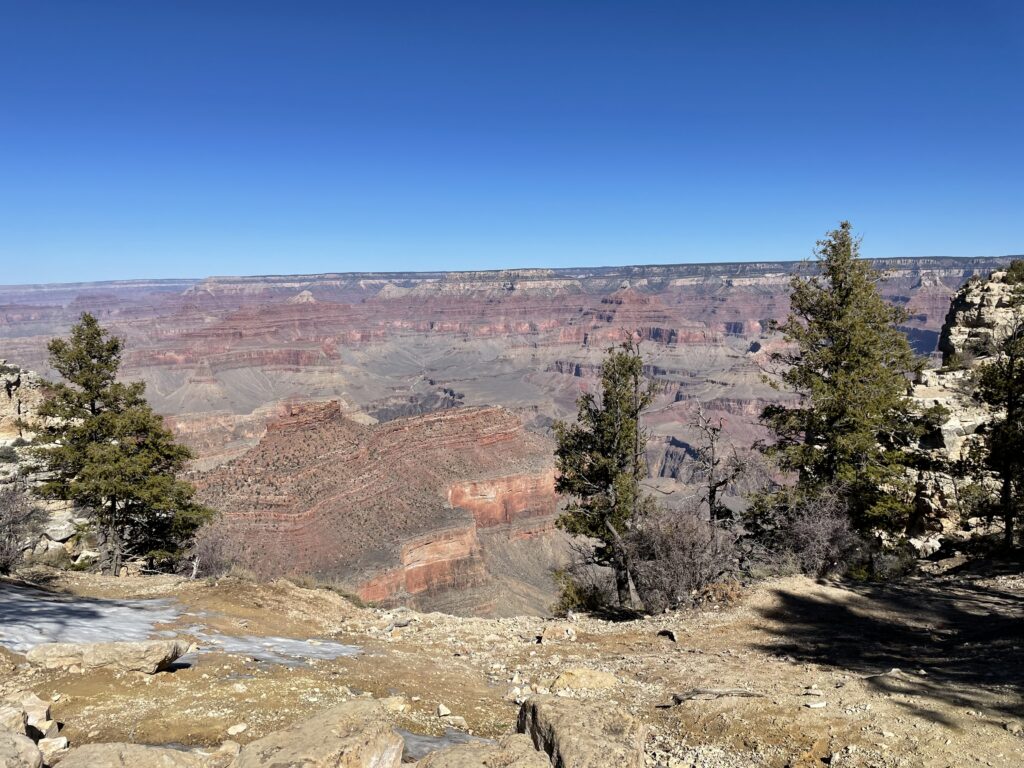
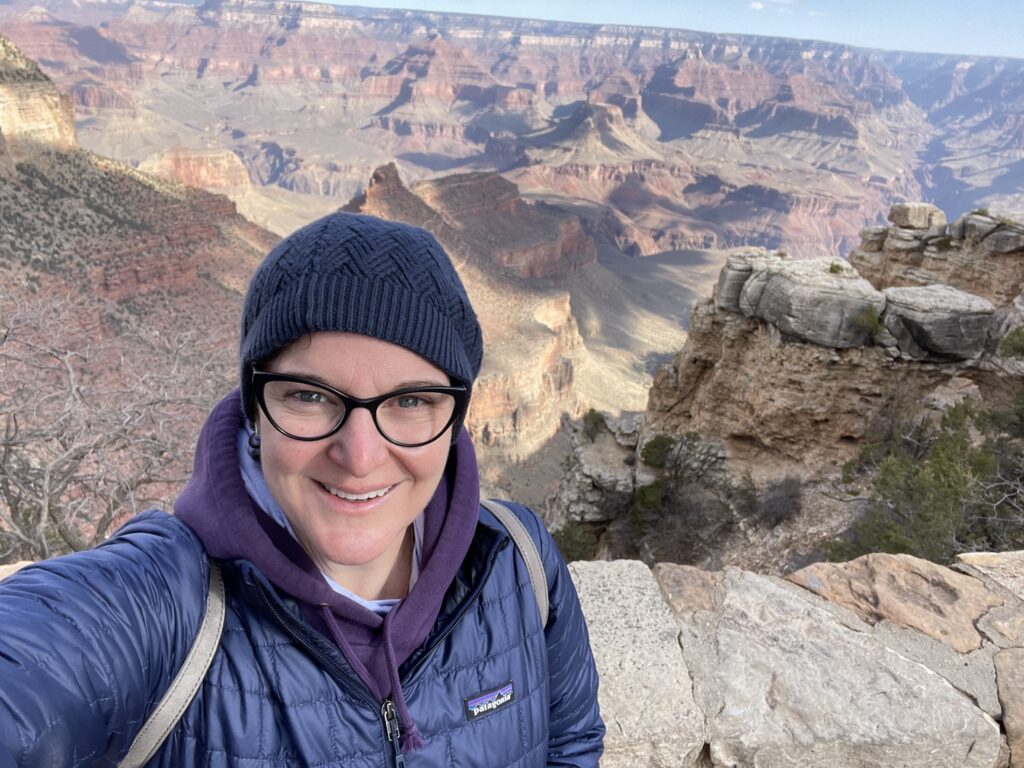
I walked out to the South Rim, saw the Grand Canyon for the first time in my life, and thought: yeah, that’s what it looks like in the pictures.
My own reaction surprised me. I had expected to be levelled by it.
I have thought about it a lot since, and I do not think the problem was the canyon. I think the problem is that the photographs of this place are so extraordinarily good that they get there before you do. You arrive already having seen it a thousand times, from better angles, in better light, taken by people who waited three days for that cloud. It is genuinely amazing to stand in front of. It is also one of the very few places where seeing it firsthand does not quite do it justice, and I would rather say that out loud than pretend.
The part that got me came later, and it was not the view.
Why I got there first
My brother and his family were coming out for their spring break, and I arrived several days ahead of them on purpose.
This was my first solo camping trip.
I wanted a day or two on my own to set everything up and get comfortable with how I had it all arranged before anybody else turned up. I had stopped at Bryce Canyon on the way down, and now I was here with a car full of gear and nobody to ask.
I emptied that car more than once and reorganised it. Not because anything was wrong. Because I wanted to know where everything was.
That is what first-time nerves actually look like, in my experience. Not panic. Just a person unpacking a car twice in an empty campground so that when it matters, she knows.
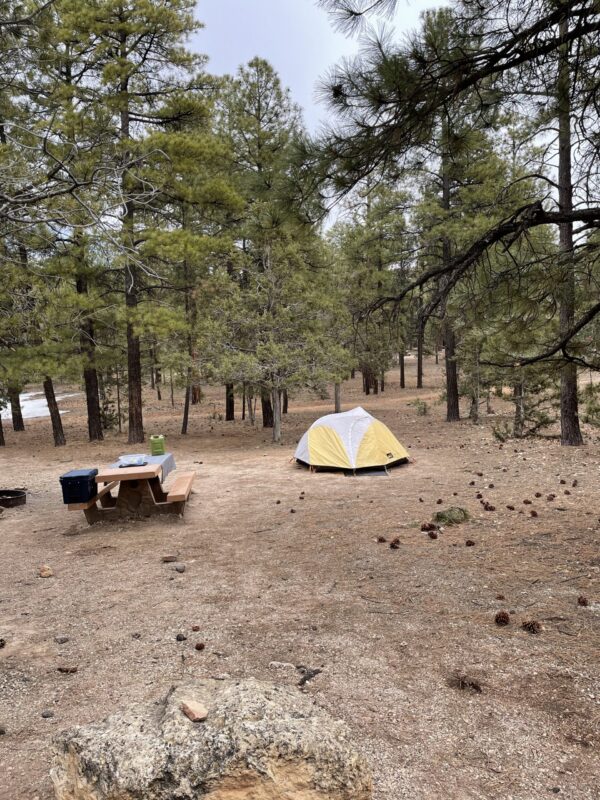
I stayed at Mather Campground, which was lovely and far more spacious than I expected. In early March it was quiet, which suited me exactly.
The spikes I got teased for
When the family arrived we hiked the Bright Angel Trail.
It was spring, technically. I had packed slip-on traction cleats for my boots anyway — the stretchy rubber-and-steel things you pull over your shoes — and I got a certain amount of gentle mockery for it.
Then we got to the shaded sections of the trail.
They were solid ice. People were on their hands and knees, crawling, trying to get through it. It was frightening to watch, because there is not a lot of room to spare on that trail if you slide.
I walked up it normally.
I am not telling that story to be smug about it. I am telling it because the National Park Service says the same thing and people still do not do it: from roughly November into spring, the upper sections of the Grand Canyon’s trails ice over, and slip-on foot traction and trekking poles are recommended. The rim is at seven thousand feet. The sun hits one side of a switchback and not the other, and the side it misses stays frozen.
They weigh almost nothing and they live in the bottom of a pack. Bring them.
The cold front that came through while the family was there was serious enough that eating in the lodge stopped being a treat and started being a relief.
The best thing that happened
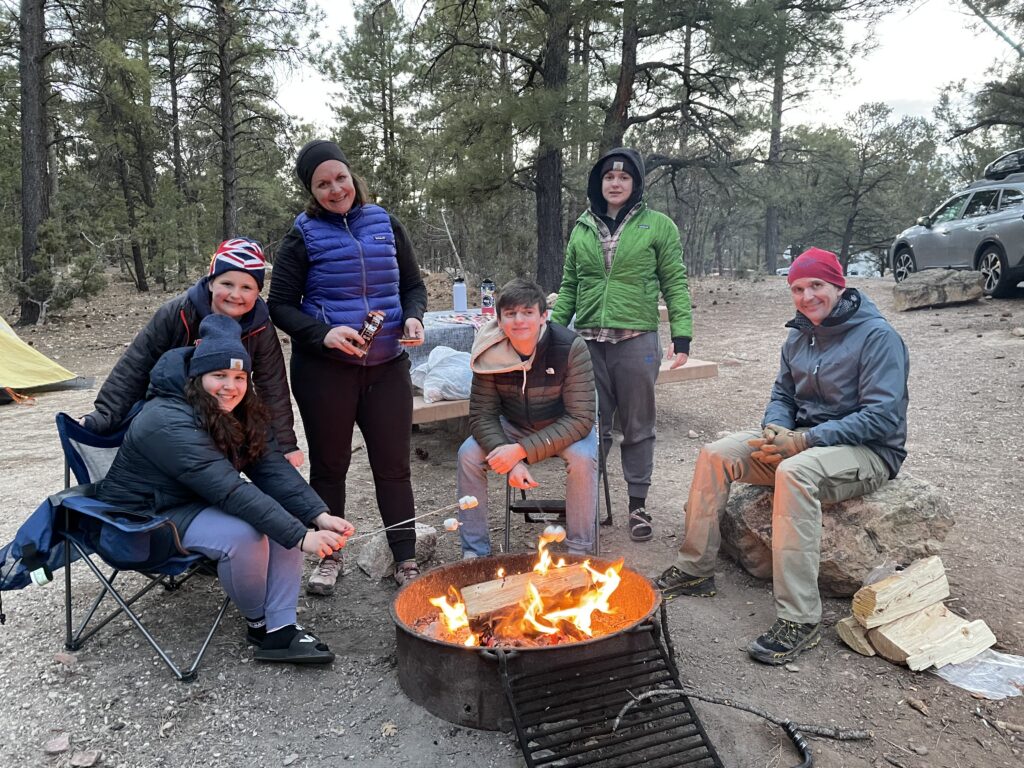
On the last night my nephew, who was about six, decided he wanted to camp with me.
We knew it was going to be cold. We did not know how cold. It snowed.
We woke up with enormous plans. We were going to build a campfire and cook breakfast over it, the two of us, like proper campers.
We barely got the fire going.
I looked at him and said, do you want to go eat in the lodge?
He was emphatic. Yes.
So we put the fire out, broke camp, and went and had hot chocolate and a hot meal indoors, and it was the correct decision by a wide margin. I have thought about that morning more often than I have thought about the view.
What I would go back for
I have learned a great deal about this place since that trip, and almost none of what I want to return for is the canyon itself.
I want the historic buildings. Grand Canyon Village is a National Historic Landmark district — El Tovar, Hopi House, Lookout Studio, Hermit’s Rest, the Desert View Watchtower. I walked past most of them without understanding what I was walking past.
And I want the Indigenous stories. There are eleven tribes traditionally associated with the Grand Canyon — among them the Havasupai, the Hualapai and the Yavapai-Apache Nation — for whom this is not scenery but origin. At Desert View, the park and those tribes have been building an Inter-tribal Cultural Heritage Site, which is a deliberate turn away from how that end of the park used to present Native culture and towards those nations speaking for themselves. That is what I want to spend a day on.
Hiking down to the river, if I am honest, does not do much for me. I could be talked into it. But it is not the pull.
It is the history that has me hooked.
Which is a strange thing to conclude about the Grand Canyon, and it is also the honest answer to the question I started with. The view did not undo me, because I had already seen the view. The stories I had not already seen.
Fees, hours, trail conditions and closures change. Check with the National Park Service before you go — details here were verified in September 2026.
How people used to get here
I said the history is what has me hooked. Here is a piece of it I did not know until afterwards.
Getting to the Grand Canyon used to be the hard part. In 1901 the Santa Fe Railroad ran a line up from Williams, Arizona, and that turned a small mountain town into the front door of the canyon.
Then in 1926, Route 66 came through Williams.
So for most of the last century, the way ordinary Americans got to the Grand Canyon was this: drive the Mother Road, and turn north at Williams.
Williams was the very last town on Route 66 to be bypassed by the interstate — October 13, 1984. It took that long for the road to let go of it.
The railway still runs out of the old Harvey House depot, and it still carries somewhere around two hundred thousand people a year up to the South Rim.
I drove in, the way nearly everyone does now. But I like knowing that for decades this place was not somewhere you simply arrived at. It was somewhere you reached by taking a particular turn, off a particular road.
Plan your visit
Entry: Charged per private vehicle, good for 7 days. Check the current rates before you go. The America the Beautiful pass covers it.
Visiting from outside the US: there is a per-person surcharge for anyone aged 16 and over, on top of the entrance fee. An annual park pass or the America the Beautiful pass covers it, and there is a separate non-resident annual pass.
South Rim: open year round. Roads are drivable except in bad weather. The park uses cinders rather than salt or snow melt on the roads, so expect grit rather than clear tarmac after a storm.
North Rim: closed to vehicles from 1 December to 14 May. If you are planning a winter or early spring trip, you are planning a South Rim trip.
Camping: I stayed at Mather Campground on the South Rim. Spacious, and quiet in early March. Book ahead.
Shuttles: the free park shuttles do a lot of the work on the South Rim, and in the busy season some areas are shuttle-only.
Worth knowing: the rim sits around 7,000 feet. That is why the shaded side of a trail can be ice while you are standing in the sun in a t-shirt.
What to pack & wear
Slip-on traction cleats, if you are going any time from late autumn through spring. This is the one I will keep banging on about. The Park Service recommends over-the-shoe traction and trekking poles for winter trail conditions, and the upper sections of Bright Angel ice up exactly where you cannot afford to slip.
Layers, and expect to use all of them in a single day. A cold front at 7,000 feet in March is a different proposition from a cold day at home.
Water, and more than you think even when it is cold. The air here is extremely dry and it does not feel like you are losing anything.
If you are camping in the shoulder season, pack for a night colder than the forecast. Ours snowed.
Pets
The Grand Canyon is better set up for this than most big parks, and there is one thing here that almost nowhere else has.
Leashed dogs, six feet, are welcome on the trails above the rim — including the Rim Trail, which is a long paved walk with the whole canyon beside it — and in Mather Campground, Desert View Campground, Trailer Village and the developed areas generally.
They are not allowed below the rim on any inner canyon trail, they are not allowed on the shuttle buses, and of the in-park lodges only Yavapai Lodge takes them.
The thing worth knowing: there is a kennel on the South Rim, near Maswik Lodge, open daily from 7:30am to 5pm, taking dogs and cats for the day or overnight. You need proof of current vaccinations and you should reserve ahead, especially in summer.
So the Grand Canyon is one of the few places where wanting to hike below the rim and traveling with a dog are not mutually exclusive. That is rare, and it is the reason this park is easier with a dog than Bryce or Zion.