
General Coffee State Park in Nichols, Georgia is not a park you’d stumble into by accident — and that’s exactly what makes it special. It preserves the agricultural history of Georgia’s wiregrass region, with a working farm (goats, sheep, pigs, Gulf Coast sheep, a horse, chickens), historic structures moved from across Coffee County, a bog full of pitcher plants, and one of the best gopher tortoise habitats in the state. Park Manager Mikayla Spencer joins The Parks Podcast — shortly after the park partially reopened after Hurricane Helene — to share everything.
A note from Missy: I went to General Coffee State Park because I was intrigued by a park that was preserving the rich agricultural history of the region. Despite the recent storm damage, the park is vibrant with recreation and agriculture. Bring on more farm animals!
Episode Guest
MiKayla Spencer, Park Manager
General Coffee State Park (Georgia)
Park Stats
- Location: Nichols, Georgia
- Donated: To Coffee County in 1970; community-initiated park
- Size: 1,511 acres
- Named for: General John E. Coffee (Georgia state militia, Georgia Senate, US Congress — reelected after his death in 1836)
- The farm: Mid-to-late 1800s agricultural history; Gulf Coast sheep, goats, pigs, horse (Pepper), chickens, crib corn, tobacco barn, smokehouse, blacksmith shop, Meeks Cabin, Han Cabin, Kirkland Tobacco Barn
- Endangered species: Gopher tortoise (keystone species), eastern indigo snake (protected, uses gopher tortoise burrows), pitcher plant
- Bog: On-site pitcher plant bog managed through controlled burns
- Geocaching: 8 caches on site; additional planned
- Hurricane Helene: Park closed for evacuation; partially reopened with one trail, campground, and farm
- Camping: 50 standard sites (electric/water), 2 pioneer sites, 4 cottages, Hawk’s Nest (tiny house), Burnham Cottage (historic two-story, moved to site)
- Reservations: gastateparks.org/generalcoffee
- Events: Turpentine Festival, Pioneer Skills Day, Kids Carnival (Oct), Fried on the Farm (Halloween), Pioneer Harvest Festival (45th year, Nov 8), Christmas on the Farm
- Location context: 2–2.5 hours from Georgia coast; 45 minutes from Okefenokee Swamp
Transcript
General Coffee State Park — A Hidden Gem of South Georgia’s Agricultural Heritage
The Parks Podcast, Episode 32 | Mikayla Spencer, Park Manager, General Coffee State Park
Welcome and Park Stats
Missy Rentz: Today we are so lucky to have Mikayla Spencer, who is the park manager at General Coffee State Park in Georgia. Mikayla, welcome to The Parks Podcast.
Mikayla Spencer: Thank you for having me.
Missy: So we start every episode with some park stats. This park is located in Nichols, Georgia. It was donated to the state by Coffee County in 1970. The park is 1,511 acres. Some interesting facts: it was named for General John Coffee, who was a planter, a congressman, and a military leader. The park celebrates southern agriculture history with goats and sheep, pigs, a corn crib, a tobacco barn, and so much more. And it’s home to several endangered species, including the pitcher plant, the shy indigo snake, and the gopher tortoise. And I have to say, I hunted and hunted to see a gopher tortoise and never got to see one. But this is a great park.
Mikayla: Yeah. And when it comes to the gopher tortoise — I’ll talk about this when we talk about planning your trip — they start to come out whenever it really warms up. In springtime and summer, like right now, they’re everywhere.
Missy: Oh, I just missed it then.
Mikayla: Yeah. You’ll have to come back.
The History of General Coffee State Park
Missy: There are so many parks in Georgia and they’re all great and very diverse. This is one that really celebrates a different part of culture and shares a little bit more of the history of what was happening in that area. Can you tell us a little bit of the history of General Coffee State Park?
Mikayla: I think there’s so many things — even just the parks in Georgia, they’re so diverse. We have so much to offer here and I think that’s a really cool thing about our parks. As you said, it was donated in 1970, and I think that was a big testament to how the community feels about this park. The community wanted a park, and that still shows through today. We have a lot of community involvement — the Chamber of Commerce, local organizations, the City of Douglas, DOT, and our friends group. We have an impeccable friends group. They support us in so many ways, and we experienced a lot of that with Hurricane Helene — some of that relief we wouldn’t have been able to make it without some of those organizations really stepping in and helping us out.
Mikayla: When it comes to the namesake, it’s John Coffee — and it’s also Coffee County. There are two John Coffees, and people get confused. There’s John E. Coffee, which is ours, and then there’s his cousin John R. Coffee. John R. Coffee was part of the Tennessee militia. Our John Coffee was part of the Georgia state militia, and then the Georgia Senate, and then US Congress. The interesting thing about his time in Congress is he was actually reelected in 1836 — but he was reelected after his death, because they didn’t hear about his death until after his reelection. So he had already passed, but he was reelected. The reason he’s got the namesake here in Georgia is that he oversaw the construction of what’s now Old Coffee Road, which served as a supply road from Jacksonville, Georgia down to Florida. That’s where we get the namesake for the county and the park.
Missy: For reference — this wasn’t his farm.
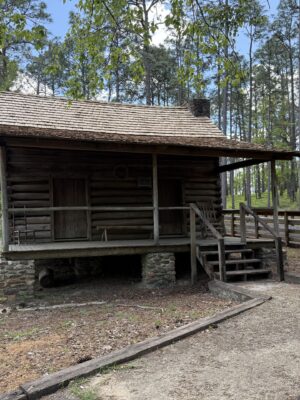
Mikayla: No. The likelihood of him ever being here is slim. It’s more of a namesake for the things he accomplished. But he was a big proponent of agriculture. And our farm covers mid to late 1800s agriculture. The farm has several elements to represent different things during agricultural life of that timeframe. We have historical structures like the Meeks Cabin, which was actually a cabin in Coffee County that was moved here. We have the Kirkland Tobacco Barn — another local tobacco barn moved here. We have the Han Cabin, another local cabin moved here. And then we have reconstructed buildings to offer a glimpse into how those things were done — our smokehouse, our blacksmith shop, our corn crib. We also have turpentine implements on display, and turpentine was a really huge industry here. If you go through the park, you’ll see cut scarring in a lot of the pine trees — that’s from turpentine. That’s a relic and remnant of the past history here of naval stores and turpentine.
Missy: Oh, that’s fascinating. And I also want to talk about — you all were hit very hard by Hurricane Helene. When I was there, it was shortly after you partially opened. I could stay in the campground, I did a couple of the trails that were open, and certainly this historic area was open. But it was really sad to see what the hurricane did to the park and the community.
Mikayla: And there are still some things we are recovering from — the trails being one of them. We are thankful to have one trail open and that’s definitely a continuing process. We plan to have them back opening and fully operational. We closed for evacuation the day before the hurricane, and then we partially opened June 31st — the campground and the farm. We’ve been slowly opening things as we go along. But in that community support, there were so many people that really came together to help, including our sister divisions such as Wildlife Resources. Our leadership was instrumental. My staff worked themselves to get us in a good spot, and they’re continually trying to catch us up.
Missy: And it does — when I went, it’s still super enjoyable. You just really do notice that there are parts of it that are still a work in progress. I want to get into the history through the planning a trip section. This park is about two to two and a half hours from the coast, just to give people a visual of where you are. What do you recommend people do to start planning a trip?
Planning Your Visit
Mikayla: For us, our section of the state — you have the mountains and you have the coastal region, and then we’re in the Wiregrass region. And that plays into where we’re talking about the gopher tortoise — that’s their habitat, the Wiregrass region, where we’re located. It plays into what agricultural life looked like at that time as well. So all of it’s really Wiregrass region history. My view on planning a trip to a park always goes back to time. So if you wanted to see a gopher tortoise, you want to make sure that you’re going in a warmer month — around spring and summertime. In Georgia, with such variable weather, it also means knowing what supplies you need to bring. I think the biggest thing is deciding what time of year you want to go, and for Georgia State Parks especially, making sure you plan ahead so you can get a reservation. On weekends it can be hard to get in.
Missy: And that even starts in the springtime — it was so beautiful and it was packed.
Mikayla: Yes. It’s a little bit warmer here in the summertime, so we really see our heaviest visitation being around the holidays and springtime, especially spring break. For us personally, knowing our events is another part of that time thing. In the springtime, we do a Turpentine Festival and Pioneer Skills Day. For Pioneer Skills Day, we focus on goods that were made during the time — sheep shearing, because we have sheep on the farm, what that wool was used for and how they really made things and survived. Then in the fall and wintertime, we have our Kids Carnival in October with games and things for the kids. Then we have Fried on the Farm, which is our Halloween event. We have our 45th Pioneer Harvest Festival that’s really centered on cane syrup — we actually make cane syrup on site and teach that. It’s another one where we can teach those old ways of how things were produced. We have plants planted in the garden, candle making, soap making, broom making, corn husk dolls with the kids — anything that’s kind of like that, domestic or agriculture, how they did it during that timeframe in the Wiregrass region. And then we usually do a Christmas on the Farm as well.
Missy: I’m looking at parks all the time, and I think it was the agricultural appeal for this one — it was so different, and you all do a really good job of that recreation. I got a sense of this is where somebody would live, this is what their barn would look like, and then the chicken coop and the rooster calls. It really set the stage for showing what life was like — as I go back to my air-conditioned RV. That was a tough life for them. And so when you’re coming, you have lots of options for how to stay. Camping, cottage, the Burnham house. Let’s start with camping.
Mikayla: So we have 50 standard campsites, which you can either camp with RV or tents — they’re all electric and water. Then we have two pioneer sites — no electricity, so you’re doing more traditional camping on those. And then we have our cottages. We have four standard cottages, then we have our Hawk’s Nest, which is like a smaller tiny house situation. And then our Burnham Cottage — that’s actually a historic structure that was moved here on site. So you can stay in something and get an idea of what it would be like inside of it. Now it is a very large cabin compared to our Meeks Cabin — it’s two story — but it is historic and it was moved here.
Missy: It’s really beautiful. It feels like a special occasion type of place. I also want to go back because the camping is great — you’ve got a great bathhouse, great laundry facilities that I was very grateful for. It’s a really well-equipped campground. The way it’s situated, there was like a playground in between the two camp lakes, so it was a great place for kids — they were running around constantly. How do people book either campsites or cottages or the Burnham house?
Mikayla: So gastateparks.org/generalcoffee is our specific site, and there’s a blue button that says Reservation. You can easily do it online through Reserve America. But gastateparks.org/generalcoffee for reservations. And if you ever have any questions, staff is here in the office. Our office is open seven days a week, eight to five, and we’re definitely ready for your questions and help any way we can.
What to Do — From Boating to Geocaching
Missy: When they come to visit, we’ve talked a little bit about the agricultural part, but there’s also hiking and things like that. Let’s talk about what people can do when they visit.
Mikayla: I think that’s another part of the charm. Like I said, the whole park itself has so much diversity in what it offers. I think it’s a hidden kind of gem for South Georgia. So we do boat rentals — we have a four-acre pond on site, and we do pedal boats, canoes, kayaks, and bicycle rentals. We have our trails of course — only one of them is open right now, but we are working to make sure the rest get open. That really offers some cool wildlife opportunities, the biggest one being the gopher tortoise, but also birding, especially when we’re able to get those trails closer to the 17 Mile River. The 17 Mile River does go through our park, but it’s more of an ephemeral situation — it’s not full of water year round. Sometimes you might be able to walk across it, sometimes it might be waist deep. It’s really dependent upon rainfall. So it’s more of a birding and nature opportunity than anything for paddling.
Missy: But on the lake, there were so many people out paddle boating and canoeing. Can people also bring their own boats?
Mikayla: Yeah, absolutely. And the fishing around the pond is also really good, especially if you’re wanting to catch catfish. We actually stock catfish there — there’s plenty of opportunity to catch something in our pond. We also have seven picnic shelters. Those get used pretty heavily — they can be rented out for parties, family reunions, things like that. And if you have a larger group, we have our group shelter that people use for weddings, family reunions, birthday parties, graduations. And we do have equestrian trails — that’s part of the system we really want to get back up and going, and we’re putting a lot of effort into it.
Missy: And I will say your website is excellent at updating on what’s open and what’s not. It’s always good to look at the park website for alerts, so you’re not surprised by closures or programming opportunities. When we talk about the agricultural historical part — you’re driving down the park road, make a right, and you have the massive lake and picnic tables, and then just off to the side is this area that has the historic places. Can we just do a verbal tour of what people see when they’re there?
Mikayla: Yeah, absolutely. Once you get to the actual farm, on your left you have our Han Museum Nature Center building. We actually have our reptiles and amphibians there — we have snakes, turtles, and a salamander named Tony the Tiger Salamander. They kind of get less attention because it’s the farm and the farm animals, but in the building we do have those really cool opportunities for animals native to the area. We have quilts on display in there as well, and we actually sell quilts here in the office. We have a quilting group through our friends group that comes every Wednesday and does a quilting circle, and after they finish those quilts we sell them here in the office — done by hand. Then on the right, the Meeks building — that’s a historic structure, originally here in Coffee County, moved here — that we really use for living history programs, whether it’s a cooking program, broom making, or just what daily life would’ve looked like. Behind that, we have our garden and our smokehouse, giving a representation of food sources and how those things would’ve been managed. Then you come up to our chicken coop — we’re working on representing the breeds that would’ve been indicative of that time. As you get in further, that’s when you get into our animal enclosures, where you have our sheep and our goats. Our sheep are actually Gulf Coast sheep — more indicative of what would’ve actually been in the area at the time. We also just got two brand new pigs — new additions for us, we’re excited to have them on site. And then of course we have Pepper, our horse, who is also here.
Missy: I could have just sat and watched them all day. I went early in the morning, so everybody was just waking up, and they were just so funny. It was great to see all the kids exploring it. You all do a good job of having things interesting for a child and things interesting for an adult. From a recreation standpoint, can you talk about the pitcher plant and the shy indigo snake?
Mikayla: Yeah. The pitcher plant — we actually have pitcher plants in our bog. That’s another aspect to our farm, next to our Han building. There’s a bog that we try to manage through burns, and within that we’re trying to make it where you can really see the pitcher plants and they have a place to thrive in that wetland area. So we offer another sighting of something you might not see every day. And the indigo snake goes hand in hand with the gopher tortoise. The gopher tortoise is what’s considered a keystone species, so there are other commensal species that depend on it — the indigo snake is one of those, using the gopher tortoise’s burrow for shelter. That’s why it’s so important that we manage here for the gopher tortoise, so that we don’t lose other species like the indigo snake.
Missy: It is fascinating, the more I learn about how much work and thought goes into the conservation of endangered species and how important it is. One of the programs that you all offer on your website is geocaching. Can you tell us about that program?
Mikayla: Yeah. So if you’re not familiar with geocaching, there’s the geocaching website. You sign up — it’s free to use the site and to do geocaching itself. You create an account. If you’re looking for General Coffee itself, you just look at geocaches near the area. We actually have eight caches listed on site. The purpose is you get your coordinates from the geocaching website and you might get some hints, clues, and riddles to make it really fun and involved. When you find the cache, there’s usually a logbook — you sign your name to show that you found the cache. And if it’s a large one, there’s usually a box full of things — you can take one out and leave something, whether it’s a coin that has your name on it. You take theirs and leave yours. But it’s really just to show where you’ve been and have a cool experience and get to go around that area. We have eight on site and plan to add more as we get our trails and everything back online.
Missy: I love the gamification of it to find things that you wouldn’t otherwise see. Is there anything else about the park that we want to make sure visitors know as they’re planning a trip?
Mikayla: I think that goes back to what we were talking about before — really preparing for the park you’re going to. Checking any updates on the park website, but also locally how far your park is from the nearest larger town that has grocery stores and ways to get supplies, and what other places are nearby. For us, like you said, we’re two and a half hours from the Georgia coast. We’re also 45 minutes from Waycross, which is one of the entrances to the Okefenokee Swamp — so there’s another addition to a trip if you’re really trying to make a big trip out of it. And there are local events that happen in Douglas in October — they have their Gopher Tortoise Festival. So if you’re planning for a time of year, you can look at what’s going on in local places. South Georgia always has some kind of festival going on, especially in the fall and spring.
Speed Round
Earliest park memory?
My parents made sure we got to experience parks, and it was really Georgia State Park heavy. Camping at places like George T. Bagby, the yurts at High Falls, FDR’s Little White House. And I grew up right outside of Reed Bingham, so swimming in Reed Bingham and going there every week was a big part of my childhood.
What made you love the parks?
I think just the memories that I had, and wanting to be able to know that I can keep those resources available for other kids as they grow up.
Favorite thing about General Coffee State Park?
I think it’s a hidden gem that really is diverse and offers a lot more. And once people get here, they really understand and see how much there is to offer.
Favorite thing to do at General Coffee State Park?
I think fishing is one — like I said, we stock our pond and it’s always a good time to fish here. And the animals are a huge plus for me in managing this park, especially the reptiles. Snakes are one of my favorite animals to teach on.
Park on your bucket list?
I’m ashamed to say it, but I haven’t been to Cloudland Canyon yet — that’s a Georgia State Park that I really need to go to. And then Yosemite, I’d like to go there and experience that.
Three must-haves for a park visit?
I always forget my lighter to make the campfire every single time — so that is one I always try to make sure I have. A water bottle, because please stay hydrated. And if you’re in South Georgia, probably some bug spray. Or sunscreen.
Favorite campfire activity?
It falls on me anyway, but I really enjoy making the fire. I really enjoy making the fire and keeping it going. I like that I’m given that task.
Tent, camper, or cabin?
I really like to stay in yurts. I think that’s a good midway point. But then cabin and tent are a close second.
Hiking with or without trekking poles?
It really depends. I don’t want to be so overprepared for a mile and a half hike, but if I were to do a strenuous hike, I think trekking poles are a good thing to have.
Favorite trail snack?
Jerky and then shelled pistachios — so we can practice our Leave No Trace with the shells.
Best animal sighting?
I think any kind of snake. I love snakes. Pileated woodpeckers, water birds, and birds of prey are some really cool things to see. And you can see all of those here.
Favorite sound in the park?
I really like when we’ve got a really good crowd here and you can really hear the visitors chatting and enjoying their time at the park. And then on a quiet day, the birds that you have the chance to hear here.
Greatest gift the parks give to us?
I think the fact that it’s a space dedicated to our resources — which means that other generations will be able to experience them for years to come, and they’re protected because of that reason.
Missy: I love that you said two things that really resonate so deeply with me about General Coffee. You said that it was charming and you talked about it being a hidden gem, and I agree with you. It was such a pleasure to visit and spend some time in the park, and I’m grateful to you for joining us to talk about the park and sharing its stories.
Mikayla: I appreciate you having me.
Missy: That’s all for today’s episode. Until next time — we’ll see you in the parks.
Music for The Parks Podcast is performed and produced by Porter Hardy. Follow us @TheParksPodcast or visit TheParksPodcast.com.