
Fort McAllister is one of the finest examples of a Confederate earthen fort in America — and one of the most overlooked parks on the Georgia coast. It guarded the back door to Savannah for most of the Civil War, repelling eight Union naval attacks (including four Passaic-class ironclads at point-blank range) before falling to Sherman’s Army on December 13, 1864. Today it pairs that extraordinary military history with some of the best birding on the Georgia coast, a campground with sites large enough to feel private in tall marsh grass, and a witness tree that has been growing since before the War of 1812. Park Manager Jason Carter — also an award-winning wildlife photographer — joins The Parks Podcast to share it all.
A note from Missy: Fort McAllister State Historic Park pairs a State Park and State Historic Site. While I was there it was peak mosquito season, but I could still enjoy the birding, hiking trails, and the historic site. I’ve never experienced a fort quite like this.
Episode Guest
Jason Carter – Park Manager
Fort McAllister State Historic Park
Park Stats
- Location: Richmond Hill, Georgia
- History: Land purchased by Henry Ford 1930; given to State of Georgia by International Paper Company 1958
- Size: 1,725 acres
- Dual designation: Georgia State Historic Site + Georgia State Park on same grounds
- Historic site hours: 8am–5pm Mon–Fri; museum, fort, film
- Park hours: 7am–10pm; office 8am–5pm Mon–Fri
- The fort: One of the finest examples of a Confederate earthen fort in the US; repelled 8 Union naval attacks (7 by Navy, 1 by Army); fell December 13, 1864
- The ironclad battle of 1863: Four Passaic-class ironclads — the most advanced weapons in the world at the time — engaged the fort at near point-blank range; effectively a stalemate
- Underground areas: Hot shot furnace, central bombproof (20 bunks, fireplaces), ammunition magazine — all accessible to visitors
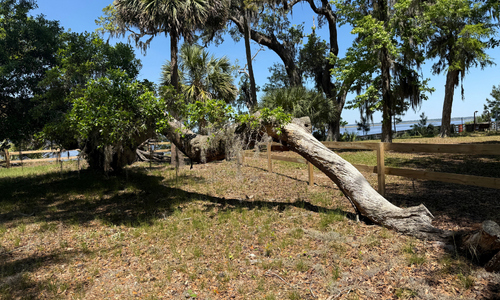
- The witness tree: 210+ year-old live oak (standing during the Civil War and War of 1812); blown over by Hurricane Matthew but still growing on its side
- Birding: On the Colonial Coast Birding Trail; painted bunting, bald eagle, osprey, tricolored heron, great blue heron, little blue heron, egrets, pilated woodpecker, raptors
- Camping: 60+ sites (18 full hookup with sewer), pioneer camping, backcountry camping, 7 premium 2-bedroom cottages
- Fishing: Two fishing piers; public and private boat ramps; Georgia fishing license required
- Pets: Welcome; only restricted from historic site buildings and certain cottages; non-pet-friendly cottages exist alongside pet-friendly options
Episode Transcript
Fort McAllister State Historic Park — The Unbreakable Fort
The Parks Podcast, Episode 40 | Jason Carter, Park Manager, Fort McAllister State Historic Park
Welcome and Park Stats
Missy Rentz: Today’s episode we’re joined by Jason Carter, who is the park manager at Fort McAllister State Historic Park in Georgia. Jason, welcome to The Parks Podcast.
Jason Carter: Thank you and thank you for having me. Looking forward to it.
Missy: Let’s get into some park stats. The park is located in Richmond Hill, Georgia. It was created when Henry Ford bought the property in 1930 and began the restoration, and then International Paper Company purchased the land. They ultimately gave it to the state of Georgia in 1958. The park size is 1,725 acres. Some interesting facts: it is one of three forts that protected Savannah during the Civil War. It was attacked nine times by Union forces — eight times by the Union Navy and once by the Army — and it fell in 1864 during General Sherman’s March to the Sea. I had such an amazing April visit at this park, Jason.
Jason: April’s a pretty good time to visit because the temperature’s really nice. The bugs can be a little rambunctious in April.
Missy: I met a lot of black flies and mosquitoes.
Jason: Yes. There’s a few here and there at that time of year.
A Dual-Purpose Park — Historic Site and State Park
Missy: Fort McAllister is really divided into two parts. The first is the historical site, and the other I would call the natural site. What’s the difference and what’s the relationship between these two pieces?
Jason: We are one of only a handful of sites in Georgia what we call dual-purpose sites — both a historic site and a state park on the same grounds. The historic site side operates like a regular Georgia historic site. Our hours are eight to five Monday through Friday on that side of things, and the historic site encompasses the museum, the fort, and a short movie in our AV room where you can get an overview of the historic site itself. Then on the state park side, it’s your more common state park operation where I have a large campground with 65 campsites, seven cottages, backcountry sites, pioneer camping, two different nature trails, and standard hours of 7:00 AM till 10:00 PM on the park operations side.
What Role Did Fort McAllister Play in the Civil War?
Missy: During visits to military parks, you almost can allow yourself to sink into the history as the story unfolds. And Fort McAllister, you all do such an incredible job of telling that story. The fort is — I couldn’t even imagine what a fort looked like until I came there and actually got to go underground and see the infirmary and whatnot. What role did Fort McAllister play in the Civil War?
Jason: At the beginning of the Civil War, Mr. Joseph McAllister knew that the area known as Genesis Point — property that he owned — is the highest area in this part of the county for about five miles in any direction. So he knew it would be strategically important to the Confederacy because the Ogeechee River, which is immediately adjacent to the park to our north, is basically a back door into Savannah. It’s a deep-water channel that goes all the way up to the southern side of Savannah — what Mr. McAllister called the back door of Savannah. He gave the land to the Confederacy and they started constructing what was just a simple naval battery with three to four coastal defense naval guns. They stretched a chain across the river to blockade it, which would require any vessel going up and down the river to come within point-blank range of those naval guns. As the war waged on they added more guns. The main purpose of the property was to guard the back door of Savannah via the Ogeechee River.
Missy: When you’re there, maybe because of the different places I’ve been, I expected a fort to be some concrete or brick structure up high. But a lot of this is all through mounds on the ground.
Jason: Correct. It’s a subterranean earthen fort — one of the best examples of a Confederate earthen fort in the country. Even though it may not be as big and as pretty as a masonry fort like Fort Jackson or Fort Pulaski, or even a wooden fort like Fort George, what they found out through the naval bombardments is that an earthen fort is actually really resilient to artillery fire, much more so than those other two types.
Missy: And it’s really unassuming when you’re there, and then you get into it and it’s massive — the amount of trenching and digging to create the structure. The other thing that was interesting to me: you have the fort and then the field beside it was where camps were set up, and I had read that it was so polite that they would not shoot toward the camps where people were living and sleeping.
Jason: No — during the naval engagements, they pretty well tried to drop ordnance anywhere and everywhere on that site. The way it was laid out, you saw the four wooden huts there on the greenway — originally there were 16 of those, and that’s where your non-commissioned officers stayed. All of the fort garrison would actually have stayed in tents in rows on that field there. When they actually got attacked, they would move into the fort, man their positions, man their guns. But most of them stayed out there in the open. When the Union Navy engaged, nothing was off limits.
Missy: And I would assume at that day and age, shots weren’t all that reliable — targets weren’t all that reliable.
Jason: That’s correct, especially on the Confederate side. The Confederates for much of the war didn’t have really good rifled artillery like the Union had. So even more so on the Confederate side, the cannons in the fort were fairly inaccurate compared to some of the technology that the Union had.
Why This Park Matters — The Naval Engagements of 1863
Missy: Tell me why it’s so important that this park is part of the Georgia State Park system.
Jason: It basically tells the story not only of the Civil War — there’s a lot of Civil War history in Georgia, especially up towards Atlanta — but people don’t realize there was a great deal of activity here along the coast as well. Our claim to fame is we are the site of the final battle of William T. Sherman’s March to the Sea. Everybody knows about Sherman, they know about the March to the Sea. But I’ve always been more fascinated by the scale of the naval bombardments and the naval engagements here. Because in 1863, a Passaic-class ironclad was the latest, greatest weapon of mass destruction in the world — the most advanced piece of military equipment — and the fact that four of them were sent to engage the fort in 1863 is pretty amazing. Maybe the best example of a large-scale, close-range artillery battle that happened during the Civil War. You had the fort’s big guns — a 32-pounder, inch Columbiads, a 10-inch Columbiad, a 42-pound rifle — all going at once. And then you had all these big guns on these ironclads, including the 11-inch and the 16-inch cannons. The 16-inch gun is the biggest gun fired during the Civil War. And all of these are going at the same time at basically point-blank range for heavy artillery. The fascinating thing is that they weren’t really able to do damage to the other side — it was pretty much a stalemate because the earthen fort was impenetrable to artillery fire. Yes, it could blow big holes in the dirt, but they could just fill them right back in.
How Much Is Original — and What Was Reconstructed?
Missy: When it did become a park, how much reconstruction was needed versus how much is still true to that era?
Jason: That’s a really good question. The Union did a really good job of destroying the fort before they left. They not only trashed all the artillery pieces and threw cannonballs into the river — a lot of their equipment was more advanced, so it was obsolete stuff the Confederates had — they also destroyed much of the fort as far as the mounds and the underground bunkers. When Henry Ford got the property in the 1930s, he had the original footprint but that was pretty much it — he had to reconstruct everything else. So the footprint of the fort is original, but the earthworks and the mounds are all pretty much reproductions. If you look at photographs from the Civil War versus what we have today, you can see some pretty obvious differences in how the mounds look, the shapes, the parapets, the gun emplacements. So again, the footprint is original, but everything else is pretty well a reconstruction.
The Post-Battle Dinner — and the Land Mines
Missy: After the fort fell, one of the stories I love about this park is that the Union hosted a post-battle dinner and invited the commanding officers from the Confederacy. Can you tell me a little bit about that dinner — and more importantly, what happened after?
Jason: Sure. When General Sherman watched the reduction of the fort from across the river at Cheves Rice Mill, after receiving word that the fort had been taken, he moved with his staff to the fort. They met with General Hazen, who was the commanding officer that took the fort, and the commander of the fort, Anderson, and one of his subordinates. They all had a dinner close to the fort here. The interesting thing about that is Sherman was really mad that the fort had used landmines — they called them torpedoes back then. We’re not a hundred percent sure, but we’re pretty sure this is the first documented case of landmines causing casualties in a battle. They had been used in battles before that but hadn’t caused casualties. Some Union soldiers were actually killed by them here, and a lot were injured. Sherman felt like it was a violation of the gentlemanly rules of war. So he was very upset, and he and Major Anderson had it out at the dinner over the use of the landmines. The result was Sherman made Hazen fall in with the enlisted men the next day and get down on the ground and dig all those mines up.
Missy: I just love it. I imagine it was contentious, but there was also a bit of sharing strategy during this dinner, and then the next day they were back to enemies again. It’s just a funny part of war — the relationships and how you go from enemy to let’s talk it out, then enemy again.
Jason: There was still a lot of chivalry between opposing commanders back then — not only in after-war activities like the dinner, but even on the battlefield, they were still using Napoleonic war tactics and there were certain ways you were supposed to fight a battle and shoot at each other. It was maybe the last major conflict that involved that type of behavior.
The Natural Side — Ecosystems, Wildlife, and Birds
Missy: I don’t want to overshadow the beautiful natural part of this park and the conservation efforts and natural resources that you guys are working with. And I just want to paint a picture: the drive in to this park, you’re driving down this two-lane road, passing sailboats and cute little seafood shacks, and then you get to the park and it’s this grand drive with beautiful trees and Spanish moss — it’s like a movie when you’re driving into your park. Jason, it’s beautiful.
Jason: Yes, indeed. It’s a really interesting site in that we have so many different habitat biomes in one location — not only a tidal river on one side, but a true estuary environment with Redbird Creek on the other. Then you’ve got the marsh, the upland scrub pine forest, maritime forest, and old-growth pine forest as well, with a pretty good spattering of live oaks mixed in here and there, and of course Spanish moss everywhere. It’s a pretty fascinating area with all of the different types of ecosystems and biomes involved here.
Missy: So Jason, what are some of the animal species that people can find when they visit Fort McAllister?
Jason: Where do I start? Probably the most common animals people see on a daily — sometimes hourly — basis are the white-tailed deer and the raccoons. I have a large population of both that roam the park day or night. I’ve got three really nice white-tailed bucks that live in the campground right now on the island, and people are seeing them daily. But we have just about anything you can think of as far as coastal wildlife species. We are on the Colonial Coast Birding Trail — one of the main stops on that trail — so we get a lot of birding activity. Bird photography is one of my things. The most popular species for people to come and see is probably the painted bunting — the crown jewel of Georgia birds. But raptors, bald eagles, osprey — we see ospreys daily, pretty much bald eagles daily as well. Any of your wading birds: tricolored heron, great blue heron, little blue heron, egrets. And if you get into the upland forest part of the park, your woodpeckers, buntings, sparrows, warblers — you can spot all those pretty easily. It’s pretty easy to get 35 or 40 species of bird here within an hour if that’s your thing.
Jason: But to get away from the birds — a really neat animal that a lot of people don’t realize we have in Georgia until they see it here: about once a month I’ll see mink on the causeway, and people are pretty fascinated that we actually have those. In the winter months, we see a lot of otters — they disappear during the warmer months but in winter you can see those usually once or twice a month. Reptiles and amphibians — gosh, it’s endless. We’ve got probably 30 species of snake that can be found in the park. All of the venomous snakes that we have in Georgia do occur on the park. Several species of salamanders, toads, a couple of species of legless lizard. And of course plenty of bugs, insects, and spiders.
Planning Your Visit — When to Come and What to Expect
Missy: Let’s talk a little bit about planning a trip. How do you recommend someone begin to plan a trip to Fort McAllister?
Jason: First of all, there’s never a bad time to come here — it just depends on what you want to get out of your trip. If you want to avoid hot weather, obviously try not to come during the warmer months. We do try to get the word out that we have a pretty healthy population of deer flies seasonally — usually April through mid-June. Luckily they only stay around for a couple of months. But we try to tell people that if you’re going to be heavy into outside activities, just come prepared. Bring some insect repellent, some long pants and long sleeves, because they do get a little rambunctious, especially back there in the fort in late April through early June.
Missy: I was not prepared, Jason. I was running, flailing my arms on the hiking trail along the water in the campground. It was comical, but I also knew that was my fault. And you can still enjoy the space during this season — you just have to be prepared.
Jason: If you’re looking for certain bird species like painted buntings, the warmer months are the best time to come — they’re not here in numbers during the winter. But if you want to come during the cooler months, we have a lot of our big events and activities then as well. That’s when we do our candle lantern tour, winter muster, our car show in February. If you’re into wildlife, there’s plenty during the cooler months too — it’s just different stuff. If you want to spot Northern Harriers or Peregrine Falcons, you need to come during the wintertime.
Missy: Another thing I’ll note — you’re really close to Savannah.
Jason: Yes. We’re only 15 or 20 minutes from the Savannah city limit. What I like to say is, we’re in Savannah’s backyard, but we’re a world away from Savannah. If you want to come experience Savannah but you don’t want to experience the traffic and the crowds, you can come stay here and feel like you’re a hundred miles away, but within 30 minutes you can be in Savannah. It’s a great option for people who want to visit Savannah as well.
Lodging — Something for Everyone
Missy: What are some of the lodging options that are within the park?
Jason: I have a campground with just over 60 sites. Sites one through 18 are full hook-up — 50-amp service, sewer, the whole nine yards. The rest of the sites have water and electric, and we do have a dump station. I have seven premier cottages — they’re all two bedrooms with four queen beds each. We don’t even like calling them cottages anymore because they’re more like staying in a condo. They’re fully equipped. All you have to bring is your clothes and your food — everything else is provided. Full linens, full kitchen utensils, everything. If you prefer more rustic accommodations, I have pioneer camping and also backcountry camping where you hike in and hike out. And then some day-use facilities as well — picnic shelters, a group shelter.
Missy: And if anybody wants to reserve that, they just do that through your website?
Jason: Yes, they can call the 1-800 number to make reservations or go through gastateparks.org and do it online.
What You Can Do — Park Side
Missy: Let’s talk about what people can do while they’re visiting — first the park side, then the historic site.
Jason: On the park side, we have nature trails. The Magnolia Trail is in the campground and is easy access for our campers. If you’re looking for a little bit more of an arduous hike, I have the three-and-a-half mile Redbird Creek Trail up in the day-use area. I have two fishing piers — one on the Ogeechee River accessible to everyone from 7:00 AM till 10:00 PM, and a private pier on the island for overnight guests. I have two boat ramps if you’re into boating or fishing — a public boat ramp open 24/7, and a private boat ramp in the campground for overnight guests only. We also have both wet and dry storage areas for boats. Day-use area has two picnic shelters, a fishing pier, and a playground. And of course birding and nature watching throughout. There’s a nature observation area in the campground that overlooks a clearing — a good place to spot deer, raccoons, songbirds, and raptors.
Missy: And it’s clear where the good birding areas are because you have benches in the most strategic spots. The Magnolia Trail — I did a sunrise hike on it and oh my gosh, the orange sky was so beautiful. And then on the causeway, there are benches that are strategically placed.
Jason: Yes — those benches on the causeway are strategically placed so you can sit there and watch the bat boxes. We have bat houses on the causeway and a spot where you can sit down and watch them come in and out in the evenings.
The Witness Tree
Missy: Tell me about that tree that’s in the day-use area — the one that’s laying down.
Jason: We call that the Witness Tree. We were pretty sure until a few years ago that it was the only tree remaining from the Civil War, because the Confederates had cut down every tree within about a half mile in every direction — not only to give them an open line of sight to the enemy, but to use as barriers to make it hard to get to the fort. I brought some people from the Forestry Commission out here to have it tested. They told me they couldn’t give me an exact date, but that it was at least 210 years old. So it was definitely standing during the Civil War — and actually all the way back to the War of 1812, which is pretty fascinating. Unfortunately it got blown over by Hurricane Matthew. We started cutting it up to remove it, and then it started growing again, laying on the ground. So I stopped. I said, nope. We’re going to let it grow. We put a fence around it, we’ve got an educational sign over there, and it’s doing well — growing, laying on its side. And there are actually musket rounds inside the tree from the Civil War.
Missy: I will post pictures because just to set the tone — it looks like a dead tree laying on the ground and then there are trees growing on top of it. It’s so cool to see. I love it.
What You Can Do — Historic Site
Missy: Now let’s talk about what people can do on the historical side and what they’ll see.
Jason: You come into the historic site, pay your admission, and you can see the museum — it’s one of the better Civil War museums in the state. That also gets you access to the video in the AV room, and there’s some artifacts in the AV room as well. Right now there’s an exceptional collection of some rare carbines from the Civil War that a lot of people don’t even know exist, which are on loan and can be viewed right now. There are also some pretty rare artillery pieces and artillery rounds that are somewhat obscure and unknown.
Jason: Then from there you can go out to the fort itself. You can tour the actual battleground. There’s a reproduction of a caretaker’s house down there — the lower floor is made up to look like period officers’ barracks, and you can tour that from time to time when we have staff down there. Then of course you can go into the fort. There are three places you can go underground. The hot shot furnace — walk by the hot shot cannon itself, and then walk into the furnace underground where they would have heated 32-pound cannonballs up red hot, shot them into wooden vessels, and set them on fire. You can actually go into the furnace underground and go back to the backside — it’s creepy in there, but if you like dark places, it’s pretty neat. The central Bombproof always amazes people — they don’t realize how big it is until they get down in there. It doesn’t look that big from the outside, but when you get down in there, there are 20 bunk beds, a couple of chimneys and fireplaces. And then there’s a magazine — one example of a heavy artillery magazine where they would have stored powder, rounds, and other equipment. Then you can climb up on the parapet itself and walk around the perimeter of the fort, see the river, and imagine what it was like for those ironclad vessels to be parked out there at basically point-blank range, engaging you with the largest rounds fired during the Civil War.
Missy: It’s so cool. They are creepy underground — they are damp and a little creepy and I can’t imagine being in them in the middle of a war.
Jason: Interesting story for the central Bombproof — we had an alligator in there about three weeks ago. A visitor had come out from under one of the bunks and scared a good-size one, about four and a half, five feet.
Missy: What? How did you get it out?
Jason: We had to wrangle it out of there, capture it on the causeway, and let it go in the river. Because it’s really dark in there — that would be hard to spot until it was really close to you.
Permits, Reenactments, and Ranger Programs
Missy: You mentioned a couple of things that might require permits and licensing. Do people need to get permits before coming for some of these activities?
Jason: Not necessarily. The only permits you would really have to have — if you want to launch kayaks at the overnight boat ramp, you do have to get a special use permit for that from time to time. Fishing — if you’re going to fish, you do need a Georgia fishing license, whether you’re a resident or non-resident. Those need to be obtained ahead of time. It’s really easy to get on your phone on the internet now. But we do not sell them at the park.
Missy: You guys have some reenactments and some ranger programs. Can you tell us a little bit about those?
Jason: For a true reenactment, we only have one per year — around December 13th, which is the date of the actual battle. That’s the only time of year we shoot at each other. That’s usually the Saturday closest to December 13th. But I have reenactors present probably a dozen times a year for various events and programs — small arms demonstrations, marching demonstrations, cannon fire. For the most part those are around major holidays. If you want to guarantee you’re going to see a cannon firing, come for a major holiday, the winter muster, or the candle lantern tour. We try to have at least one program a month where I have reenactors present doing at least small arms demonstrations.
Missy: And besides the reenactors, I think your rangers are so knowledgeable. I really do encourage people to take time to engage with them and ask questions because they really made the park come to life for me when I was there.
Jason: Yes. I’ve got a really good staff right now — a lot of key ranger staff that are long-term, been in the system for a while. They’re pretty well versed not only on this site, but on park operations as a whole. They’re pretty sharp.
Pet Friendly — and Jason’s Photography
Missy: I also want to talk a little bit about our four-legged friends. I travel with my dog, and Fort McAllister is a pet-friendly park.
Jason: Yes, we want your four-legged friends to have just as good of a time and create just as many memories as you do. I have very few facilities here that are not pet friendly. Of the cottages, I do have pet-friendly cottages as well. We really don’t have any areas where your pets aren’t allowed.
Missy: You just need to be respectful and responsible — a six-foot leash and pick up after them. Tootsie and I had a great time. It was rare and unexpected to me to get to explore the fort with the dog, which was great. And Jason, you have some amazing photography of this park — I’m looking at a picture you’ve taken of an amazing lightning bolt down from the sky to the water. You’ve got a lot of photos capturing the parks.
Jason: Photography is by far my main hobby right now. Shooting lightning is probably one of my favorite things to do just because it’s so dramatic. I spend a lot of my free time not only here at the park but throughout Georgia taking a lot of photographs — especially nature photography and landscape. If they want to follow me on Facebook it’s Photography by Jason C.
Missy: Perfect, and we will tag you as well.
Speed Round
Earliest park memory?
The earliest park memory I have is from Cooper Creek in Columbus, Georgia. I remember sitting beside my mother and father at a large electrical transformer and catching a giant catfish — “giant” to me when I was little. The funny thing is my mom says there’s no way I could remember that because I had to be less than two, but I can remember it.
What made you love the parks?
I’ve always been an outdoors person, especially in regards to wildlife photography. When I moved down to South Georgia, I took a liking to Laura Walker State Park initially — it was close to the Okefenokee Swamp. I spent a lot of time out there, and the more time I spent out there, I decided I needed to work there. That’s actually where I got my start.
Favorite thing about Fort McAllister State Historic Park?
Just the diversity. I know everybody says that their park has a little bit of everything, but I think mine has a little bit more of everything than most. We have the historic side aspect plus the natural history and recreation and overnight amenities. Pretty much anything you want — from seeing small arms and artillery military demonstrations to pier fishing, staying overnight in a rustic environment if you want to do backcountry or pioneer camping, all the way up to upscale glamping in a modern condo-style cottage. If you want a place where you can literally do just about everything that Georgia State Parks offers, both from the historical and recreational aspects, it’s hard to beat Fort McAllister.
Favorite thing to do at Fort McAllister?
If we’re talking about work-related — firing cannons. If we’re talking about on my own time — photography. Bird photography and landscape photography.
Park on your bucket list?
I actually have visited the Grand Canyon, but it was on a work trip and I didn’t really get to get out and do anything. So right now that one’s on the top of my list to get back to where I can actually take some time and spend several days doing some photography. It’s an amazing place and I just didn’t get a chance to really get into it like I would have liked to.
Three must-haves for a park visit?
Water. Always my camera gear — no matter what park I’m going to, work-related or not, I’m always bringing camera gear. And first aid.
Favorite campfire activity?
Spooky stories, by far.
Tent, camper, or cabin?
I think my tent camping days might be behind me. I’m usually probably going to stay in a camper or a cabin. Not to say that I wouldn’t stay in a tent — I have done it before recently — but just being honest, it’s not really my cup of tea anymore.
Hiking with or without trekking poles?
I usually don’t carry a pole. I may carry a walking stick. I usually have a camera in my hand, so.
Favorite trail snack?
Probably peanuts.
Best animal sighting?
I’ve got a tie. My two favorite animals by far, not only here but in Georgia — a painted bunting. Every time I see one of those, it doesn’t matter if I’ve seen it a hundred times, it’s still magical. It doesn’t seem real. Especially when you see one in good light. It’s just magic. And the Eastern Diamondback rattlesnake — probably my favorite animal altogether, because it’s just the king of snakes.
Favorite sound in the park?
Pileated woodpecker.
Greatest gift the parks give to us?
They just give us the opportunity to not only make memories with our friends and family currently, but to bring back memories of years past when you were able to go out with your friends and family when you were younger. That’s my biggest thing here — I try to tell all my staff that these people are paying us money to come here and recreate, they’re trying to have great memories. We are in the memory-making business. So let’s do everything that we can to sure that we’re fostering that type of environment. I think that’s the greatest thing that parks can give: an opportunity to get out, get away from the stress of everyday life, make some great memories with your friends and family, but also give you a chance to recollect about all the things that got you interested in parks when you were little.
Missy: Jason, thank you so much for taking time to chat today. You have given me the opportunity to relive the time that I spent at Fort McAllister — because it is a really special place. Thank you.
Jason: Thank you for having me. Very much.
Missy: That’s it for today’s episode. Until next time — we’ll see you in the parks.
Music for The Parks Podcast is performed and produced by Porter Hardy. Follow us @TheParksPodcast or visit TheParksPodcast.com.