
Death Valley is the hottest place on Earth, the lowest elevation in the United States, and one of the most misunderstood parks in the system. Drive through at noon and you might think it’s just gray rocks. Wait for sunset — and everything turns purple, green, orange, and red. Ranger Abby Wines joins The Parks Podcast to share the full story of Death Valley: the pupfish with a population of 35, the con man whose scam became a castle, the Timbisha Shoshone people who call this place not Death Valley but home, and everything you need to know to visit safely.
A note from Missy: I came to Death Valley escaping a winter storm from Zion. I arrived skeptical — just a sea of gray rocks. Then the sun set. I have never been so wrong about a place in my life. Death Valley also taught me a hard lesson about trail safety — I got lost on an unmaintained trail. I turned back the moment something felt off, drove straight to Las Vegas, and bought a Garmin GPS watch. This episode is why I now have a safety system: I text my plans when I get on a trail, and text again when I get off.
Note: This episode was recorded in August 2023, 11 days after Hurricane Hilary caused major flooding throughout the park. Before visiting Death Valley or any park, always check the official website for current conditions.
Episode Guest
Abby Wines, Park Ranger
Death Valley National park
Park Stats
- Location: Death Valley, California
- Established: National Monument 1933; National Park October 31, 1994 (President Bill Clinton)
- Park number: 53rd National Park
- Size: 3.4 million acres — 5th largest national park
- Highest elevation: Telescope Peak Summit — 11,049 feet
- Lowest elevation: Badwater Basin — 282 feet below sea level
- Annual visitors: 1,128,862 (2022)
- Temperature: Hottest place on Earth — up to 130°F in summer
- Trails: 170+ miles
- Wildlife: Bighorn sheep, kangaroo rats, desert tortoise, coyotes, jackrabbits (most nocturnal)
- Dark sky: International Dark Sky Park designation
- Best time to visit: November through March
Show Notes & Links
- Death Valley National Park — official website and current conditions
- Plan Your Visit — Death Valley
- Furnace Creek Visitor Center
- Camping reservations — Furnace Creek Campground
- Scotty’s Castle — current status
- Devil’s Hole Pupfish information
- Timbisha Shoshone Tribe
- Women of Death Valley — exhibit at Furnace Creek Visitor Center
- Rhyolite Ghost Town — BLM land near Beatty, Nevada
- Star Wars self-guided tour — Death Valley
- Oasis at Death Valley
- Stovepipe Wells Resort
- Panamint Springs Resort
Transcript
Death Valley National Park — The Hottest Place on Earth Has a Lot to Teach You
The Parks Podcast, Episode 8 | Abby Wines, Park Ranger
Editor’s note: This episode was recorded in August 2023, eleven days after Hurricane Hilary caused unprecedented flooding throughout Death Valley National Park. Parts of the park were closed at time of recording and reopening in phases. Always check nps.gov/deva for current conditions before planning your visit.
Missy Rentz: I’m excited to welcome Abby Wines, a park ranger at Death Valley National Park. Prior to Death Valley, she worked at Wind Cave, Great Basin, Sequoia, and Carlsbad Caverns, among others. Abby, welcome to The Parks Podcast.
Abby Wines: Thank you very much, Missy.
After the Hurricane — The Park in Crisis
Missy: This is August 2023 and Death Valley was just flooded by Hurricane Hilary. How are you and how is the park?
Abby: Exhausted. All of the staff here are exhausted. We’re eleven days out from when the hurricane passed through. It dropped 2.2 inches of rain at Furnace Creek on the valley floor — more than we typically receive in an entire year, and by far the single rainiest day on record. Higher elevation areas received up to eight inches.
What happens when that much rain falls here is extensive flash flooding — but different from what people in the east picture. Think about the steep roof of a house — water runs off rather than soaking in. That’s what the steep, rocky mountains on either side of Death Valley are like. The canyons are the gutters. And what lies at the bottom of all those canyons are the roads.
Every time a flash flood came down a canyon and crossed a road, it either deposited up to five feet of rock and debris on top of the pavement, or it carved out the downhill side underneath it — leaving asphalt suspended over nothing. Big holes. Drop-offs. We have no idea when the park will begin its phased reopening. Please check the official website at nps.gov/deva before planning any visit.
The Pupfish — Tiny Fish, Big Stakes
Missy: I saw on your Instagram that the pupfish actually did okay through the flooding?
Abby: The pupfish are these tiny fish — less than two inches long — with five distinct populations, each either a distinct subspecies or distinct species.
The one of greatest concern are the Devil’s Hole pupfish. Devil’s Hole is a sinkhole — a 50-foot opening with a pool at the bottom, and then 500 feet of water continuing down into a cave below that. The pupfish depend entirely on a small shelf at the very top of that pool, the only place sunlight reaches, where algae grows for them to eat.
The flooding deposited debris on that shelf, which isn’t good short-term — some eggs were likely disrupted and the algae is covered. But long-term, it brought in fresh nutrients that will benefit future generations.
A few years ago, the entire Devil’s Hole pupfish population was down to 35 individuals. Thirty-five. The Salt Creek pupfish, another population here, lost some individuals in the flood — but the population as a whole is expected to be fine.
How Death Valley Got Its Name — And What the Timbisha Shoshone Think of It
Missy: How did Death Valley get its name?
Abby: A group of people trying to reach California’s Gold Rush in 1849 came through this valley and had a very hard time finding their way out. After one difficult day, a woman reportedly looked back and said, “Goodbye, Death Valley.” One person had died during the crossing — he was old and sick and, as the story goes, would have died anywhere. The place arguably didn’t deserve the name.
And for the record: the Timbisha Shoshone, who have lived here since time immemorial, do not like the name Death Valley. For them, this is a place of life. It is their homeland. It is sacred.
What Was Here Before the Park
Missy: Death Valley was a mining community before it became a park. What was actually happening here?
Abby: The Timbisha Shoshone have always been here — living seasonally on the valley floor in winter and moving up to around 5,000 feet elevation in the mountains during summer. That was the rhythm of life here for a very long time.
Then in the mid to late 1800s, miners arrived. More often than not, it was a scam. They might find a little gold or a little borax, but mostly they were pitching investments to wealthy people back east who were too afraid of the name Death Valley to come see what they were actually funding.
One of the successful mining operations — a borax company — realized how beautiful the place was and started developing tourism. They built the first hotel here in the 1920s and lobbied to have Death Valley designated a national monument, partly to eliminate competition and partly to benefit from better federal promotion. Death Valley became a national monument in 1933 and was expanded to a national park in 1994 at 3.4 million acres.
Some mines were genuinely productive — the Keane Wonder gold mine, the talc mines in Warm Springs Canyon that were once the largest in the country, the borax operations that were the real economic engine here from the 1890s through the early 1900s.
And then there was Leadfield — an entire town built as a scam, now a ghost town.
Scotty’s Castle — The Greatest Con in Death Valley
Missy: Tell me about Death Valley Scotty and Albert Johnson.
Abby: Around 1902, a man named Walter Scott — Death Valley Scotty — claimed to have a gold mine in Death Valley. He never had so much as a hole in the ground. But Death Valley was the perfect place for an imaginary fraudulent gold mine, because with that name, who was going to come check it out?
He had multiple investors from New York and Chicago. One of them, a wealthy businessman named Albert Johnson, called his bluff and announced he was coming to inspect the mine. This was a serious problem for Scotty, who had nothing to show him.
Scotty gathered his brothers and friends and staged an ambush. The plan: hide behind a hillside, fire guns in the air when the wagon passed below, scare the rich man from Chicago, send him home. What actually happened is that someone — probably because they were drunk — shot one of Scotty’s brothers in the hip. When that happened, Scotty dropped his gun and yelled, “Stop shooting, you shot Warner.” The whole scheme collapsed.
At this point, Albert Johnson obviously understood there was no gold mine. The con was completely exposed. But here’s where the story gets strange: he didn’t care. He was having the time of his life living out this wild west fantasy in the most extreme landscape in America. He kept investing. He kept coming back. He brought his wife. She eventually got tired of camping, so about twenty years later they started building what became Scotty’s Castle — though they named it Death Valley Ranch. Scotty called it Scotty’s Castle, and they let him, because it was a better story.
The castle was severely damaged in a 2015 flood and has been closed for repairs since. The park was approximately 90% done with repairs when this episode was recorded, with hopes to reopen in 2025 or 2026.
Ghost Towns
Missy: Death Valley has several ghost towns. What can visitors find?
Abby: The ghost towns here are sometimes less substantial than people expect — because these mining towns often grew and died in less than a year. People lived in tents or thrown-together wooden shacks, and when the mining played out or the scam was exposed, they packed up the entire building and moved fifty miles away. So what you often find are foundations, low walls, the occasional chimney.
Panamint City is one of my favorites — a great backpacking route, about six miles from the trailhead, with water along the route. It’s from the 1870s and has a 70-foot chimney still standing. Skidoo and Leadfield are others within the park.
And just outside the park on BLM land near Beatty, Nevada is Rhyolite — absolutely worth the short detour. Really spectacular standing structures there.
The Women of Death Valley
Abby: Something the park has worked to recognize more intentionally is the role of women in this history. Mary DeDecker was a botanist who pioneered the discovery of plant species endemic to Death Valley — species that live nowhere else on Earth. She was the first to identify several of them.
Louise Grantham ran one of the large talc mining operations here — a woman mining entrepreneur in an era when that was essentially unheard of.
And Pauline Esteves was a Timbisha Shoshone elder who was instrumental in getting formal tribal recognition and in passing the Timbisha Shoshone Homeland Act in 2000 — which gives the tribe co-management with the National Park Service over roughly two thirds of the park. That is an extraordinary achievement and a model for how parks and Indigenous peoples can work together.
There’s a temporary exhibit at Furnace Creek Visitor Center that highlights these women and others.
When to Visit
Missy: The seasons here are extreme. When should people come?
Abby: November through March is the prime window. October and April are possible but on the warm side. Highs in the winter are usually in the 60s and 70s with lows in the 40s — ideal camping and hiking weather, while much of the country is dealing with snow and cold.
Summer — July and August — is bucket list territory only. Temperatures reach 130°F in the shade. At those temperatures, we don’t advise anyone to walk more than five minutes from air conditioning. You can drive the scenic roads, do very short walks like Badwater, but no extended hikes at low elevation in summer. The mountains and higher elevations are hikeable in summer, where it’s significantly cooler.
If you want trails almost entirely to yourself, come in December or January, avoiding holiday weekends. The weather is ideal and visitation is very low.
Where to Stay
Abby: There are three hotels within the park: the Oasis at Death Valley, Stovepipe Wells Resort, and Panamint Springs Resort. All three will be fully booked during March, over Thanksgiving, and over Christmas through New Year’s. Book well in advance for peak season.
For camping, most campgrounds are first-come, first-served. The one exception is Furnace Creek Campground, which is reservable on Recreation.gov and books up quickly during popular periods. Right next to it is Sunset Campground — always has room, essentially infinitely expandable, but it’s a large open gravel lot. Better for RVs than tents.
The nicer tent camping option is Texas Springs Campground, right next door — trees, CCC-built stone structures, real character. If you’re a tent camper, stalk Texas Springs.
Safety — The Most Important Conversation
Missy: Safety in Death Valley is different from almost any other park. What do people need to know?
Abby: Start with this: there is no cell phone service in most of the park. Have a plan.
The best option is a satellite messenger — an inReach or similar device. If you don’t have one, designate a person back home who cares about you and give them your complete itinerary: where you’re going, what car you’re driving, what trail you’re taking, and the exact time by which they should call the park if they haven’t heard from you. We can’t check on everyone. If we see a car parked on a trail, we don’t know if it belongs to a backpacker or someone who’s lost. Be responsible for your own check-in.
Download a printed map before you leave. Do not depend on your phone for navigation in the backcountry.
On heat: in summer at 130°F, no extended hikes at low elevation. Period. Stay in the car or near air conditioning.
On trails: Death Valley has very few maintained trails. Most of the park is open cross-country travel — you can park anywhere and walk toward anything that looks interesting. This is one of the most remarkable things about this place. But it also means situational awareness is entirely your responsibility. Pay attention to landmarks. The moment something feels wrong, turn back.
The single biggest cause of death and injury at Death Valley? Single-vehicle rollover accidents. People take their eyes off the road looking at the scenery, drift a wheel off the edge, overcorrect, and flip. Pay attention while driving. It’s the most dangerous thing anyone does in this park.
What to See
Abby: Top highlights you can see from the road or a short walk:
Dante’s View — a high overlook with a panoramic view of the entire park. On a clear day you can see the full sweep of the valley floor from high above.
Zabriskie Point — multicolored badlands formations at sunset are extraordinary.
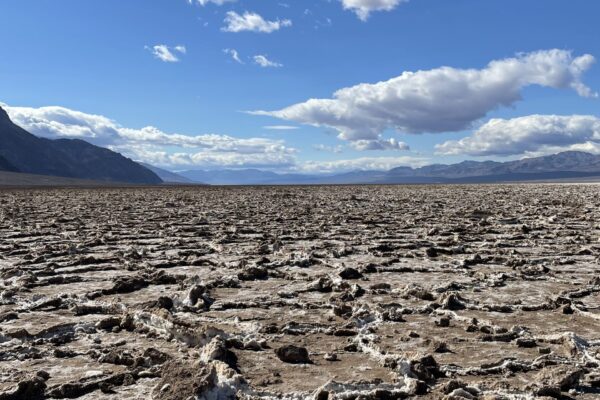
Badwater Basin — the salt flat at 282 feet below sea level. Walk a few minutes out onto the flat and the salt is fractured into massive polygons — a completely alien landscape, bright white against dark mountains.
Mesquite Flat Sand Dunes — only 4% of the park is sand dunes, but they’re spectacular.
Artist Drive and Artist’s Palette — a loop road through hills where the rock contains minerals that create vivid natural colors — pinks, greens, purples, yellows. Rocks have no business being that many colors.
Best hikes: Golden Canyon and Mosaic Canyon — short, dramatically different from each other, both beautiful.
Stargazing: Death Valley is an International Dark Sky Park. On a moonless night, the Milky Way is fully visible. Ranger-led astronomy programs happen regularly during periods of peak visibility. One event last year drew 1,500 people.
Star Wars: Death Valley is Tatooine. Mesquite Flats, Golden Canyon, and 20 Mule Team Canyon were all filming locations. The scene where Luke looks down and says “that’s a den of villainy and thieves” — he’s pointing toward Furnace Creek. There’s a self-guided Star Wars tour available on the park website.
Dogs at Death Valley
Abby: You’d probably be happier leaving pets at home. Dogs are only allowed in campgrounds and on roads — not on trails, not cross-country. That limits most of what there is to see in the park. And for much of the year, the heat makes leaving pets in cars genuinely dangerous.
Speed Round
Missy: Speed round — whatever comes to mind first.
Earliest park memory? Mammoth Cave National Park. And it’s why I became a park ranger.
What made you love the parks? Exploration. I wanted to be a cave explorer, so I did an internship at Wind Cave thinking I’d be exploring caves. It turned out I was being trained as an interpretive ranger. Nobody told me the difference.
Favorite thing about Death Valley? The open space. It feels like freedom.
Favorite thing to do at Death Valley? Canyoneering — rappelling down cliffs.
Park on your bucket list? The Alaskan parks I haven’t visited yet. Gates of the Arctic especially.
Three must-haves for a park visit? A map, food, and water.
Favorite campfire activity? Talking with friends.
Tent, camper, or cabin? Tent — but I prefer sleeping in the back of my truck.
Trekking poles or no poles? Usually with, especially on steep terrain.
Favorite trail snack? Chocolate.
Best animal sighting? About seventeen years ago, I was working on a project with two elders from the Timbisha Shoshone tribe. The younger elder asked the older elder where the rock art was in the area. The older woman said she had been taught not to go to these places of power herself, but she showed us where to go.
The Timbisha woman and I walked toward a 20-foot-tall white cliff covered in petroglyphs. Sitting on top of it, in the middle of the day, was a mountain lion.
Favorite sound in the park? Silence.
Greatest gift the parks give us? Peace.
Missy: Thank you so much, Abby. Death Valley is absolutely going back on my revisit list.
Abby: Great talking with you, Missy. Let me know when you come out.
Missy: Until next time — we’ll see you in the parks.
Music for The Parks Podcast is written, performed, and produced by Porter Hardy. Follow us @TheParksPodcast or visit TheParksPodcast.com.