
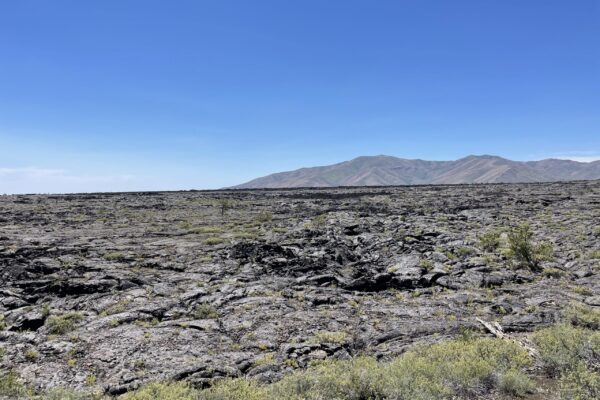
How is this place located on Earth? Craters of the Moon National Monument in southern Idaho is 750,000 acres of hardened lava flows, cinder cones, and lava tube caves — created by eight volcanic eruptions over the past 15,000 years. It looks like the surface of the moon. It feels like the surface of the moon. And in 1969, four Apollo 14 astronauts came here to train for exactly that reason. Interpretive Ranger Matt Pfeiffer joins The Parks Podcast to share the full story — including the caves that house more than half of Idaho’s known bat maternity colonies, and why geologists think we may be overdue for another eruption.
A note from Missy: How is this located on Earth? I camped an hour outside of the park surrounded by large pine trees and blue lakes — and then drove into this lava-covered experience. It was surreal. One of the most unique parks I’ve ever been to.
Episode Guest
Matt Peiffer, Interpretive Ranger
Craters of the Moon National Monument
Park Stats
- Location: Arco, Idaho
- Established: May 2, 1924 (President Calvin Coolidge); Wilderness designation added 1970 — first wilderness in the NPS
- Size: 750,000 acres
- Highest elevation: 7,729 feet (Pioneer Mountains foothills)
- Annual visitors: 237,774 (2022)
- Dark sky: International Dark Sky Park designation (2017)
- Volcanic history: 8 eruptions over 15,000 years; most recent lava flows approximately 2,000 years ago
- Next eruption: Geologists estimate within the next 900 years along the Great Rift
- Lava tube caves: 500+ documented; 2 open to public
- Bat research: More than half of Idaho’s known bat maternity colonies documented here
- Notable: Apollo 14 astronauts trained here in 1969; winter skiing and snow camping on the loop road
- Plants: 750 species; first super bloom certification in recent history
- Wildlife: Pack rats, skunks, fox, bobcats, mountain lions, bats, owls — many nocturnal
Show Notes & Links
- Plan Your Visit — Craters of the Moon National Monument
- Cave information and visiting tips
- Hiking trails — including North Crater Trail
- Camping — Lava Flow Campground (first come, first served)
- Backcountry camping and wilderness permits
- Winter activities — skiing and snow camping
- Dark sky information
- Apollo 14 astronaut training history
- Bat conservation research
Transcript
Craters of the Moon National Monument — Where Lava Meets the Sky
The Parks Podcast, Episode 7 | Matt Pfeiffer, Interpretive Ranger, Craters of the Moon National Monument
How It Became a Monument
Missy Rentz: Today we are joined by Matt Pfeiffer, who is an interpretive ranger at Craters of the Moon National Monument. Prior to Craters of the Moon, Matt also spent some time at Gateway Arch in St. Louis. Matt, welcome to The Parks Podcast.
Matt Pfeiffer: Well, Missy, thank you so much for having me. I’m excited to be here.
Missy: Let me start with some park stats. It’s located in Arco, Idaho. It was created on May 2nd, 1924 as a national monument, and in 1970 it was designated as a wilderness — the first wilderness designation in the national parks. When it was created, Calvin Coolidge was president. The park is 750,000 acres. Its highest elevation is 7,729 feet in the foothills of the Pioneer Mountains. In 2022, you welcomed 237,774 visitors. There are 16.2 miles of hiking trails. Nocturnal animals you may see on a visit include pack rats, skunks, fox, bobcats, mountain lions, bats, owls, and many more. Some animals found at Craters of the Moon are native and can only be found there — including the great basin pocket mouse, the yellow pine chipmunk, and lava beetles. There are 750 different types of plants. And in 2017, you were designated an international dark sky park. I am so excited to talk about this park — it is one of the most unique parks I’ve been to.
Matt: Yeah, I’m excited to talk about it with you. This is definitely a unique area. Very few places in the world look anything like us. That’s for sure.
Missy: So tell me the story behind it becoming a monument.
Matt: That story really begins in the early 1900s, when people first started taking serious scientific interest in the lava flows here. The guy who coined the term Craters of the Moon was a geologist with the USGS named Harold Stearns. He came out here in 1918, and on his trip he brought with him another very important person for the monument’s creation — Robert Limbert. Mr. Limbert was originally from Nebraska but moved to Boise in the early 1900s. He actually led one of the first expeditions across the entirety of the lava fields — him and one other partner, along with a dog, hiking about 52 miles from end to end. He made many subsequent journeys and was one of many people who started to petition to have this made into a national monument. In 1924, he wrote an article for National Geographic titled “Among the Craters of the Moon.” That same year, he was also petitioning President Calvin Coolidge to preserve this area, sending photographs from his expeditions and written accounts. It must have worked, because on May 2nd, 1924, Calvin Coolidge signed the executive order making this a national monument. We are now just about 100 years old.
The Volcanic Story
Missy: The area had eight volcanic eruptions over the past 15,000 years, correct?
Matt: That’s correct. The first eruption here occurred just about 15,000 years ago. The most recent eruption — the lava flows you’ll see as you come to the visitor center and our loop road area — those were flowing just a little over 2,000 years ago.
Missy: Is there any chance they could erupt again?
Matt: Oh yeah. Most geologists are pretty confident it will erupt at some point in the future. The reason we have these eruptions is something called the Great Rift — a big rift line that runs through the area, essentially a weak point in the North American plate where the plate is stretching open slowly. Most geologists predict that within the next 900 years, we’ll probably have another eruption somewhere along that rift line. Typically we’ve had a cycle of one eruption every two to three thousand years, so we are entering that timeframe. It could start any day now.
Missy: When I think about volcanoes, I think of the pictures from school — something that looks like a mountain. That’s not what this area looks like at all.
Matt: That’s probably one of the most common questions I get — people asking where the volcano is. Rather than one central volcano like your Mount St. Helens type, we just have that series of fissures in the ground and the lava comes up through those. It’s a very different type of volcanic landscape — most similar to what you’ll see in Hawaii and Iceland.
Missy: Is there any indication of what the land looked like before the eruptions?
Matt: We do have a pretty good idea. Part of that is due to what are known as kipukas throughout the monument — a Hawaiian term for an area inside a lava flow that got completely surrounded by lava and was left untouched by the flows. Those are really valuable for scientists because they give us a baseline of what this area would have looked like well before human expansion and before agriculture and ranching changed the land. From fossil records, we know that at one point this area had actual camels — those would have gone extinct about 11,000 years ago. And even cheetahs used to range throughout the area. That’s actually part of the reason the pronghorn here are known to be so fast — they evolved to outrun those guys.
Life in the Extremes
Missy: There are extreme conditions here — very, very hot and very, very cold. How do plants and animals survive such extremes?
Matt: Most of the plant and animal species here are adapted to exactly that. One of our most common flowers is dwarf buckwheat, and a very common question we get is whether they’ve been planted, because they space out so evenly. The reason for that is they have a very wide root system designed to maximize the water they can soak up. A lot of our animals also make use of the lava itself. All the rock has gas bubbles left over from when it was molten, making it a wonderful natural insulator. We actually have pika here — which are uncommon at this elevation, since they usually live way high up in the mountains. Pika are very sensitive to high temperatures; something as low as 72 degrees can kill a pika from heat exhaustion. But that lava here is such a great insulator, they’re able to survive where they normally wouldn’t.
NASA and the Apollo Connection
Missy: One of the things that intrigued me in my research is how NASA used Craters of the Moon in preparation for Apollo 14.
Matt: Yes. The Apollo 14 astronauts came out here in 1969 — Alan Shepard, Joe Engel, Eugene Cernan, and a fourth crew member. They came out for a crash course in geology because part of their mission was bringing back moon rocks to be studied by scientists on Earth. With strict weight limits on space travel, they could only bring back so many samples. What they were doing here was getting taught by park geologists how to identify rock samples that would be most valuable for study and worth bringing back from the moon.
Missy: Was there ever a debrief? Did they say it was similar to the surface of the moon?
Matt: We’ve since discovered it’s not all that geologically similar to the moon — the name was coined in the early 1900s before we knew as much. But they came back here in 1999, and Alan Shepard said it was a really unique and valuable experience for them. And NASA has actually continued coming out here — they’ve done a few more training missions since that one as well.
Conservation and Research
Missy: Are there any notable projects happening at the park that speak to how parks contribute beyond recreation?
Matt: One of the really big ones over the past few years has been working with a bat biologist from OSU. We’ve been trying to map where the different caves are that bats are using and what they’re using them for — things like maternity colonies, where bats go to give birth and raise their young. At one point, over half of the known maternity colonies for bats in the state were here in our caves. Bats are such an important species for pest control and pollination. And with white-nose syndrome — an invasive fungus that’s been killing bats all across North America — we’ve been working hard to understand them better and protect our caves, because thankfully it still has not reached any of our caves yet.
Planning Your Visit
Missy: Craters of the Moon is a big park, but it’s a pretty digestible one. However, you have extreme temperatures and it’s geographically not really close to a lot of other things — it’s probably a destination. What’s the best time of year to visit?
Matt: I would say probably the end of spring into the beginning of summer, or early fall. The temperatures are usually pretty comfortable — not too hot, not too cold. And especially if you get here at the end of spring to early summer, that’s usually right when our wildflowers hit peak bloom. We actually got certified as a super bloom this year. When they’re at their peak, you can look out over the lava fields and every square inch is just coated in little wildflowers.
Missy: When you get to the park — and it is a destination, you’re going to drive a ways before you hit it — there’s a visitor center and then camping. How many sites are there?
Matt: There are 42 campsites in our campground, and it’s all first come, first served. When you arrive at the park and pull off the highway, you’ll come to the visitor center first, and the campground is just a little further past us on the road. You can drive to the campground, find an unoccupied spot, and pay at the self-service machine just outside the campground entrance — available any time, day or night.
Missy: The campground can fill up, but there are great forests and campgrounds within 30 to 40 miles if you arrive and there’s nothing available.
Matt: That’s one of the nice things. There’s also a lot of dispersed camping right outside our entrance. And we do offer backcountry camping in our wilderness area — you backpack out, which just requires a free wilderness permit you can get at the visitor center. A very popular spot for that is Echo Crater on our main wilderness trail. It’s a big volcanic crater and you can actually camp right down inside the bottom of it. A beautiful spot.
The Trails and Caves
Missy: Let’s talk about the trails and what people can expect.
Matt: All of our hiking trails are right off our loop road — about a seven-mile one-way loop that’s very easy to navigate, with parking lots at each trailhead. Our shortest trail is about a quarter mile, up to our eight-mile wilderness trail. One of my personal favorites is the North Crater Trail — about 3.6 miles round trip with a good bit of ups and downs, our more challenging one, but with some amazing views. The majority of our trails are fairly flat and manageable for people of even lesser hiking experience.
Missy: People need to remember to pack supplies, particularly water, because there aren’t resources out on the trails away from the visitor center.
Matt: That is something we always stress, especially in the summer. We can get temperatures of over 100 degrees, and at 6,000 feet elevation you can dehydrate quicker than at lower elevations. We have water pumps in our campground available 24 hours a day, and water bottle fillers in the visitor center. As for the terrain — it’s a mixture of gravelly sandy dirt and at certain points you go directly over the lava flows, so it’s rolling, uneven, rocky. I’d always recommend sturdy hiking boots. Lots of water. And a salty trail snack to replace electrolytes. And definitely sun protection in the summer — it is very easy to get sunburned out here.
Missy: And then you have the caves, which are some of the most amazing things I’ve seen in a park.
Matt: The caves are definitely some of our most popular attractions. Currently we have two lava tube caves open to the public. We’ve documented just about 500 total throughout the lava fields and we keep finding new ones almost every year — there are probably anywhere from 2,000 to 3,000 total. Whoever on our resource management crew finds a new one usually gets to name it.
Missy: The one I remember going to had a boardwalk out to it and then stairs down into it. Can you describe the experience?
Matt: That would have been Indian Tunnel — the only one with a staircase. They’re all right off our caves trail, which is a paved walkway out over the lava flows. Indian Tunnel is our biggest and most famous cave — about 800 feet from end to end, with 40 to 50 foot high ceilings and massive wide open chambers. It has some roof collapses that provide natural skylights. You can see the way lava was flowing on the floor, and the remnants of molten lava dripping down off the walls. I’ve been in there more times than I can count and it’s still amazing every time.
Missy: Do you recommend bringing a headlamp or flashlight?
Matt: We definitely recommend some sort of light. Indian Tunnel has natural skylights so it’s a little easier without one, but for the other caves you’d definitely want a light because they get quite dark. And even for Indian Tunnel, having a light helps you spot all those little details. And if you have any trepidation about going inside, it’s still wonderful to walk out the boardwalk — Indian Tunnel is a massive hole that you can see down into even from the surface.
Winter at Craters
Missy: I was astonished by the research I did on winters here — snow camping and skiing on the loop road. Tell me about that.
Matt: For snow camping, our Lava Flow campground is technically open all year. When we get enough snow, we no longer charge for a site — you just walk in and find a campsite. And once we get enough snow, usually sometime around November or December, we actually groom the loop road and it becomes a skiing and snowshoeing trail.
Missy: Is everything else still open in the park during winter?
Matt: The caves we do close in the wintertime because they can fill with ice and snow and become treacherous. The trails you can still go out on snowshoeing or skiing — we don’t clear them, so you can’t just walk them. But the park is open pretty much year-round. We may temporarily close the visitor center for seasonal maintenance at times, but you can come out any time of year and enjoy the park.
Dogs and Backcountry
Missy: Are four-legged friends welcome at Craters of the Moon?
Matt: We don’t allow dogs on any of the hiking trails, unfortunately, but they are allowed pretty much everywhere else — around the campground, picnic areas, parking lots. On the trails we don’t allow them for two main reasons. One is wildlife — even the scent of domestic animals can cause wildlife to react unpredictably. And two, the lava terrain is incredibly rough on dogs’ paws. Robert Limbert, on his first expedition, brought a dog named Teddy. Three days into the trip, he had to take a knife and cut strips out of his leather jacket to make boots for the dog. And in summer, the surface of the lava flows has been measured at up to 157 degrees — definitely not ideal for dogs.
Missy: Any other key highlights for someone planning a trip?
Matt: I always love going out in the wilderness area. Aside from the loop road, there is a lot of backcountry preserve area with dirt roads for four-wheel drive vehicles. One of my favorites is a place called Laidlaw Park — a massive kipuka just east of the main entrance. You can get away from the crowds and see a completely different side of the monument. Just make sure you have a vehicle with good clearance and four-wheel drive, and definitely bring a spare tire. I actually shredded one on my truck out there last year. But if you’re the adventurous type, it’s really cool.
Speed Round
Earliest park memory?
Going to Fort McHenry in Baltimore as a kid — I grew up in Maryland, not far outside the Baltimore area. I think I first took that field trip in second grade. I also spent a lot of time at Catoctin Mountain Park out in Maryland. Beautiful park.
What made you love the parks?
I’ve always had an interest in the outdoors, but what really made me realize how much I love the National Park Service was after my first year here at Craters. When I went back home to Maryland for the winter and then drove back, I had no timeframe so I stopped at as many national parks and monuments as I could. That experience made me realize I can’t imagine myself doing anything else.
Favorite thing about Craters of the Moon?
On some of the cinders here — the small droplets of lava sprayed out when it first starts erupting — because of the way they cool, a glass forms on the outside. When you hit them in the right light, it gives this beautiful metallic rainbow color to the surface. It’s an incredible sight, especially if you go to Inferno Cone at just the right time of day. The entire pathway just shines with those cinders.
Favorite thing to do at Craters of the Moon?
Camping out in the wilderness area. Every time I’ve been backpacking out there, I’ve been the only person out there. Not a lot of people realize that’s an option here. Camping in the middle of an old volcanic crater, looking up at the stars, watching the bats and nighthawks fly overhead — it is something I have greatly enjoyed.
Park on your bucket list?
Zion National Park. I first heard about it when I was around 13 or 14 and ever since I’ve seen pictures of it, it’s been very high on my list.
Three must-haves for a park visit?
A good sun hat — I’ve got a pretty pale complexion so the sun does not go well with me. A solid metal water bottle — mine holds about 36 ounces. And a pair of binoculars, in case you spot an animal and want a good view while still keeping a safe distance.
Favorite campfire activity?
I bought myself a harmonica a few years back and I’ve been teaching myself to play. One of my favorite things on a solo camp is playing it around the campfire as I fall asleep for the night.
Tent, camper, or cabin?
Always a tent man. I’ve got a few different tents — one for backpacking, one for car camping — and they’ve been serving me well for years.
Hiking with or without trekking poles?
Usually without, but if I know it’s going to be a particularly rough hike with a lot of elevation gain, I’ll bring them along just in case.
Favorite trail snack?
Beef jerky. Easily packable, tasty, and it gives you lots of protein and energy to keep the hike going.
Best animal sighting?
Pika here at Craters — I’ve spotted them twice, which is rare. They’re around but tend to stay hidden. Some rangers who’ve worked here for 10-plus years have never seen one. Pika are members of the rabbit family, very cute little animals that kind of look like a big hamster. They’re known for making hay piles — storing grasses and plants for winter — so you can often spot them running around with a bundle of flowers in their mouth.
Favorite sound in the park?
Right around sunrise in the springtime when I’m camping out — all the birds start chirping, the wind’s going. It’s a very peaceful, very relaxing sound.
Greatest gift the parks give to us?
The opportunity to get out and connect with nature and be away from all the busyness of modern urbanized life. Getting away and experiencing these pristine wilderness areas where you can be the only person there for miles and miles — just enjoying all the beauty of nature and the outdoors.
Missy: Matt, thank you so much for sharing Craters of the Moon with us. I love your stories, and this is such a unique park. I’m so glad we can share it with everybody else.
Matt: Thank you so much for having me. I’m very glad to come on and share my stories with everybody.
Missy: Thanks for joining us for today’s episode. Until next time — we’ll see you in the parks.
Music for The Parks Podcast is performed and produced by Porter Hardy. Follow us @TheParksPodcast or visit TheParksPodcast.com.