
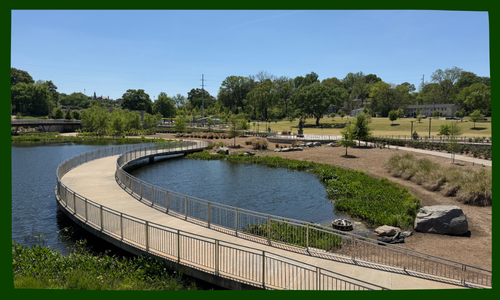
Cook Park in Atlanta’s Vine City neighborhood is one of the most remarkable urban parks in America. Built on land that once flooded families out of their homes with six feet of sewage, it now holds 10 million gallons of stormwater — and gave a historic civil rights community world-class green space, art, and a splash pad designed by the people who live there. Jay Wozniak, Director of Georgia and Alabama Parks at Trust for Public Land, joins us to tell the full story.
A note from Missy: I love how they listened to the community and put the ideas into the center of the efforts — true community partnership. I love how much they accomplished and how beautiful it is. Typically these Black, lower-income communities aren’t given the best. But this one is spectacular. I also love that they made this amazing park and also found a way to save the community from flooding.
Episode Guest
Jay Wozniak, Director, Georgia & Alabama Parks
Trust for Public Land
Park Stats
- Location: Vine City neighborhood, Atlanta, Georgia
- Created: June 29, 2021
- Size: 16 acres
- Stormwater capacity: 10 million gallons
- Residents within 10-minute walk: 3,671
- Flooding impact: Eliminates flooding across approximately 150 acres
- Notable features: Walking paths, basketball/futsal/foursquare courts, splash pad, playground, outdoor workout equipment, climbing boulders, picnic areas, green space
- Civil rights statues: Congressman John Lewis, Ambassador Andrew Young, Dr. Martin Luther King Jr.
- Nearby: Mercedes-Benz Stadium, MLK Jr. National Historic Site, MARTA rail access
What to know before you visit
Cook Park is a neighborhood park — there is no parking lot or garage. Street parking is available, and the nearest MARTA station is two blocks away. Bathrooms, water fountains, and running water are all on site. Jay’s top recommendation: bring a blanket. There’s plenty of shade, open green space, and enough going on around you to spend hours just taking it all in.
Transcript
Cook Park, Atlanta — Full Transcript
The Parks Podcast, Episode 70 | Jay Wozniak, Trust for Public Land
Missy Rentz: I’m so excited to welcome Jay Wozniak to The Parks Podcast. He is the Director of Georgia and Alabama Parks at Trust for Public Land. Jay, welcome.
Jay Wozniak: Hi, Missy. Thanks for having me.
About Cook Park
Missy: I’m really excited to talk about Cook Park. I start every episode by running through some stats to give everybody a background on the park we’re talking about and why we’re talking about it.
Cook Park is located in Atlanta, Georgia. It was created on June 29, 2021. It is 16 acres in the city — and it has a remarkable backstory. In 2002, a flood displaced 60 families from this area. The park was created through a partnership between the City of Atlanta and Trust for Public Land, and it now eliminates flooding across about 150 acres.
The park can hold 10 million gallons of water, gradually releasing it after treatment to eliminate contamination. When Hurricane Helene hit in 2024, the park flooded — but the community didn’t. That was the real test, and it passed.
The park features walking paths, workout equipment, basketball courts, playgrounds, and a ton of green space. Jay, this park is incredible — ecologically, visually, in every way.
Jay: Thanks, Missy. It’s a special place. Not just because of what was designed and built, but from a historic perspective — this is a neighborhood that some could argue is the center of the civil rights movement in Atlanta. It had a strong community of activists for decades, but unfortunately had very little investment over the years. That’s what caused the flooding.
How the Flooding Happened
Jay: This 16-acre site was actually 16 acres of single-family and multi-family homes built on top of a creek. Proctor Creek was channelized into a pipe and buried in the 1930s to make room for new homes. As more residents came and more development occurred, the infrastructure never kept up.
It wasn’t just stormwater flooding. It was also sewage overflows — because like many large cities, Atlanta had combined sewer systems. Stormwater and sewage went into the same pipes. When there was a backup, it wasn’t just water coming out of the storm grates.
The 2002 event was the last straw. The City of Atlanta realized these residents needed to be relocated. People had six feet of stormwater and sewage in their living rooms. Fortunately, no one was killed. But from that day to the ribbon cutting in June 2021, it was a remarkable transformation.
Why Local Parks Matter
Missy: This is the first time I’ve featured a city park. People tend to think about national parks or big state parks — and I think we neglect the benefits of local parks and the impact they have on the community. Why are they so important?
Jay: Local neighborhood parks are where people meet. Where they connect with others. And if they don’t want to connect, they’re going out for their own mental wellbeing — to breathe fresh air, listen to moving water, listen to birds. Exercise matters too, and the stats don’t lie about the health value parks provide.
But so many of the parks Trust for Public Land works on provide multiple benefits beyond recreation. There’s no better example than Cook Park.
Cook Park manages stormwater and reduces flooding. It’s bringing tree canopy back to a neighborhood that lost it. It’s making people who live within a 10-minute walk measurably healthier — and making the broader community more resilient.
Building a Park That Holds 10 Million Gallons
Missy: I want to set the scene from my visit. You’re driving through the city — totally normal. And then all of a sudden, it’s like the block drops. The park sits lower than the sidewalks around it.
Tell me about the process of creating this park and making it able to hold 10 million gallons.
Jay: There are a lot of layers to this park — both literally and figuratively. Vine City is in a low topographic part of Atlanta, which caused flooding over the years. After 2002, there were ideas about what could happen to this space, and how it could connect to other low-lying points in West Atlanta.
A planning strategy called the Proctor Creek North Avenue Study looked at the whole chain of low topographic points in West Atlanta through the lens of green infrastructure — how water could be captured and managed to reduce urban flooding. That study identified this 16-acre site as the most critical point in the entire system. Everything downstream depended on what happened here.
From 2002 to 2014, not much happened. It was a complicated site — buried utilities, contaminated soil, political layers.
Then the stars aligned. A new football stadium was being built nearby. Philanthropic energy was coming into the neighborhood. The City of Atlanta asked Trust for Public Land to orchestrate the community engagement, design, and construction of Cook Park.
We had been working in Atlanta for 20 to 25 years. We helped get the BeltLine off the ground. We acquired the properties around Dr. King’s birthplace to make it a park unit. We had earned trust in the city. So we were asked to get this done.
Over six years, we worked closely with the community to understand what they wanted — while also knowing that at the end of the day, this space had to capture and manage millions of gallons of stormwater. There are a lot of stories from that site. If you ever visit Atlanta, I’m always happy to give a tour.
Parks can be engineering marvels that restore the health of a neighborhood and a city. Cook Park has gotten attention nationally and internationally because it proves what’s possible.
Community at the Center
Missy: One thing I really love about this project is the community input. What was important to the Vine City community?
Jay: From the very beginning, it was about earning trust. No other neighborhood in Atlanta had been let down more by broken promises and lack of investment. There was a lot of uncertainty about whether this was actually going to happen.
Once Trust for Public Land earned that trust, we really got to hear what people wanted.
They wanted a splash pad — and it wasn’t just kids asking for it. Seniors wanted their grandchildren to have the same kind of park experience as kids across the city.
They wanted active recreation. The sports courts are lined for basketball, futsal, and foursquare. The walking trails are wide enough for four people to walk side by side — and wide enough to set up 10-by-10 festival tents for the events that happen there now.
Shade. Benches. Simple stuff. Well-designed parks get the simple stuff right.
There’s nothing more exciting than when the splash pad jets turn on Memorial Day weekend. It’s the official opening of summer in Vine City.
What Makes Cook Park Unique
Missy: When I visited, a few things stood out. The outdoor workout equipment — everything you’d see in a gym, covered with canopies because it’s Atlanta and it’s hot. The art. The series of bridges over the lake. A duck that was making my dog Tootsie absolutely crazy. You don’t expect those things in a major city park, and they just made me exhale.
Jay: A lot of people see Cook Park as an oasis. You can see the Atlanta skyline from inside the park and realize you’re only blocks away from downtown.
The workout equipment was designed with a local neighborhood fitness organization focused on affordable fitness for residents. They helped select and lay out every piece of equipment. And right next to it are the first two outdoor climbing boulders in the city of Atlanta — made possible through a partnership with The North Face.
That bouldering area is one of my favorite things in the whole park. The boulders were designed by kids and young teenagers through workshops Trust for Public Land facilitated. At the last workshop, the kids got to climb at a local gym — and then put their hands in clay to shape the actual boulders that are now in the park.
Those kids can come back five, ten, fifteen years later and say: I did that.
Civil Rights History Woven Into the Park
Missy: You and I both have a deep love for civil rights parks. The way Cook Park honors that history — through art, murals, statues — is really something.
Jay: How do you connect a community to its history? Is it a plaque? A statue? Art? Cook Park has a little of all of them.
There’s a mural themed around Magnolia Ballroom — a music venue that stood two blocks from the park. It was the musical venue for every Black musician who passed through Atlanta in the 1940s, 50s, and 60s. That building no longer exists. Most people don’t know it ever stood. But it lives on in Cook Park.
There’s another mural honoring the neighborhood leaders who kept Vine City and English Avenue going after the 1960s — the people who picked up the torch and got things done.
And currently, there are three statues in the park: Congressman John Lewis, Ambassador Andrew Young, and Dr. Martin Luther King Jr. More will likely be added over time. These came directly from the community.
A park that opens is just a foundation. What gets added, refined, and celebrated over the years is where the real story lives.
The Impact on the Community
Missy: Trust for Public Land’s three pillars are equity, climate, and public health. What impact have you seen in the community since Cook Park opened?
Jay: The most obvious impact is community building. When people are involved in creating a park, they take ownership of it. They become its stewards. They pick up the extra piece of litter. They show up for festivals.
Walking groups meet there almost every week. Atlanta’s Caribbean Festival has been held there for the second year in a row. The intent was to create a gathering place not just for Vine City, but for the entire city.
The health benefits take longer to measure. But we know that over time, Vine City and English Avenue are going to be much healthier — not just because people have a place to exercise, but because we’re managing stormwater that used to cause mold in people’s homes. We’re reducing flooding. We’re restoring tree canopy.
Parks improve physical wellbeing, mental wellbeing, and psychological wellbeing. And a lot of this work is happening in the neighborhoods where it’s needed most.
The 10-Minute Walk Mission
Missy: Trust for Public Land has a goal of having a park within a 10-minute walk of every home in the country. Within 10 minutes of Cook Park, there are 3,671 residents. How has that mission changed communities across the country?
Jay: It takes time to truly see the health benefits — the behavioral changes, the measurable improvements. But we know they come.
Whether a park is half an acre or 16 acres, there’s an opportunity to change things for the better. And when the right people are in place to not just design parks but carry the torch after they’re done, the impact compounds over time.
Visiting Cook Park
Missy: Let’s talk about planning a visit. Cook Park is close to other historic Atlanta sites — it’s an easy stop if you’re visiting MLK Jr.’s birthplace. What should visitors know?
Jay: You don’t need a car. There’s no parking lot — which is how the best city parks are designed. That space goes to green space and park elements instead. There’s on-street parking, and MARTA rail is two blocks away.
The park has bathrooms, running water, and water fountains. There’s something for every age — playgrounds, sports courts, open fields, workout equipment, and shaded seating areas.
My one recommendation: bring a blanket. There’s nothing better than setting up under a tree and having a picnic at Cook Park.
Resources for planning your visit:
- Atlanta Area Parks (great photography and detail)
- City of Atlanta Department of Parks & Recreation
- Alliance for Cook Park (the park’s conservancy group)
- Trust for Public Land
Speed Round
Missy: We end every episode with a speed round. Just answer with whatever comes to mind first.
Earliest park memory? Camping with my parents and sister at what felt like every state park in Ohio.
What made you love parks? Just loving being outside. It’s probably why I became a landscape architect.
Favorite thing about Cook Park? Knowing the full story behind every design decision. Going out there and explaining why things are the way they are never gets old.
Favorite thing to do at Cook Park? Observing how people use it. You keep learning — things you’d do differently, and things you got exactly right.
Park on your bucket list? Baxter State Park in Maine. I’ve hiked sections of the Appalachian Trail and hope to stand on Katahdin soon.
Three must-have items for a park visit? Water, sunscreen — and bandanas. I always have at least one, usually two. And I’m a sock snob. If I’m hiking, the socks have to be right.
Favorite campfire activity? Cooking in pie irons. Breakfast, lunch, dinner — all of it. Second favorite: sitting around the fire listening to five conversations happening at once and tuning into the best one.
Tent, camper, or cabin? Tent, always.
Trekking poles or no poles? Poles, for sure.
Favorite trail snack? Slim Jims and Rice Krispie treats.
Best animal sighting? Moose at Grand Teton National Park with my family. Seeing them in their natural environment — there’s nothing like it.
Favorite sound in a park? In a neighborhood park like Cook Park: kids laughing. In a national or state park: moving water.
Greatest gift parks give us? The opportunity to connect with others, whether you’re looking for it or not. Parks are community. That’s the whole mission.
Missy: Jay, thank you for bringing Cook Park to life for us — and for the work you and Trust for Public Land do every day. I’m coming back for that tour.
Jay: It was great chatting with you, Missy. Thank you.
Missy: Thanks for listening. Until next time — we’ll see you in the parks.
Music for The Parks Podcast is performed and produced by Porter Hardy. Follow us @TheParksPodcast or visit TheParksPodcast.com.