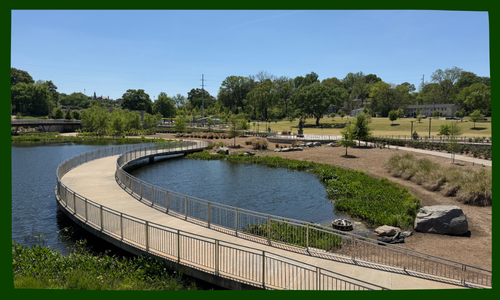
Cook Park in Atlanta’s Vine City neighborhood is one of the most remarkable urban parks in America. Built on land that once flooded families out of their homes with six feet of sewage, it now holds 10 million gallons of stormwater — and gave a historic civil rights community world-class green space, art, and a splash pad designed by the people who live there. Jay Wozniak, Director of Georgia and Alabama Parks at Trust for Public Land, joins us to tell the full story.
Episode Guest
Jay Wozniak, Director, Georgia & Alabama Parks
Trust for Public Land
Park Stats
- Where park is located – Atlanta, GA
- Date Created – June 29, 2021
- Size of the park – 16 acres
- Field Notes
- The area was on a flood plain. In 2002 a flood displaced 60 families.
- The park was created with a partnership between the City of Atlanta and Trust for Public Land to eliminate flooding of about 150 acres around the park
- The park can hold about 10 million gallons of water, and then gradually release it after it’s been treated to eliminate contamination.
- The park was put to the test in 2024 when Hurricane Helene flooded the park, but not the community
- Features of the park were a collaboration with the community. It is home to walking paths, workout equipment, basketball courts, playgrounds, and a lot of green space for playing and relaxing.
What to know before you visit
Cook Park is a neighborhood park — there is no parking lot or garage. Street parking is available, and the nearest MARTA station is two blocks away. Bathrooms, water fountains, and running water are all on site. Jay’s top recommendation: bring a blanket. There’s plenty of shade, open green space, and enough going on around you to spend hours just taking it all in.
Transcript
Journey to the heart of Atlanta where this park provides recreation, community building, and a solution to devastating flooding for this historic neighborhood Let’s explore Cook Park. I’m your host, Missy Rentz, and this is The Parks Podcast
Missy Rentz
I’m so excited to welcome Jay Wozniak to the Parks Podcast. He is the director of the Georgia, Alabama Parks at Trust for Public Land. Jay, welcome to The Parks Podcast
Jay Wozniak
Hi, Missy. Thanks for having me
Missy Rentz
I’m really excited to talk about Cook Park, which is our focus for today. It’s in Atlanta. And I start every episode where I just go through some stats just to give everybody a background of where’s this park we’re talking about, and why are we talking about it? So I’m gonna run through those, and then we’ll start talking about the park. So Cook Park is located in Atlanta, Georgia. It was created on June 29th, 2021. It is 16 acres of pure beauty in the city. And just some notes about it, it was a floodplain in the area, and in then 2002, a flood displaced 60 families from the area. And so then the park was created in a partnership with the City of Atlanta and Trust for Public Land, and you worked your magic, which you’re gonna tell us all about it, and it now eliminates flooding of about 150 acres around the park. The park can hold 10 million gallons of water, and then it gradually releases it after it’s been treated to eliminate any sort of contamination. The park was put to test. Y’all made the park, it opened in 2021, and then in 2024, Hurricane Helene flooded the park, but not the community. So we quickly got a test to how it works. And features of the park were a collaboration with the community so it’s home to walking paths and workout equipment, basketball courts, playgrounds, and a ton of green space for playing and relaxing. Jay, this park is incredible. I think It’s amazing ecologically and visually, and it’s just such a great park.
Jay Wozniak
Thanks, Missy. It’s a special place for sure. Not just what ended up being designed and constructed and now being used as a park, but just from a historic perspective, this is a neighborhood that some could argue as being the center of the civil rights movement in Atlanta. This is a neighborhood that even though it had a strong community of activists for decades, unfortunately over the years just had not a lot of investment put into it and that’s what caused the flooding that occur- occurred there over years. You mentioned the floodplain. This site the 16-acre site was actually 16 acres of single-family, multi-family homes that were built on top of a creek. And Proctor Creek was channelized in a pipe and buried, and land was made to, to build new homes in the 1930s. When more and more residents came to the neighborhood and more development occurred in the area unfortunately the infrastructure improvements didn’t keep up with it. And so it wasn’t just storm water issues and storm water flooding that occurred in this neighborhood for a long time, it was also sewage overflows and that had to do with the fact that, like many large cities still, to this day across the country, have combined sewer systems. And so what that means is that storm water and sewer are going into the same pipes, going to a water treatments facility, and if there’s a backup in the system, then it’s unfortunately it’s not just storm water that’s coming out of the storm grates it’s sewage too. And that event that took place in 2002 that you mentioned was the last straw. The City of Atlanta realized that these residents need- needed to be relocated to other places. This was not a place for anyone to live. And over my years working in the neighborhood and getting to know the residents I’ve heard quite a bit of stories about that day. Fortunately, no one was killed even though people had six feet of storm water and sewage in their living rooms in some cases. But yeah, it’s been a, it’s been a… It’s taken a remarkable transformation from that day up until when the, we cut the ribbon in June of 2021
Missy Rentz
So this is the first time I’m featuring a city park, and I think oftentimes when people talk about parks, they think about the big national parks or maybe they think of a prominent state park near them. And I think we tend to neglect the benefits or th- neglect thinking about the benefits of those local parks and what impact they have on the community. You do a lot of work. You and Trust for Public Land do a lot of work in local parks. Why are they so important?
Jay Wozniak
Parks are important for a number of reasons, especially local neighborhood parks. This is where people meet. This is where they connect with others. If they don’t wanna connect, certainly they’re going out for their own improvement for their own mental wellbeing, whether that’s just being outside, breathing fresh air, listening to moving water, listening to the birds. It’s also exer- exercising. The stats don’t lie in terms of the value that parks have, not just for those residents that use them from a health perspective, but so many of the parks that Trust for Public Land works on are also providing multiple benefits from an environmental perspective, and there’s no better example than what’s been done at Cook Park. Cook Park is managing storm water and reducing flooding. We’re bringing tree canopy back to the neighborhood, and we all know the value that, that trees bring to a neighborhood. We are focused on building parks that are making those residents who live in the area within a 10-minute walk healthier, but are also bringing those added benefits to the city and to the community by making neighborhoods more resilient
Missy Rentz
So okay, I just kinda wanna set the stage, and this is my experience there. You’re just, you’re driving through the city, and it’s a normal city that you would expect. And then all of a sudden, you- the sidewalks are normal, but it’s kinda like a block drops is kinda how I felt. Suddenly the park is kinda lower than the sidewalks. And tell me a little bit about the process of creating this park and what you all did to m- make it be able to hold 10 million gallons
Jay Wozniak
Sure. Yeah, there’s a lot of layers to the park both literally and figuratively in, in terms of how we ended up at the final design. This neighborhood is in a low topographic part of the city. And because of that, it caused flooding over the years, urban flooding. We’re far from an open body of water at, in the Vine City neighborhood. Since the event that occurred in 2002 there was ideas and thoughts about what could happen to this space and how does this connect into other low topographic points in West Atlanta. And there was a park system strategy that was developed called the Proctor Creek North Avenue study. And what it did was it looked at the chain of low topographic points in the West Atlanta neighborhoods, and it looked at it through the lens of green infrastructure. How can water be captured and managed to reduce urban flooding? And so, within this document it basically pointed out that this 16-acre site was the most important, and it was gonna affect everything else downstream, literally before it, before water makes its way to the Chattahoochee River. It’s hard to believe, but from 2002 to 2014 there wasn’t a lot of activity in terms of actually implementing this project ’cause it was a complicated site. There’s buried utilities, there’s contaminated soil there’s a lot of layers and from a local political perspective in, in, in terms of getting this thing moving forward. And fortunately, the stars aligned when Trust for Public Land was asked to be a part of this. And the stars were different philanthropic activities taking place in the neighborhood. There was a new football stadium that was being built in the area. More than just football. They host a whole variety of different events and activities. But it was an opportunity for everyone to look at, okay, how is the city going to responsibly and sustainably invest in the West Atlanta neighborhoods? And so Trust for Public Land was asked to basically orchestrate the community engagement design and construction of Cook Park. And the reason we were asked was based on our experience working in Atlanta. At that time, we had been working in Atlanta for about 20 to 25 years with different projects. Those in Atlanta are certainly familiar with the BeltLine or a visitor to Atlanta ha- are familiar with the BeltLine. We were the ones who got that effort off the ground. Trust for Public Land in Atlanta was the organization that acquired the properties around Dr. King’s birthplace home in East Atlanta in order to make that a park unit. And we’ve been involved with the acquisition of thousands of acres a- along the Georgia coast and that Chattahoochee River. So Trust for Public Land was asked by the City of Atlanta and a significant donor to get this project moving. And so I was brought on board and hired to really try and figure out how to get this done. And so for over six years, we worked very closely with the community to understand their expectations and their desires and what they wanted to see. But in addition to that we also knew that at the end of the day, we had to design a space that was going to collect and manage 9 million gallons of storm water. Like I said, there’s a lot of layers to this, and there’s a lot of coordination and conversations and that’s what Trust for Public Land does. And so over the years, over six years we got it done. And there’s a lot of stories out on site. If anyone ever comes to Atlanta, I’m always happy to give a tour. It probably takes a couple hours, but, there’s a lot of nuances to the project and at the end of the day, it’s something that we’re all very certainly proud of because it shows the power of parks. It shows that parks can be much more than just a collection of recreational elements and spaces. Parks can be a, an engineering marvel that can really restore the health of a neighborhood and the city. At Trust for Public Land, we’ve certainly gotten some significant attention with Cook Park and, whether it’s nationally or internationally we’ve shown that we can create park projects that really improve the entire community and the environment at the end of the day
Missy Rentz
And I do think a lot of times people think, local park is there ’cause I- we needed soccer fields,” which is important, or basketball courts or whatever it is. And the recreation is important, but when you dig a little deeper and you realize the environmental impact or the community impact that the park is there for, it’s it makes it even more fascinating. One of the things I really like that you said is the community input. What was important to this community for the park?
Jay Wozniak
From the very beginning, from the get-go it’s having trust with who’s a part of the project. And so for years, even over those six years, it was an ongoing process in terms of earning trust and relationship building. And, in there, no other neighborhood in Atlanta is probably that, as important as in, in Vine City. Unfortunately be- because of promises that weren’t delivered upon and the lack of investment, there was just a lot of uncertainty of, if whether or not this was going to happen. And so that was key to the community. And once Trust for Public Land earned that trust with individuals, we really got to hear truly what people wanted. We heard we wanted a splash pad, and it wasn’t just the kids that wanted a splash pad, a water element that’s shooting jets out of the ground. It was the seniors who were saying that ’cause they wanted to have their kids in the neighborhood experience the same type of space that other Atlantans are experiencing across the city. Obviously active recreation. We got sports courts out there. The sports courts are lined not just for basketball, but for futsal and foursquare, and there’s a track out there. So it’s just it’s one of those examples of where we have a space with multiple activities. Wide walking trails not just so you can walk like four people abreast through the park, but, these paths were designed to be set up for 10 foot by 10 foot festival tents when the festivals occur in Cook Park. And shade, benches it- it’s a lot of the stuff that in parks well-designed parks, and it’s simple. It’s simple stuff. There’s nothing more exciting than when the jets get turned on Memorial Day weekend at Cook Park because it’s the official opening to summer in Vine City.
Missy Rentz
Some of the things that struck me when I was visiting that I think are unique to the park not all parks, but maybe to your point, well-designed parks the workout equipment. There’s this whole area where, everything that you see in a gym you can see there, and you have… I mean, it’s it’s Atlanta, it’s hot, and you have these great canopies over them. I loved that. There was some art there, which I thought was just really beautiful and w- worth, taking a minute to reflect on. There’s this series of bridges that go over a lake. So in the middle of the city you have these great pond grasses, and you have, I think it was a duck that was making Tootsie crazy, but you have some wildlife and, just some of- those are some elements that I don’t think of in a major city’s park, and it was brought to life at Cook Park, and it just, God, it just you felt yourself exhale a little bit as you’re walking around it
Jay Wozniak
Yeah I think a lot of people see Cook Park as a bit of an oasis. It’s so close to downtown.
Missy Rentz
It’s a great
Jay Wozniak
and, you know, when you do visit it you see the skyline of Atlanta, and you realize you’re only blocks away. But it’s these spaces that were planned and designed for that allow for those unique activities. I’m glad you mentioned the workout equipment. We worked very closely with a neighborhood fitness organization that’s focused on providing affordable fitness opportunity to residents of the neighborhood. They helped us select that equipment. They helped us lay it out so that we understood, exactly how is someone gonna go through this series of equipment to get the best workout that they can get. What’s funny is when you go out there and you see the local firehouse running around once a week, and, after they do their laps, they end up jumping on the workout equipment to to get their exercise in. Right next to the workout equipment are the first two outdoor climbing boulders in the city of Atlanta that we’re very fortunate to, to have been partnered with The North Face on that because two things. It allowed residents in this part of Atlanta to be exposed to the sport of bouldering. Otherwise kids, adults wouldn’t, would not be aware of that. But the coolest part of that space was that it was designed by the community, and so it was it was designed by basically kids and young teenagers through some workshops that Trust for Public Land hosted and facilitated and introduced them to the value of parks and the sport of climbing. And then at the end of that at the very last workshop the kids got to climb at a local climbing gym, and then they put their hands in clay to, to shape those climbing boulders. There’s these moments in the park that, and the climbing boulders is certainly one of my top three, where, it is a great example of the community shaping what you see. and then, those folks involved with that can come back five, 10, 15 years later and say, “I did that.” And so that’s pretty special. I’m glad you mentioned the art. And I think that’s one of the most tangible connections in terms of how this site Connects to the rich history of the neighborhood. There’s a mural out there that’s, that is themed around Magnolia Ballroom, which is a music venue that stood in the neighborhood two blocks from this site, and it was the musical venue for every single Black musician who passed through Atlanta in the ’40s, ’50s and ’60s. That building does not exist. Most people don’t even know that building stood, but we’re able to remember it in, in Cook Park. There’s another mural that’s based on the local neighborhood leaders who really picked up the torch and ran with it in Vine City and nearby English Avenue after the ’60s. And so it’s an opportunity to share with visitors to the park, really who, who has continued to rally the neighborhood and get stuff done. And, it’s a… it harkens back to really the history of activism in the neighborhood
Missy Rentz
Yeah, and I think that’s another point I wanna talk about ’cause you and I both have a l- a love and do a lot of work on the civil rights parks. And this, you guys did such an incredible job through art, through statues of, honoring our civil rights leaders and honoring the role that this neighborhood in Atlanta played in civil rights movement
Jay Wozniak
Yeah, there are, It’s always interesting when you go to a park and, some people pick up on this and some people don’t, but it’s just like how do you connect with that history? Is it a plaque? Is it a statue? Is it art? And so there’s a little bit of all of those in Cook Park. I mentioned the murals. There are currently three statues in the park right now. One of Congressman John Lewis, one of Ambassador Andrew Young, and one of Dr. Martin Luther King, and there’s likely going to be more installed over the years. These are things that we heard from the community. And at the end of the day, I think it’s important to accept that when a park opens, it’s only the foundation for much more to occur. I’ve seen Cook Park evolve quite a bit over the past five years since it’s opened. It’s very exciting. We had an incredible design consultant team and, obviously engaged the community in terms of determining what should go into the park. But the fact of the matter is that park spaces evolve, and when you have passionate neighborhood leaders and residents who are able to recognize that and then find the funding and will to make those changes then things do change. So yeah, it’s been really great to see those to see that refinement of the park since it’s opened
Missy Rentz
I, yeah. I often think that people don’t understand that value, and one thing that’s the Trust for Public Land pillars are equity, climate, and public health. And I often think when going through parks like this, when I’m in that more contemplative mode, not just there for recreation, that this park, in particular, the health benefits, and yes, invest in it because we’re providing clean water, we’re providing safety, we’re providing all of these other things for our community. Why, when looking at those pillars, what impact have you seen in the community since Cook Park has started?
Jay Wozniak
I think the most obvious is actually the community building. And we see this with pretty much all the parks that Trust for Public Land works on across the country. And what’s key to our engagement and participatory design is getting people involved. And when they get involved, they build… Obviously they’re you’re building trust with them, but you’re also basically pulling out the sense or need of responsibility in, in, from the community in terms of actually taking care of the space once it’s opened. And so everyone knows, and I know that there’s people who listen to this podcast who struggle with this on a daily basis how do we maintain our parks? And it’s tough. Parks are great. But it does require the community to have that extra set of eyes on a site and, pick up that extra piece of litter that maybe didn’t make its way into the waste receptacle. We’re building ownership over these parks with the work that we do. It’s exciting to see the festivals and activities that take place out there. Some are programmed, some are not. There’s walking groups that take place on a regular basis out there almost weekly. There’s festivals that occur. I was out of town unfortunately, but I know Atlanta’s Caribbean Festival was there for the second time in a row, and after seeing the photographs, it was quite a party. And that was the intent of the space, was to not just pull people from the neighborhood, but from, pull people from the city and make this a true gathering place.
Missy Rentz
And it’s super inclusive. I, you know, I was walking, with my dog and a young gentleman stopped me to say, “Ah,” I’m, I have a big RV and everything. I’m clearly a visitor. He wanted to know, what brought me there, why I was there. But then he said, “Are you gonna be around this weekend? We have this great festival. You should come to this festival.” And I was like, God, you already feel like you’re part of the community there
Jay Wozniak
Yeah, it’s special. Whenever I’m out there I’m always running into people that I haven’t seen in a while. And I don’t live near the park, but, based on my time working on the project and getting to know the residents it is my second home in Atlanta. It’s always fun to to run across people you haven’t seen in a while. But, probably my most favorite thing to do at Cook Park is just observe how it’s getting used.
Missy Rentz
Okay, one thing I wanna get into with you is that Trust for Public Land has a goal of having a park within a 10-minute walk from every home in the country. Am I saying that right?
Jay Wozniak
Yes
Missy Rentz
I think that’s incredible, and within 10 minutes of Cook Park, there’s 3,671 residents. How does a park impact a neighborhood, and how has that program changed people all over the country?
Jay Wozniak
Yeah. It takes time to truly see the health benefits of residents in a neighborhood around a new park. Same thing with behavioral changes. We know that over time, Vine City, English Avenue are going to be much healthier than they were before, not just because we created a space for them to exercise, but, the fact that we are managing storm water, which is reducing flooding and reducing, mold and, un- in, in certain conditions in some of these homes. I- it’s it is great, is going to greatly impact and improve not just the physical wellbeing of folks who live nearby, but also the mental and psychological wellbeing, that’s Cook Park specific. But across the country there’s pockets of parks, and whether they’re a half an acre or 16 acres there’s opportunity to make changes for the better. And obviously those opportunities exist, and when you have the right in place to, to not just design them but then carry the torch after they’re done it’s who knows how these are all going to im- improve the neighborhoods where they live. Whether it’s managing storm water, adding tree canopy or what have you, it’s, we know that the work that Trust for Public Land does truly impacts the public health of where we were. It certainly makes the communities more resilient and a lot of this work is taking place in, in neighborhoods where it’s needed most.
Missy Rentz
Jay, I know Trust for Public Land and this park in particular really depended on the community. You’ve talked about community several times. What does it mean for a community to come together? Who is that?
Jay Wozniak
Missy I’m so glad you brought that up because with a park like Cook Park, obviously the residents play a big role in this project. But at Cook Park, this project would not have been possible without the other nonprofits that we worked with. Trees Atlanta, Path Foundation, a number of others. The city of Atlanta focused on delivering public projects as a village, as a group project mentality. And if we don’t have the donors who we’ve earned the trust of, Cook Park would not have been possible. So we’re fortunate to have the donors locally and nationally who believe in the work that we do. And then, as importantly, these projects across the country that we work on are not possible without the very innovative design consultants who make these projects a reality, landscape architects, engineers, ecologists whole collection of folks. And then, at the end of the day, it’s the contractors who implement this vision. I was fortunate over six years to get to know and work with these people on a daily basis. So to see it from an idea of the community, and then work it with the designers, and then actually work with the contractors there’s nothing more rewarding than that. And at the ribbon cutting, to see everyone together as the community celebrating is definitely the h- the highlight of this entire project
Missy Rentz
It’s gotta be really beautiful to see the collective ownership of this space, and I think it comes across when you visit the pride that everybody has in this community park. It’s really beautiful
Jay Wozniak
Certainly. Everyone who’s a part of the project and continues to use the park are extremely proud of Cook Park. They know how much it brings to their neighborhood, to their families. Without that passion, without this expertise, Cook Park would not have become a reality
Missy Rentz
Yeah. I love it. Let’s talk about planning a visit to Cook Park. It’s a pretty easy one to plan a visit to. It’s located really close to other very historic parts of Atlanta, so it’s an easy stop if you’re doing like visiting Martin Luther King’s Jr.’s birthplace. What do you need to think about when coming to Cook Park?
Jay Wozniak
There’s a variety of options to actually arrive at Cook Park. And so you don’t need a car.
Missy Rentz
Which is good ’cause parking can be challenging
Jay Wozniak
parking can be challenging and, this is a neighborhood park. There’s no parking lot. There’s no parking garage. There’s on-street parking. This is how the best city parks are designed. They fit right into the neighborhood, and we end up using that space that would’ve been used for pavement and parking structures for even more green space and trees and park elements. There’s a MARTA station two blocks away. MARTA is Atlanta’s transit system, so you can certainly walk from there. A lot of folks who visit Cook Park are actually visiting the Georgia World Congress Center, which is where a lot of our confer- pretty much all of our conferences and conventions are held. I- in some of those floors of the conference center, you can actually look over and see, oh my gosh, that’s a really great park two blocks from here. It’s gotten quite a bit of attention which is good. So I, I think in terms of things you need to bring c- to Cook Park, there’s a lot of stuff that’s already there. There’s bathrooms, there’s running water, there’s water fountains. There’s a whole variety of different activities that will keep people interested, and that’s people of all ages. Whether it’s the playground, splash sports courts or, open fields for the kids. If you’re older and you just wanna find a place to get away from it all there’s certainly a bunch of shaded areas for seniors to rest. I think the one thing I would recommend people bring to Cook Park is a blanket ’cause there’s nothing better than just setting up a blanket and having a picnic there
Missy Rentz
Absolutely, right? There was a big tree right o- there’s multiple, but there was a person sitting on a blanket under a tree, and it just looked so appealing. And, thought, oh the hours you could spend watching people and enjoying a little bit of nature. I, when I went to go Google and learn about all of the activities there I had to do a little bit of searching, and I found Atlanta Area Parks website to be really good. Is there any other place that you recommend people go to learn more about Cook Park?
Jay Wozniak
There is a… Atlanta Area Parks is a great website. Great photography too.
Missy Rentz
Oh my gosh. And it’s like I’ve never seen the detail that go into like explaining what’s in a park. It’s amazing
Jay Wozniak
Yep. I would start there. Also look at City of Atlanta’s Department of Parks and Rec website in order to learn more about Cook Park. There’s a great explanation on the conservancy group’s website. There is a group called the Alliance for Cook Park, and basically this is the park’s conservancy group and the folks who are responsible for managing the care and stewardship of the site in addition to the parks department. But yeah, check out Trust for Public Land’s website to learn more about Cook Park. There’s a lot of information about Cook Park out there. Trust for Public Land is always excited to uh, tell its story
Missy Rentz
Yeah. And I’ll put links to all of these websites in the episode notes. So Jay, when we wrap up every episode, we do a speed round of questions. Just answer with what first comes to mind. What is your earliest park memory?
Jay Wozniak
I would say my earliest park memory is actually camping with my parents and my sister and seeing I feel like all of the state parks across Ohio. We did a lot of camping growing up
Missy Rentz
What made you love the parks?
Jay Wozniak
Just love being outside. It’s why I chose the profession of being a landscape architect probably. And, whether it’s just being with other people or just tr- truly going on my own to explore there’s so much to see wherever you are outside
Missy Rentz
What is your favorite thing about Cook Park?
Jay Wozniak
Probably my favorite thing about Cook Park is knowing and living really the coordination and design of that project. It is so fun now to go out there and talk about why things are the way that they are. So I love all parts and pieces of Cook Park
Missy Rentz
What’s your favorite thing to do at Cook Park?
Jay Wozniak
I would say my favorite thing to do at Cook Park is just observing people. Like I said before it’s really neat to see how people use the park and y- and I certainly continue to learn ab- about things maybe we could have done differently or, and also see things we did right
Missy Rentz
What park have you yet to visit but it’s on your bucket list and why?
Jay Wozniak
So a park that’s on my bucket list is actually Baxter State Park in Maine. I’ve spent some time on the Appalachian Trail and get out once a year and try to click off 70, 80 miles, but I hope to be standing on Katahdin here soon
Missy Rentz
What are three must-haves you pack for a park visit?
Jay Wozniak
Like most folks, probably packing water and sunblock, but it’s usually what’s on me that’s important for me when I go in a park. It’s handkerchiefs. I usually always have a bandana on me even if I’m not outside. If I’m in a park or getting ready to go out, I usually have two, especially with two small boys. And I’m a bit of a sock snob, so if I am hiking I gotta make sure I’ve got the right socks on
Missy Rentz
What is your favorite campfire activity?
Jay Wozniak
Probably my two favorite campfire activities are cooking in pie irons, whether that’s breakfast, lunch, or dinner. But probably my second is just hanging out around a campfire and laughing with friends. There’s nothing better for me than hearing five different conversations going on and then zeroing in on or dialing in on the one that everyone’s most interested in
Missy Rentz
And are you in a tent, camper, or cabin?
Jay Wozniak
I’m definitely a tent guy
Missy Rentz
Do you hike with or without trekking poles?
Jay Wozniak
I hike with poles for sure
Missy Rentz
What is your favorite trail snack?
Jay Wozniak
So my two favorite trail snacks are Slim Jims and Rice Krispie treats, believe it or not
Missy Rentz
And what is your best animal sighting?
Jay Wozniak
Um I would say probably seeing moose in Grand Teton National Park a couple years ago with my family. It was just so cool to see moose in their natural environment
Missy Rentz
What’s your favorite sound in the park?
Jay Wozniak
I would say at Cook Park or other, say, small neighborhood parks, it’s kids laughing. There’s nothing better than that for me. If it’s in a much bigger, say a national park or state park it’s the sound of moving water that I really like
Missy Rentz
And what’s the greatest gift that parks give to us?
Jay Wozniak
I think the greatest gift and the most important gift is the opportunity to connect with others, whether or not you want that. It’s a place for community and, we have seen that quite a bit over the years and, very fortunate to be working with the Trust for Public Land who’s really focused on that mission
Missy Rentz
Jay, I am so grateful to you for talking to us about Cook Park, getting us a little bit more interested in exploring our local parks, and I’m excited to come back and maybe take you up on that offer of a tour, ’cause I could learn more about it
Jay Wozniak
It was great chatting with you, Missy and thanks for this opportunity
Missy Rentz
Thanks for listening to this episode. Until next time, we’ll see you in the parks. Thanks for listening. If you enjoyed today’s episode, please be sure to like and share on your favorite podcast platform. Music for the parks podcast is performed and produced by Porter Hardy. For more information, please follow us at The Parks Podcast, or visit our website at TheParksPodcast.com.