
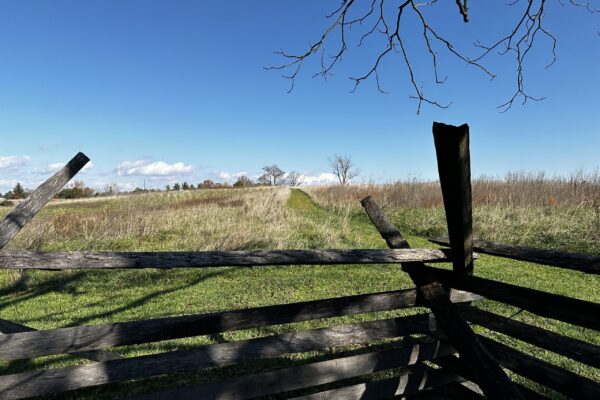
Cedar Creek and Belle Grove National Historical Park doesn’t look like a traditional national park — because it isn’t one. Created in 2002, it’s a partnership park where the federal government owns just 130 of the park’s 3,700 acres. The rest belongs to private landowners, nonprofits, and local organizations who’ve been protecting this land for decades. The result is a park woven into the community of Middletown, Virginia — with battlefields, historic homes, hiking trails, and stories from backcountry to breadbasket to battlefield and beyond. Ranger Adam Prado joins The Parks Podcast to explain how it works and how to explore it.
A note from Missy: Cedar Creek and Belle Grove is a relatively new park to the system. The trails are lovely, the history is rich, and it’s a glimpse into how parks start — and what they can become.
Episode Guest
Adam Prato, Park Ranger
Cedar Creek & Belle Grove National Historical Park
Park Stats
-
-
- Location: Middletown, Virginia
- Established: December 19, 2002 (President George W. Bush)
- Size: 3,700 acres total; federal land only 130 acres
- Driving tour: 17.5 miles, 9 stops
- Key battle: Battle of Cedar Creek, October 19, 1864
- Partnership organizations: Belle Grove Inc., Cedar Creek Battlefield Foundation, National Trust for Historic Preservation, Shenandoah County, Shenandoah Valley Battlefields Foundation
- Park model: Partnership park — largest landholder is private citizens
- Motto: From backcountry to breadbasket to battlefield and beyond
- Note: Park visitor center is located in a strip mall in downtown Middletown
-
Transcript
Cedar Creek and Belle Grove National Historical Park — Backcountry to Breadbasket to Battlefield
The Parks Podcast, Episode 9 | Adam Prado, Park Ranger, Cedar Creek and Belle Grove National Historical Park
Why This Park Exists
Missy Rentz: I’d like to welcome Adam Prado, who is the park ranger at Cedar Creek and Belle Grove National Historical Park. Adam, welcome to The Parks Podcast.
Adam Prado: Thank you, Missy.
Missy: Let me go through some park stats. Cedar Creek and Belle Grove National Historical Park is located in Middletown, Virginia. It was created on December 19, 2002, when George W. Bush was president of the United States. The park is 3,700 acres. There is a driving tour that is 17.5 miles long and includes nine stops. And the park is dedicated to preserving historic spaces, maintaining open spaces, and protecting natural resources in partnership with five other key organizations. Adam, let’s start with why it was so important in 2002 to create this as a park.
Adam: There had never been a national park battlefield in the Shenandoah Valley, even though the valley was an important theater of the Civil War. The Confederates used it to threaten Washington, D.C. and keep federal troops away from Richmond. In the late 90s, there was probably a lot of development that threatened the battlefield, which was under preservation to different degrees by private organizations. But in 2002, it became part of the national park system.
Missy: Does it happen very often where a park is created with this model of preserving open space in partnership with others?
Adam: Yes and no. The traditional model of a national park or battlefield is usually the federal government owns some amount of property and does everything inside that. A lot of newer historical parks created over the last 25 years or so use a slightly different model — some kind of federal-private partnership. At our park, the federal government only owns about 130 acres out of the 3,700. The rest is owned by those other organizations that are part of the law that established the park, and private landowners.
Missy: I want to mention those partner organizations because they’ve been around for a long time and have done a lot of work long before 2002 — Belle Grove Inc., Cedar Creek Battlefield Foundation, National Trust for Historical Preservation, Shenandoah County, and the Shenandoah Valley Battlefields Foundation. Full disclosure, I grew up not far from this park. These organizations, if you’re from that area, are well known. Belle Grove and the surrounding area has been very active in preserving this space.
Adam: Correct. All those organizations predate the National Park Service in the Shenandoah Valley.
Backcountry to Breadbasket to Battlefield
Missy: One of the things I love on the website is this phrase — “backcountry to breadbasket to battlefield and beyond.” Can you tell us what that means?
Adam: That’s kind of our way of summing up the full scope of human history and prehistory in the valley. People have been occupying this valley since 11,000 years ago. It also saw some of the early colonization of western Virginia, its development into an important agricultural region — which is one of the reasons the Shenandoah Valley campaigns during the Civil War were fought here, because it was such an important strategic area. And “beyond” is our way of keeping open the interpretation of history past the Civil War, through Reconstruction and up until the present day.
Missy: What would this area have been like prior to the battles?
Adam: In the early 1800s, it was agricultural farms. Belle Grove was a big plantation, but mostly it was smaller holdings — a little different from the Virginia you might picture with Monticello or George Washington’s Mount Vernon. Here it was more commercial grain farming. Wheat was a big crop — food grown for sale outside the valley. Along with that, there were a lot of mills and small-scale industry up and down the valley. The farms and mills depended to some extent on enslaved labor — some owned by the people who ran the farms, and in a lot of cases in the Shenandoah Valley, enslaved labor was rented out to people who needed it seasonally. It was a slightly different model of plantation agriculture than you might have found in other parts of the South.
Missy: I stood there looking out at these rolling hills and thought to myself — how in the world did they build these homes and plow these fields? It would have been treacherous to be in that part of Virginia.
Adam: It was a little remote, even in an eastern state like Virginia. The Valley Turnpike — that’s Route 11 today — goes back to the 1830s when it was first commissioned to improve access between the farms in the valley and the markets on the coast. But there have been trails up and down this valley since prehistory. Native Americans used it to travel the Appalachian Valley and later settlers followed those routes into the valley.
The Battle of Cedar Creek
Missy: In 1864, there were some pretty major battles from the Civil War here. Can you tell us a little about the Battle of Cedar Creek?
Adam: There had been battles throughout the war, especially in 1862. But in 1864, as the end of the war was getting closer, the U.S. Army finally showed up in force and aggressively tried to push the Confederates out of the valley. The Confederates had used the valley well — it was a little inaccessible, a good place to hide, an important food source for the Confederate army, and occasionally they would come down the valley and threaten Washington, D.C. Eventually Lincoln and his generals had enough. Philip Sheridan was the commanding general. He came in with a large army — about 40,000 troops — with a well-equipped cavalry and good supplies, and they started beating the Confederates back up the valley. They won some important battles at Third Winchester and Fisher’s Hill, and after that came the Battle of Cedar Creek, which was really the Confederates’ last attempt to engage the Federals in the valley, and really the last time they were an effective fighting force there.
Missy: I was reading about the Heater House — a home in the area that’s being restored for preservation. One of the stories talked about how they would welcome soldiers for meals, and it alluded to the fact that on October 16th, 1864, they would have been home just living life while this battle was taking place. Were these battles literally taking place in people’s front yards?
Adam: Yes — and they were probably being generous when they said they welcomed soldiers. Sometimes soldiers were hungry and took what they needed. There are plenty of eyewitness accounts of the battle, and we know that a lot of people who lived in Middletown and the valley left during the war. There are references to one man staying in the home of somebody in Middletown who had left — he said his neighbor had “refugeed up in the mountains somewhere.” We’re not entirely clear about all the families who stayed, but we do know some firsthand accounts of people who literally saw the shooting happening around them.
Missy: Is there still a lot of research happening to find these stories?
Adam: Yes. The Civil War is pretty well documented, but especially on the lands held by the federal government, we still do occasional archaeological work and have learned some new things — usually more detail about things we already knew about, like confirming the location of a certain camp. And over at Belle Grove, they’ve done a lot of archaeological work on the enslaved quarters and learned a great deal about what everyday material life would have been like for the people enslaved there, but also uncovered a lot of questions that still need to be answered. So yes, there’s still lots of ongoing research here.
Faces of the Valley
Missy: The visitor center has an exhibit called Faces of the Valley, and there’s so much emphasis on the people of this story. Is there anyone in particular whose story you love to share?
Adam: It was important for us to show that the battles and history weren’t just numbers and statistics — there are people involved. The Faces of the Valley exhibit shows a pretty diverse group of people who lived in the valley: Confederate and U.S. officers and soldiers, but also civilians, some white, some Black, men and women, families, individuals. One story I love — she’s not in the exhibit — is from a woman named Serena Spencer. She has a descendant living in this area of Virginia today who likes to share her story. Serena was interviewed back in 1915 about her experience witnessing the battle as a little girl, about 10 years old. She said she didn’t really understand what was going on or comprehend the danger. So as the cannons — bombs, as she called them — were flying around Middletown, she ran out into the street watching the battle, thinking it was all pretty grand. As an older woman, she looked back on it and thought that was kind of silly. Her parents and the neighbors had to chase her around and get her back inside.
Planning Your Visit
Missy: This park kind of goes against the grain of what you think of when you think of a park. A lot of people think of a big grand entrance — like the Roosevelt Arch at Yellowstone. At Cedar Creek and Belle Grove, you’re really incorporated into the community. The main park headquarters is an old house. How do people navigate coming to a park that is spread out throughout a community?
Adam: This park does feel a little different when you come here — it’s kind of insinuated into the community in Middletown and spread out around it. Our visitor center is in a strip mall in downtown Middletown, which a lot of people don’t expect. But as with a lot of parks, that’s a great place to start. We have exhibits there, you can pick up a self-guide for the tour or download the National Park Service app, pick up the Junior Ranger booklet. We have a three-dimensional animated battlefield map lit up with fiber optic lights that narrates the events of the battle and shows the terrain. After that, it’s not always clear when you’re in the park versus outside the park. I would say start at the visitor center, then visit our partner properties. The Cedar Creek Battlefield Foundation has a museum right on Route 11 overlooking some of the preserved parts of the battlefield. And then there’s Belle Grove Plantation, which was at the heart of the battlefield — their main focus is interpreting the plantation property. It’s a pretty old manor house dating back to 1797, built by a grandson of one of the original white settlers of the valley. You can take a tour of the manor house there. You can also take the driving auto tour of the battlefield, which takes you past a lot of those places and down into some lesser-seen parts of the park. At a lot of those auto tour stops, there are trails you can pick up and walk, and you can spend a good half day or a full day just exploring the battlefield.
Missy: I could have spent three quarters of a day and definitely soaked up more time. Let’s talk about the hiking. These aren’t long trails — they’re completely manageable. The 19th Corps Trenches trail was through the woods and the Morning Attacks Trail was through a field. Can you describe what someone will see at the 19th Corps Trenches?
Adam: The trenches that are left over from the Civil War are 150 or more years old and pretty seriously weathered. In the case of that trail, also overgrown by woodland. They are hard to see — you do have to know a little bit about what you’re looking for. Starting in the fall when the vegetation comes down, they are very shallow depressions in a snaky line along the trails, with a little bit of a ridge or mound on one side. They may have been three or four feet deep at one time. Now you kind of have to see where the leaves collect. The trail is about a mile and a half if you take every leg of it, and it actually connects all the way through the woodland to Belle Grove.
Missy: And then the Morning Attacks Trail — park near the park headquarters along Route 11, and you go down into a ravine.
Adam: Yes. If you park in the lot near the park headquarters — which is just a mid-century house we took over that was built on the battlefield — you go down into a little ravine and then follow the route of some of the federal soldiers who were responding to the Confederate surprise attack in the pre-dawn hours of October 19th. The fields you’re looking at are some of the fields where the 8th Corps was camped and under attack. There was a lot of confusion. They were caught by surprise. But some troops came from across the pike, including the 8th Vermont, which engaged in some pretty intense hand-to-hand fighting. Along that trail you’ll see a monument to the Vermonters who fought to hold off the Confederate attackers just long enough so that the rest of the troops could retreat back across the turnpike. Those Vermont soldiers took some pretty heavy casualties doing that. If you pay attention to the changes in the terrain, you can kind of see where it would have been hard to see somebody sneaking up on you — the rising sun in the east would have made it hard for the U.S. soldiers to see the Confederates attacking until they were right on top of them.
Missy: What are some other highlights from the nine driving tour stops?
Adam: If you like battlefield monuments, we don’t have a lot, but we have a few neat ones. The Vermont Monument is just a slab of marble with an inscription. The 128th New York Monument is at the end of that trench line, right at the beginning of the 19th Corps Trail. Other stops include the cemetery in Middletown, where the Federals regrouped and tried to halt the Confederate advance. And two places to visit along the tour represent where the Confederates stopped advancing and where the Federals reformed their line in the afternoon counterattack that drove the Confederates back out of Middletown. A couple of stops are right along the roadway with just wide places to pull over — do be careful, Route 11 is a major through road and people drive pretty quickly outside of Middletown.
Missy: What about ranger programs?
Adam: Summer leading up to the anniversary of the battle — October 19th — rangers lead tours of the battlefield. We don’t always stop at all nine stops, but we usually cover much of it. With a ranger, you can spend about two hours visiting five or six of the nine stops. We also give talks at Belle Grove pretty regularly, usually introductions to the park, but sometimes more specific aspects of history.
Missy: This isn’t a park with campgrounds.
Adam: Correct. The park doesn’t have any camping, and there’s no private campground in Middletown at the moment. We’re right along I-81, so there’s plenty of places to stay along the interstate exits, plenty of places to eat within about 15 minutes. And the area has wonderful smaller towns — Middletown, Stephens City, Winchester — all with really great and unique stops. And this park sits in a region with a lot of beautiful parks — Harpers Ferry National Historical Park, C&O Canal, Shenandoah National Park, Manassas. Washington, D.C. is about 80 miles away. You can get a lot of Civil War history in a very short visit.
Speed Round
Earliest park memory?
The sunken forest at Fire Island.
What made you love the parks?
Being a ranger made me love them.
Favorite thing about Cedar Creek and Belle Grove National Historical Park?
Probably the fall scenery.
Favorite thing to do at Cedar Creek and Belle Grove?
I walk up to the 8th Vermont Monument. It’s a nice short walk, a little bit of a hill, nice and fairly quiet for being in between two major highways.
Park on your bucket list?
Yellowstone — and I probably don’t need to tell you why.
Three must-haves for a park visit?
Water, good walking shoes, and a hat. I think that covers just about every park.
Favorite campfire activity?
Just being quiet.
Tent, camper, or cabin?
Cabin.
Hiking with or without trekking poles?
Depends. I prefer without. Sometimes I need them.
Favorite trail snack?
Anything that doesn’t have a lot of crumbs, like a soft granola bar.
Best animal sighting?
I always get a kick out of seals and marine animals — dolphins, porpoises, whales.
Favorite sound in the park?
Natural silence.
Greatest gift the parks give to us?
We get out of them what we put into them. Just an opportunity to see something that hasn’t changed in a long time, or has been maintained for its beauty and its specialness — for everyone to enjoy.
Missy: Adam, thank you so much for being part of The Parks Podcast. It is Thanksgiving week, so happy Thanksgiving to you and your family. We really appreciate you being here.
Adam: Thank you, Missy. It’s been a pleasure.
Missy: Thanks for listening to today’s episode. Until next time — we’ll see you in the parks.
Music for The Parks Podcast is performed and produced by Porter Hardy. Follow us @TheParksPodcast or visit TheParksPodcast.com.