
Biscayne National Park is 95% water — and most people drive past it on their way to the Keys without stopping. That’s a mistake. Beneath the surface of Biscayne Bay lies one of the most extraordinary ecosystems in America: coral reefs, mangrove forests, seagrass beds, 600 species of fish, manatees, crocodiles, and the story of Israel Lafayette Jones — a Black man who in the early 1900s became the largest private landowner of what is now Biscayne National Park, guided four presidents on fishing trips, and sold key limes to fuel the cocktail boom of the Roaring Twenties. Gary Bremen, retired National Park Ranger and naturalist at the Biscayne National Park Institute, joins The Parks Podcast to share everything.
A note from Missy: This is one amazing park. I didn’t come prepared — just thought I’d take a quick boat trip. It was fantastic, and the guide was so knowledgeable. But next time I want to do the kayak and paddleboard trips. I want to get in the water and see the majority of the park.
Episode Guest
Gary Bremen – Naturalist
Biscayne National Park Institute
Retired National Park Ranger
Park Stats
- Location: Homestead, Florida (south of Miami)
- Established: National Monument October 18, 1968 (President Lyndon Johnson); redesignated National Park 1980
- Size: 172,971 acres
- Water coverage: 95%
- Highest elevation: 9 feet (Totten Key)
- Lowest elevation: 60 feet below sea level
- Annual visitors: 571,242 (2022)
- Wildlife: 600+ species of fish, crocodiles, manatees, sea turtles, sawfish, and the critically endangered Schaus swallowtail butterfly
- Plant life: Mangrove forests, seagrass beds, coral reefs
- Jones family: Israel Lafayette Jones became the largest private landowner in what is now Biscayne NP; his son Lancelot guided four U.S. presidents on fishing trips
- Key lime connection: The Jones family sold $40,000/year in key limes at the peak of the Roaring Twenties
- Teapot Dome connection: Warren Harding, Albert Fall, and Edward Doheny were at the Coco Lobo Club on one of the park’s islands in the months before the scandal broke
- Campgrounds: Elliott Key and Boca Chita Key — both island campgrounds, no shuttle service, boat access only
- Biscayne National Park Institute: Partner organization operating boat tours, kayak trips, and snorkel programs
Show Notes & Links
- Plan Your Visit — Biscayne National Park
- Biscayne National Park Institute — boat tours, kayaking, snorkeling
- Dante Fascell Visitor Center
- Camping — Elliott Key and Boca Chita Key
- Jones family history
- Snorkeling and diving information
- Mangrove information
- Coral reef information and spawning
- Fort Mose Historic State Park — Florida’s free Black settlement
- Everglades National Park — 18 miles away
Transcript
Biscayne National Park — 95% Water, 100% Wonder
The Parks Podcast, Episode 22 | Gary Bremen, Naturalist, Biscayne National Park Institute & Retired National Park Ranger
Why Biscayne Exists
Missy Rentz: I’m thrilled to welcome Gary Bremen to the podcast. Gary is a naturalist at the Biscayne National Park Institute and a retired National Park Ranger. Gary, welcome to The Parks Podcast.
Gary Bremen: Thanks, Missy. I’m excited to be here.
Missy: We start each episode with park stats. Biscayne National Park is located in Homestead, Florida — just south of Miami. It became a national monument on October 18th, 1968, when Lyndon Johnson was president, and the designation changed in the 1980s to a national park. The size of the park is 172,971 acres. Its highest elevation is a whopping nine feet at Totten Key, and its lowest elevation is 60 feet below sea level. Last year, there were 571,242 visitors. The park is 95% water. The area was a top key lime producer back in the day. It is home to over 600 species of fish and tropical birds. And they have some endangered species, including crocodiles, sawfish, sea turtles, manatees, and the critically endangered Schaus swallowtail butterfly. Conservation is really important in this park, not just for the animals, but for the plants — including the mangroves, which I cannot wait to get into with you. I love this park. This is one of those parks, Gary, that surprised me — it’s really at the top of my list.
Gary: That’s awesome. And that’s how I determine my favorite parks too. People ask me all the time, what’s your favorite national park? And it’s Biscayne, hands down — because I know it better than any other. But also the parks that surprise me are the ones I love the most. If I have low expectations and they’re blown away — or if I have really high expectations and they’re exceeded — that’s when it becomes something special.
Missy: I went to it more as “let’s get the stamp and check the box” and my mind was blown. It’s probably the one I’ve told the most people about this summer. So let’s start telling everybody else about it. It’s so unique. I mentioned that much of it is water — so it’s a different kind of park to visit. Can you talk a little bit about why this park is so important to the National Park Service?
Gary: Yeah. The idea of a park mostly covered by water was really different when the park was established in the 1960s. The reason it was established was because there were two threats to the area. One was the city of Islandia, which would have connected the last remaining Florida Keys with roads and bridges to Miami Beach and to Key Largo — creating a whole new city with condos, marinas, amusement parks, and golf courses. And the other was a major petrochemical plant on the shoreline of Biscayne Bay that would have required digging a 40-foot-deep channel through a six-to-eight-foot-deep bay for eight miles, and cutting through the coral reef to allow tankers through. So it was very much a grassroots effort of people trying to stop those two things to protect the places they loved — scientists, anglers, authors, writers, people who found inspiration in this place. And ultimately it was like, wow, this is what national parks are really all about. They called it a national monument at first because they were really only trying to protect the islands. And that’s the difference between a national monument and a national park — a national monument protects a singular nationally significant resource, whereas national parks protect multiple nationally significant resources in close proximity to one another. The idea of a marine park was argued against. People said, who’s going to get to see it unless you’re rich enough to have a boat? And there’s validity in that. Biscayne National Park is not an inexpensive park to visit. You need to get out on a boat to see it in its glory.
10,000 Years of Human History
Missy: The story starts long before 1968. From my research, humans started occupying the area more than 10,000 years ago. Can you share the evolution of this land?
Gary: Sure. And it’s really relevant to conversations today — Biscayne National Park, and all of Florida, is a product of climate change. The park 10,000 years ago didn’t look anything like it looks today. It was a big, broad prairie, basically, because the people in Wisconsin and Michigan sucked up all the water on the planet into their glaciers and drained Biscayne. So the coral reef that had been growing offshore was exposed as hills. The climate changed. We had mammoths, mastodons, horses, camels, dire wolves — all kinds of crazy animals wandering around, just like in the Ice Age movie. And people were hunting those animals. So we probably have submerged archaeological sites out in the middle of the bay — campsites that are now underwater — because when the glaciers melted, the water level rose back up and didn’t quite cover those coral reef tops, which were left exposed as islands. And that is what a Florida key is — a true Florida key is an island that at one time was living coral reef. As you walk along the trails at Biscayne, if you look carefully down at your feet, you’ll see the brain patterns and the star patterns in the rocks from the coral reef that was there.
Gary: In more recent times, into the 1500s, 1600s, and 1700s, the Tequesta people were the native people of Southeast Florida. They lived largely from the sea — they didn’t have to chase after herds of animals. They didn’t farm on a big basis. They lived from the sea, so it was a relatively cushy life. We have evidence of these folks on all of the islands. We have piles and piles of takeout containers in the park — the conchs and the whelks and the oysters and the clams. Mountains of them in various places.
Missy: I love that phrase — takeout containers. I’m never going to see those again without thinking of you.
Gary: Then when Europeans arrived, they unintentionally introduced disease and largely wiped out the Tequesta people. Some survived and merged in with a later group of people coming down the Florida peninsula — the Creek people, partly to avoid warring tribes in Georgia and Alabama. When Andrew Jackson said everyone had to move to Oklahoma, several groups refused and continued to push down into the wilds of Florida, settling in places like the Everglades and the Big Cypress — also national parks now. They merged with whoever was left of the Tequesta people. So Biscayne sits on the ancestral lands of the Tequesta, but the Seminole and Miccosukee people also claim those lands as their ancestors as well.
Gary: Then it goes full bore with Spanish exploration and English exploration. Florida was part of Spain for a long time — so we have lots of Spanish names written on the land. Biscayne comes from the body of water between Spain and France that the Spanish called the Bay of Biscay. We have Spanish shipwrecks in the park. Then we were part of England for about 20 years. And the English hated the Spanish, so they changed all the names. There’s actually a little spot in the park still called Sandwich Cove — named for you know who. Then back to Spain, then to the U.S.
Gary: We also have evidence of the Underground Railroad coming through — and a lot of people think the Underground Railroad only went south to north, everyone heading to Canada or Michigan. But if you lived in southern Georgia, it was a very long way to Canada. It was much easier to come south. When Florida was still part of Spain, Florida was safe. When it became part of the United States, suddenly slavery was legal — so the next nearest place to go was England, which meant the Bahamas, only 40, 50, 60 miles away. There was an exodus of the Underground Railroad leaving Florida and going to the Bahamas, sometimes called the Saltwater Underground Railroad. In fact, there’s a community in the Bahamas called Red Bays on the island of Andros where almost everyone traces their personal histories to formerly enslaved people in the United States.
The Jones Family — The Story at the Heart of Biscayne
Missy: We fast forward quite a ways to the mid to late 1800s and the Jones family, who play a very pivotal role in the story.
Gary: Yes. Israel Lafayette Jones is born in North Carolina in 1857. Put that place and that time. And if you saw a picture of him as a Black man, you can make the assumption that he was born into slavery. We don’t know that for a fact. But when slavery ended, he ended up with his family in Wilmington, North Carolina, working as a stevedore. He starts making his way down to Florida, initially working in the citrus industry around Orlando. In 1894 and 1895, there was a huge freeze in Florida that decimated the citrus industry. But there were stories that the freeze hadn’t hit a brand new area down in South Florida called Coconut Grove. So he made his way there.
Gary: There was a very small community in Coconut Grove. Charles and Isabella Peacock had a little hotel — the Peacock Inn — where eccentrics hung out, writers and artists and poets. All of the staff at the Peacock Inn were Black Bahamians. This is where Israel gets a part-time job as a handyman. His primary job was taking care of the grounds around the Cape Florida Lighthouse over on Key Biscayne. And this is where he meets Moselle Aubrey, one of the maids at the hotel. Both pretty much said it was love at first sight. They married and had two sons. Israel was a big fan of the Knights of the Round Table stories and wanted his sons to have regal sounding names to get more respect in life. So he named his first son Arthur and his second son Lancelot.
Gary: While he was taking care of the grounds around Cape Florida Lighthouse, he had two months off every summer — it was miserable in the Keys with the heat and bugs. So he started visiting people he knew lower in the Keys. A lot of them were farming pineapples and he realized the difference: they were farming their own stuff, he was working for somebody else. He had about $250 saved up and bought a little piece of land on one of the islands in the southern end of the park. His brother Samuel helped him build a little two-story shotgun house. Israel, Moselle, Arthur, and Lancelot moved there and started growing pineapples. Every time they had a little extra money, they bought a little more land. Soon they owned all of Porgy Key. Eventually they owned all of Totten Key. Then most of Old Rhodes Key. They ultimately became the largest landowners in what is today Biscayne National Park — all at a time when everybody else who looked like them was riding in the back of the bus and drinking from separate water fountains in Miami. So it’s a pretty extraordinary story.
Gary: They were always up against some kind of odds. A hurricane would come along and salt the soil, and pineapples don’t like salt. Fortunately, they were not a one-crop family. They had adopted a citrus fruit originally from Asia, being grown in Mexico, about the size of a ping pong ball, bright yellow — and it grew very well on the keys. So well that most people today don’t realize where it came from. Everyone calls it the key lime today. We’re right at the turn of the 20th century — 1900, 1910, 1920 — and by 1915 they are selling $40,000 a year. They are sending barrels and barrels of key limes to Chicago, Boston, New York, Philadelphia, Detroit. It was the Roaring Twenties. Cocktails were super popular. One of the most popular cocktails was essentially straight gin with lime juice. And that’s where all those key limes were going.
Gary: Then prohibition comes along and pulls the rug out from under them again. They’ve got all these key lime trees and nobody wants key limes. So they ended up selling seafood to a little fishing club on an island just across the way — the Coco Lobo Club, owned by Carl Fisher, the man who developed Miami Beach. It was a hangout for the rich and famous. These were the Firestones, Charles Kettering of AC Delco, Florsheim, Kroger — and Presidents Harding, Coolidge, Hoover, and Nixon all hung out there. So the Jones family would come down to the dock. And these rich visitors would say, how did you even know how to find that? Can you show me? And they became fishing guides to some of the wealthiest people in America. Imagine how often you’re going to find a United States president sitting in a little boat with a Black man — just the two of them going out fishing.
Missy: We all know that’s a great place to talk and learn.
Gary: Absolutely. Lancelot — everyone called him Lance — said that President Hoover was by far the best fisherman of them. And he said Harding was a terrible fisherman, but he had a really interesting story about him. Of the four presidents who spent time at Biscayne, only one cracks the top half in presidential rankings. Nixon, Harding, and Hoover are considered pretty lousy presidents. Harding’s administration was riddled with controversy and scandal — the Teapot Dome scandal, where a secretary of the interior received an oil lease without competition or bidding, with bribery involved. The secretary of the interior in the Harding administration was Albert Fall. So Albert Fall, Warren Harding, and Edward Doheny — the man who received all the benefits from the Teapot Dome scandal — were all hanging out at the Coco Lobo Club just months before the scandal broke.
Missy: In the room where it happened.
Gary: Lancelot said exactly that. He said, “That’s where it happened — right there on that island.”
From Family Land to National Park
Missy: How does it go from the Jones family to becoming a park?
Gary: The Jones family owned probably close to 9,000 acres of land in what is now the park. When people started talking about turning these islands into a city — the city of Islandia — people started selling their land. Lance was the last surviving member of the family, living out there by himself in an outbuilding from the original house. He had the opportunity to sell just like everyone else, and honestly I think he was holding out for more money — that was just him, always the entrepreneur. And then when things started to look like it was going to become a national park, he realized he should sell. He sold his land — originally purchased for $250 to $300 and added on to bit by bit — for $1.2 million, with the caveat that he could live there for the remainder of his life.
Gary: He didn’t ultimately live out his life there because on August 23rd, 1992, the rangers living in one of the buildings on Adams Key went over one last time to convince him to come with them. He had been through a lot of hurricanes, but nothing like what was predicted. And so he agreed and left with them. The next day, Hurricane Andrew took everything he knew. But think about what he saw over the course of his life — he literally moved there when he wasn’t much more than a babe in arms. If he had the presence of mind to look to the north on a clear night, he might have seen a tiny little glow on the horizon where a brand new city was just a couple of years old. When he left that island in 1992, he could look at that same spot and see the 12th largest city in the nation. Enormous amounts of change. He was quoted by the Miami Herald — and I won’t get the quote exactly right — but he said he was ultimately really glad it was going to become a national monument. And he said he especially liked the term monument, because it means that things are finally going to stay the same.
Mangroves — The Walking Trees
Missy: Let’s talk about the conservation in this park. I mentioned mangroves. I was down there in Biscayne not long ago this spring and they’re so beautiful. Can you describe what a mangrove is?
Gary: Biscayne National Park has a narrow strip of forest along the shoreline that consists of trees with their roots growing in saltwater. If you tried to do that in Philadelphia or Richmond and watered your plants with saltwater, they’d die. A mangrove, by definition, is a tree that is able to survive in saltwater. We have three — some people say four — different species of mangroves in Biscayne National Park. They’re unrelated to one another, but they are all mangroves because of that ability to grow in saltwater.
Gary: The most easily recognizable one is the red mangrove tree. It has reddish-orange roots — long, curving roots that reach down like legs out into the water. They get roots that grow off of their branches too. As that root grows down and gets longer, the branch gets heavier and the root gets pushed down into the sediment. It eventually catches. Then another one comes out. So these trees are literally walking out into the water over years and years. And of course, like Chumbawamba, they get knocked down but they get up again — pushed back by storms and hurricanes. But slowly they increase, and those roots start to catch leaves and debris and create a little bit of land. When you’ve got a little bit of dry land, a different species of mangrove can attach on. This idea of biological succession is something that comes along in all national parks — and that’s our version of it at Biscayne. These mangrove forests.
Gary: That network of roots is cool for so many reasons. It holds on to the shoreline, stabilizing it so when we get strong winds, storm surges, or hurricanes, the shoreline isn’t eroded away as much. The network of roots provides habitat for little animals to hide from predators, or places for predators to hide so they can sneak out on their prey. The leaves on the trees don’t fall off every year — these are not deciduous trees. One scientist, Candy Fellner from the Smithsonian, has figured out that sometimes mangroves keep their leaves on for decades. A single leaf will stay on that tree. And so if the leaves aren’t falling off and releasing their carbon dioxide out into the atmosphere the way northern trees do every fall, mangroves are holding in a lot of the CO2 that’s responsible for climate change. Mangroves are the best forest type in the world for mitigating climate change. And when leaves do fall off, they go into the water, where it’s sequestered in the ocean — the so-called blue carbon that you’ve probably heard of.
Conservation — Down to the Coral
Missy: The work being done for the manatees, the sea turtles, and other endangered species is really crucial in this space.
Gary: And a lot of times when people think about wildlife in national parks, it’s all about the so-called charismatic megafauna — the giant animals everyone wants to see, the bears and wolves. Biscayne’s got our charismatic megafauna with the manatees and the crocodiles. But a lot of the really important stuff is much, much smaller. Right now we are coming into coral spawning season. When you cannot move around and you’re in a spot where you can’t meet up with others, you have to maximize your opportunities to create future generations — so everybody within a species does it on one night.
Missy: What? Really?
Gary: Coral spawning happens — usually in late August, tied to the full moon, a certain number of days after. We have endangered species of coral that are so rare that if they release their sperm and eggs into the water, it’s not going to do anything because they’re not near anybody else. So we have our park staff going out there and putting big nets over coral heads to capture the spawn that comes out. Then they rush it back to land and somebody makes an after-midnight run to another location to trade spawn so we can cross-fertilize. And we have our own little temporary lab set up at Biscayne. We mix it all up in buckets, play a little Luther Vandross, and hope for the best.
Missy: Setting the mood for the coral. It’s just amazing what’s done. And I think when you’re in nature, you begin to have a better appreciation and respect for what’s living there. One of the things I love most is how small I feel. The work that the parks do — figuring out that spending an evening setting the mood for coral is the right thing to do — it’s really a gift to the rest of us.
Gary: And credit where credit is due — it’s not just the National Park staff doing this. We work extensively with researchers and universities. We have cooperative park study units all over the country at universities that work to make science happen and to protect species.
Planning Your Visit
Missy: Let’s talk about planning a trip to Biscayne National Park. This is a unique visit because you’re not driving under an arch and hiking around. How do you recommend someone get started?
Gary: I would definitely think hard about when you come and what you’re looking to experience. A lot of people assume that the best time to visit South Florida is the winter. If you want to go camping on an island or hiking, absolutely — that’s a good time. But if you want to go snorkeling, the likelihood of getting to go snorkeling on a coral reef in January isn’t real high because wintertime is our season for lots of wind. That murks up the water and it’s just not safe some days to go out. So set your expectations for what you want to do.
Gary: One of the biggest mistakes people make is not planning ahead for Biscayne. It’s 95% covered by water. We have about a half a mile of road. If you want to truly see Biscayne National Park, you need to get out on a boat. The Biscayne National Park Institute — the organization I now work for — is a true partner of the National Park Service. Everything beyond the costs of actually operating the boats goes right back to Biscayne National Park. We have about 10 different boat trips from three different locations. You can do a simple kayak or canoe paddle along the mangrove shoreline. You can do a full day of sailing on Biscayne Bay. You can combine paddling in Jones Lagoon with snorkeling. And if you really have your heart set on snorkeling in the wintertime, you can still do it — but it’s likely not going to be at the reef. It could be. We get calm days at any time of year.
Gary: But snorkeling is not just about coral reefs. Snorkeling in mangroves is one of the coolest experiences. I’ll tell a story on myself — I’d worked at Biscayne National Park for 29 years total. When I would go snorkeling in the bay, I would hang out over bare areas with sponges and seagrasses. Kind of cool. I went out one time with a Girl Scout who was getting her gold award. My good friend Ranger Maria was with us. After about 20 minutes of snorkeling in seagrasses, the Girl Scout sticks her head up and says, “Are you ever going to get to the good stuff?” I said, what do you mean by the good stuff? And she starts swimming hard straight toward the island. I’m thinking, the water up there is 10 inches deep if that. And she goes full bore right into the mangrove roots. So I do it too. And I’m just sitting there staring. And after a minute or two, all the animals that you terrified when you swam in come back out to see what you are. A half-inch-long barracuda comes out from behind a root and stares you in the face — and you know this fish is going to grow someday to four or five feet long. Feather duster worms emerge from their tubes and start waving around like something out of Avatar. Big parrot fish will come out. You’ll see lobster with their antennae coming out from rocky outcrops. Then you swim 20 feet away and do it again. And it’s all different.
Missy: And you bring up a good point — when you’re planning a trip like this, go to the National Park website, go to the Biscayne National Park Institute website. But ask the ranger when you get there. The ranger is going to know based on conditions what’s coolest to see and do. Most of the time whatever my plan is at a park gets thrown out the window because the ranger tells me what’s good today. And I was there in March and a lot of things were booked. So it really does take some planning — you’re not guaranteed to get on one of the Institute tours if you just show up.
Gary: The busiest week of the year is Christmas to New Year’s. If you want to go at that time of year, August is not too early to start booking. Spring break is also very busy. But January is a lighter month — January especially.
Missy: Lodging is very different here. You mentioned camping, but it’s not like driving into a campsite.
Gary: Our two campgrounds at Biscayne are both on islands. We do not provide a shuttle service for that — if you want to go camping out there, you would have to have your own boat or have somebody drop you off. Once you get there, you are on your own. This is not a campground with a camp store. If you go to Elliott Key, there are cold water showers, toilets, and drinking water — as long as the system hasn’t gone down, which it does occasionally. So bring drinking water with you. And be prepared for mosquitoes, even in the wintertime.
Missy: Biscayne is very close to Miami, so you’ve got a million lodging options nearby. You can get creative. I stayed at campgrounds at Everglades for the week. But it’s still very manageable being so close to a city.
Jones Lagoon — Don’t Miss This
Missy: What are we not sharing about the park that we should share for people thinking about coming?
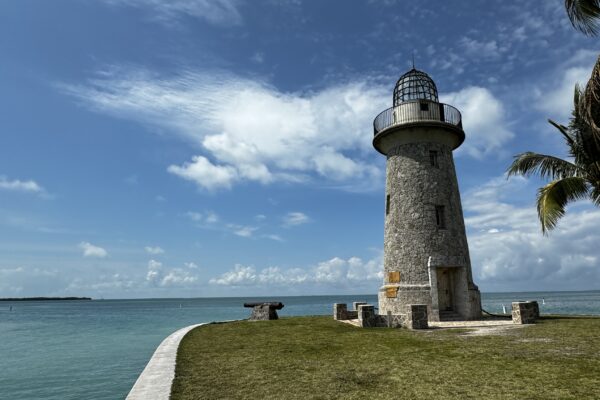
Gary: Preparation. And in an Instagram world where if you do a hashtag search on Biscayne National Park, probably half the pictures are going to be of the same building — the Boca Chita Lighthouse. It’s very iconic. Certainly you’re at Biscayne. But that is not what Biscayne is about. It’s part of the park for sure. It’s not the reason the park is there. There’s a lot more out there.
Gary: My favorite part of Biscayne National Park is Jones Lagoon — the body of water surrounded by the islands the Jones family owned. It is inaccessible to powerboats. They’re not allowed in there, and they couldn’t get in anyway — the water is extremely shallow. The best way to do it is on a stand-up paddleboard. If that sounds scary — it’s not. Stand-up paddleboards are way easier than most people think. If you absolutely have to go in a kayak, you can do that too. But stand up, because that perspective of five or six feet above while looking down into water that might be six or eight inches deep — that’s when you’re going to see the upside-down jellies on the bottom, the sea cucumbers, the sea stars. It’s almost unheard of to go into Jones Lagoon and not see at least a shark. Usually small sharks — not always. But you don’t go to Africa to not see a lion. Why would you not go to Biscayne because you don’t want to see the top predator? It’s not interested in you. You are way too big and too much work. Suck it all in and enjoy the amazing experience of Jones Lagoon.
Speed Round
Earliest park memory?
When I was seven, my mom and dad bought a 15-foot travel trailer and a sky blue Ford Ranger pickup truck. I was the oops baby in the family — my brothers were old enough to take over the family business, so I got to go with my parents when they decided to take a six-week trip out west. We went to Grand Canyon, Yellowstone, Carlsbad, and so many places. That was when I decided to be a National Park Ranger. Subsequent trips went as long as 10 weeks. Those trips were extremely formative for me, and I think of my mom and dad every time I visit any national park.
What made you love the parks?
They’re beautiful places for sure. But honestly, I just had a crush on park rangers. They were so smart and they seemed to know everything and they were fun. And it’s like, I wanted to do that. And that’s why I decided to do it at seven.
Favorite thing about Biscayne National Park?
The little things. The moodiness of the place — the way it looks in different conditions. I’m not adverse to being there on a really crappy weather day because that offers its own gifts too. It’s the little stuff. It’s discovering tiny things on a shoreline and the cloud formations. It’s not any one thing. It’s the little stuff that I really love.
Favorite thing to do at Biscayne National Park?
Paddleboarding in Jones Lagoon.
Park on your bucket list?
I’ve been to 283 national parks, so there are still about 150 or so on my list. Of the big ones, Crater Lake has eluded me. Of the smaller parks, Pipestone National Monument in Minnesota — it’s a little bit out of the way from everything else and I’ve just missed it on trips, but I want to go there.
Three must-haves for a park visit?
My iPhone so I can take lots of pictures and remember it. My husband, because there ain’t nothing like traveling with someone you love. And a raincoat — always be prepared with a raincoat.
Favorite campfire activity?
Telling stories.
Tent, camper, or cabin?
I do not sleep well in tents, so it would have to be one of the latter two — and probably more of a cabin guy, yeah.
Hiking with or without trekking poles?
I have rarely used poles. I think when I went to the bottom of the Grand Canyon I used them, but never otherwise.
Favorite trail snack?
Oh, some kind of nutty, raisiny, chocolatey, mixed up thing.
Best animal sighting?
My second favorite national park is Katmai National Park. I went there in July of 2018 specifically to watch the bears — now so famous with Fat Bear Week and all that. So in the big scheme of things, probably the bears. At Biscayne, it’s the little tiny animals — something like finding a violet sea snail on the shoreline, or seeing coral spawn in the middle of the day, which was a shocking experience I had one time.
Favorite sound in the park?
Quiet.
Greatest gift the parks give to us?
It’s the opportunity to connect with something much bigger than we are — whether that is a giant sky filled with stars, or an enormous tree, or a coral reef, or the incredible history of a place being saved for future generations, or to be there with the person you love. Ken Burns once said: sometimes it’s less about the place than who’s holding your hand when you’re there.
Missy: Gary, it has been such a pleasure. I could listen to your stories all day, and I’m very grateful and honored that you are speaking with us and giving everybody an insight into Biscayne National Park.
Gary: I’m glad to be here. And if you do come to Biscayne, ask for me. I’m usually there one day a week now.
Missy: I will. I will reach out and let you know when I have plans. Until next time — thanks for listening, and we’ll see you in the parks.
Music for The Parks Podcast is performed and produced by Porter Hardy. Follow us @TheParksPodcast or visit TheParksPodcast.com.