
Big Bend National Park sits at the edge of the United States — sharing 118 miles with Mexico, containing the darkest skies in the lower 48 states, and protecting more bird species than any other national park in the country. The deed establishing the park crossed President Roosevelt’s desk on June 6th, 1944. D-Day. Even on that day, someone thought it was worth setting this place aside. Tom Vandenberg, Chief of Interpretation and Visitor Services at Big Bend, joins The Parks Podcast to tell the full story — and everything you need to know to plan your visit.
A note from Missy: I was on my way to Big Bend when violent storms forced me to turn back. I recorded this episode having never set foot in the park — and left more determined than ever to get there.
Episode Guest
Tom Vandenberg, Chief Of Interpretation and Visitor Services
Big Bend National Park & Rio Grande Wild and Scenic River
Park Stats
Location: Big Bend, Texas in Brewster County
National Park Number: 27th
Park established: June 12, 1944
President in office: Franklin D. Roosevelt
Park size: 801,183 acres
Highest elevation: Emory Peak at 7,832 feet
Lowest elevation: Rio Grande River at 1,715 feet
Visitors: 516,000 in 2022
Fun fact:
-
- 118 miles that form the border between the United States and Mexico
- 200 miles of hiking trails
- 1200 species of plants
- 450+ species of birds
- 56 species of reptiles
- 75 species of mammals
Show Notes
SHOW NOTES & LINKS
- Plan Your Visit — Big Bend National Park
- NPS App — Big Bend
- Camping reservations — Recreation.gov
- Chisos Mountains Lodge
- River outfitters — west entrance area
- Big Bend Dark Sky information
- Fossil exhibit — Big Bend
- Boquillas Port of Entry — crossing into Mexico
- Lodging and camping options — Terlingua, TX
Transcript
-
Big Bend National Park — The Park at the Edge of Everything
The Parks Podcast, Episode 2 | Tom Vandenberg, Chief of Interpretation and Visitor Services
Missy Rentz: Today’s guest is Tom Vandenberg, Chief of Interpretation and Visitor Services at Big Bend National Park and Rio Grande Wild and Scenic River. Tom, welcome to The Parks Podcast.
Tom Vandenberg: Thanks for having me. It’s good to be here.
A Park Established on D-Day
Missy: Big Bend is the 27th national park, created June 12, 1944 under Franklin Roosevelt. It shares 118 miles of border with Mexico and protects over 1,200 plant species, 450 birds, 56 reptiles, and 75 mammals across 801,163 acres. It’s a remarkable place.
Tom: And here’s something most people don’t know — we’re the only national park established during World War II. The deed crossed the president’s desk on June 6, 1944. D-Day. In the middle of one of the most turbulent moments in American history, President Roosevelt took a few minutes and signed this into existence. People knew even then that a place like Big Bend needed to be set aside for the future.
Big Bend is sometimes called Texas’s gift to the nation. The land was obtained by the state of Texas specifically to donate to the federal government as a national park. It’s the 14th largest national park — about 1,200 square miles. And visitation is rising every year. More and more people are finding this park as they respond to the need for isolation, solitude, and something truly remote. We were a major pandemic destination. People love Big Bend more than ever.
In terms of biodiversity, Big Bend has more species of birds, bats, butterflies, reptiles, cactus, and even ants than any other national park. We also have nearly 150 miles of dirt roads in addition to the 200 miles of hiking trails — roads that take you way out into the back of beyond if you have the right vehicle.
How Big Bend Became a National Park
Missy: Most parks have one defining reason for their creation. Big Bend seems to have many. What was the tipping point?
Tom: This whole place was largely unknown. It was sparsely settled and very hard to reach until the late 1800s when a few families began ranching out here. One of the early champions was Everett Townsend — a Texas Ranger, mounted customs officer, Brewster County sheriff, and eventually a state representative. He loved this place and devoted the latter years of his life to getting the word out. Even people in Texas didn’t know this part of Texas existed. Who knew there were mountains in Texas?
Thanks to his efforts, word slowly started spreading in the early 1930s. Texas established a state park here, but really wanted a national park. The National Park Service sent a team down in the early 1930s and they were blown away. Congress approved legislation to establish Big Bend National Park in 1935 — but with no money and no land. The state of Texas spent seven years raising the roughly one and a half million dollars needed to acquire the land. The park was finally established in 1944.
The first year: 1,400 visitors. Today: over half a million annually.
The People Who Came Before
Missy: There’s so much history here — archaeological sites going back nearly 10,000 years, settlements all along the river. Can you talk about the communities that were here before the park?
Tom: There were many more people living along this river in the early 1900s than there are today. Mercury mining operations in the back country. Small family farms all along the Rio Grande. Candelilla harvesting — a desert plant processed for its high-quality wax — supporting little communities near springs throughout the remote areas.
When the Park Service arrived and Texas began purchasing land, many people sold willingly — the Depression had hit hard. Others had been here for generations and had deep ties to the land. Some were proud to be part of something that would showcase this place to the world. Others were heartbroken to leave.
Remains of that history are scattered throughout the park — old ranches, graveyards, the remains of a restaurant along the river, a Model T truck sitting in the middle of the desert. Anywhere you go, that history is there. This place has been home to people for thousands of years, and you can find evidence of it almost anywhere.
One important note: all artifacts in national parks are protected. Enjoy them, photograph them, feel the thrill of discovery — then leave them exactly where you found them, so the next person has that same experience.
Key Areas of the Park
Missy: Walk me through the main areas visitors should know about.
Tom:
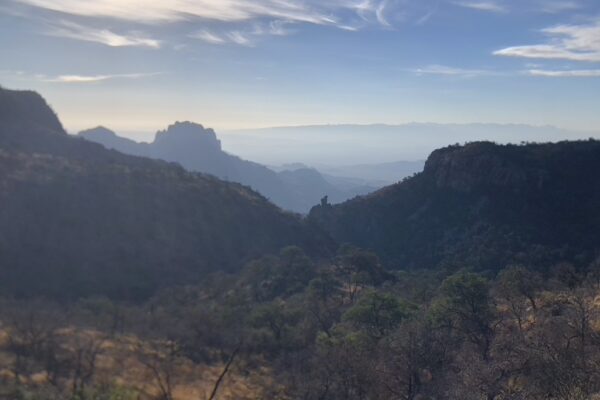
Chisos Basin is the mountainous heart of the park. The road in takes you past 6,000 feet before you drop down into the basin at about 5,500 feet elevation. It’s the full-service hub — visitor center, lodge with motel rooms and stone cottages, restaurant, campgrounds, and tremendous hiking trails in every direction. It’s also significantly cooler than the rest of the park. When we’re speaking today in June and it’s 110 degrees along the Rio Grande, the Chisos Basin is in the low 90s. That matters.
Panther Junction is the main park headquarters and full-service visitor center, open year-round. About 200 people live here — park employees, Border Patrol families, concession staff, and their kids. There’s even a school for children growing up in Big Bend. It’s one of the most remote postings in the entire National Park Service outside of Alaska.
Rio Grande Village sits along the river on the east side of the park. It’s our largest campground, with an RV park with full hookups, a boat ramp for river trips, and a visitor center open in winter months. The Hot Springs historic area is nearby. And there’s a port of entry here — visitors can cross into Boquillas, Mexico, spend the day, have a taco, and experience a completely different culture. That’s pretty unique among national parks.
Castolon Historic District is on the west side — one of the early centers of agricultural activity. The Alvino House, over 100 years old, is the oldest standing adobe structure in the park. Old visitor center, a store, a ranger station, a wonderful campground. And nearby: the remains of old Mexican settlers’ villages, graveyards, and the Rio Grande flowing right past. In the distance, Santa Elena Canyon — a 1,500-foot vertical chasm carved by the river through solid limestone. You can walk to the entrance, explore the riverbanks, or spend two days floating through it.
Planning Your Visit
Missy: Big Bend has two entrances and is not on the way to anything. How do people plan a trip here?
Tom: Just come. But plan first. This is a destination, not a drive-through, and it’s surprising how many people show up without preparing. This is a desert. If you come in June or July, it is going to be very hot, and not all facilities will be open. Use the official National Park website — nps.gov/bibe — and the NPS app. There’s a lot of misinformation online. Trust the official sources.
Peak season is October through April. Big Bend is a winter park. Spring and fall are the sweet spots. Summer is genuinely challenging because of the heat.
Be flexible. The park is enormous. If one trail’s parking lot is full, there’s another trail half a mile down the road that’s just as spectacular. Don’t wait in line for one spot when this much park surrounds you.
Cell service is very limited. You’ll be largely disconnected. That’s part of what makes Big Bend what it is.
Lodging inside the park: Chisos Mountains Lodge is the only in-park lodging — stone cottages and motel rooms with a restaurant.
Outside the park: Terlingua, Texas, just west of the entrance, has grown significantly. Motels, Airbnbs, teepees, glamping, luxury rentals — search “camping and lodging Terlingua Texas” and you’ll find options across every budget.
Camping reservations are through Recreation.gov. Campsites open up six months in advance, with a two-week rolling window for last-minute availability. Reserve early — especially for peak season. The days of showing up and finding a campsite are long gone. Everything fills up, often by 9am the morning reservations open.
Three campgrounds open in winter: Chisos Basin, Rio Grande Village, and Cottonwood Campground.
Backcountry and primitive camping: 42 designated primitive campsites in the high country, accessible by foot. Plus primitive sites along the dirt roads — if you have a four-wheel drive vehicle, you can get hours from pavement and be completely alone in the desert.
River Trips
Tom: River trips are one of the great experiences here, especially October through April when the water is cooler and levels are higher. Big Bend has over 100 miles of riverfront property and three major canyons:
- Santa Elena Canyon — about 20 miles long, 1,500 feet deep
- Mariscal Canyon — about 10 miles long
- Boquillas Canyon — about 30 miles long
Floating through these canyons is not a technically demanding river experience — mostly calm water, gentle current, ancient limestone walls towering above you. It’s the sense of time and scale that gets people.
If you have your own gear, the park website has the complete equipment list. If not, contact one of the approved outfitters located just outside the west entrance. They run guided trips daily in every section of the river — half-day, two-day overnight, and gear rental. If you have any interest in a river trip, call an outfitter before you arrive. They’re the experts.
Birding — The Best in the National Park System
Missy: With over 450 bird species, birding must be a huge draw.
Tom: It’s one of our fastest growing activities here. Big Bend has more bird species than any other national park, and some of them exist almost nowhere else in the United States.
The Colima Warbler nests in just one canyon in the Chisos Mountains. Over 12 species of hummingbirds. A type of jay rarely found in the US. Species from Mexico that drift north because of our latitude and the diversity of habitats — riparian areas along the river, desert, mountain woodlands.
The best month for sheer species count is March and April. The dawn chorus during migration season can be almost deafening in some spots. It’s one of the most extraordinary natural sound experiences in the park.
During winter months we run guided bird walks and evening programs about Big Bend’s birds. They’re among our most popular ranger programs.
The Darkest Skies in the Lower 48
Missy: Big Bend is a designated International Dark Sky Park. What does that actually mean?
Tom: It means you can see things here that most Americans have never seen in their lives. We’re so far from any major development, cities, or industrial activity — and the air is so dry — that Big Bend has literally the darkest skies in the lower 48 states.
Every night, people see the Milky Way for the first time. Many of them have never seen it before. It’s profound. It genuinely blows people’s minds.
And here’s something unique: we’re so remote that no airplane flight paths cross Big Bend. You can spend two weeks here and never see a contrail. At night you’ll count satellites instead.
Planning tip: The moon matters. During a full moon it’s bright enough to read a newspaper outdoors — beautiful for guided full moon hikes, but not ideal for Milky Way viewing. If you want the full dark sky experience, plan around a new moon or when the moon rises late. The park website has ranger program schedules — pair that with a quick Google search on the lunar calendar and you’ll be set.
Dogs at Big Bend
Missy: Can you bring dogs?
Tom: You can bring pets, but it significantly limits your experience. Dogs are not allowed on trails or in the backcountry — and hiking is the primary activity here. Dogs are permitted anywhere vehicles can go, but that still means most of the park’s signature experiences are off the table. And in summer, it’s often too hot to leave a dog safely in a car. Worth thinking carefully about before you make the drive.
Speed Round
Missy: Speed round — whatever comes to mind first.
Earliest park memory? Crater Lake National Park as a little boy with my grandparents. I remember family photo albums from that trip. Years later I was a ranger at Crater Lake. Pretty cool full circle.
What made you love the parks? My family. We had an old beat-up Winnebago motorhome — one of the first ever made — and every summer we hit the road and drove to national parks. I became a Junior Ranger at every stop. It was just how we lived.
Favorite things to do at Big Bend? Birdwatching, hiking, and time on the river. I’ve worked here twice in my career — left for Alaska for many years and came back. That tells you everything.
Park on your bucket list? The historic parks back East. American Revolution sites, Revolutionary War parks — I’ve spent most of my career out West and there’s a huge gap in my experience there. A big East Coast road trip is overdue.
Three must-haves for Big Bend? Water. A really good hat. Sunscreen.
Three things families should do? Visit the fossil exhibit — brand new, designed for kids, 130 million years of geologic time and all the creatures discovered in Big Bend’s rock. Spend time on the river — float it or just sit on the banks and look across into Mexico. And get away from the crowds — even at peak season, if you’re not at the main visitor center, you basically have this park to yourself. Use that.
Favorite campfire activity? Sitting around and recapping the day’s adventures with family and friends. I look forward to those times more than almost anything.
Tent or cabin? Tent.
Trekking poles? My wife loves them. I hate them — I can’t use my binoculars or touch things when I’m holding poles. They’re always in my way.
Favorite trail snack? Triscuits. Salty crackers are exactly right in the desert.
Best animal sighting? Hiking through a yucca forest in the park when I heard crunching sounds around a corner. A black bear — standing on its hind legs, ripping into the heart of a torrey yucca as tall as it was, chunks of yucca flying everywhere, drooling, completely consumed by it. The sounds it was making. The wildness of seeing a bear in a habitat like that, doing something I’d never imagined. That one stays with me.
Favorite sound in the park? The Scott’s Oriole in summer. A neotropical migrant — bright yellow and black, with a flute-like song they sing from the tops of high cactus and desert vegetation. We know spring is here when we hear it. Even in the harshest desert at the harshest time of year, beautiful colorful life is all around. That sound reminds me of that every time.
Missy: Tom, thank you so much for your time and your excitement about Big Bend.
Tom: You bet. That was really fun. Thanks for having me.
Missy: Until next time — we’ll see you in the parks.
Music for The Parks Podcast is written, performed, and produced by Porter Hardy. Follow us @TheParksPodcast or visit TheParksPodcast.com.