
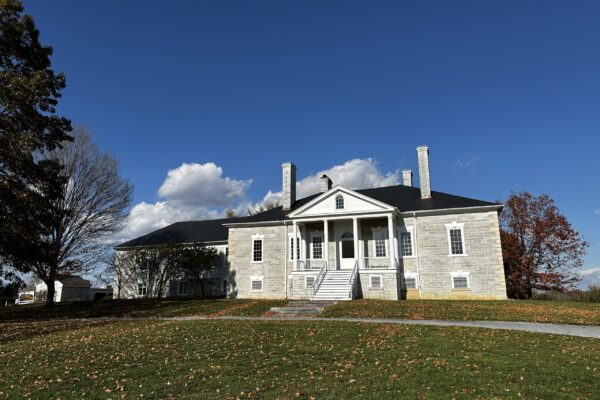
Belle Grove Plantation sits in the Shenandoah Valley of Virginia, part of Cedar Creek and Belle Grove National Historical Park. The manor house was built in 1797 by the grandson of the valley’s first European settler, whose wife was the sister of President James Madison. At its peak, Isaac Hite Jr. enslaved 270 people — the growth and success of Belle Grove was built entirely on their labor. Today, Belle Grove is doing the work of putting names and stories to those 270 people, one by one. Executive Director Kristen Lays joins The Parks Podcast during the holiday season to share the full story — and why the most moving moment of the holiday season is 170 LED candles, one for each enslaved person whose name they know.
A note from Missy: In 9th grade I did a project on Belle Grove Plantation. I was a news reporter telling the story of its rich history. It was a full circle moment to be back on the grounds telling the story for The Parks Podcast — and extra special to be there leading into the holiday season. A step back in time.
Episode Guest
Kristen Laise, Executive Director
Belle Grove Plantation
Park Stats
- Location: Middletown, Virginia (part of Cedar Creek and Belle Grove National Historical Park)
- Owner: National Trust for Historic Preservation (managed by Belle Grove Inc.)
- Manor house built: 1794–1797
- Size: 283 acres
- Enslaved population: Isaac Hite Jr. enslaved approximately 270 people (3rd or 4th largest enslaver in Frederick County, VA)
- Historic connection: Home of Nellie Madison Hite, sister of President James Madison
- Civil War role: Union Army headquarters during Battle of Cedar Creek (1864)
- Graffiti attic: 500+ signatures dating to 1857, including Civil War soldiers and 20th-century visitors
- Heritage features: Manor House, Ice House, Smoke House, Teaching Garden, Enslaved Burial Ground, Heritage Apple Orchards
- Tours: Guided tours only; 10am–4pm Mon–Sat, 1pm–5pm Sunday; evenings Fri–Sat 4–8pm during holiday season
Show Notes & Links
- Belle Grove Plantation — official website
- Belle Grove online museum — enslaved community histories
- Graffiti attic documentation
- Cedar Creek and Belle Grove National Historical Park
- National Trust for Historic Preservation
- Shenandoah Valley Battlefields Foundation
- Follow Belle Grove on Facebook
- Follow Belle Grove on Instagram @bellegrove1797
Transcript
Belle Grove Plantation — From Backcountry to Breadbasket to Battlefield and Beyond
The Parks Podcast, Episode 10 | Kristen Laise, Executive Director, Belle Grove Plantation
The Partnership Park Structure
Missy Rentz: We are celebrating the holiday season with Kristen Laise, who is the executive director of Belle Grove Plantation. Kristen, thank you for coming and welcome to The Parks Podcast.
Kristen Laise: Thank you for having me today.
Missy: Let me go through some stats. Belle Grove Plantation is located in Middletown, Virginia, and is part of Cedar Creek and Belle Grove National Historical Park. That park was created on December 19th, 2002 when George W. Bush was president, though Belle Grove has been around a lot longer than that. The plantation is on 283 acres of the park, and the homestead includes the Manor House, the Ice House, Smoke House, Teaching Garden, Enslaved Burial Ground, and Heritage Apple Orchards. It was the home of Major Isaac Hite and Nellie Madison Hite, who is the sister of President James Madison. It grew to 7,500 acres. Belle Grove was the headquarters of the Union Army for the Battle of Cedar Creek, and its growth is credited to the enslaved people who lived and worked there. Kristen, this park is structured a little differently than most. Can you tell us how it all fits together?
Kristen: There had been a lot of discussions, especially in the 1990s — Ken Burns’ documentary about the Civil War had come out, there was a lot of Civil War research happening, and there was significant concern about development pressure on battlefield properties. There was a feeling that the Battle of Cedar Creek battlefields would be lost. At the same time, the entire Shenandoah Valley is very rich with Civil War history, and it just didn’t seem feasible for the National Park Service to create a national park for the entirety of the valley. So what wound up happening is they created a National Historic District, managed by a nonprofit organization called the Shenandoah Valley Battlefields Foundation. And when historians studied which battle was the most pivotal, they settled on the Battle of Cedar Creek. The legislation designated it as a national park — but a partnership park.
Kristen: The partners in the park are the National Trust for Historic Preservation, which owns the majority of the land at Belle Grove Plantation; Belle Grove Incorporated, a local nonprofit that manages Belle Grove for the National Trust and also owns a couple of other parcels related to the Hite family history; Cedar Creek Battlefield Foundation, a local nonprofit that has preserved key battlefield areas; Shenandoah County, whose parks department holds a piece of property; and the Shenandoah Valley Battlefields Foundation. We like to say that the largest landholder in our national park is actually private citizens — they are free to do whatever they wish with their property. The federal government owning land is not the largest landholder in this national park. We really rely on that partnership. The National Park Service has been instrumental in several ways — helping preserve a monument, planning trails, and creating unified signage across the park so that no matter who owns a property, the visitor experience feels consistent. When Belle Grove is open during our high season in summer and fall, National Park Rangers do daily programs on our front lawn. We collaborate on public programming all the time.
The Story of Belle Grove
Missy: The motto for this park is “from backcountry to breadbasket to battlefield and beyond.” Can you share the story of Belle Grove and the important role it has played in history?
Kristen: The big name drop is the Madison family. Nellie Madison, younger sister of President James Madison, married Isaac Hite Jr. He was the grandson of one of the first European settlers to the Shenandoah Valley — a German immigrant named Jost Hite. When Europeans started settling the Shenandoah Valley in the 1730s, they were predominantly German and Scots-Irish, new to the country, looking for economic opportunity. The colonial government of Virginia wanted European settlers in this strategic location just west of the Blue Ridge to quell Native American resistance and counter increased French activity on the western side of the valley. The land was incredibly fertile with excellent water sources, and a really productive agriculture sprang up and down the valley.
Kristen: In time, the Hites gained wealth and prestige and started to mix with settlers who had come from the tidewater of Virginia — predominantly British families who had depleted their farmland growing tobacco in southeastern Virginia and were seeking fresh land. So this is a classic social climbing story of a German immigrant family mixing with a first family of Virginia like the Madisons. In time they had the funding, the labor, and the large manor house you see today was built in 1794, completed around 1797. Nellie Madison sadly passes away, and Isaac Hite marries another esteemed young woman, Anne Tunstall Maury, from another first family of Virginia. They have ten children. Around 1810 to 1820, this is the most booming period in Belle Grove’s history. Then there’s an economic crash, a reversal of fortune, and Isaac Hite ages and passes away. The house is sold out of the family right before the Civil War. During the Civil War, as I mentioned, this became a site of Union occupation — a very nice strategic point for Union forces gaining ground toward the South.
Kristen: After the Civil War, the house changed hands many times and ultimately became a country inn, owned by a local farming family as a way to increase revenue. One of the frequent guests was Francis Hunnewell, a well-networked, well-to-do family from the Northeast. He was the one who actually started to restore the home — a very sensitive restoration that happened right at the eve of the Depression. He passed away and left it to the National Trust for Historic Preservation to be a museum. So we have about 100 years from when the Hite family lived here to when we became a museum. When you come to visit, we tell you the stories of how we furnished the house back to when the Hites lived here.
The Enslaved Community at Belle Grove
Missy: Belle Grove does a really great job of crediting those who were enslaved there for its growth and success. Can you tell us about that work?
Kristen: We know that Isaac Hite Jr., in the time he lived here, enslaved about 270 people — putting him as the third or fourth largest enslaver in Frederick County, Virginia. The 1810 census records 103 people owned by him; in 1820, it was 101. For this part of Virginia, that’s a pretty significant number. But we don’t want to just talk about it like numbers. These are people, human beings. Bringing the humanity to the individuals is a really important part of what we’re doing here.
Kristen: We developed a successful program with one of the National Park interpretive rangers about Judah, who was one of the enslaved cooks. We had a few pieces of documentation — family letters and other information — that allowed us to put her biography together and present it in the kitchen, where she would have worked. We also published 24 issues of a two-page newsletter, each featuring one or two enslaved individuals, talking about their lives. We have a really interesting story about the Jackson family — a free Black father who purchased the freedom of a number of his children, and they went on to live in Pittsburgh. We’ve created an online exhibit at virtual.bellgrove.org where you can find the Jackson family story, other stories, and links to all 24 newsletters. It gives you a real sense of these people beyond just statistics on a census form.
The Graffiti Attic
Missy: One of the stories on the website is about the graffiti attic. Can you tell us about that?
Kristen: In the attic of Belle Grove — which isn’t open to daily visitors — there are over 500 signatures all along the walls. The oldest we can locate is from 1857, but it really took off during the Civil War. Graffiti from occupying forces is pretty common in the Shenandoah Valley — we’re seeing it in homes, churches, courthouses. But what happened at Belle Grove is that when it became an inn and then opened as a tourist site in the early 20th century, the idea kind of went viral. So we have basically a guest book on the walls. When I was new in this position about ten years ago, I got a small grant so we could document and transcribe it all — and that’s what you’re seeing on our website.
Kristen: We have two “Kilroy Was Here” signatures. We have people joking around — someone signed Edgar Allan Poe, but on a date after he was alive, so it definitely wasn’t Edgar Allan Poe. It sparked oral histories in our community. People recognize names of friends, neighbors, relatives. It’s not unusual for someone to tell me their granddad signed the attic. Now with the transcription, we can look that up and get them a picture of it. We even have the signatures of the interns in the 1970s who worked on the Historic American Buildings Survey documentation of the site. It really is a who’s who of the history of our site.
The Holiday Experience
Missy: Let’s talk about the holidays at Belle Grove. How do you transform the whole plantation for the holiday season?
Kristen: We could not do a lot of things without partnerships. We are fortunate that for many years, we’ve had partnerships with local garden clubs. They each choose a room. We pick a unifying theme and throughout the week after Thanksgiving, they rotate through and decorate the space. Belle Grove gets a large Christmas tree — that always goes in the parlor — and our volunteers come out and help decorate it. We get it done in mostly three days. This year’s theme is Winter Whimsy. I’ve heard hints there will be snowflakes and woodland creatures. They’re not all historically necessarily appropriate — some modern stuff sneaks in — but hopefully it stays within the taste of the house, if not the exact period.
Missy: What would the holidays have looked like at Belle Grove in 1797 for the Hite family?
Kristen: A much simpler affair. Holiday decorating, even Christmas cards — a lot of these traditions we love today really didn’t come about until the Victorian era, around the Civil War and a little bit later. The Hites were very religious, Anglican, and would have been focused on the religious celebration. There may have been some decorations, some greens at their place of worship, definitely special foods, and definitely a focus on gathering family and friends. It would have been a very social time of year. But not probably a 13-foot Christmas tree in the parlor. So when we decorate for the holidays, it’s more a nod to Belle Grove’s later eras. Were they a social hosting family? With ten children just to start with — and in-laws sometimes living here — just the immediate family was a crowd. Anne’s letters mention people coming to visit regularly. The holidays could even be a time for a family wedding, when everyone was already gathered.
Planning Your Visit
Missy: When someone is planning their visit to Belle Grove, do they need to make reservations?
Kristen: We do not require reservations. Tickets are sold on a first-come, first-served basis. We like to keep tours to around 12 people so that you can walk into each room of the house — that’s an important part of our tour. Guided tours are offered 10 to 4, Monday through Saturday, and 1 to 5 on Sundays. The tour takes about an hour. Give yourself a couple extra minutes to walk around the grounds and visit the museum shop. Our tour is more intimate than a lot of historic sites — you’re not standing in a doorway looking over a velvet rope, and you’re not hurried through. On Fridays and Saturdays from 4 to 8, we’re open in the evenings with LED candles all around the house. The ideal visit, if you really want the full experience, is a Friday or Saturday tour at 3:15 — linger a little bit afterwards, watch all the candles flicker on, sunsets here are beautiful. You get to enjoy the whole spectrum of what we have to offer.
Missy: And Belle Grove is part of the larger park. There are hiking trails, you can walk the grounds, and it’s close to Washington, D.C. — maybe an hour and a half on I-66 East. When you first drive up the beautiful driveway, I imagine the visitor center is your first stop?
Kristen: Yes. We have a 1918 barn that we’ve converted to the Beverly Beach Shoemaker Welcome Center — that’s where the museum shop and restrooms are, and we have some information about the agricultural history of the site, especially in the 20th century. That’s all free of charge. Right across the road is one of the trails that goes into a wooded area where there are remnants of the entrenchment lines — where Union soldiers dug in — and you can still see evidence of that. It’s a nice hike. You can do at least three miles if you want, or as little as a mile. There are a couple of other smaller trails around the park as well. Fridays, Saturdays, and Sundays, the National Park visitor center is open with even more exhibits and information. All of the park partners have passport stamps, so bring a passport book. And then the surrounding community is charming — Middletown and Strasburg both have great spots for lunch and shopping, including the huge Antique Emporium in Strasburg. There’s definitely a way to make a full day of it.
Missy: When is the best time to visit throughout the year?
Kristen: We close in January, February, and half of March. Starting around the third week of March through the end of October, we’re open seven days a week except for major holidays. We have several festivals throughout the year — in May, the longest running beer festival in Virginia on Mother’s Day weekend; a wine festival at the end of August; evenings with bluegrass music in the barn; kids’ nature programs; and more. Follow us on Facebook at Belle Grove and Instagram at bellgrove1797. Our website always has our busy calendar.
A Spirit of Remembrance
Missy: Are there any special moments during the holiday season we should make people aware of?
Kristen: Yes. On December 1st — our first day open once we’re decorated for the holidays — we will have a program about the contributions of the enslaved community. It’s wonderful when people want to visit Belle Grove during the holidays. It’s a family tradition for many, a warm and fuzzy place to visit. But we don’t want to forget that this place wouldn’t exist without the enforced labor of many people. So we bring a spirit of remembrance to the season. We’ll have a program that talks about people who were enslaved here, and then we’ll light a candle — one for each person. We have over 170 small LED votives. The name of that person and their birth date will be on it, and we’ll arrange them by family, because understanding family groupings is a really important part of our research. Slavery rips families apart, and so even in a symbolic way, if we can keep families together, it’s important to us. These candles will illuminate the exhibit area where the enslaved quarters were. They go on timers — every day between two and eight o’clock, they’ll flicker on and then flicker back off later in the evening. It’s surprisingly simple, but also extremely moving.
Speed Round
Earliest park memory?
Death Valley. A camping trip with my family. I was not terribly enamored with the accommodations. It was very windy and very sandy.
What made you love the parks?
My family lived out west for a while and traveled back east a couple of times, so we hit a lot of national parks. It is amazing just to see how much has been preserved — these vistas, just as nature had them. It’s really amazing.
Favorite thing about Belle Grove?
Uncovering stories like we’ve talked about. When you do that research and you have a point of information that connects you to a story — whether it’s with the Hite family or the enslaved community or anything else — it is so satisfying to get another little piece of information to help flesh out the lives of the people who were here.
Favorite thing to do at Belle Grove?
Enjoy the golden hour of the day. Late in the day, we have beautiful mountain views throughout the property. Watching the sunset is a really wonderful thing to do here at Belle Grove.
Park on your bucket list?
If given an all-expenses-paid trip, I’d probably go back to Acadia. I’ve been there just very briefly and didn’t have a chance to really explore or be in the park for very long. I’d love to go back. I also have Dry Tortugas on my list.
Three must-haves for a park visit?
Comfortable shoes, a camera, and maybe bug spray.
Favorite campfire activity?
The classic s’mores.
Tent, camper, or cabin?
I’m not that particular, but if given a choice, I’m going for the cabin.
Hiking with or without trekking poles?
Without — only because if I need trekking poles, I probably shouldn’t be on that trail.
Favorite trail snack?
Almonds.
Best animal sighting?
At Cumberland Island National Seashore, off the coast of Georgia — the first time I saw an armadillo in the wild.
Favorite sound in the park?
A toss-up between birds and crickets at night.
Greatest gift the parks give to us?
The protection of unspoiled lands and a real chance to escape to nature — to see the history of our country before a lot of human intervention.
Missy: Kristen, thank you for being part of The Parks Podcast. I wish you and all the Belle Grove family a happy holiday.
Kristen: Thank you very much for including us, Missy. Please come out and enjoy the holiday with us. We’re open seven days a week in December, except for Christmas Eve and Christmas Day. Our last day open for the season will be December 30th — a great place to visit the week after Christmas when a lot of other holiday things have wrapped up. If you have family in town and need to get out of the house, come see ours.
Missy: Thanks for listening to today’s episode. Until next time — we’ll see you in the parks.
Music for The Parks Podcast is performed and produced by Porter Hardy. Follow us @TheParksPodcast or visit TheParksPodcast.com.