
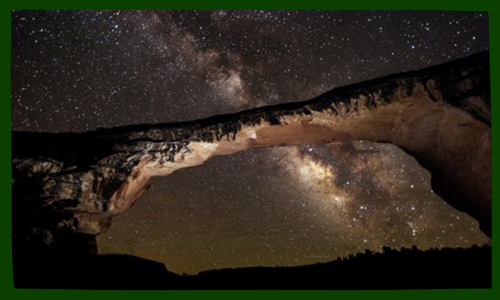
Southern Utah has some of the darkest skies on Earth, and it isn’t an accident. The land stayed wild, protected by federal, state and tribal governments, so the sky above it stayed dark too. Utah now has more certified International Dark Sky Places than any other state, and the very first one in the world, Natural Bridges National Monument, sits right in the middle of this region.
Michael Rymer of DarkSky International joins me for our second Our Story episode, about why darkness matters for wildlife, for the tribal nations who have always looked to this sky, and for the rest of us. And what happens when development brings light to places that have never had it.
A note from Missy: I’ve spent years in parks, and I’ve never really seen a true dark sky. I’m an early-to-bed kind of girl. This fall I’m finally staying up for it, at the new moon. If you’ve never seen the Milky Way either, come with me.
Episode Guest
Michael Rymer – Communities Program Manager, DarkSky International
darksky.org
What we cover
- Why Southern Utah is so dark: protected land means fewer lights
- Utah and the Colorado Plateau, home to more dark sky places than anywhere
- It’s not just about the stars: wildlife, energy and safety
- Lights out for migrating birds, and why it should last all year
- The night sky as family: its meaning for the tribal nations of the region
- How mining and development would bring light to Bears Ears and Grand Staircase
- What you need to see a dark sky (less than you think)
- Protecting your night vision: 20 to 30 minutes, and a red screen
- Why you won’t be able to find the constellations
- Getting there safely, and stargazing from the parking lot
- Timing your trip with the new moon, and the winter Milky Way
- Finding certified places, dark sky festivals and ranger programs
- Speed round: Big Bend, the stillness of a dark sky, three lessons, and staying curious
Show Notes & Links
- DarkSky International
- Find a certified International Dark Sky Place: darksky.org/places
- Natural Bridges National Monument, stargazing: nps.gov/nabr
- Bluff, Utah, International Dark Sky Community: townofbluffutah.gov/dark-sky-designation
- Hovenweep National Monument: nps.gov/hove
- Goosenecks State Park: stateparks.utah.gov
- Utah State Parks dark sky program: stateparks.utah.gov/dark-sky
- Michael’s pick:
- Bears Ears and Grand Staircase news: KUER, August 2026
- Related listening: The Birding Boom: Join the Migration (Episode 89)
Transcript
Our Story: Dark Skies in Southern Utah
The Parks Podcast, Episode 91 | Michael Rymer, Communities Program Manager, DarkSky International
This Is Our Story
The landscapes of our nation hold the echoes of every footprint ever laid upon them, weaving together the diverse lives and pivotal moments that shaped our common ground. From the visionaries who protected these spaces to the cultures that have always called them home, our parks are a living tapestry of who we were and who we are becoming. This is our story.
Missy Rentz: In today’s episode, I am thrilled to welcome Michael Rymer. Michael is the Communities Program Manager for DarkSky International. Michael, welcome to The Parks Podcast.
Michael Rymer: Thank you, Missy. It’s great to be here.
Missy: I am so excited to talk to you about dark skies. I think we talk about them in almost every episode, but when this particular episode airs, I will be in Southern Utah, specifically Bears Ears, and it will be the new moon in November. So I am so excited to experience really my first dark sky. I have spent a lot of time in… I’m an early-to-bed kind of girl. So a wintertime dark sky, and I’m thrilled about it. In Southern Utah, this is a region that has so many dark skies. You have Natural Bridges National Monument, Hovenweep National Monument, Goosenecks State Park, Bluff.
Why Southern Utah Is So Dark
Michael: The reason for that is that so little of that part of the state is developed, for one reason or another. I suppose one reason is probably the landscape, that it may not be so conducive to development. But I think a lot of it is also so well protected by federal, state, and even tribal governments, and that is what keeps development from inflating around the region.
The less development you have, the less lighting you’re going to have. So the dark skies are as pristine as a lot of the ground is. That’s what makes it so unique as far as darkness goes in the United States. You are so lucky to have all these places you just mentioned considered that level of dark. It’s a desirable place for people to go during the day, so it only makes sense for folks to stick around at night and check out the other half of the day.
Missy: And there aren’t that many dark sky places around the world. You were telling me 200 and some. To have that many in one part of the United States is really a gift.
Michael: Yes, absolutely. Utah leads the way with the most certified International Dark Sky Places of any state. The Colorado Plateau, the Four Corners area, has the highest concentration of any region in the world, for the same reasons: the natural landscapes have been preserved, and so the dark skies are preserved.
It also helps that a lot of these places are big tourist attractions. The certification helps garner attention from visitors who may already be planning to come to these places, and now they have another reason to come and to stay at night. So Utah, and Southern Utah especially, has so many certified dark sky places because they’re already desirable travel stops, and the dark skies add to that.
More Than the Stars
Missy: When I look up at a night sky, even in Richmond, Virginia, I’m going to go, “Oh, it’s pretty. Oh, it’s beautiful. Oh, the Big Dipper.” With dark skies, beauty is certainly part of it, but dark skies have greater meaning than just the beauty. Can you tell us a little bit about that?
Michael: Yes. It’s not just about seeing the stars. That’s obviously how the organization, DarkSky International, came to be. It was astronomically based, and a lot of people’s interest in dark sky conservation is still based in astronomy. However, there are so many more, maybe even more directly impactful, reasons that dark skies are so important. And it’s not so much just dark skies. It’s about using less light at night, because of the ecological impact, the energy impact, and safety.
Excessive light at night, even in our neighborhoods and in the cities where we live and work, is not safe. It is not efficient. And it certainly isn’t healthy for the environment, whether it’s our pollinating wildlife species or the nocturnal species that rely on darkness for hunting, migration, and navigation. So it’s not just about seeing those stars. It’s about using light more responsibly, only when we need to.
That’s at the heart of our mission: using light in a more responsible way, and protecting dark sky places by conserving what is already dark and preventing the urban sprawl and increased development that could damage those dark skies. It’s a twofold approach at DarkSky, but both are meaningful to our mission.
Lights Out for Migrating Birds
Missy: I just went birding for the first time in Ocean City, Maryland, and it’s October, so it’s migration season. This time of year you get the news stories saying, “We’re in migration season. Turn your lights out.” And there’s that toss-up, because it’s also getting dark earlier and people are out walking their dogs, so you want them to be able to see your sidewalks. But there is something about turning our lights out for these migrating birds, because they’re important too.
Michael: For sure. We obviously appreciate those lights out campaigns. Here in the western part of the country, we have DarkSky Texas, DarkSky Colorado, and the Audubon Societies in those states, and they have lights out campaigns as well. It’s great to engage in that, but we want the idea to carry through the rest of the year too, because even though those are peak migration periods, there are still creatures flying through the air every night of the year.
The Night Sky as Family
Missy: It’s so fascinating to think about. That part of it I had really never thought of until you and I decided we were going to talk. So there’s certainly the environmental, agricultural, and wildlife component. But we’re in Southern Utah, where there’s more cultural significance with our Native American nations. There was a quote I saw on your website by Daniel Bulletts: “The tribes depend on night skies for guidance, cultural awareness, and preparedness for life’s great journey upon Mother Earth.” I had to write that down immediately because I thought it was so beautiful. Talk a little bit about the cultural significance of dark skies in Southern Utah specifically.
Michael: As Daniel said, and Daniel is a huge advocate for night skies, especially from a cultural heritage perspective, we know many people of Indigenous backgrounds who share that same kind of heritage. The stories are different among the cultures, of course, but I think the overall spirit is the same. The people of this part of the country relied on the night sky not just as a tool, but for storytelling and for imagination.
The night sky was part of their community, and so were the stories they could take from what was painted in the heavens above them. It told them when to plant and when to harvest. It was almost a person. Maybe not even almost. I think a lot of these night sky figures were part of their community, the way you and I are part of each other’s community.
So it’s meaningful to these nations who had that relationship. And when it is taken from them because of an outside influence, it’s akin to removing someone from your family. A lot of the Western world doesn’t subscribe to that anymore, because for one reason or another, we don’t care about the night sky in that way. So it’s heartwarming to me to learn about the cultures, tribes, and nations that still have that relationship. It doesn’t come from my own background, but it’s always so fascinating to know that someone else has that level of care for the night sky.
Missy: And as you explain it, we talk about the historical significance, but the fact of the matter is that a lot of those rituals and traditions still take place with tribal nations around the country, and that’s so important.
Michael: Yes.
Development and Light Pollution
Missy: Bears Ears and Grand Staircase-Escalante are two places that had mining leases opened up, and we’ve done many episodes about that. One of the many reasons we don’t want mining leases is that they bring light pollution to these places, correct?
Michael: Yes, absolutely. Wherever you have industry, you’re going to have paved roads, and you’re going to have to light those roads. You’re going to have some form of administrative facilities, and you’re going to have to light those. Maybe even housing. Once something is developed and the landscape has changed, the common mentality is, “Now we have to light it.”
A place that was so pristinely dark, now even one streetlight will change that entire immediate surrounding, so the impacts are so much bigger than we can ever plan for. And lighting doesn’t stop at a boundary, whether it’s a natural one or an artificial one. That light is just going to go. Having been to Bears Ears before, I can tell you that you can see a light on the horizon for miles, because it’s a flat landscape. There are some geological features that block light on the horizon, depending on where you’re looking. But in Southern Utah, where there’s a lot of flat, open space, you can see even one little streetlight from 20 miles away. So that’s what we’re talking about with places that may be under threat of further development, like Bears Ears or Grand Staircase.
Missy: It’s so important. I know we will continue to talk about writing to your representatives, but this is an interesting perspective on one of the reasons it’s important to voice our opinions. I encourage you to go to DarkSky International, and on The Parks Podcast we’re going to do a lot around dark skies, so we’re going to share it. When you experience it, it’s hard not to be in awe. Even the photos leave me in awe. I cannot wait. I hope I see a fraction of it.
What You Need to See a Dark Sky
Missy: So no matter where you are, if you want to see a dark sky, what do you need to see one?
Michael: You need two working eyes attached to a functional brain, and a big heart, because you’re going to love it.
Missy: Is that it? I won’t need any device? It’s that obvious?
Michael: If you want a device, best of luck to you, depending on where you are in the national monuments, because cell phone coverage is spotty. I will say that in the Valley of the Gods, the very southern part of Bears Ears, I actually did have cell service. So if you want to take your preferred stargazing app with you, it’s not a bad idea, if you’re inclined to ask, “Hey, what’s that constellation? What’s this object?” Totally fine.
But I’d certainly recommend preserving your night vision. It takes 20 to 30 minutes for your eyes to fully adjust to a dark setting. Once you have your smartphone in hand and you’re looking up information, I recommend going into your settings and turning your screen brightness all the way down and changing the colors to totally red. All you need is to see the information, and that will protect your eyesight as you keep looking up at the night sky.
I also recommend doing some homework ahead of time, so you have a plan and an expectation of what you’re going to see, and you don’t have to look at your phone all night. You can say, “I want to make sure I see this, and I want to identify it from memory.” Because you’re going to be out where there are so many stars that seeing constellations is actually going to be difficult. Not in the same way it’s difficult in cities. It’s because there are so many stars, it’s a wash.
Missy: Really?
Michael: That’s how I would manage your expectations. You’re going to see constellations, no doubt, but you’re going to see so much more beyond them.
Planning Your Night
Missy: Does your website have resources that tell me, this is a great sky map, or this is a great place to research what you could see?
Michael: It’s not on our website, but we can certainly link to these resources, and I’m absolutely happy to share with you everything I know.
Missy: If you share them with me, I’ll put links on the episode page.
Michael: Yes, because there are many. It’s not just knowing what’s up in the sky. It’s knowing the weather conditions, the cloud conditions, all those things. I’m a night sky photographer myself, so I have a few websites I check before I go out. If cloud cover at that time is projected to be 80 percent, I’m not going out. If it’s going to clear up to about 5 percent, all right, I can work with that. There are so many tools out there that will help you prepare.
But when you get there, I think all that preparation, at least at the beginning, is going to be worthless, because you’re going to be so immensely captivated by the night sky. Bears Ears is a huge place. Natural Bridges is phenomenal. It’s right in the middle of Bears Ears, and it’s so remote that it’s going to have one of the best skies you’ll ever see.
Missy: Really? And are you hiking places, or are you driving places, when you’re in that region?
Michael: When I go at night, I want to make sure I go somewhere that’s road accessible, or at least dirt road accessible, because I’ll more than likely have equipment. And I certainly don’t encourage folks to go backcountry hiking at night. I don’t do it. So going somewhere your car can go is probably a good bet. Even a visitor center, like at Natural Bridges, you can go there at night. You don’t even have to hike. You can just sit in the parking lot. They’re not going to have their lights on at the visitor center, and you’re good.
If you want to go on a nighttime hike, bring everything you need to be very safe, because it’s unstable ground in a lot of places and you don’t want to invite risk. But you don’t have to hike in this national monument, or at least not very far, to see a pristine night sky.
Missy: I always say the first thing I do at a park is go talk to a ranger, and I’ll ask not only what I can do, but where I can go to see the darkest sky.
Michael: Very good idea.
Timing the Moon and the Milky Way
Missy: Now, I am intentionally going at a new moon. Tell us a little bit about the strategy. If you have the luxury of picking when you go dark sky viewing, what are you going to see depending on the moon cycle?
Michael: The moon is the brightest thing in the night sky when it’s up, obviously, and it’s its own beauty. When I went, it was during the full moon, but there was a lunar eclipse that night, so I kind of got the best of both worlds. When you go at the new moon, it’s going to be super dark on the ground. You don’t have any moonlight illuminating the ground, so you’ll want to be extra careful watching your step. But you’re going to see as many stars as you can comprehend, because the moonlight isn’t washing out the rest of the sky. You’re going to see the band of the Milky Way in all its glory.
Later in the fall, by the time you go, the summer Milky Way will be pretty much gone, but in the early part of the morning you’ll start to see the winter Milky Way, and that is its own beauty. So we’re very lucky that half the year we get two versions of the Milky Way, depending on the time of night. You’re in for quite the show. You’re going to see Orion, Cassiopeia, Ursa Major, the Big Dipper. You’ll see the familiar faces of the night sky, but you’re also going to see a lot where you think, “I don’t know anything about this.”
Missy: Amazing.
Michael: Because that moon isn’t there, and you’re just going to be in the audience of all of it.
Missy: When you’re in a true dark sky place, is it obvious what you’re seeing?
Michael: If you’ve done a little homework, yes. But if it’s your first time ever seeing a dark night sky and you see this weird streak, I wouldn’t say bright, maybe dim, but it certainly stands out, you’re going to say, “What is that?” That’s probably the Milky Way. In my experience at star parties and talking with folks at night, people say, “What is this weird streak of dim light going from horizon to horizon?” That’s the center of our Milky Way galaxy. Sometimes people are taken aback by what they’re seeing, because they’ve never had the chance to see it or to learn about it.
Finding Dark Sky Places
Missy: That’s really cool. So if you’re going to a dark sky anytime, and certainly if you’re preparing for this new moon in November, check out the links on the episode page, which will have resources for you. And go to the DarkSky International website, because you have information there, including a list of all the places people can go for dark skies, correct?
Michael: Every Certified International Dark Sky Place is listed on our website, and you can learn about each one individually. You can even read their applications, which are linked on each site’s page, and learn what their night sky looks like and what events they may have. When I go places, I always like to see if they have an event around the night sky. You’ll be in Bears Ears National Monument, and Bluff, Utah, is a Certified International Dark Sky Community. They often put on dark sky events and festivals. That’s another great way to be involved with the night sky: communing with others who are appreciating it, learning about it, and learning what they’re doing to protect it where they are.
Missy: Oh, that’s such a great idea. And ranger programs also, certainly during peak times, and oftentimes throughout the year. I find that you’ll see ranger programs particularly on new moons.
Michael: Absolutely.
Speed Round
Missy: This is fascinating. I love hearing why dark skies are so important, and I’m getting ready to explore them myself. Michael, as we wrap up every episode, we do a speed round of questions. Just answer with what first comes to mind.
Michael: Got it.
Missy: What is your first park memory?
Michael: The first park I ever went to was probably Big Bend National Park.
Missy: And what made you love the parks?
Michael: I think the parks are our greatest idea in the United States, and it’s an idea that has spread throughout the world: that we have these wonderful landscapes that should be protected and should be enjoyed. And I love the outdoors, especially in the western US. I love red rocks. I love weird geological formations. It just makes me feel at home, where the sky and the land clash, both day and night, and I can’t get enough of it.
Missy: What is your favorite thing about a dark sky?
Michael: I like the stillness. I like the sense of tranquility in seeing the stars. And when I say stillness, I mean stillness within myself. The sky is obviously moving, and that’s really cool to see. Over time, the stars appear to rotate over the Earth. But in me, it just feels like, okay, there’s nowhere else I need to be. There’s nowhere else I’d rather be. And all I need to do right now is be in this moment. That’s what I feel is most impactful for me about being under a really dark sky.
Missy: What are three important lessons we can learn from dark skies?
Michael: The first one is quite existential: we are all part of something bigger than ourselves. It’s a good reminder that we have a strong responsibility to protect what we’re a part of, which is my second point. It gives us a direction for taking care of what we have. We need to do it. And extending from that, the third point is that it’s something we get to share. It may be bigger than us individually, but together we can do so much to protect, preserve, and celebrate this thing called the night sky. All of that together is what I value in it.
Missy: What else is piquing your interest these days? What are you getting curious about?
Michael: Oh, goodness. Everything. Never stop being curious. That’s another thing about the dark sky: it gives you a bigger canvas to be curious, to paint that picture on your heart and in your soul and to wonder what else there is. Not just out in space. We can all be curious about what’s in the universe, but what do I not know about the world I’m standing on? And what can I learn to appreciate and love it more? That curiosity always burns in me.
Missy: And what’s the greatest gift that our parks and public lands give to us?
Michael: I think it’s a gift to ourselves. It’s the gift of being part of this world that is so unique, so special, and so accommodating to our survival. It’s a gift we can give ourselves every day: to appreciate where we’ve come from and to really take into account where we’re headed. I think that’s the value in protecting parks, national monuments, and landscapes. It’s the gift we can give ourselves in the future. It’s our legacy, and I’m very proud to be part of that legacy in my work. I really hope that as more people come to the parks, they realize the night sky is another part of this gift that’s worth including.
Missy: Michael, I am so grateful to you for taking the time to talk with me. You’re helping me plan my trip, which is also a benefit, and you’re sharing the beauty of our night skies and why they’re so important in Southern Utah. I’m really grateful to you for coming on and sharing these stories with us.
Michael: Of course.
Missy: That’s it for today’s episode. Until next time, we’ll see you in the parks.
Music for The Parks Podcast is performed and produced by Porter Hardy. Follow us @TheParksPodcast or visit TheParksPodcast.com.