
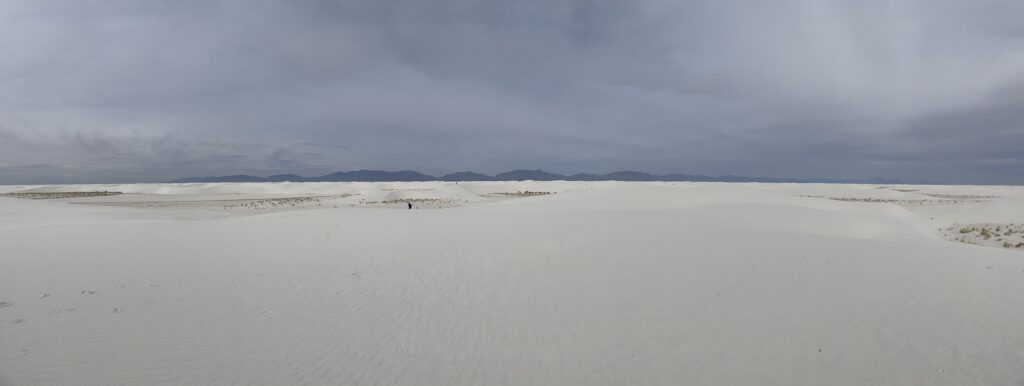
I visited White Sands on a very gray day.
Which meant the sky and the ground were all just about the same color, and it was even more disorienting than I had expected.
Everybody photographs this place blazing white under a hard blue sky. That is the picture you have seen. I did not get that picture. I got something stranger — a world with no horizon in it, where the thing under your feet and the thing over your head were the same shade of pale, and nothing told you where one stopped.
I would not trade it.
There was also a lot of wind. I can see it in my own photographs.
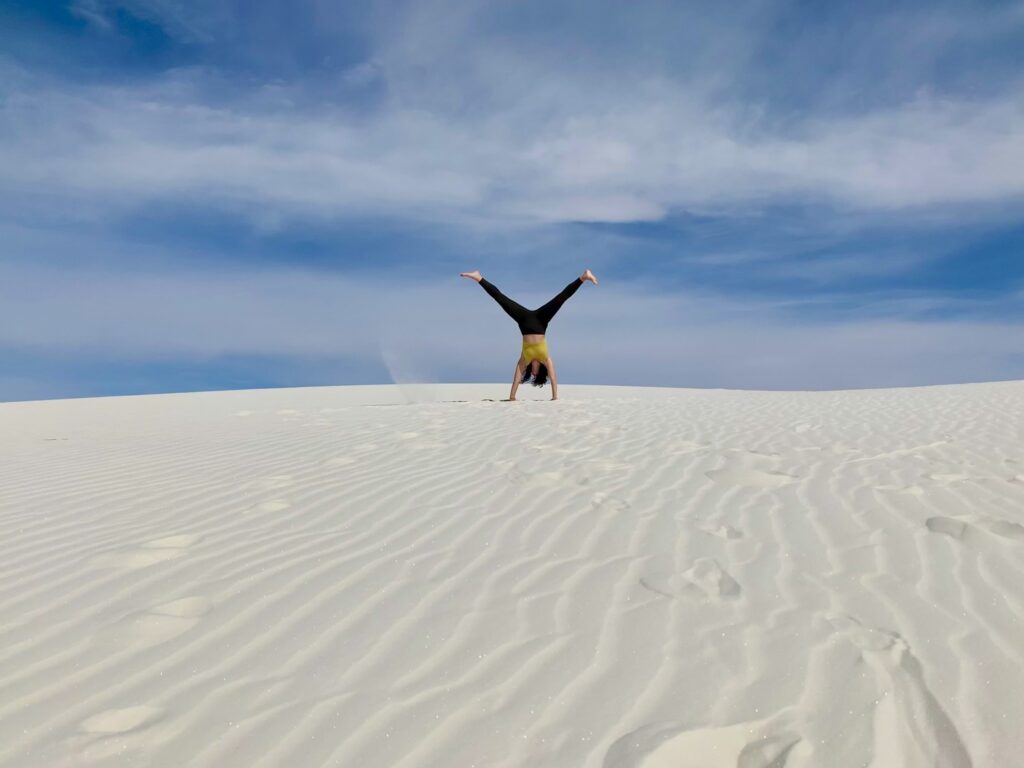
The blue sky photographs here are not mine. They are my friend Rachel’s, from a different day, and she was generous enough to let me use them. She is the one doing the cartwheel.
I wanted both versions in the post, because it is the same sand and it is not the same place at all. Rachel’s is the White Sands everyone has seen. Mine is the one nobody puts on a poster.
The trails frightened me, and I was right
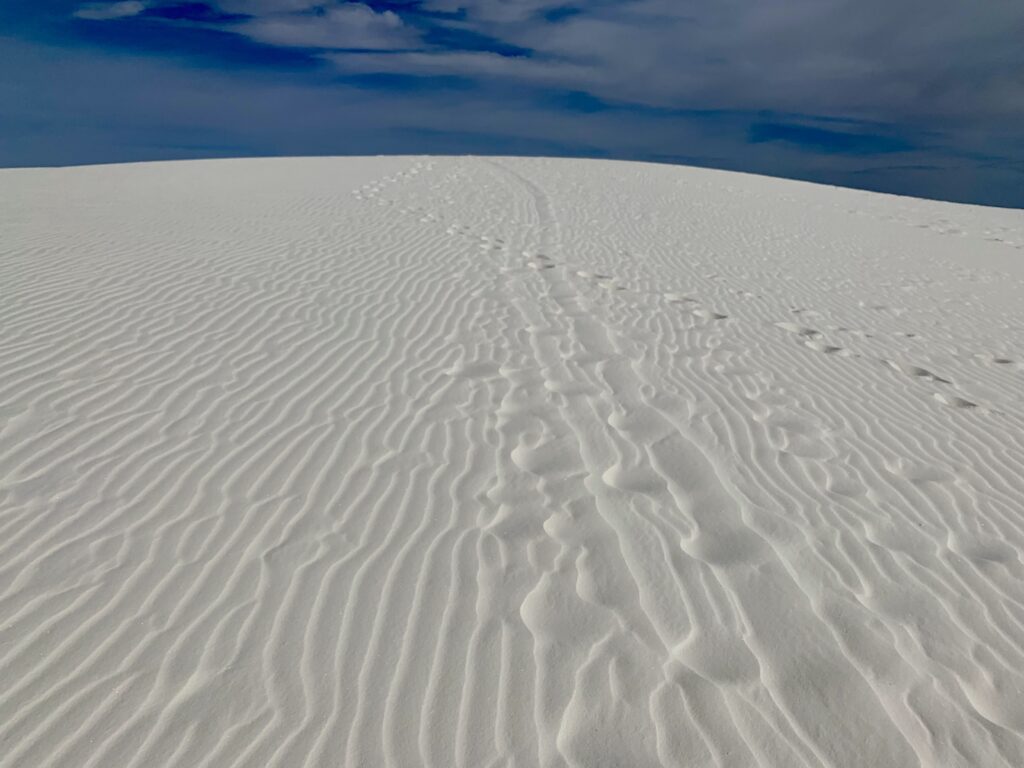
I watched people set off on the hiking trails and it genuinely intimidated me.
I kept thinking I would have needed to leave breadcrumbs — and those would have been white too.
I found out afterwards that I was not being a coward. I was reading the situation correctly.
The long trail out here — Alkali Flat, five miles there and back over dunes that get up to sixty feet — is marked with red diamond posts, and you go from one to the next. The Park Service’s own instruction is this: if you cannot see the next marker, because the wind is blowing or because it has been knocked over, do not continue. Go back to your car.
They also say that strong wind can drop visibility to a few feet, and that it is easy to become lost.
So: a gray sky with no contrast to see by, and wind. That is the exact set of conditions the park tells you to turn around in. Standing there with no idea which way was which, turning around was not timidity. It was the instruction.
What it actually is
Here is what I did not know while I was standing in it.
It is not sand. It is gypsum. This is the largest gypsum dunefield in the world — about two hundred and seventy-five square miles of it, with a hundred and fifteen of those inside the park.
And gypsum is transparent. Every grain of it. The reason the whole place is blinding white is that the grains have been scratching against each other for a very long time, and all those tiny scratched surfaces throw the light back at you.
It also means the dunes do not hold heat. You can walk on them barefoot on a hot day and they stay cool.
It is beautiful to see a space so pure and pristine. And because it is sand moved by wind, it is never the same place twice. The dunes shift. Which is also, of course, why your footprints do not last and why the trail markers get knocked flat.
The sledding
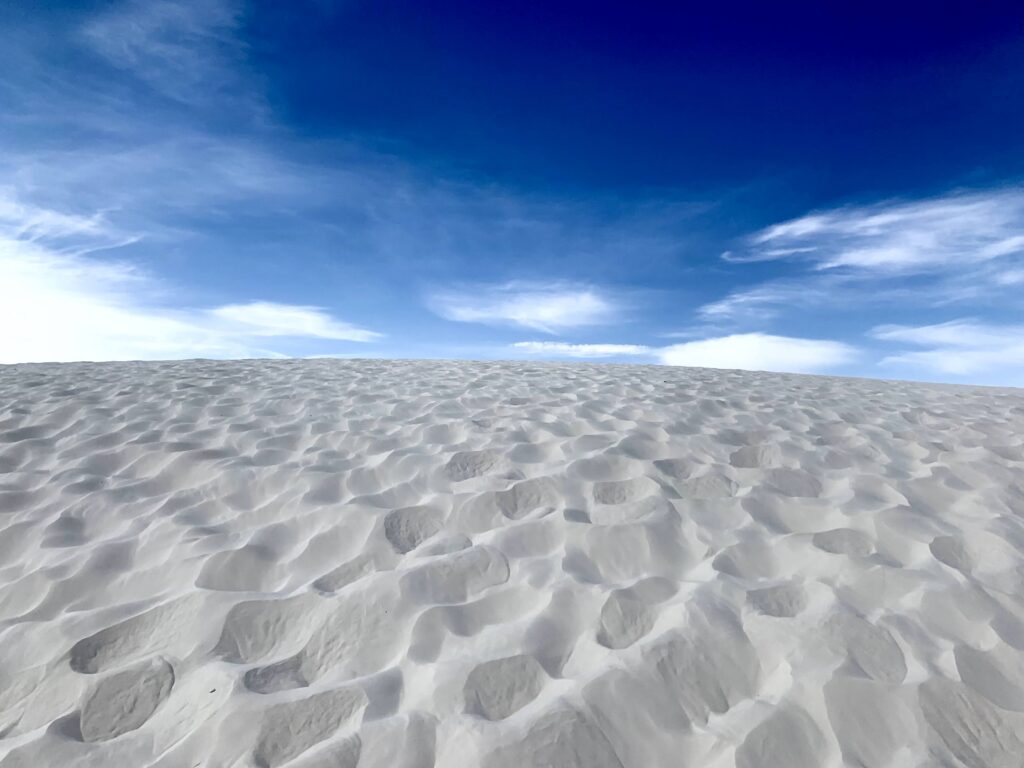
I got a sled and waxed it the best I could and took a run down the hills.
That is genuinely fun and you should do it.
But I will be honest — I had more fun watching the children do it. There were kids out there absolutely committed to the project in a way I could not match, and standing at the bottom of a dune watching that was better than the run itself.
You can rent or buy a saucer at the shop by the visitor center, and wax with it. Do not skip the wax.
Where you sleep
There is no developed camping inside the park. There is a backcountry campsite, but it has been closed for a while with no reopening date.
So you stay somewhere else. I ended up at Aguirre Spring, over on the far side of the Tularosa Basin under the Organ Mountains — which turned out to deserve a write-up of its own, so I have given it one.
One more thing you need to know
All of this sits inside an active missile range.
You hear things occasionally. And there are times when you cannot go places, because testing is taking place — the road through the dunes can close for up to three hours during a test.
There is a closures page. Check it before you drive out, because closed for three hours is a different day from the one you planned.
Plan your visit
Where: southern New Mexico, between Alamogordo and Las Cruces.
It became a national park on 20 December 2019. A national monument since 1933.
Entrance fee: Charged per vehicle for 1 to 7 days, with a lower motorcycle rate and an annual pass available. Check the current rates before you go.
Check the closures page before you go. The park sits inside White Sands Missile Range, and Dunes Drive can close for up to three hours during missile tests.
What the dunes are
Gypsum, not sand. The largest gypsum dunefield in the world — about 275 square miles, 115 of them inside the park.
Gypsum is transparent. The white comes from grains scratching each other. It also means the dunes do not absorb heat and stay cool underfoot.
The trails — read this part
Five marked trails, from the 0.4-mile Interdune Boardwalk to the 5-mile Alkali Flat Trail (strenuous, dunes up to 60 feet, about three hours).
Trails are marked with posts, not paths. Alkali Flat uses red diamond markers.
The Park Service’s rule, and it is not advisory: if you cannot see the next marker — because of blowing sand or because it has been knocked down — do not proceed. Return to your car.
Strong wind, especially in spring, can cut visibility to a few feet. Be off the trails by sunset.
Sledding
Saucers are sold and rented at the shop by the visitor center, used or new, and they sell wax. Use the wax.
Camping
There is no developed campground inside the park, and the backcountry sites have been closed with no reopening date.
I stayed at Aguirre Spring, in Organ Mountains—Desert Peaks National Monument, on the far side of the basin. It has its own post — it earned one.
What I’d do next time
I’ve never left a park knowing everything about it. Here’s what I’d do differently next time — and I’ll add to this as I find out more.
Walk one of the trails, on a clear still day, when I can see the next marker from the one I am standing at. I turned around on a gray windy day and I still think that was right — but I would like to have gone out into it properly.
Pets
Leashed dogs are welcome — six-foot leash maximum — and there are two designated pet walking areas.
The gypsum does not hold heat, which makes this far kinder underfoot than most desert parks. That is a real advantage and it is unusual.
The wind is the thing to plan around, not the temperature. Blowing gypsum in a dog’s eyes is miserable, and visibility drops fast.
Traveling with a dog? Where I Would Actually Take My Dog is every park on this site, sorted by whether she can do the activities you came for.
Fees, closures, backcountry availability and pet rules change, and missile-range closures are unpredictable. Check with the National Park Service before you go — details here were verified in September 2026.