
I stopped at the Medgar and Myrlie Evers Home having only recently heard it existed, and knowing nothing at all about Medgar or Myrlie Evers.
It is completely unassuming. It sits in among neighbourhood houses, exactly as it did in 1963. When I arrived I drove a loop around the block, just to be sure I had it right and that I was in the right place. Then I parked the van by Myrlie’s Garden, about half a block from the house, which turned out to be a good spot to run the generator so Tootsie had air conditioning while I went in.
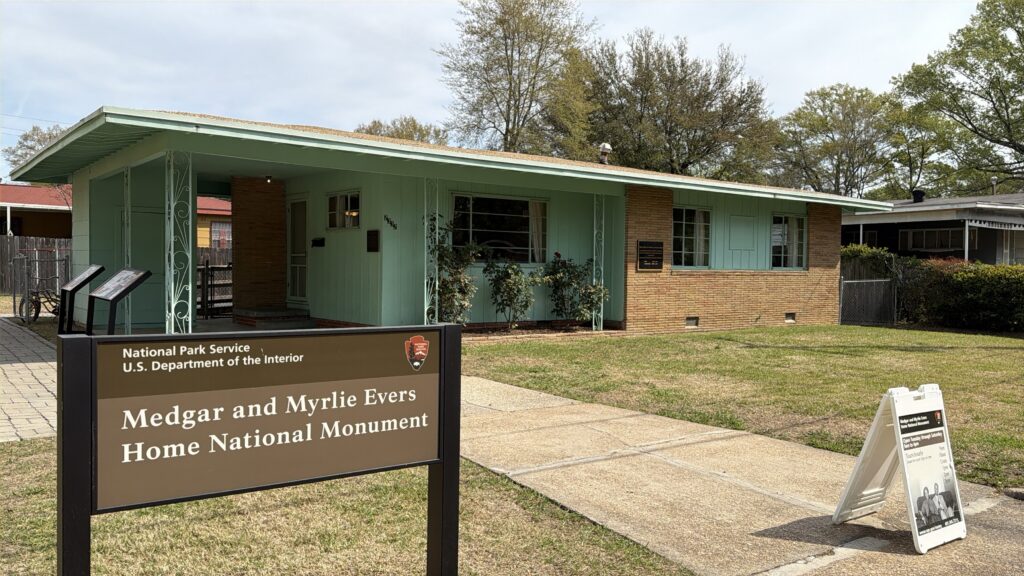
Two rangers met me, and they knew this family completely.
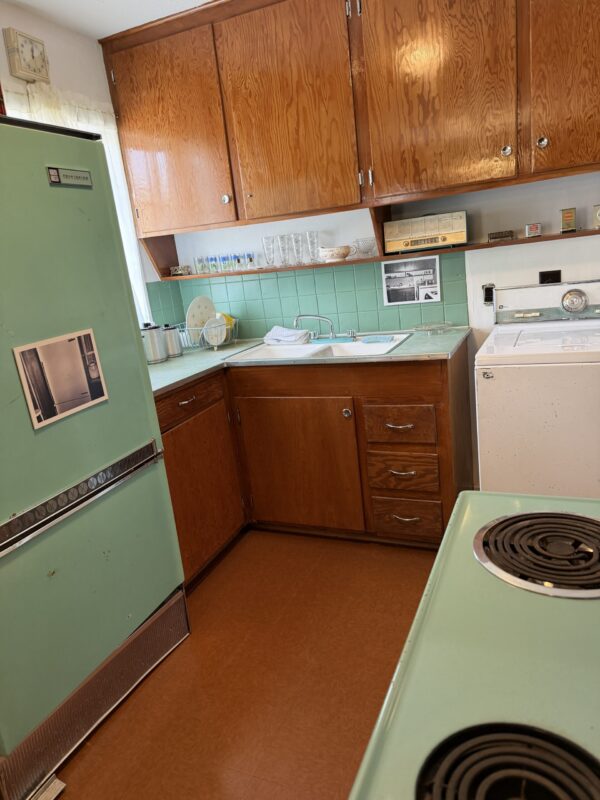
Walking into the house was like stepping back in time. Nothing had changed. It reminded me of my grandparents’ house, and of my great aunts’ and uncles’ houses. The aqua. The gold. The maple table.
Then I asked about the story.
What the ranger told me
In 1952, straight out of Alcorn, Medgar and Myrlie moved to Mound Bayou, an all-Black town in the Delta founded by freedpeople after the Civil War. Medgar sold insurance there for T.R.M. Howard, whose Regional Council of Negro Leadership was headquartered in the town. Medgar became its president.
Mound Bayou is where Medgar Evers became an organiser. Everything after that starts there.
In 1954 he became the first NAACP field secretary in Mississippi. Voter registration drives. Boycotts. Integrating the state fair, the Leake County schools, the Jackson buses. Backing the wade-ins on the segregated beaches at Biloxi.
Then in 1955 Emmett Till was murdered. Evers, Ruby Hurley and Amzie Moore ran a search across the Delta for Black witnesses willing to testify against two white men in a Mississippi courtroom. They found them. They persuaded them. And when the all-white jury acquitted, Evers and T.R.M. Howard got those witnesses out of the state, because staying would have killed them.
During the trial the witnesses were sheltered in Mound Bayou. The same town.
And when the movement could no longer meet where it used to meet, people came here, to this house. James Baldwin sat in it. So did James Meredith, whom Evers helped get into the University of Mississippi.
The threats escalated for years. In May 1963 someone threw a Molotov cocktail into the carport. Ten days later he was nearly run down by a car.
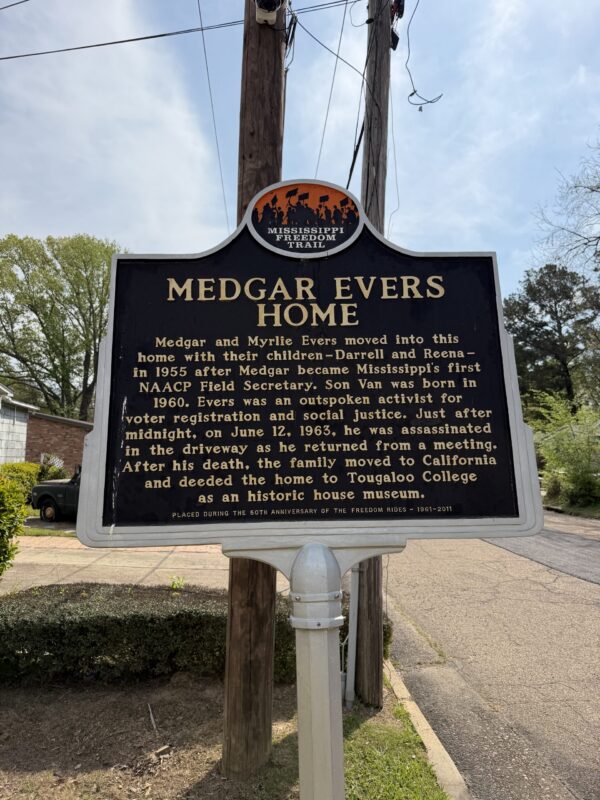
On 12 June 1963 he came home from an NAACP meeting and was shot in his own driveway. He made it thirty feet to his door. He died at the hospital fifty minutes later, the first Black patient that all-white hospital ever admitted.
Myrlie took the children to California and spent the next thirty-one years making the state try his killer again. Byron De La Beckwith was finally convicted in 1994. She went on to chair the NAACP nationally and to found the institute that carries both their names. Whatever a supporting role is supposed to mean, it does not mean that.
Walking through afterwards
The house was built without a front door. You come in from the carport, because a front entrance is a target.
The furniture sits away from the windows. The three children, Darrell, Reena and Van, slept on mattresses on the floor rather than in beds. The family practiced drills: the children crawled army-style to the bathroom and sheltered in the bathtub.
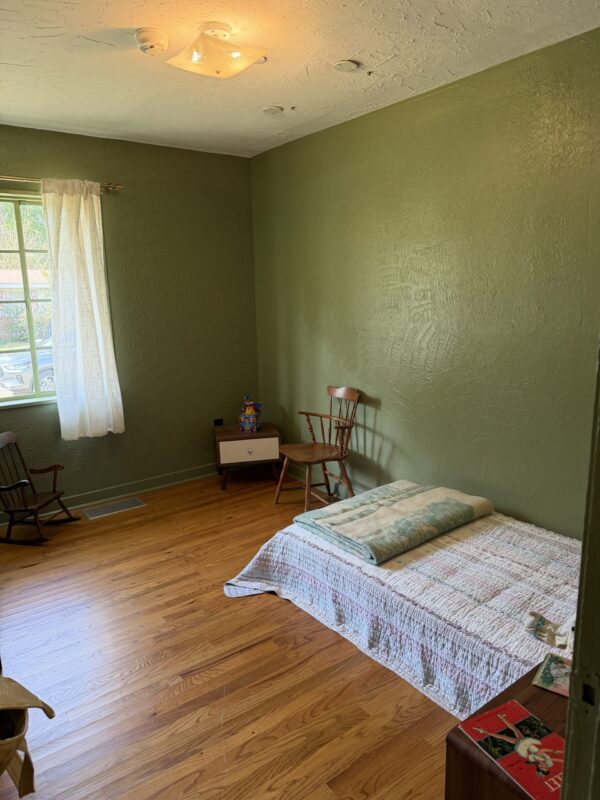
The ranger told me that Medgar and Myrlie kept their own bed up on its frame. Their children got the floor; they did not. As if to say that their own lives were not going to change shape around this.
Darrell was nine.
I walked through the house again after hearing all of it.
And I looked at the pictures, and the toys, and the way the rooms were set up, and I realized that his children were not all that much older than me.
Some of the toys I played with were in their bedrooms.
What I’d tell a friend
Let the ranger talk. I came in knowing nothing and left an hour later changed. That is not the audio tour; that is a person who knows this family telling you about them. Ask, and then stop talking.
Go through the house twice. Once before you hear the story and once after. The second walk is a completely different house.
It is a small home, not a museum. Tours are limited to ten people without notice, and the rooms are tight. Go on a quiet morning if you can.
Look at the bedrooms. That is where it stops being history.
Hours, tours, parking and access change. Check with the park before you go — details here were verified in September 2026.
Plan your visit
Where: 2332 Margaret Walker Alexander Drive, Jackson, Mississippi, in among the neighbourhood houses. Note that 1425 Lelia Drive is the administrative office, not the house.
Entry: Free. There is no fee and no pass required.
Hours: Tuesday to Saturday, 9:00 to 4:00, closed noon to 1:00. Closed Sunday and Monday.
Tours: Ranger-led. Groups of up to 10 are taken without advance notice. Groups over 15 need to call ahead, and the site cannot take more than 30 at once.
Parking: Street parking is limited. Use Myrlie’s Garden at the Missouri Street intersection, which has four spaces plus one accessible space, about half a block from the house.
Access: There is a ramp, but the house is small and wheelchair users may need to transfer to a narrower chair to see all of it. There are no restrooms on site.
Worth knowing: Myrlie Evers gave the house to Tougaloo College in 1993. It became a national monument under an act signed in 2019, and was formally established in December 2020 when the National Park Service acquired it. The bullet holes are still in the house.
What to pack & wear
Not much. This is an hour indoors. Water and something for Mississippi heat if you are visiting in summer, and shoes you do not mind taking slowly through a small house.
Come with time. The value here is the conversation, and you cannot rush that.
Pets
This one needs planning. It is a small historic home and a dog is not coming inside with you.
What I did: parked at Myrlie’s Garden half a block away and ran the van’s generator so Tootsie had air conditioning while I was in the house. If you are traveling with a dog through Mississippi in the heat, work out your version of that before you arrive. There is no shade solution here, and this is not a stop you want to rush.