What if a bridge being six inches too narrow was the only thing standing between someone and the trail they love? That’s the story that started everything.
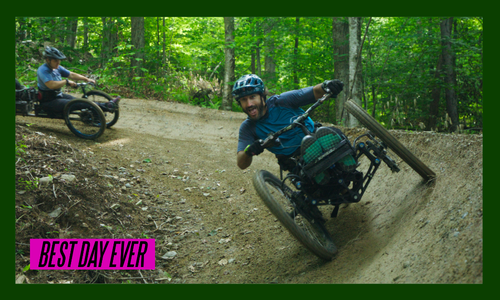
Best Day Ever is a new documentary film about what happens when a community decides that the outdoors really should belong to everyone — not just in a pamphlet, but in practice. It follows the building of the first fully adaptive mountain bike trail network in the world, in Richmond, Vermont, and the people whose lives were changed by it.
Greg Durso, Senior Program Ambassador at the Kelly Brush Foundation, was injured in a sledding accident in 2009 and has been navigating a world that wasn’t built with him in mind ever since. Berne Broudy, co-director and producer of the film, met Greg on a group bike ride and watched the group stop — not because of difficult terrain, but because a bridge was six inches too narrow for Greg’s adaptive bike. She went from frustrated to building a movement.
What they’ve created is not just a trail — it’s a proof of concept that the outdoors can be genuinely, fully, joyfully inclusive. And their answer to what the biggest barrier is might surprise you.
A note from Missy: This conversation opened my eyes to a world I didn’t know existed — and made me look at every trail, every bridge, every park entrance differently. I think it will do the same for you. Watch the film. Listen to this episode. Then think about one thing in your community you could change.
Watch the film and find screenings: bestdayever.mov Kelly Brush Foundation / Adaptive Rec Hub: kellybrushfoundation.org
Episode Guest
Greg Durso — Senior Program Ambassador Kelly Brush Foundation kellybrushfoundation.org
Berne Broudy — Co-Director & Producer, Best Day Ever | Freelance Journalist bestdayever.mov
Transcript
Best Day Ever — The Movie That Will Change How You See the Outdoors
The Parks Podcast, Episode 78 | Greg Durso, Kelly Brush Foundation & Berne Broudy, Co-Director, Best Day Ever
What Is Best Day Ever?
Missy Rentz: I am really excited to be here in person with Greg Durso, the Senior Program Ambassador of the Kelly Brush Foundation, and Berne Broudy, who is the co-director and producer of Best Day Ever, and a freelance journalist. Thank you guys for being here today and on The Parks Podcast.
Greg Durso: Thank you for having us. We’re so excited to be here too.
Berne Broudy: So psyched.
Missy: Okay, so we’re talking about a movie that you all are both in, produced, were very involved in — but also a deeper meaning to it. The movie is Best Day Ever. Tell me about it.
Greg: For me, and for the adaptive community, I think it’s something that was needed — but we didn’t realize probably how needed. It’s about the power of inclusive spaces and the power of normalizing outdoor recreation for everybody.
Berne: It’s also a movie about community and about how to make change — whoever you are and wherever you live — and that it’s in all of our power to be able to do that.
Missy: That’s beautiful. That’s a lot of what I took away from it too. Greg, it is clear to me — and I have known you for all of 30 seconds but I feel like I have lived half of your life with you — that being outside is super important to you. It’s also very clear to me that you don’t let obstacles get in your way.
Greg: No — it’s funny. I feel like I have this naive picture of life a little bit where I just don’t compartmentalize what’s really out there. For me it’s just blazing a path and going through it all. Nothing ever keeps me down. Even when I was injured 18 years ago, all you know how to do is be yourself — and that’s all I know how to do, and that’s all I’m gonna keep doing. Being confident in yourself is what is so successful. People always ask me, how are you doing this if you’re injured? And I’m like, you would probably do the same. You know how to be you, and I never changed. I was just so excited that I was alive after my injury, and I just wanted to have a smile on my face. And to be honest — it’s boring to bitch and moan. So I just wanna be out having fun.
Missy: We just jumped into it assuming everybody knows — but you were in an accident.
Greg: Yes. 18 years ago when I was 23, on New Year’s Day of January 1st, 2009, I was on a plastic sled with my friends in Vermont — just bailing off the sled when we were going too quickly. Probably after the 30th time doing it, when I bailed off I slid into a stump and shattered my spinal cord at T5 and T6. I’m paralyzed from the chest down — no abs or lower back function, things of that nature. And yeah, 18 years ago. Time flies when you’re having fun.
The Six-Inch Bridge
Missy: So the movie on its surface level is about the process of building this adaptive trail. Prior to the adaptive trail being built, what was your outdoor experience like?
Greg: Even growing up on Long Island, I loved to be on the water, I loved to play soccer, I loved to ski. After my injury, the question was — can I do these things again? What does that look like? And you realize you can, but the barrier to entry is just so high. Equipment costs are significant, and then actual access to recreation is also difficult. I work for the Kelly Brush Foundation — we help people with spinal cord injuries live active lifestyles, giving out grants for adaptive sports equipment, creating camps across the country. The bikes in the film cost anywhere between $15,000 and $25,000. That’s a gigantic barrier. And then meeting Berne — literally on a ride in 2021 — I realized that access is another layer. It’s great that you have this $20,000 bike, but then where and how do you use it with others? That’s why meeting Berne was so amazing. She watched me on the bike and said, “This is crazy that you can’t get through some of the simplest things on the trail.” You can do all the hard stuff, but the easiest things just don’t work — trail width, bridge width. And the rest was kind of history from there.
Missy: I didn’t know about this adventure biking community to begin with. But then to watch in the very beginning of the film — a bridge was six inches too narrow — I went into it with a little bit of shame that I hadn’t thought about what I take for granted.
Berne: No shame required.
Greg: And this is the point — it’s this education process. You just don’t know what you don’t know. I was in the outdoor space for forever even after my injury. I got grants through the Kelly Brush Foundation to ski again, I wanted to do an Ironman, I got a better handcycle. I realized all these opportunities and chances I had, and that everyone should have those same opportunities. So I quit my banking job in New York and moved to Vermont in 2019 to work for KBF — and now I’m in charge of giving those grants out, creating those camps and events, and getting people outside. But the bigger problem we see now is access to recreation.
Missy: And you, Berne — based on the movie — you were on a ride with friends?
Berne: Yeah. I just went out on a ride with some friends — the way a lot of us recreate. My friend Christina invited me on a bike ride, and Greg was along, a group of maybe 10 of us. Everybody really strong riders. And we just had to keep stopping — not because Greg couldn’t handle the terrain. Just because the bridges were too narrow. And that seemed like such an easy problem to fix, and also so ridiculous. This was the barrier — some lumber cut six inches too short, just because no one thought about it.
Missy: So what was that moment where you went from “this is ridiculous” to “I’m gonna do something about this”?
Berne: I feel like it was pretty immediate. Greg and I chatted and I was just like, “Seriously? This happens everywhere you go?”
Greg: Yeah. It was a bit serendipitous too. Christina had talked about Berne a lot — “It’d be great for you guys to meet and ride.” And now I sit next to her through all that’s been going on with the movie. It’s a bit funny to think about that first ride and how much we just chatted about all the different trail systems in Vermont, where I could ride and where I couldn’t and what it was like.
Building the World’s First Fully Adaptive Trail Network
Berne: I’m also the president of Richmond Mountain Trails, a small nonprofit trail club under the umbrella of Vermont Mountain Bike Association. So we had this chat, and pretty soon after, a private landowner approached Richmond Mountain Trails and said, “Hey, we have this parcel of land with a maple sugaring operation on it. Would you guys be interested in building trails there?” At that point, the wheels really started turning. I pitched the idea to my board — all volunteers, tiny organization — and everyone was like, “Yeah, that sounds great.” And Greg and I were talking, and his friend Rob McNulty, an adaptive mountain bike instructor, joined the board to help as the trail boss. We learned going into it that there are other adaptive trails in Vermont — we now have something like 200 miles of adaptive accessible trail in the state — but this was the first fully adaptive trail network in the world. We did not know that going into it. We just decided that if we’re building new trails, we build them so Greg and other people can access them.
Greg: The little win. I’m planning for the weekend. I wanna go for a mountain bike ride on Saturday. On Monday I’m figuring out — okay, who wants to come? What adaptive bikes do we have? Which trails can we access with those bikes? How many able-bodied people do we need to come help us? And then you still feel like a burden. I know my friends love riding with me, but to always have to ask for help — sometimes the ride does change because they have to pick us up over the bridges or spot us. And now — now I can just text my group text on Thursday at 3 in the afternoon and say, “Who wants to meet at the driving range at 6?” And we all go. No planning for weeks ahead. No asking for help. Just going. That’s the little win I always wanted.
Berne: And to be clear — Maggie, Louis, and Kelly are all adaptive riders. So Greg can now go out with other friends who are adaptive riders, and they don’t need me or Rob or someone else to come with them.
Greg: We still wanna ride with them. But it’s the shameful ask — you feel guilty asking because you’re like, “Do you wanna come for a ride?” But there’s more in that ask. And now we can just — it simplifies it. It makes it just a normal thing that people can access the outdoors.
Berne: And before meeting Greg, I just never thought about that.
How They Built It — Pink Spray Paint and All
Greg: The cool part is — the trail is the trail. There’s not a different trail for us to ride. Berne’s not riding different. We’re all on the same trail. The genius is you would never go there and know it was made with adaptive bikes in mind. It’s fun for everyone.
Missy: One of the things I had to write down from the movie — you said, “There’s no playbook. There’s no rule book.” And it just resonated. And to go back to the volunteers — you all were a community that came together and built this with your own hands.
Berne: Yes. Richmond Mountain Trails’ board is six people. We put a notice out on our social media — which doesn’t have that many followers — and just said, “Hey, we’re gonna try and build this trail network.” And people just started showing up. And those people kept showing up. They really felt ownership of the project. So many of them became really involved in this idea, and so excited about it — able-bodied people who resonated with wanting other people who also love mountain biking, who access trails differently, to still be able to have those trails and have that joy. The joy of being outdoors, the joy of being in the woods, the joy of being with your friends in a beautiful place.
Greg: The irony is that the trail nights were actually almost more fun than actually riding the trails were. Every Wednesday night I knew I had somewhere to be and people to see. Usually we’re the afterthought — the disability community. And now to be the forethought is huge. And to have a big role in that, taking all the things that are in my brain when I’m riding and getting them out to the trail builders — the learning and teaching with everyone — that was something.
Berne: People wouldn’t go home. It’d be dark, people had been there since 5. It’s 9 PM and people are still hanging out. Or it’d be pouring rain and people would still be there, because everyone was getting so much from just being together and building this.
Missy: And it was two years, right?
Berne: We met in 2021 and brainstormed it, scouted for many months of 2021, then started building in spring of 2022. And honestly, we didn’t really finish the network until this spring. We got an incredible grant through Shimano Trailborn to rebuild one of the first and most popular trails — we knew we could do better. Make it safer, more fun for more people, and better able to hold up under a lot of use.
Berne: When we were first building, we would literally clear the corridor, dig it to how we thought it should work — build corners we thought Greg’s bike or Louie’s bike could get around — and then we’d say, “Greg, come out.” And Greg would come and ride that section. His friend Jeff would follow him with a can of spray paint.
Greg: Yeah, my pink spray paint can. I had it with me everywhere.
Berne: They’d be like, “Nope, this needs to be shaped differently.” So the volunteers would drop behind Greg, re-dig that section, turn Greg around, get him back down the trail, and Greg would ride it again. “Okay, that corner’s good. Moving on to the next corner.” That’s literally how we learned to do it. And then we hired Tom, and once he actually rode the trail on an adaptive bike, he said it totally changed everything. You’d come out and “Look what Tom built” — and Greg would ride it and say, “This is so perfect.”
What Access Actually Means
Missy: Okay. I know you tested throughout, and I know you haven’t seen the finish — but how did it feel the first time you could go on a real ride?
Greg: I think I cried. It meant so much — having all the volunteers, the sweat equity that people put into this, and that people realized this dream. I love people. I love community. So it was just overwhelming in the best way. Just the innate moments of every Wednesday night and what we did, and then we have this. And it’s weird when it’s done because you keep working at it thinking, “Is it ever gonna be done?” And then it’s done. And you’re like — holy shit, we have the coolest playground on the planet right now. And it’s literally the most sought-after trail system in Vermont right now.
Berne: It’s become one of the most popular trail systems amongst any mountain bikers in the state of Vermont, and people are traveling from all over to come check this out. We’re teaching an adaptive trail-building camp in August. And Greg is working on assessing trails in other places — because there are so many trails out there that don’t have to be totally rebuilt. There are just a few things on the trail that could be modified in order to make it accessible for more people. Sometimes it’s literally cutting one tree out or moving a boulder away from the entrance.
Greg: While all of this has been going on, working with the Vermont Mountain Bike Association, there’s also Vermont Adaptive — an adaptive program that has bikes and does skiing, all different sports. We all partnered together and started assessing the different trail networks in Vermont. Trails that already exist. Because a lot of people don’t realize that a lot of the trails probably work — you just don’t know it yet. We need to get adaptive bikes on them and eyes on them. So we’d go around, the trail system would sign up with VMBA, and we’d assess. I started a grant program through the Kelly Brush Foundation — we gave out $60,000 over the last three years to make improvements to some trails. Now we have over 180 miles of trail that are mapped as adaptive-friendly. All on a map on VMBA’s website. That does not exist anywhere else. And we’re trying to change that.
The Biggest Barrier
Missy: The outdoor industry talks a lot about everyone belonging outside. What’s the biggest barrier standing in the way of that actually being true?
Berne: The biggest barrier is that people give a shit. The biggest barrier is that somebody takes that extra amount of time to learn how to do something a little differently to make recreation better for more people. The barrier is just each one of us deciding to do something. That’s what we did — we just decided to do something. We don’t have special permission. We don’t have a special degree in change-making or trail building. We just saw how we could do something differently that would make it better for more people, and we decided to figure it out. If you’re interested in trails, we made a free series — it’s on YouTube, it’s called How to Build Adaptive Trails. Go watch it. There are guidelines coming out through IMBA for the BLM, hopefully in early 2027, that will give us a starting point for best practices in adaptive trail building. But there are plenty of other things you can do in your community to make access better. It doesn’t have to be mountain bike trails. There’s a ton of places where people with different kinds of mobility have opportunities to get out — maybe if each of us just looked around and thought about one thing we could do, it would make a lot of change.
Greg: And there’s a misconception about what accessible means. When people hear “adaptive trail,” the first thing they picture is a wide, flat, easy path. And listen, the ADA is important — I couldn’t have lived my life the way I do without the ADA. But this is a bit different. This is about actual mountain biking, and what we don’t wanna do is dumb the trails down.
Missy: I feel like the accessible trail push is sometimes a check-the-box. Like, we have accessible trails — and it’s the flat green space or the wide paved path. Maybe that’s a step. But I feel like we’re missing the mark.
Greg: It’s about experience. What is the experience that’s supposed to be happening on that trail — and how do you create that equal experience? That’s the way you need to look at it.
Berne: There’s a misconception that if somebody has experienced an injury that changed their mobility, they only want to do easy stuff. But if a skier who skis blue or black runs gets hurt and their mobility changes — are they gonna be happy skiing green trails for the rest of their lives? There is absolutely a place for green trails and ADA-accessible paths. But progression — allowing for progression — that shouldn’t just be reserved for able-bodied people. It should be available to everyone.
The Kelly Brush Foundation and the Adaptive Rec Hub
Missy: Let’s talk about the programs. The camps. Allie, Gretchen — people in the film who didn’t know this world existed. What are you doing to reach more people like them?
Greg: When Kelly was first injured 20 years ago, her college ski team raised money for a mono ski so she could ski again. They raised more money. And they turned it into a foundation. For the last 20 years, we’ve been giving out grants for adaptive sports equipment — because it is so expensive. A mountain bike is $20,000. A handcycle starts at $5,000. That’s a huge barrier. But once you have that piece of equipment, what community do you have, and where can you access it? So these camps are really important. We’re giving people equipment, but we need them to use it in the right environment with people. Creating these camps and bringing the community together — because we always feel like a minority, and if we could feel like a majority for a day or two, it’s the greatest feeling in the world.
Greg: And the camps transcend the sport. It’s people with a mobility impairment flying for the first time. Staying in a hotel room by yourself for the first time. Transferring into a bed or getting to the showers. Things that people don’t do because they don’t put themselves out there. We have the ability to break that boundary down and give people the access they didn’t know they had.
Berne: KBF does some really cool camps for people who are newly injured, and also for young people who are injured. Meeting Gretchen at the KBF camp — she says in the movie, “I’ve been injured for 10 years, and now I’m just discovering this.” That’s the point of making these camps and getting them out there geographically across the country.
Missy: And for someone like Gretchen — 10 years since their injury — how can they find out what’s available to them?
Greg: We started something called the Adaptive Rec Hub — a website with all the resources about adaptive recreation in one spot. Anyone with a physical disability can go on there, sign up, and find all the different adaptive sports, the equipment needed, the vendors, plus a map of users in the community — who we are, where we live, what sports we have, what equipment we have. Plus all the different rehab hospitals around the country, plus over 330 adaptive sports programs around the country on an interactive map. There’s also a whole event schedule — all the different events, all the different camps, not just KBF. We want everyone to have the ability to do anything with anybody. And a grant portal — because there are other granting organizations around the country, and we have all of them on there. We basically took the question “how do I find this?” and we created the answer.
Berne: And you can link to the Kelly Brush Foundation through bestdayever.mov. If you’re interested in seeing the trailer for the movie, you can find it there. There’s a list of where the movie is screening. And if you’re interested in screening the movie in your community — you could be a mountain bike club, a land manager, a group of friends — reach out to us. We are doing a ton of private screenings. You can get a link just for yourself or actually host a screening.
What We Want You to Walk Away With
Missy: If someone is watching the film and they’ve never thought about adaptive access, what’s one thing you want them to walk away thinking, feeling, or believing?
Greg: I think it’s that education piece — understanding that hey, we are out here. But also that we can all do this together. We don’t have to be segregated. The biggest takeaway is that you can join a community, and you can be whole in that community, and you can create these experiences you wanna have, and they can exist. We don’t always have to be separate.
Berne: My answer is I hope people can think and believe and experience that somebody with a disability is just another human being. They’re not any different because of how they get around. They’re still a person that happens to be in a wheelchair. I hope people will shift their preconceptions around what it means to be in a wheelchair — and just expand their thinking around what might be important to that person, what they might wanna do. Because it turns out, there is no difference between wanting to be in the mountains with your friends. Greg is in a wheelchair and I’m not — but that shouldn’t define our experience of loving to mountain bike.
Greg: And people have invisible disabilities too. You never know. The point is — nothing should matter. We should all be able to recreate together. And that’s the best feeling on the planet.
Speed Round
Earliest park memory? — Greg:
Lake George with my family when I was about five. I don’t know why that just came to my brain, but it did.
Earliest park memory? — Berne:
Camping in a VW bus with friends from Switzerland when I was a little kid.
What made you love the parks or the outdoors? — Greg:
Grass stains on my jeans when I was little. Just knowing that I was having fun.
What made you love the parks or the outdoors? — Berne:
The water. I started my love for the outdoors in the St. Lawrence River.
Favorite thing to do in a park? — Greg:
If I could mountain bike, I would be mountain biking.
Favorite thing to do in a park? — Berne:
Being as deep in the mountains as I can.
Park on your bucket list? — Greg:
Glacier National Park. That’s high up there.
Park on your bucket list? — Berne:
Yosemite. It’s legendary, and I somehow have never gotten there.
Three must-haves for a park visit? — Greg:
Sunscreen — that’s key. A hat and sunglasses.
Three must-haves for a park visit? — Berne:
Water. Snacks. Good attitude.
Favorite campfire activity? — Greg:
Whiskey.
Favorite campfire activity? — Berne:
Chilling.
Tent, camper, or cabin? — Greg:
All of the above.
Tent, camper, or cabin? — Berne:
Yes. Is that a trick question?
Favorite trail snack? — Greg:
Gummy bears.
Favorite trail snack? — Berne:
Chocolate.
Best animal sighting? — Greg:
I love bears. Just seeing a bear gets me so hyped.
Best animal sighting? — Berne:
Bobcat.
Favorite sound in the park? — Greg:
The quietness at nighttime with the stars.
Favorite sound in the park? — Berne:
Silence.
Greatest gift the parks give to us? — Greg:
Just the beauty. Being able to sit and stare at something for so long and knowing that memory will never go away.
Greatest gift the parks give to us? — Berne:
Space.
What does your best day ever look like? — Greg:
Waking up early and going on the bike path in Burlington for a sunrise pedal, then mountain biking after that — but getting an egg sandwich in between. Eating lunch in the parking lot when done biking, then going on the boat to chase the sunset in the afternoon and have dinner on the water, then coming back to have a fire and have whiskey. That would be my best day ever.
What does your best day ever look like? — Berne:
Disappearing into the woods with no cellphone service — preferably with a friend or my husband, maybe my dogs — and being able to just fully decompress and not have any outside input for some period of time.
Missy: Greg and Berne, thank you so much for being on the podcast, especially in person. Thank you for this great gift you’ve given to us with The Best Day Ever movie — and just for educating us and opening my eyes to a world I didn’t know existed.
Greg: Thanks for chatting. I had a blast talking with you. This was great.
Berne: Thank you — and I hope this inspires some other guests on your program that you hadn’t thought of before.
Missy: Absolutely. Until next time — we’ll see you in the parks.
Music for The Parks Podcast is performed and produced by Porter Hardy. Follow us @TheParksPodcast or visit TheParksPodcast.com.