
If you want a campsite at Voyageurs National Park, you’d better bring your boat.
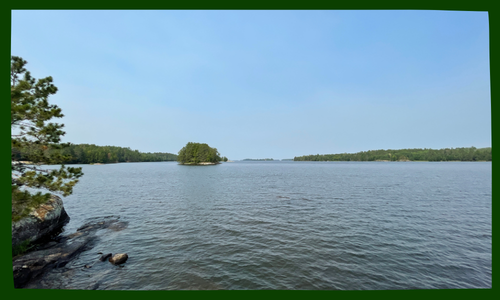
Approximately 40% of this stunning northern Minnesota park is water — and most of its campsites, historic sites, and hidden gems are only accessible by getting out on it. Kate Severson, Program Manager for Interpretation, Outreach, and Partnerships, joins me to talk about the French Canadian fur traders who gave the park its name, the Ojibwe people whose knowledge made their journeys possible, invasive cattail islands that had to be towed back to shore, and why winter might actually be the best time to visit.
I only got to experience Voyageurs from the shore on my visit. After this conversation, I’m already planning to go back — this time with a boat.
A note from Missy: This park surprised me. I knew it was beautiful, but I didn’t know it was this layered — historically, ecologically, culturally. Kate’s description of the Voyageurs themselves — paddling 16 to 18 hours a day, carrying 180 pounds on portages, traveling in birch bark canoes built by Ojibwe craftsmen — stopped me. And the porcupine spirit guide story in the speed round is one of my favorites we’ve ever gotten.
Episode Guest
Kate Severson – Program Manager for Interpretation, Outreach, and Partnerships
Voyageurs National Park
Park Stats
- Where is the park located – International Falls, Minnesota
- Park was dedicated – April 8, 1975
- President when the park was created – Gerald Ford
- # National Park – 36th
- Size of the park – 218,055 acres
- Number of visitors last year (2024) – 199,030
- Field Notes
- Park is made up of 4 large lakes, 26 small lakes, and 655 miles of shoreline
- Evidence of humans 10,000 years ago
- It was a major route for fur traders, who were called Voyageurs
- 270 secluded campsites that you get to via boat
- Home to 50 species of mammals, 100 birds, 10 amphibians, 4 reptiles, 54 fish
Episode Transcript
Voyageurs National Park — Where You’d Better Bring Your Boat
The Parks Podcast, Episode 60 | Kate Severson, Program Manager for Interpretation, Outreach, and Partnerships, Voyageurs National Park
Welcome and the Indigenous History Behind the Voyageurs
Missy Rentz: In this episode, I’m so excited to welcome Kate Severson. Kate is the Program Manager for Interpretation, Outreach and Partnerships at Voyageurs National Park. Kate, welcome to The Parks Podcast.
Kate Severson: Thanks for having me, Missy. I’m really excited to talk about the park today.
Missy: So I only got to experience Voyageurs National Park from the shore — most of it requires a boat to get to. But picnicking at the visitor center and soaking up the environment was enough for me to know how special it is. I want to start with the history of the park and who the Voyageurs were. But first — why are there indigenous peoples in this story, even before the Voyageurs?
Kate: Oh yeah. So even before the French Canadian fur traders arrived, there were indigenous peoples — the Cree, the Assiniboine, the Sioux, the Ojibwe or Anishinaabe. The Ojibwe and the Anishinaabe were the most recent in the area, and it’s honestly thanks to them that the Voyageurs were able to travel here. They used their technology — the birch bark canoe. They depended on these folks for trade and for food. And it’s really the knowledge that the Ojibwe and other indigenous peoples had of the land and how to travel on it that meant that the Voyageurs could come here and establish the fur trade routes.
Missy: Was that an important area because that’s basically as far west as people could go by water?
Kate: The fur trade went even further west — as far as Lake Athabasca. But the Voyageurs and the traders would often rendezvous in Grand Portage in Minnesota — that’s a national monument on the northeastern corner of Minnesota, where the Great Lakes converged with these water routes. Seasonally, with the thaw and then before the next ice layer came in, this was a place where they could meet to trade goods. And here in Voyageurs there was another outpost, another trading fort nearby that was pretty significant.
The Voyageurs — Modern Day Truck Drivers, But Way Harder
Missy: Tell me more about the Voyageurs themselves.
Kate: One of my favorite comparisons is when people compare them to modern day commercial truck drivers — because they’re traveling immense distances across the country, transporting goods. But I would say a lot of the similarities end there. One big difference: Voyageurs traveled as a company of men — they’re in a group, they work as a team, they paddle, they depend on each other. Another big difference is the physicality of the work. Voyageurs would often work and paddle for up to 16, even 18 hours a day. And when they aren’t paddling, they’re often carrying things across what are called portages — the parts of land where they would have to carry canoes and all those goods because there would either be rapids or no connecting water between spots. And so they would carry around 180 pounds. Not to mention the canoe. So it was a very physical job and they were tough. The other thing I like to mention is they were on the shorter side — I like to point out that not all the Voyageurs were these tall men. They were a little shorter so they could fit into the canoes.
Missy: And what were these canoes like?
Kate: No, the canoes used around here would’ve been around 20 to 25 feet long, fitting about eight to 10 men. They were made from birch bark — the birch bark would line the outside, the frame was cedar, and spruce resin would fill the gaps. And this was something they learned, and often Ojibwe craftsmen would create the canoes for them. They were relatively light and fast, and they worked in transporting trading goods — blankets, metal sewing needles, knives — which would be traded for fur, typically beaver pelts. Both legs of the journey, they have to carry the goods there and carry the goods back out. So they don’t ever really have a lighter load. It’s a fascinating time period. It started in the late 1600s and went into the late 1800s — about 200 years.
Missy: Was it a competitive environment?
Kate: There was some competition between the groups. The Hivernants — who wintered out in the western wilderness — would be competitive with what was called the Montreal Pork Eaters, who were seen as a little bit softer. But it sounds like it was friendly for the most part. It could be a bit rowdy when they’d get together. But it wasn’t a safe job either — bad storms, weather, rapids that sometimes you decide to shoot rather than portage — that could be a risky choice. There was also commercial competition between trade companies like the Northwest Trade Company and the Hudson Bay Company.
Wetlands — Marshes, Bogs, and the Floating Cattail Island
Missy: About 40% of Voyageurs is water, and there’s a lot of natural conservation around the water. I’m going to be honest — I don’t really know what a wetland is. What defines a wetland?
Kate: So wetlands are usually found on the edges of aquatic areas and terrestrial areas — between water and land. They are defined by this water saturation of their soil and their ability to support plants that thrive in that kind of soil. There are two types of wetlands found in Voyageurs: marshes and bogs. Marshes are the most prevalent — they have soft herbaceous plants like reeds, sedges, and cattails. Bogs have that soft, spongy peat-like soil of partially decayed plant matter. And there’s so much diversity in the plants found in these ecosystems — there are even carnivorous plants. Pitcher plants are shaped like a pitcher — they draw in insects, and the plant has evolved to decompose the insect and use it for nutrients. It’s really neat.
Kate: And I do want to talk about some conservation work we’ve been doing here. When I first started, there were meetings about how to contain floating cattail mats. And I was like, what do you mean? It was basically a floating island of hybridized cattails that had broken loose from the shoreline and was floating out into the middle of the bay, creating a hazard for boaters and a nuisance for people recreating in the park. So they were trying to figure out how to bring it back to where it had broken off from, stake it down, and then eradicate it. Because these invasive hybrid cattails are really aggressive.
Missy: So they’re invasive — they’re not native.
Kate: No. We do have native cattails, but they aren’t as aggressive and they don’t form those dense mats and they don’t choke out the shorelines as badly as the hybridized invasive cattails. So since 2015 there’s been a wetland restoration project here at the park. Our biologists are trying different techniques and finding out what is most effective. They’ll use prescribed burns — which I was like, how do you burn something that’s on water? But they wait until winter until the cattails are mostly dried out, and then they’re able to set them on fire. They also have machinery that chews it up and spits it out on shore. It’s really important that they do this so that a lot of those native reeds and sedges can grow back.
Missy: Is there anything that park goers can do to help with this?
Kate: Yeah, for the cattails and other aquatic invasive species — things like zebra mussels — we have rules in place when park visitors come about clean, drain, and dry. So if they are going to be in the park for multiple days and they go from one large lake to another, they need to really make sure they’re not bringing any invasive species from one to the other. Their boats and their equipment — if they’re wading in the water — need to dry out completely for at least three days. And we partner with the Minnesota Department of Natural Resources who have staff at the boat launches to check where people are coming from. It takes all of us, because even just one little thing can have that ripple effect. The waters are all connected, so it’s very hard to contain any invasive species.
Historic Structures and Fascinating People
Missy: And Voyageurs is more than just water. When the park was created, there were a lot of structures within the boundaries that you all have historic preservation ongoing for.
Kate: Yes. A lot of people came out here to be inspired, to relax, sometimes even for their health. One of the early conservationists well known in this area — Ernst Oberholtzer, also known as Ober — experienced heart damage caused by rheumatic fever. He was told he could even die within a year. So he came out to Rainy Lake and paddled around here, and he said his health improved with every stroke of the paddle. His home is located just outside the park on Mallard Island. He was a really passionate and eloquent speaker and advocate for this area, and in 1930 he helped usher in important legislation called the Shipstead-Newton-Nolan Act of 1930. It was one of the first federal laws to really protect and conserve wilderness areas — it prevented logging from happening near shore and prevented dams from being built in the park, because there was a lot of industry looking to build dams that would’ve raised the water level by almost 80 feet. That would’ve destroyed habitat, would’ve destroyed shorelines.
Kate: One of my other favorite folks to talk about is June Fujita — a Japanese American photographer in Chicago who photographed some really historic events for different newspapers, including the Valentine’s Day Massacre. One of the taglines for a book about him is that he was “the man who shot Al Capone” — as in photographed him. His job sounded a bit stressful, and he had a summer home out here in Voyageurs National Park. That home is still preserved. He was passionate about his motorboats and would motor all across the lakes. He also wrote poetry inspired by his time out here. Last year we had an artist in residence — Marco Beiser — who composed an orchestra piece based on his time out in the park paddling and camping.
Kate: And then another place in the park called the Ellsworth Rock Gardens — a man named Jack Ellsworth came out and created a sculpture garden that is still available for people to come and see. Unfortunately, that is one of the places you need to take a boat to get to.
Planning Your Visit — Visitor Centers, Lodging, and Camping
Missy: When I was first coming to Voyageurs and researching, a lot of it was about boating and camping. But there’s hiking options, great history. It’s a lot more than just taking a boat to go camp on a campsite.
Kate: Yes it is. There are trails accessible from each of our visitor centers. We have four visitor centers now. The Rainy Lake Visitor Center is the closest access point from International Falls. About 20 minutes from International Falls is Kabetogama — there’s a visitor center there with trails. And I know I’m not supposed to pick favorites, but my favorite visitor center is Ash River Visitor Center, which is in a historic lodge and has that real log cabin type feel. There are some really nice viewpoints from there. And then our newest visitor center, which we just opened up last year, is the Crane Lake one. If you were to drive from Rainy Lake Visitor Center all the way to Crane Lake, it’s an hour 45 to make that full drive. So we’re very spread out across our 218,000 acres.
Missy: What’s the best approach for planning a visit?
Kate: If you’re coming to Voyageurs, it’s highly likely you’re going to be driving a little ways — a lot of people fly into Minneapolis and it’s about a five-hour drive from Minneapolis-St. Paul up to International Falls. We’re right on the Canadian border. If you’re investing in making the trip out here, you should also invest time in planning and really thinking through what you want to get out of the park. If you can, I would recommend camping. It’s really how you can experience one of the most beautiful things you can see in the park — the night sky. I’d also really recommend getting a ticket for one of our boat tours. We are 40% water, and one of the best ways to explore and really get deep into the park is to go out on the water. Our boat tours have ranger guides that give talks about what you’re seeing and about different histories connected to the route you’re on.
Missy: And the lodging — if you’re not a camper, what are the options?
Kate: The park only has one option for lodging within the park — that’s the historic Kettle Falls Hotel. But you have to get there by water. The hotel does offer a water taxi. If you’re looking for something more land-based, there are multiple resorts in International Falls, Ranier, Kabetogama, and around Ash River.
Missy: And when it comes to camping — what are front country, backcountry, and primitive?
Kate: So the word “front country” can be a little deceiving — when I first read that, I thought, oh, I can drive up and pitch my tent. But it’s not accurate. All of the front country sites need to be accessed by water, or in the middle of winter, you could potentially hike out across the frozen lake. There are water taxis that can take you out there. And I really like our previous superintendent’s description — she always called them some of the most scenic and best campsites in the National Park Service, because every single campsite has a water view. Worth the effort to get there. You can also rent canoes or kayaks and paddle out there.
Kate: The backcountry sites are in the interior of the park — you have to hike into them. They’re located on our interior lakes. I like to compare those interior lakes to really fragile ecosystems — almost like alpine tundra — because you’re going into an area that’s very sensitive. But everyone I talk to who goes back there says, I need to go back. It’s just such a fulfilling experience. And then the primitive sites are the only campsites accessible from land — off of the CabAsh Trail, which connects Kabetogama to Ash River.
Getting Around — Water, Drive, or Ice Road
Missy: How do you get around the park?
Kate: You’re going to need to plan on driving, or you’re going to need to access the water. Or alternatively, you can wait till this time of year — in about the next week or two, probably mid-January, we’re going to be opening up our ice road. You can drive your vehicle out onto the ice road and travel through the park. Our staff checks the ice thickness — you need 14 inches of good ice to travel on. And that’s a really unique way to experience the park.
Activities — Fishing, Night Sky, Northern Lights, and Winter
Missy: Let’s talk about things to do. What else can people do?
Kate: Fishing is really popular — people hire fishing guides, go out for walleye and crappie, and do what’s called a shore lunch. Birdwatching — we have a huge diversity of songbirds. And the other thing folks are coming out to see a lot more is our night sky. We’re a certified International Dark Sky Park, and we have multiple night sky programs throughout the year. Personally I like the winter best for viewing stars because it’s not a night owl situation — it gets dark by seven or eight o’clock versus summer when it doesn’t get dark till 10 or 11 PM. And because we’re a certified International Dark Sky Park, we have less light pollution and more visibility of planets, the Milky Way, and even the Northern Lights if conditions are right.
Kate: And we get asked all the time: when can I come out and see the Northern Lights? And it’s really hard to predict because it depends on local weather and on the weather on the sun — because Northern Lights are created by solar particles traveling through our atmosphere. But there are multiple apps that will give you a prediction about three to four days out, and the really good apps will even tell you the likelihood of cloud cover blocking your view.
Missy: And it is winter in Minnesota for a while. What can people do this time of year?
Kate: Right now our Rainy Lake Visitor Center is the only one open, and from there you can rent snowshoes and cross-country skis. If you’re new to winter activities, I would recommend the snowshoes — they’re a little bit slower pace, and I like the snowshoes for multiple reasons. It’s not just about traveling on top of the deep snow — it also gets you to slow down and really appreciate what you’re seeing around you. And the snowshoes we have at Rainy Lake Visitor Center are the traditional style — wooden and woven together. They just have this really great feel. It feels like, I am in the north woods in winter of Minnesota. Oh, and then cross-country skiing is great too.
Missy: I bet the wildlife that comes out in winter is spectacular.
Kate: Oh yes. And everyone asks in the summertime, how do I see a moose? Or how do I see a wolf? And I’m like — come back in the winter. You can see them better, you can see tracks better, so you know what’s been around you.
Speed Round
Earliest park memory?
I’m a second-generation parkie of sorts — my family was always outdoors. But one of my most formative memories is working in the Boundary Waters with AmeriCorps conservation crews. That’s really where my love of wild, remote places took hold.
What made you love the parks?
The iNaturalist app completely changed the way I experience parks — I started noticing things I had never noticed before. But really it’s the connection to the natural world. There’s something about being in a place that was protected for its natural beauty that just makes me feel really at home.
Favorite thing about Voyageurs National Park?
The water. There’s something really special about a park where the water is such a central part of the experience — whether you’re just looking out at it or actually getting on it. The water makes Voyageurs what it is.
Favorite thing to do at Voyageurs?
Paddling on the lakes. I love being out on the water in a canoe or kayak and just exploring. You can get into areas where you feel completely alone and completely surrounded by wilderness.
Park on your bucket list?
Isle Royale National Park. It’s an island park in Lake Superior — you can only get there by boat or float plane. It’s one of the least visited national parks and one of the most remote in the lower 48.
Three must-haves for a park visit?
My phone — I know you try to get away from your screens, but it’s the best way to take pictures and I have the iNaturalist app on it. My dog — I like to bring her along and hike with her. And my water bottle.
Favorite campfire activity?
Reading aloud around a campfire. I worked in AmeriCorps and one of the things we would do was read around the campfire. I worked in the Boundary Waters and we read The Hobbit around the campfire one summer and it was great.
Tent, camper, or cabin?
Tent when I’m feeling adventurous, cabin when I’m feeling like I just want to be cozy and make it easy.
Hiking with or without trekking poles?
Trekking poles on mountains or really rocky ground. If it’s a flatter area, then no trekking poles.
Favorite trail snack?
Savory — cheese and crackers. Sweet — peanut M&Ms.
Best animal sighting?
So when I was younger, I hiked the Tahoe Rim Trail and a friend and I decided we’d hike one of the peaks in the dark to get up there before sunrise. Close to the top we completely lost the trail and I was getting nervous. And then my headlamp caught this animal in the corner of my eye — it was a porcupine. And I went to get closer to see it and this porcupine just trundled along and basically led us back to the trail. So I see it — the porcupine is like my spirit guide in a way.
Favorite sound in the park?
The loon. It’s a waterbird, and once you hear its call across the lakes, you’ll just — it’s so magical, and it is iconic for the Northwoods. I have to say the loon.
Greatest gift the parks give to us?
I would say perspective. Almost like a good book. You go out and you experience the park and you come back with a whole new way of looking at things. Just as with a good book — if you read a good book, you have a new way of understanding the world around you. And a trip out into the park is the same way.
Missy: Kate, thank you so much for joining us and teaching us all about Voyageurs. I want to come back and do the water parts of it and I’m just really grateful to you for sharing your park.
Kate: Yeah. Thanks for interviewing me today, Missy. I’m always happy to talk to people about Voyageurs.
Missy: Thanks for listening to this episode. Until next time — we’ll see you in the parks.
Music for The Parks Podcast is performed and produced by Porter Hardy. Follow us @TheParksPodcast or visit TheParksPodcast.com.