
Episode Guest
David Kilton, Interpretation, Education, and Visitor Services Lead
Pearl Harbor National Memorial
Park Stats
- Location: Honolulu, Hawaii
- Date designated: March 12, 2019
- President when the monument was created: Donald J Trump
- Park size: 21.3 acres
- Number of visitors last year: 1,577,798 people in 2024
- Interesting Facts:
- The attack on Pearl Harbor was what brought the US into WWII
- The attack killed more than 2300 military and civilians
- USS Arizona Memorial was built between 1961 – 1962
- Elvis Presley performed a benefit concert to raise money for the memorial
- Survivors of the USS Arizona can choose to have their ashes entombed on the ship
- Includes Memorials to the USS Arizona, USS Utah, and USS Oklahoma
Speed Round
What is your earliest park memory?
It would be going to the Grand Canyon. I lived in Arizona at the time and I vaguely remember the rim, but I was very little. What I remember more than going to the Grand Canyon and actually seeing the rim and looking down into the canyon, is I was bouncing on the wall between ours and our neighbor’s house prior to us loading up in the van and going and I fell off the wall into our neighbor’s yard into a cactus.
I remember my mom pulling the prongs outta me, and then we went to the Grand Canyon. So that’s my earliest park memory. But we went to the parks a lot and that’s one of the reasons I wanted to work for the Park Service. We have amazing family memories of going camping in the parks and just having amazing family experiences.
But that’s my earliest memory.
What made you love the parks?
Really, the serenity and being out in nature is one aspect, as well as the love of history in whatever National Park service site you go to. You can go to these amazingly beautiful things,have these amazing experiences, seeing wildlife and things like that. But there’s always unique history that connects them to the native peoples, of the connections of people at those locations. Those that first started to preserve and tell the stories of those locations and engage with the beauty of that place, as well as the tragic and. And difficult stories. Or those stories of triumphs that all connect at the National Parks and connecting with those things and having these amazing experiences out in the beautiful areas that help to make, I think the United States, have the unique stories of what make it engaging and just complex in its history and the reality of what this country is.
What is your favorite thing about Pearl Harbor National Monument?
Telling the stories of those who were just beginning their lives and had things cut short in such an unexpected way. And having people to come and understand that the tragedy of that moment is real, and the sadness of it can impact our lives, but it doesn’t have to define our lives or our relationships.
That brings to mind the peace and reconciliation story. One of the most powerful stories that I love to share. It’s a story of a Japanese bombardier and a marine bugler that were on the opposite ends of the story. They came together during one of the commemorations and ended up forming a friendship of bond of love for one another.
That is such a powerful reminder of how we can move past. Those differences and those forces that are pulling us apart or putting us at odds against each other form bonds and relationships that are transformative and beautiful.
What is your favorite thing to do at Pearl Harbor National Monument?
Going and being on the sacred and knowing that is a place we get to honor them. We highlight qthat it’s not just a location where we memorialize those individuals with over 900 of the 1,177 that lost their lives on the Arizona never being able to be removed from the ship. It’s also their burial site. So it’s basically their graveyard. And being able to connect with them and have a quiet moment in that hollowed and reverent location is amazing.
What park have you yet to visit but is on your bucket list and why?
Hawaii Volcanoes. I’m right here and I haven’t been able to go yet. I went for a training over there and was like, “I’ll wait till it stops raining.” It always rains in Hilo so I need to go back and I wanna go.
I worked at Craters of the Moon National Monument in Idaho.
And that location has some connections to basically the hotspot that’s created the Hawaiian Islands. Yellowstone is the hotspot that is created, all the geothermal activity that’s there at Yellowstone, but also left a track similar to the Hawaiian Islands across Idaho. So you can see all these volcanic formations.
So going, and actually connecting with and being there when there’s an actual eruption is a goal. And so I definitely wanna go see it.
What are three must-haves you pack for a park visit?
1. Water bottle
2. Camera
3. My family
What is your favorite campfire activity?
Although I don’t like them, I love roast and s’mores with my family. I don’t like the marshmallows, it’s just the chocolate and graham crackers. But just sitting there together, talking and, fond memories of that.
Tent, camper, or cabin?
Tent. As I’m getting older, I need an air mattress, but still a tent.
Hiking with or without trekking poles?
Without trekking poles
And what is your favorite trail snack?
Fruit leather strips.
What is the favorite animal sighting that you’ve had?
Grizzly bears in Yellowstone.
What is your favorite sound in the parks?
At Pearl Harbor, we have nice, quiet, peaceful, calm waters out at the memorial. It’s just powerful. It’s amazing.
What is the greatest gift the parks give to us?
Enduring stories and places for generations to come.
Transcript
We are headed 2,400 miles off the mainland of the United States to a spot that serves as a memorial to the 2300 people who died during a military attack, the same attack that marked the entry of the United States into World War ii. Join us as we explore Pearl Harbor National Memorial. I’m your host, Missy Rents, and this is the Parks podcast. In this episode, we are so lucky to have David Kilton, who is the Interpretation, education and visitor service lead for Pearl Harbor National Memorial. David, welcome to the Parks podcast.
David Kilton:
Thank you. I’m glad to be on this and excited for our opportunity to talk.
Missy Rentz:
So we start each episode with some park stats. I am gonna run through these just to set the stage.
The memorial is located in Honolulu, Hawaii. It was dedicated as Pearl Harbor National Memorial on March 12th, 2019, when Donald Trump was serving as his first term as president. The Memorial Park area is 21.3 acres, and in 2024 there were 1,577,798 people who visited. Some interesting facts. The attack on Pearl Harbor is what brought the US into World War ii. That attack killed more than 2300 military and civilians. The USS Arizona Memorial was built between 1961 and 1962, and some of the money that was raised for the memorial was from a benefit concert where Elvis Presley performed. The memorial includes the USS, Arizona, USS, Utah, and the USS Oklahoma. And even now, survivors of the USS Arizona attacks can choose to have their ashes ENT tombed on the ship when they pass. David, this is a very special place.
David Kilton:
Yeah it’s an honor. I get visitors that say all the time, thank you for what you do. And I literally, what I just mentioned, it’s an honor to work at this site and to share the powerful heart wrenching and multifaceted aspects of this piece of history and all that ties to it on a daily basis for sure.
Missy Rentz:
I came on vacation to Hawaii and so most of the vacation was beaches and pineapples and to have this really somber moment and to be there was really special. And for me, my. Grandfather was on his way to Pearl Harbor when it was attacked. And we always heard a lot of stories from that perspective of he was days away from arriving, which is really interesting. The first thing I wanna get into is in the stats. I talked about the creation on March 12th, 2019, and I think people will be like, you’re crazy, Missy. You didn’t do your research. But that’s not the case. It was the memorial was created, but like we talk about things shift in the National Park Service. So can you first explain the timeline to us?
David Kilton:
Yeah, so I jokingly say that Pearl Harbor National Memorials had an identity crisis because it’s gone through like multiple stages over, over the time and that really starts going back all the way till just after the attack. One of the amazing stories is the salvage divers that would go into these wrecks. And there were 21 total heavily damaged or sun in ships from the attack that morning, and they put 18 of them back into war service over the next coming months and years, and they would take part in World War ii. So only three. Wouldn’t go into service. And you already mentioned them. That was the Utah, the Oklahoma and the Arizona were the three that didn’t go back into No. Into service. And as they were trying to salvage the Arizona, they quickly saw that the damage that was done from that bomb that. That debt detonated and kicked off the ammunitions and fuel. It had split the keel in half, which is the very heavily reinforced kind of center line of the ship that goes from the bow underneath. And it had split in half. So basically broken the back of the Arizona, and that’s why it sank so quickly. So as they saw that they weren’t gonna be able to salvage it and put it back into war readiness. Also knew the reality and were gathering how many lives were lost on that ship. They decided we’re gonna make this a memorial on a war grave instead of continuing to try to put money into salvaging the ship. Now there were things that were salvaged off the ship. I’ll just drop that in as a little aside. They actually did pull ammunition off. They did pull the three, three of the main battery guns and other pieces off to basically recycle and reuse so they didn’t have to build those materials from scratch as they were trying to now move through having a two ocean war. And so the initial memorial would start right then, and actually the military would put plaques on the ship. Allow people to come out and land on the ship and hold different kind of ceremonies and things like that on these platforms that were there on the ship. And eventually they there’s the decision that let’s actually make a memorial. And so that goes into the process of starting to put out this contract and get a memorial made. And the actual memorial, as you mentioned was built in, was put into actual construction, 61, 62 and actually dedicated on Memorial Day in 1962. And then since after that, the Navy would provide for the visitation of the memorial for the next 18 years. And then it would come to a point that there would be a reaching out for the partnership to begin. With the Navy and the National Park Service starting in 1980. And so in 1980 Arizona Memorial the USS Arizona Memorial was actually established with the National Park Service in the United States in tandem. And then eventually, it would become World War II Valor in the Pacific. And when that was created, it would actually make so that not only the story of Pearl Harbor, but multiple other stories around the Pacific would be shared together. They would share resources, they would share stories, and they would build the story of the Pacific Theater of the War. Jointly. And then that would last until the most recent change where it would go back to a narrow focus just on the Harbor National Memorial and in include the other resources. Yeah. Within the Memorial. Actually the other resources, I’m gonna stop that for just a second. The other resources would be actually included, including the USS Utah and USS Oklahoma Memorial and. Six Chief Petty Officer bungalows, as well as six mooring keys. That would actually be where the ships would tie off and be side by side along Battleship Row. Those would all be added during the World War II valor in the Pacific actually designation. And then during the most recent first Trump administration is when they would actually be go back to a narrow firm focus and create Pearl Harbor National Memorial.
Missy Rentz:
And why do you think it’s important that it’s part of the Park Service?
David Kilton:
I think one of the reasons that is important is not that the Navy doesn’t do a good job of bringing in opportunities to connect with the their history and tell different dynamics, and they have amazing museums. I think one of the things that allows Pearl Harbor to be unique and special as being part of the National Park Service is there are some barriers for the military to get visitors onto some of their resources and things like that. And we still deal with them in some regard as the National Park Service working with. The military is it’s hard to get on base and it’s hard to do that, but we are able to welcome and bring in a much, much larger audience and a much more international audience because we are, we don’t have some of the barriers that the military have in welcoming that audience.
Missy Rentz:
And the one thing, I don’t even know if I have a question for this. I just think it’s important to note. You may have more to say about it, but the, we talked about it, it was a huge loss of life and it might have been, I think the Navy gets a lot of the attention, but it hit all branches of the military. And a lot of civilians. This was really huge.
David Kilton:
Yes that’s actually something that we get a pretty common question is how many. Pearl Harbor survivors are there. That’s a and right now that nom is gonna just continue to dwindle as time goes, but I never know where to draw a line on where I would say that line stops or I ended including the groups that I should, because you can talk about just military personnel. You could talk about just military branches, but you have to take in that their families were part of that too. And even if they didn’t take wounds or things like that. Losing loved ones. They’re part of those World War, Pearl Harbor survivors. And then if you take into account that there were the civilian dock workers that were working right alongside those military personnel, and then the communities that were hit also, some of them even by friendly fire because as they fired anti-aircraft guns. They’d actually have the time when those explosions would co go off. And because they didn’t have the time to calibrate and make that some of those missed and then landed in the local communities and then detonated those communities causing fires and things like that. And whether you want to include them in those or not. There was also the attacking imperial Japanese forces that are part of that story too. The attackers were part of. Surviving Pearl Harbor attack as well. So there’s just a huge different numbers and little circles that you could expand or contract on. What would be in that, included in that number? It’s really hard to say what that is but even on Ford Island, which is the little island behind the memorial, it is part of the active military base, the Navy base the, there’s families that were on that island that got strafed and things like that as the imperial Japanese forces were attacking the airfield and the ships. And so they’re, I’d say they are definitely included in Pearl Harbor survivor for sure.
Missy Rentz:
Absolutely. Yeah. And you talk about the survivors and one thing I think is so special about Pearl Harbor is that for many years you all have captured the stories of the people that were there. And it’s brings tears to my eyes just remembering it. And I was there like 19 years ago and I can still feel walking through the museum and hearing these stories and I think. It is, it’s so impactful to hear them firsthand and you realize how precious those firsthand stories are as fewer and fewer survivors remain.
David Kilton:
Yeah. And. One of the things so I’ve worked at multiple histor historic sites during my National Park service career and I have a little bit of talking about eras, I guess you could almost say. So my first national historic site I worked for at was Golden Swag National Historic Site. Happened 150 years ago. So in that case, you’re like, we hope the history books have it right.’cause we can’t talk to anybody that actually experienced it. My, my next one and just most recent prior to coming here was Central High School National Historic Site where I got to meet the Little Rock Nine and work directly with individuals that. Lived those experiences and happening just over 60 years ago and get to really connect and get their firsthand reflections and connections and feelings of what happened. We also had that opportunity with Pearl Harbor National Memorial, and I’m grateful that so many did take those opportunities and we still have a lingering ability to connect with those that had those experiences and lived. What that was. One of my really good friends that I’ve met here since I moved here to the island, his uncle was worked as a diver. One was actually one of those salvage divers. So hearing reflections of him, remembering what happened with his uncle, and he is yeah, he disappeared for two weeks and we didn’t know what was going on and even really what he was doing and just then eventually they. He talks about, then we went down to the docks and we’d see him come up out of the water covered in the crude bunker oil that looked like tar and coming out and there’d be just kids hanging out on the docks, seeing that, seeing the reality of what it was. So those type of experience where you actually get to hear the reality, what happened, and this is a side story to those that actually lived it and being able to have had, those stories captured and be able to be the stewards of carrying them forward as again, why it’s an honor to.
Missy Rentz:
Yeah. And I think I remember it also at Ellis Island very, a very similar feeling, but the memorabilia that you also are able to get. So the museum is not, recrafted from pictures. There’s actual memorabilia that people have donated in order to showcase the story of that day and the time after it.
David Kilton:
Yeah. One of, one of my favorite things when I first came here that is just incredible to see is we have basically the edit of. Franklin President Franklin Delano Roosevelt’s speech that he would say the famous day of Infamy speech. And as you look and see his markings of words he changed and things that he did, it just makes it so much more real. And you get to step into a little bit the mindset of the president preparing to announce that. The United States would now inter officially into World War ii and just it just, his selection of words and some of the things it just’cause infamy wasn’t even the first word that was in that speech and he changed it to, to bring that out. So it’s really cool.
Missy Rentz:
Wow, that is really cool. Oh, I love that. Okay, so right now, if you are able to watch the podcast, you will see that David is sitting in front of this incredible image. Of the museum and I, what I wanna do is we get into planning a visit. I’d love to talk about, this is unique because you actually, I’d just like to talk about like, when you get there, what exactly is the experience that you’re gonna have?’cause you’re not walking into a big stone building that, has has all the artifacts there. This is unique.
David Kilton:
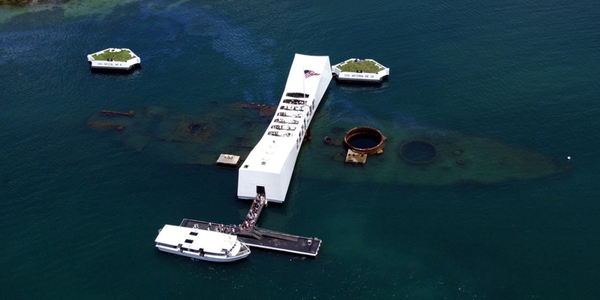
Yeah. Pearl Harbor the memorial is probably one of the most sought after designations or destination spots on Oahu and. Even potentially even in Hawaii, the, all the islands. So we, we get a large number of people to come and I wish I could say, oh, it’s easy. You know how you come in and you know how to do everything you need to, but it does have some confusing nature of it. And I I’d say one part of that is that we do have. Partners that work out outside of just the National Park Service work very closely, and we all connect at this one location. So you come in here and you have the the USS Missouri a battleship that you can go over and see as well as Pearl Harbor Aviation Museum, and then you have the Pacific, history summary Museum and our partners that also just run the bookstore and things like that. So it’s not, you come onto the campus, it’s ah, where am I going? What am I trying to do? So there’s a lot with that, but eventually you can come over and specifically for the National Park Service, you have our two museums and you have a place where you can watch a film and then where you actually board. Active duty, US Navy piloted boats that take you out to the Arizona Memorial. Now, something that’s a unique thing that a lot of people don’t know is that they actually consider those boats tenders of the USS Arizona and the the active duty sailors are considered. Part of the USS Arizona crew. So they actually are called the Arizona Detachment and they actually get the honor of helping visitors go out and have that experience. So we work very closely with the US Navy to provide for this opportunity. And if you are looking at the podcast and see this white structure that’s behind me. Is the Arizona Memorial, and that’s the like key destination point that most people want to have the opportunity to come out and see. So we can get just over 4,000 visitors a day on these boats. We take a boat out every 15 minutes. And can load 145 passengers onto that boat. And so where it’s a quick turnaround, getting folks and getting as many people that opportunity to have that honor and be able to go out there and pay their respect each day. And there are days where unfortunately we can have six 8,000 visitors. So if you can imagine, we can just only get just over 4,000 out there. There are days where we unfortunately have to say, I’m sorry. You don’t get the opportunity to go that way. And that’s hard. We want everybody to have an equal opportunity to get out there and get that experience. But there are some things that we do to help provide a little bit of planning and opportunity to make that a little bit an easier process. And one of that is we do release through recreation.gov. Opportunity to make reservations to get your spot on one of the boats. And they released tickets 56 days in advance, so about eight weeks out, and then also the day before and on for the different time slots. And I wish I could say, yeah, you jump on that reservation and again, you can guarantee you’re gonna get a spot on the boat, but they go so quick. Especially during our busy, like kind of peak seasons and stuff like that, we really don’t have a down season like some other national parks. We are a year round visitation destination spot. If you can imagine in the winter, where would you like to go and get out of the cold? Let’s come to Hawaii.
Missy Rentz:
So
David Kilton:
So
Missy Rentz:
I’m guessing like Christmas break is a big peak.
David Kilton:
it is huge and actually, the days following Christmas almost you can guarantee those days between the holidays, Christmas and New Year are gonna be the busiest days of the year. So that’s when you are gonna have the six to thousand visitors guaranteed to be on site. We also have we do have a bump for spring break for sure and then summer so typical what you’ll see at a lot. Of other NPS sites. December 7th is around the commemoration. There are, there is a a bump with that as well. And I’d say dropping to 3000 visitor days is not common. But you do have that some of those other times around the year.
Missy Rentz:
so if you have the flexibility to go during a off time, that is a better, you have a better chance to,
David Kilton:
I’m getting those reservations to guaranteed spots on the boat. Now, if you’re not able to get the, oh, I will just mention real quick to get those reservations yourself. It’s a dollar per seat and that just goes straight to recreation.gov. It won’t come to the National Park Service. We actually buy mandate. We’ll never charge to get anybody out to the memorial. That is and it makes sense. I would feel greasy if I was charging to get people out to pay their respects to the debt. I would you don’t do that now if you also wanna try to get it into a package and see other things. There are tour providers that will pass. Provide that in a package deal and they will provide for bus transportation and other things like that. And so those will be more expensive. I can’t tell you the prices on all of those because every tour company does it different. But but there’s other ways you can get those reservations. They get access to us some of the some of the time slots as well so that they can make reservations and provide those for their guests. But if you can’t get, either, if you can’t pay for the tour or you can’t do the recreation.gov reservation, all hope is not lost. There’s another option for you. And we’ve actually, within the time I’ve been here, I’ve been here almost four years we’ve created another option that is gonna, that has proven to be just positive feedback and been so helpful that we’re gonna make this a permanent, situation is you can actually come in and using just your phone, you can sign up for what we call standby and that basically just saves your spot in line. And then when we look like we can fit you on a boat, we will send you a text and then you come and jump in line. And usually by the time you get that text, you’re gonna be on a boat within the next 15 to 30 minutes and be out.
Missy Rentz:
That’s great.
David Kilton:
So prior to that, we used to have where people would get in these long lines and just have to wait and see what we could do. And with that being the case, unfortunately we would have people waiting for hours in line. They’re not connecting with the history, they’re not learning about what happened, they’re just standing in a line and seeing what their shot might be. And then also. Standing out in the heat and there was a lot of other things just uncomfortable and things and just so this option of the virtual standby queuing gives us a lot more benefit to try to help the visitors get the most out of their experience. And even on those days when they can’t, get the, get that opportunity to get on a boat. If it’s a six to 8,000 visitor day, at least they didn’t spend all their time in line and get turned away. They can go do other things while they’re waiting to see if that might be a possibility.
Missy Rentz:
And there is so much to do. I, it sounds like even more than from when I visited, the museum is spectacular that to get the history of it and to experience it.
David Kilton:
Yeah. Yeah. It, I we, so just recently we connected our site to the history of Oshima don’t, knowing the stories are very different, the, but both of our sites, so Oshima, peace Park. Tells the story of the bombing of Hiroshima and tells about what kind of happened and all the ins and outs around that story and has multiple monuments and things. Both of our sites seeing kind of some of the things connected is we both have, part of our missions is seeking as we reflect on these stories, is hoping for peace and reconciliation. And sharing what that can be moving forward. And then also have a huge educational foundation of what our missions are. So with those two guiding principles being a major factor in both parks, we felt there was an opportunity to. Combine our very different stories and make an opportunity to really connect and bring aspects of the story together. And so we now have a sister park relationship with Sima Peace Park, and we’ve done some educational opportunities where we’ve done exchanges with students going there and students coming here and just have those opportunities that are really neat and just really share our resources and the knowledge we have to be able to more effectively tell the nuances and all the different connections and the fabric of what the reality of the war and even some of the major events within the Pacific Theater of the, of World War II are
Missy Rentz:
that’s really cool. That’d be an interesting, just really, it’s really neat to see the different perspectives from the different countries. That’s very cool. So how do you go about seeing the USS Oklahoma and USS Utah memorials? I.
David Kilton:
So if you just go right onto our website, there are ways you can connect and learn a little bit about the history, but if you actually want to go and see them unfortunately this brings up something we already talked about. They are on the active military base on Ford Island. So if you don’t have military access. You really can’t get over to see them. So we started with the 80th anniversary of of commemoration to, we did a kind of a pilot run to see if we could work with the Navy to get. To guide Tors over to see those memorials and connect with their stories. It was very well received. It worked really well and the Navy was really pleased at things that we established to make sure that we were, kind of protecting their interests and things that they needed to do with that active military base as we were trying to guide the tours. As I said, it worked so well that we started actually instigating so that we would, that next spring begin so that we do this tour every week. We do it three times a week Monday, Wednesdays, and Fridays from three 30 to five. Again, through recreation.gov, people can make their reservations. We started out, it was a 25 person tour, so very limited. If you imagine how many you mentioned how many visitors we get a year, very, a drop in the bucket, drop in the ocean. How many an opportunity? And so we but again. We were doing that and it proved to be so effective that now we’ve bumped up. And so just this last year we jumped up to now we can take 44 visitors per tour. So just about 150 people a week get that opportunity to go with one of our rangers, go over on a program, get to hear more, get to see those stories and really have a unique opportunity to connect. We are hoping that as we started this relationship to provide access to those resources with the Navy, that there will be more opportunities going forward, but we definitely want to continue to maintain and protect. I. The interests of our military partners as we move forward and we’ll we’re seeing what might come moving forward to allow for that, including even maybe even accessing the other resources, which were the six Chief Petty Officer bungalows, I mentioned those briefly. So there are six units that were basically given to the National Park Service to maintain, preserve and tell the stories of these were homes. Where military officers and their families would’ve lived and would’ve been witnessed buildings to the attacks on Pearl Harbor. And so we are looking to provide for renovation and restoration as well as preservation of those units to tell more of this story.
Missy Rentz:
I can’t imagine being there that close, witnessing that. Wow. Wow. That’s special. How much time should someone allow when they come to visit?
David Kilton:
Just the experience going to the Arizona Memorial, when you get on the boat and get out there, it’s gonna be 45 minutes by itself. So if you figure in, if you wanna watch the movie, if you wanna explore the museums, and then definitely if you wanna. Check out any of the partner sites. I’d say plan at least for half a day to a day. Some people will actually spend multiple days at the site and that’s, that’s just man, yeah, we’re, we wanted to come and just do the Arizona Memorial aspect of things and do the NPS side of things one day and we’ll come back the next day and do the partner sites because those stories are fascinating and have a lot of interest for us too. Yeah.
Missy Rentz:
And then can people drive there themselves?’cause it’s not, it’s, I remember it’s not. Necessarily close to the main hotels, at least some years ago, but do they drive there or is it best to do like a bus or other transportation?
David Kilton:
So there’s multiple options and that’s something that I’d say is growing. So right now you can definitely ride the bus. And a lot of people will, I mentioned there’s the tour providers that provide bus transportation. We we do have parking lots, but they are fairly limited. And in fact, because of the limitation to the parking lots. Recently to maintain and provide other access and things for the visitors. We did institute a parking fee just so we can do what we need to do with all that. So there is a$7 parking fee covers the whole day that you can come and do that. But then the other option that’s developing is there is a rail system that is, is, is slowly progressing to provide access mainly on this side of Oahu, Honolulu, going to a lot of the destinations here in, in the area. Right now the open and operating portion of the rail is really going from just west of Pearl Harbor. Out to the more western side of the island. But the next leg that will open up will connect with the airport and really allow better access to us. And that’s gonna continue to expand going into Honolulu. And so that’s another option. Some people use Uber and and,
Missy Rentz:
lift.
David Kilton:
Yeah, Lyft and the park and ride. There are taxi services that help too. So quite a few options. And from Honolulu, which is where a lot of people will be. If you don’t have traffic that can sometimes rise and be a pretty big deal. If you don’t have traffic, it’s about 30 minutes to.
Missy Rentz:
And are there food options when you’re there or do people need to pack food?
David Kilton:
Bring up a couple things with that. First of all, for food options on site, there are some things, we actually have a snack shop. If you think of convenience, like prep, pre-prepared sandwiches, chips, that kind of stuff. There, there’s that is available right on ground, a myriad of different drinks. Then the partners, each of their sites have some other food options that they provide, and the submarine museum will actually run a hotdog stand that’s just out there so people can grab that. And then each of them, when you visit their site which do have a fees associated with them, you have like cafe or different eateries that you can eat on that. Bringing your own food. Actually is not the best idea because there is a bag policy to come on site because from our location you can board a bus that will take you over onto Ford Island to go see the USS Missouri and the Aviation Museum. The Navy has asked us to help them provide for basically, base security and we cannot allow bags onto
Missy Rentz:
So no bags.
David Kilton:
outside. So you can’t bring any bags up bigger than like a wallet size, small little like hand purse type thing. Anything bigger than that is not allowed on campus for base security. And
Missy Rentz:
And and that’s on the website? Yes.
David Kilton:
Yes.
Missy Rentz:
So it seems like as we wrap up how to plan it seems, most people when they’re gonna come to Hawaii, they’re putting a plan together anyway, so they’re in planning mode, but recreation.gov is gonna be your friend and getting your reservations in advance. I think it sounds like going early if you’re driving yourself, because parking could be an issue. And also, at least when I was there, going early meant it wasn’t hot, and by the time I left, it was still really hot. But it just, there was a little bit of, skin preservation in that one. And so I think it’s just prepare, I think the website. I’m always saying go to the website, go to the app. Does an amazing job of walking you through different planning options. But it, but this is a park where preparation is really key.
David Kilton:
Yeah. Yeah. And one of the things I will highlight with bags is if you have a clear bag. You can bring a clear bag. So as long as our security guards at the front can look and see what you’re doing and nothing that’s being brought in is at risk, you can bring that in. And then if you buy stuff on ground, so let’s say you do come in and you wanna buy some snacks to carry through your day, that’s fine. If you have one of the bags that you get in the bookstore and you have those with you, that’s fine. You just won’t be able to have any open snacks or treats or drinks besides water. When you go out to the Arizona Memorial to protect, keeping the boats from getting gross and sticky and everything like that, as well as the memorial trying to preserve, to keep that from getting covered in Coke or whatever.
Missy Rentz:
And that’s really sacred ground. It’s really very serene and reflective that, that portion of it. You have given so much information that I is linked on the website. So for listeners on the Parks podcast website, on this episode page, I’ll link to a lot of the things that David talked about, just so you have easy access to get to those tips and tricks and information. So we wrap up every episode with a speed round of questions. So I just want you to answer with whatever comes to mind. Okay. What is your earliest park memory? I.
David Kilton:
It would be going to the Grand Canyon. I was I lived in Arizona at the time and I vaguely remember the rim, but I was very little. What I remember more than going to the Grand Canyon and actually seeing the rim and looking down into the canyon. Is I was bouncing on the wall between ours and our neighbor’s house prior to our US loading up in the van and going and I fell off the wall into our neighbor’s yard into a cactus. I remember my mom pulling the praying prongs outta me, and then we went to the Grand Canyon. So that’s my earliest park memory. But we went to the parks a lot and that’s one of the reasons I wanted to work for the park Service is just we have amazing family memories of going and camping. In the parks or at Ks close by and just having amazing family experiences. But that’s my earliest memory.
Missy Rentz:
And what made you love the parks?
David Kilton:
Really the serenity and being out in nature is one aspect as well as the love of history and whatever national Park service site you go to. You can go to these amazingly beautiful things. See these amazing, have these amazing experiences, seeing wildlife and things like that. But there’s always. Unique history that connects them to of the native peoples, of the connections of people at those locations, those that first started to preserve and tell the stories of those locations and engage with the beauty of that place as well as the tragic and. And difficult stories or those stories of triumphs that all connect at the national parks and connecting with those things and having these amazing experiences out in the beautiful areas that help to make, I think the United States have the unique stories of what make it engaging and just complex in its history and the reality of what this country is.
Missy Rentz:
What is your favorite thing about Pearl Harb Harbor National Memorial.
David Kilton:
So telling the stories of those that were just beginning their lives and had things cut short in such a unexpected and, a definitive way. And having people to come and understand that the tragedy of that moment is real and and the sadness of it can impact our lives, but it doesn’t have to define our lives or our relationships. And that brings to mind again, the peace and reconciliation story. One of the most powerful stories that I. I love to share. It’s a story of a Japanese bombardier and a marine bugler that were on the opposite ends of the story that came together during one of the commemorations and ended up forming a friendship of bond of love for one another. That is, is such a powerful reminder of we can move past. Those differences and those those forces that are pulling us apart or putting us at odds against each other and form bonds and relationships that are transformative and beautiful.
Missy Rentz:
What is your favorite thing to do at Pearl Harbor National Memorial?
David Kilton:
Going and being on the sacred ground that you mentioned being at that location. And being able to see those needs and know that is a place we get to honor them. And one of the things I, we highlight quite often is that it’s not just a location where we memorialize those individuals with over 900 of the 1,177 that lost their lives on the Arizona never being able to be removed from the ship. That’s also their burial. Site, that’s the, that’s so it’s basically their graveyard. And so we being able to connect with them and have a quiet moment in that hollowed and Revent location is amazing.
Missy Rentz:
What park have you yet to visit, but it’s on your bucket list and why?
David Kilton:
I, some people are gonna go, wait, you’ve never been there? Hawaii volcanoes actually I’m right here and I haven’t been able to go yet. I went for a training over there and was like, oh, wait till it stops raining. It always rains in Hilo so I need to go back and I wanna go. So I worked at creators of the Moon National Monument in Idaho. And that location has some connections to basically the hotspot that’s created the Hawaiian Islands. Yellowstone is the hotspot that is created, all the geothermal activity that’s there at Yellowstone, but also left a track similar to the Hawaiian Islands across Idaho. So you can see all these volcanic formations. So going and actually connecting with and being there when there’s an actual eruption is a goal. And so I definitely wanna go see it.
Missy Rentz:
What are three must haves you pack for a park visit.
David Kilton:
Water bottle camera and can I say my family?
Missy Rentz:
Perfect.
David Kilton:
Yeah.
Missy Rentz:
What’s your favorite campfire activity? I.
David Kilton:
Although I don’t like them, I love roast and s’mores with my family. Like I don’t like the marshmallows, it’s just the chocolate and Graham. But just sitting there together and talking and just having the, those treats and just a lot of fond memories of that. Yeah.
Missy Rentz:
Are you staying in a tent, a camper, or a cabin?
David Kilton:
As I’m getting older, I need an air mattress, but still in tents
Missy Rentz:
And do you hike with or without trekking poles?
David Kilton:
without
Missy Rentz:
What is your favorite trail snack?
David Kilton:
fruit. Fruit, leather strips. Yeah. Yeah.
Missy Rentz:
What is your favorite animal sighting?
David Kilton:
Grizzly Bear Yellowstone
Missy Rentz:
What is your favorite sound in the park?
David Kilton:
at Pearl Harbor. We have nice quiet, peaceful, calm waters. Out on the memorial is, it’s just out there at the memorial. It’s just powerful. It’s amazing.
Missy Rentz:
And what is the greatest gift that the parks give to us?
David Kilton:
Enduring stories and places for generations to come.
Missy Rentz:
David, thank you so much for being part of the Parks podcast and sharing this incredible space. It has been too long, and I may need to plan another trip out there to remember so much of this. But thank you for joining us today.
David Kilton:
Glad to. Thank you so much. Thanks for the opportunity.
Missy Rentz:
That’s all for today’s episode. Until next time, we’ll see you in the parks.
Thanks for listening. If you enjoyed today’s episode, please be sure to like and share on your favorite podcast platform. Music for the parks podcast is written, performed and produced by Porter Hardy. For more information, please follow us on Instagram at the parks podcast. Or visit our website@theparkspodcast.com.