
Organ Pipe Cactus National Monument is the only place in the United States where organ pipe cactus grow naturally. It’s also the only US location that’s part of a UNESCO Biosphere Reserve for the Sonoran Desert, one of the most biodiverse deserts in the world — home to 650 plant species, 31 species of cacti, bats that migrate from central Mexico to northern Arizona following the blooming of the cacti, and scorpions that glow bright green under UV light. Digital Interpretation and Education Ranger Kate Blanch joins The Parks Podcast to share everything about this remarkable, remote, and deeply misunderstood park.
A note from Missy: Organ Pipe Cactus is one of my favorite parks. I don’t know if it’s when I started to get comfortable in parks, or the experience of ranger programs, dark skies, and desert landscapes — but it’s my quick answer when someone asks me about favorite park experiences.
Episode Guest
Cate Blanch, Digital Interpretation and Education Park Ranger
Organ Pipe Cactus National Monument
Park Stats
- Location: Pima County, Arizona (on the US-Mexico border)
- Established: April 13, 1937 (President Franklin D. Roosevelt)
- Size: 330,000 acres
- Annual visitors: 133,317 (2022)
- Hiking trails: 28 miles
- UNESCO designation: Man in the Biosphere Reserve (1976)
- Plant species: 650+
- Cacti species: 31
- Three large columnar cacti: Organ pipe cactus, saguaro, senita
- Only US location: Where organ pipe cactus grow naturally
- Bat species: 16+; lesser long-nosed bat is primary pollinator of organ pipe cactus
- Five seasons: Dry winter, spring, dry summer, monsoon summer, fall
- Peak season: December through mid-April
- Dark skies: Designated International Dark Sky Park
- Campgrounds: Twin Peaks (208 sites, solar showers) and Alamo Canyon (4 sites, primitive)
- Program: “I Hike for Health” — hike 5 miles, earn a commemorative pin
Show Notes & Links
- Plan Your Visit — Organ Pipe Cactus National Monument
- Camping — Twin Peaks and Alamo Canyon
- Camping reservations — Recreation.gov
- I Hike for Health program
- Pet-friendly trails at Organ Pipe
- Ranger programs — December through mid-April
- UNESCO Man in the Biosphere Program
- Dark sky information
- America the Beautiful annual pass — $80/year
- 4th Grade Free Pass — Every Kid Outdoors
- Border crossing information and safety guidelines
- Visitor center — free Wi-Fi for same-day reservations
Transcript
Organ Pipe Cactus National Monument — The Green Desert
The Parks Podcast, Episode 5 | Cate Blanch, Digital Interpretation & Education Park Ranger, Organ Pipe Cactus National Monument
What Is an Organ Pipe Cactus?
Missy Rentz: I’m thrilled to welcome Cate Blanch, the Digital Interpretation and Education Park Ranger at Organ Pipe Cactus National Monument. Prior to Organ Pipe, Cate worked at Sequoia and Kings Canyon and Olympic National Park. Cate, welcome to The Parks Podcast.
Cate Blanch: Thank you so much for having me.
Missy: I’m going to start with some park stats. The park is located in Pima County, Arizona. It was created on April 13th, 1937, when Franklin Delano Roosevelt was the president of the United States. The park is 330,000 acres. In 2022, you had 133,317 guests. There are 28 miles of hiking trails. It’s called the Green Desert and is the wettest desert in the world. There are 650 plant species and 31 species of cacti. It’s the home to three large columnar cacti, and it is the only place where the organ pipe cacti grow naturally. The Sonoran Desert is the most biodiverse desert in the United States, and in 1976 it was awarded the designation of the United Nations Educational, Scientific, and Cultural Organization. This is an incredible park.
Cate: It’s pretty impressive. I’m impressed by you getting the exact visitor count. Thank you, Google.
Missy: Okay, so I’m going to start out with something very simple. What is an organ pipe cactus?
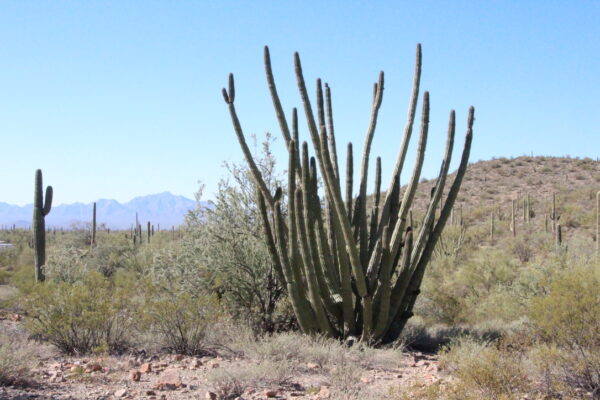
Cate: It is a beautiful columnar cactus. It has many branches, and each branch has about 14 to 20 vertical ribs — vertical columns along the branch. And the organ pipe cactus is one of three columnar cacti we have in the park. One of the reasons this park is so special is because this is the only place in the United States where the organ pipe cactus can be found. So certainly worthy of the name of a national monument.
Missy: I know that one of the reasons the national monument was created is because it was a pristine Sonoran Desert landscape. Tell me a little bit about the creation back in 1937 and why this park is so important to the system.
Cate: So as you mentioned, it was created on April 13th, 1937 by President Franklin Delano Roosevelt. What was going on at that point in time was they were looking for an area of the Sonoran Desert that would really represent the Sonoran Desert — like if you went anywhere in the Sonoran Desert, you’d be like, this is the place to go. This area was selected because of the pristine landscape and the biodiversity found here. And another important aspect of this landscape is that it is the traditional home of the Tohono O’odham peoples as well. So this landscape has an amazing scenic value, an amazing ecological value, and a great cultural value as well.
Scorpions, Stars, and the UNESCO Biosphere Designation
Missy: I was working on a blog post for this episode and going back through my journals from when I visited. I was quickly taken back — the cacti are beautiful, the flowers from them are beautiful, and then the animals are intense and diverse and even somewhat scary. I went to a ranger program and I was like, how am I going to sleep after this?
Cate: It wasn’t about scorpions. What was it about?
Missy: It was about the scorpions. And isn’t it true — the scorpions, when you go to find them, you can use a UV light because they become iridescent?
Cate: Yeah, if you shine a UV light on a scorpion, it’ll fluoresce green. It’s a really fun thing to do in summertime when they’re all out — you can just find them hiding under bushes everywhere.
Missy: I want to come back and do that because I wasn’t prepared for it at the time. Actually when I was there it was right in the middle of COVID. It was the only ranger program I could participate in for like a year.
Cate: I was probably the one who gave that program.
Missy: Really? Oh, that’s so funny. Who knew it would have brought us back? The other thing that was really intriguing to me as I was researching is the UNESCO designation. It’s not something I’ve come across with any of the other parks I’ve been researching. Can you tell me a little bit about that?
Cate: Yeah. So UNESCO is the United Nations Educational, Scientific, and Cultural Organization. In 1971, they created the Man in the Biosphere Project. To quote from their website: it “was started with the intention to test and outline how humans can strike a balance among the apparently conflicting issues of conserving biological diversity, promoting economic and social development, and maintaining associated cultural values.” In essence, it’s understanding the world around us, the life around us, and how humans play a role in and impact that life. With this program, Biosphere Reserves were created — designated areas, usually pristine areas where there isn’t too much human impact, and a lot of research happens there to understand the life in that area. This area was set aside in 1937 to be a pristine exemplar of the Sonoran Desert. So in 1976, we got that biosphere designation. Right now we have eight different researchers in this park studying everything from bats to toads to tortoises to birds. We have researchers from all around the world who come specifically to learn about the Sonoran Desert and how humans impact the life around it.
Missy: Is it hard to keep it so pristine?
Cate: It can be. There are a whole bunch of different factors. Humans can impact it physically — for example, if you walk on top of cryptobiotic soil, you’ve destroyed 10,000 years of growth potentially. But even from a distance without setting foot in a place, humans can impact it via light pollution, air pollution. All this research is studying how we are affecting these areas and how we can best mitigate those effects.
Missy: And I think it’s important to know when you’re going to a park and you see “leave no trace” or signs saying to please stay on the trail — this is to preserve it. It’s not because we don’t want to pay people to pick up your trash. It’s because we need to preserve this land for future generations.
Cate: Exactly. These areas have been set aside for preservation into the future so that if I have children and they have children, those people in the future can enjoy these places just as much as we do today. And of course the choices we make today will impact how this place is preserved into that future.
The History of Ranching and Mining
Missy: In the creation of the park, I was reading quite a bit and a lot of parks have this issue where in claiming land, sometimes it’s claiming it for others. In this area, there were ranchers and miners who really did not want this space to become a park. Can you tell me a little bit about that controversy and how it’s now such a really lovely, welcoming space?
Cate: That’s a wonderful question. And no matter throughout the history of the NPS, even today, when new parks get designated, there are human things happening — whether it’s ranching or other impacts — that we have to work through with local peoples to benefit everyone as much as possible. The history of ranching in this area actually dates back to the late 1600s with the arrival of Father Kino in this area during the Spanish mission era. So there’s been cattle ranching, horses, and burros in this area for hundreds of years. The most prolific rancher that we know of was the Gray family, who arrived in 1919. They had seven different children and the most prolific cattle ranching operation in this area — they were here for almost 20 years before this was designated a national monument. Of course there was huge impact, because these cattle need the different plants and grasses in the area. This was their livelihood. So imagine if you owned a bakery and someone knocked on your door and said, “Hey, we’re going to make this a historic district, you need to get out.” It doesn’t work quite like that. So it’s very understandable that the people in these areas were upset by this.
Cate: What ultimately happened with the ranching and some of the mining was that they were grandfathered in. Victoria Mine ran until the 1970s, and the ranching was allowed to continue with the Gray family until their permit ceased — also ending in the 1970s. By then, the last head count was about 1,700 cattle, which is a lot. And of course any introduced animal or introduced plant is going to affect that landscape. The cattle ate the grasses and plants, trampled the smaller plants and cacti, and there are actually several species of grass in this area that almost went extinct because they were getting eaten. So it’s a matter of balancing those impacts with trying to protect this area as well.
Cate: But what’s really cool is that we now also have that cultural history in this park. When you go around, you can actually see the remnants of the old mining areas like Victoria Mine. You can go see the old ranching areas at Bates Well, Dos Lomitas, and Alamo. There’s signage explaining that history. So ultimately this park is being preserved and protected for that future generation — but so is that cultural history. And sometimes that conflict plays a role in that history as well.
Wildlife — From Bats to Javelinas
Missy: We’ve talked a little bit about the wildlife in the park. There’s venomous animals, javelinas, skunks, coyotes, squirrels, mountain lions — when I was in my tent, I was like, is this right?
Cate: That is correct. An incredibly diverse amount of animals here. We have badgers, tons of lizards, reptiles, even amphibians — like the Sonoran Desert toad. We have desert pupfish. So we actually have fish in the desert. Mud turtles. Sonoran Desert tortoises. The amount of life that you can find in this desert is absolutely astounding.
Missy: One of the things you mentioned that I read a little bit about is the bats. They play a big role in the park, right?
Cate: They do. We have at least 16 different species that I’m aware of. But one of the big bats that we often talk about is the lesser long-nosed bat, because they’re the main pollinator of the organ pipe and a lot of the different cacti in this area. Those bats follow what is called the nectar trail — they actually migrate with the flowering and fruiting of the cacti all the way from Central Mexico all the way to northern Arizona and back, following the fruiting and the flowering of the different cacti. They pollinate the flowers, and then as the fruits come out, they become fruit-eating bats. In summertime, we don’t get many visitors — but summertime is actually one of the best times to visit because the amount of wildlife that starts appearing is absolutely breathtaking, including the bats.
Missy: So what is your peak season then?
Cate: Our peak season is usually December through mid-April. Right now in July we’re getting like 15 to 20 visitors a day, whereas during that time we’ll get around 300 a day.
The Border Checkpoint — What to Expect
Missy: One thing I want to touch on before we get into planning is that you are on the border of Mexico. So when I was driving in, going through the checkpoints was a little jarring the first time. Can you tell people what to expect?
Cate: Yeah, and I think everyone gets that experience the first time — like, what is happening? Did I do something? The border checkpoints are there. If you are driving toward the park, they’re not really interested in people driving through — they’re checking things on the way out. They’re generally just checking to make sure everyone in the car is a U.S. citizen, and then they just let you roll on through for the most part. The border itself is a very different checkpoint — you need your passport, and they’re going to make sure you aren’t bringing fruits and vegetables or anything that may have insects or some sort of contaminant. So that tends to be a bit more thorough. But even then, nothing crazy. And on our website, we do have some safety guidelines for making sure you’re not picking up hitchhikers and things like that when you’re getting closer to the border, just for your safety.
Planning Your Visit — Camping, Supplies, and Fees
Missy: It’s a pretty remote park. It’s not like some of the more urban parks where there’s easily a hotel nearby. But you do have a lot of camping options in the park.
Cate: We do. We have two major campgrounds. Twin Peaks Campground has 208 sites — about 174 RV sites, some with generators and some without, plus a bunch of tent sites. We can pretty much hold anyone there. It’s an established campground, so the campground amphitheater is there for ranger programs. There are a bunch of hiking trails that lead out of it. It has bathrooms and free solar-heated showers, which is really nice in the desert.
Missy: Really nice. It’s like one of the nicest campground bathrooms I’ve ever been in.
Cate: I think it was the first place where I’ve ever actually seen free campground showers. It’s a really lovely campground, and one of the dog-friendly trails — the Palo Verde Trail — leads out of it. There are also group sites, so if you have a larger party, you can group camp there as well. Besides Twin Peaks, we also have Alamo Canyon Campground. This one is better if you’re looking for a more primitive experience. There are only four sites and it’s tent only — but it’s just beautifully tucked underneath the Alamo Mountain range. You’re just tucked under these mountains in the saguaro forest, far away from the road, quiet, beautiful, and you get fabulous dark skies out there. Just this year we made the transition to have Alamo Canyon on recreation.gov, and we’ve had multiple people tell us thank you — because they’d always wanted to camp there but were terrified to drive six hours only to find no space available. Now they can just book it with the click of a button.
Missy: And I think one of the pieces of advice I would give is to make sure you get your supplies before you come into the campground because the nearest town is quite a ways away.
Cate: Yeah, Ajo is the closest place to pick up any sort of supplies — it has groceries and restaurants. Lukeville, which is right on the border, has a gas station as well. And the big thing is making sure you have plenty of water. You’re in a desert. It will surprise me sometimes — the people who will not have water. I’m like, what if you break down? Make sure you have water.
Missy: Let’s talk about fees and the park pass.
Cate: We have a seven-day entry pass, and we also do the interagency America the Beautiful Pass. There are different levels — senior, yearly, military, and access. The military and access passes are free. A big one we’re really excited about, especially if you have kids, is the 4th grader pass. If you have a 4th grader, they can get the whole family into the park for free for a year. You just have to go to the park and let them know you have your 4th grader. In general, the yearly annual pass is $80 and lasts for a year — it covers any entry into the National Park system and also covers BLM, Bureau of Land Management, Fish and Wildlife areas, and Forest Service areas. Most national parks run between $25 to $35 for entry, so if you go to two or three national parks, it’s paid for itself. If you’re just interested in visiting Organ Pipe specifically, the vehicle entry pass covers everyone in the vehicle for up to seven days and that’s $25. Motorcycle is $20, and walking or biking is $15.
Hiking in the Desert
Missy: Even if you’re sitting still and not doing anything, you need water here. Hiking in a desert feels very different. Can you talk a little about some of those differences and how someone can prepare?
Cate: Yeah, so especially shade is incredibly difficult to come by. It’s not like if you get overheated you can sit under a tree and cool down — finding that shade can be incredibly difficult. So come prepared for that sun exposure, knowing that you probably need sunscreen or some sort of long-sleeve shirt. We have lots of things that like to poke and prick you here, so definitely make sure you have long pants or sturdy boots on. This really isn’t the best place to come in flip flops because we have things like chollas that can poke right through. And you know you’re a true resident of the desert if you’ve ever been “chollad” — getting a cholla spine in you and having to have somebody come and pick it out because it attaches. If you’re going to be out in the sun all day, have sunscreen, plenty of water — especially in the heat of summer, it’s recommended a gallon of water per day, which sounds like an enormous amount, but it will go very quickly out there. And another thing to carry, especially because of cholla spines or cactus spines, is either a tiny pair of pliers or a little comb to help brush them out.
Missy: In the ranger program, you talked about those and then I noticed them everywhere. Great piece of advice — I’m going to have to add that to my emergency kit.
Cate: Do it. Also — the terrain is very different from what a lot of people are used to. Most of this area is rhyolitic rock — volcanic rock. And while it is grippy, it is much more susceptible to breaking off, which means you deal with a lot more large rocks and pebbles. Especially if you’re climbing, in some places it can be like two steps forward, one step back. Most of the hikes we have are relatively easy in that manner, but anything with a bit more of a climb can definitely be a bit more challenging than doing the same kind of climb in the Sierra Nevada where you’re on more grippy granite. We have a great variety of trails — everything from a very easy, less than a mile to Lost Cabin, which is eight miles round trip. And there’s a whole section in the Sunita Basin that connects to Twin Peaks Campground, so if you do want a longer day hike, it’s very easy to interweave and connect the trails to make the perfect size for whatever your needs are that day.
I Hike for Health — and Other Programs
Missy: You have a program called I Hike for Health. It’s unique — I haven’t seen anything like it. Can you tell us about it?
Cate: Yeah, it’s a really cool program that a lot of the Southern parks in Arizona do. Saguaro, McDowell Sonoran Conservancy, Coronado, Fort Bowie, and Chiricahua also do it. What the program entails is that you hike five miles and take photos along your trail — at a trail sign, at Victoria Mine, whatever it is — and then you come back to the visitor center and let the ranger know that you’ve hiked your five miles. The ranger is going to verify that you have. Sometimes I like to razz people and be like, “I see you only hiked 4.8 miles” — I’m not that cruel, but it’s a little fun. Once we know you’ve done your five miles, we have these gorgeous little pins with an organ pipe on them that say Organ Pipe Cactus National Monument Hike for Health. They’re beautiful, very tiny, and we give them to the visitor. It’s a wonderful memento and especially fun if you’re visiting the other parks to get your full collection.
Missy: Another unique factor about Organ Pipe is that you’re pet friendly, and it’s a real hit or miss throughout the park system. Can you talk a little bit about pets in the park?
Cate: Yeah, so we have a lot of pet-friendly trails. We have three big ones. One is the Perimeter Trail around the campground itself — that’s a mile long. We also have the Palo Verde Trail, which connects the Perimeter Trail down to the visitor center. That’s actually one of my favorite trails — a very beautiful, mellow trail, definitely friendly for Fido, and about 1.3 miles. And then the Campground Nature Trail itself is a very short, paved trail that’s also very pet friendly — a great way to learn about the park, with a lot of cool informational signage about the nature in the area. If you combine all of those, it can be over four miles of trails where you can walk your dog. And even in the campground area, there are little stands with baggies to collect dog waste, so we do actually supply that, along with trash cans nearby. Just want to make sure the trails stay clean.
Missy: And your ranger programs are spectacular.
Cate: Oh, thank you.
Missy: They only happen during part of the year. Can you talk to me about the ranger programs and what sorts of programs you’re offering?
Cate: So the ranger programs usually run from December through mid-April. We usually have a patio talk right at the visitor center with seating — usually about 20 to 45 minutes, depending upon the type of program. Some of those will be little walks or little hikes along the nature trail as well. We also have evening amphitheater programs. At Twin Peaks Campground, we have an amphitheater and rangers do evening talks usually at 7 o’clock — about 40 minutes. All these different talks cover a variety of topics, usually whatever that ranger is really interested in at the time. I’ve done scorpion talks, snake talks, but we get rangers who do plants, geology, and also dark sky programs. We actually have Celestron telescopes — and we’re hoping to do a lot more dark sky programs this upcoming year. We’ll do dark sky talks about the stars above, and then we have the telescopes to look at deep space objects too.
Speed Round
Earliest park memory?
My earliest park memory is very faint — in second grade, I went to Hopewell Furnace, I think it’s a national monument. I remember very little of the park itself, but I remember they made us do a clay impression of the furnace and I kept that for years. The one I recall more vividly was Fort Pulaski, because I lived in Savannah, Georgia for four years. Going into that one and walking around the back and being like, there are a lot of cannonball holes in that wall.
What made you love the parks?
Where I grew up, I never went hiking or camping or any of that. When I was 30, I decided to do a cross-country road trip — all I knew about Idaho was that it had potatoes. I got a pass at Fort Pulaski and wound up driving to Mesa Verde. As I entered there and drove up to the Longhouse — until that moment, I’d see mountains in a painting and it was just an abstract thing. But driving up to Mesa Verde, you could see all around — these gorgeous mountains — and I’m like, those mountains in that painting exist somewhere, more than likely. That was really my intro to the parks and to paying attention to the natural landscape. All of a sudden I got interested in rocks, geology, mountains, the ocean. It created an inspiration to learn more about this world.
Favorite thing about Organ Pipe Cactus?
The dark skies. I love being able to look at the sky and see thousands of stars across it. Where I grew up, you might be able to see a few stars of the Big Dipper or Orion. I remember coming out west and looking up and just being dazzled — I didn’t even know that the Milky Way was visible until I came out west. And Organ Pipe is a place where you can see the Milky Way. It’s just absolutely breathtaking.
Favorite thing to do at Organ Pipe Cactus?
I’m a huge hiker, so definitely hiking. But I also just really enjoy interacting with people coming here. Most of the time, this may be their first interaction with the Sonoran Desert. They have a picture of a desert being a very barren landscape and they come in and go, there are just trees and bushes and so much plants all around. Seeing that amazement that a desert is very green and very lush — it’s really a pleasure to always interact with visitors and get to share that experience with them.
Park on your bucket list?
Haleakalā. I have always wanted to go to Hawaii. I love volcanoes. I would love to see one in action.
Three must-haves for a park visit?
Water. Lots and lots of water. And then some more water. But definitely water. Sturdy boots — I’ve seen people out in sneakers and everyone hikes the way they like, but I tend to get a lot of gravel and bump my feet, so I’m definitely a sturdy boot person. And my day pack — I usually use a reservoir, and I can put all my salty snacks in there. Having a nice light day pack is really a go-to for me.
Favorite campfire activity?
I have a friend who’s a librarian and she’ll come down for fires that we’ll have here. She will bring a children’s book and read us a children’s book around the campfire. And it is so fun. I highly recommend it. Definitely my favorite activity.
Tent, camper, or cabin?
I used to work as a trailhead and wilderness ranger in Sequoia, so I’m used to living out of a tent and backcountry cabins, and they both have benefits. But I ultimately like the tent because I like being able to pick up and move and go somewhere else the next day.
Hiking with or without trekking poles?
Both — it depends. If I’m hiking with a light day pack and not doing anything too strenuous, I’ll usually forego the hiking poles. But if I’m wearing my backpacking pack with 30 pounds on my back, or doing some really strenuous hikes going up thousands of feet in elevation, I definitely take the poles. They are a lifesaver on your knees.
Favorite trail snack?
Trail mix is so overrated — I feel like it’s overused, but I love trail mix. Mozzarella sticks though. Mozzarella sticks, I will just consume those like crazy. They carry so easily. They don’t melt. Definitely a fan of those.
Best animal sighting?
When I went down to Quitobaquito Springs last time — a beautiful oasis here in the monument — we went down with a school group with binoculars and arrived to find what I believe was a great blue heron in the middle of the water. It stayed around the entire time we were there. We all immediately pulled out the binoculars and just admired this heron. I did not know great blue herons were in this area, and I found out that they were. That was an amazing sighting.
Favorite sound in the park?
The monsoon rains. If you come from mid-July through mid-September, that’s when the monsoon season happens — because we have five different seasons instead of four here in the park. We have the dry summer and the monsoon summer. We’re about to move into the monsoon summer, and it’s essentially like picking up the park and putting it in Florida — you get these amazingly beautiful thunderstorms that roll in with high winds and just dump rain all across the desert. They’re absolutely spectacular. What happens during that time is the desert gets very green, very lush, and very verdant. But the sound of the rain — you know it’s starting — hearing that rain hit the pavement and hit that dirt is just so magical to hear in the middle of the desert where it’s usually so dry.
Missy: Cate, thank you so much for joining us for this episode of The Parks Podcast.
Cate: My pleasure. Thank you so much for having me.
Missy: Until the next episode — thanks for joining us, and we’ll see you in the parks.
Music for The Parks Podcast is performed and produced by Porter Hardy. Follow us @TheParksPodcast or visit TheParksPodcast.com.